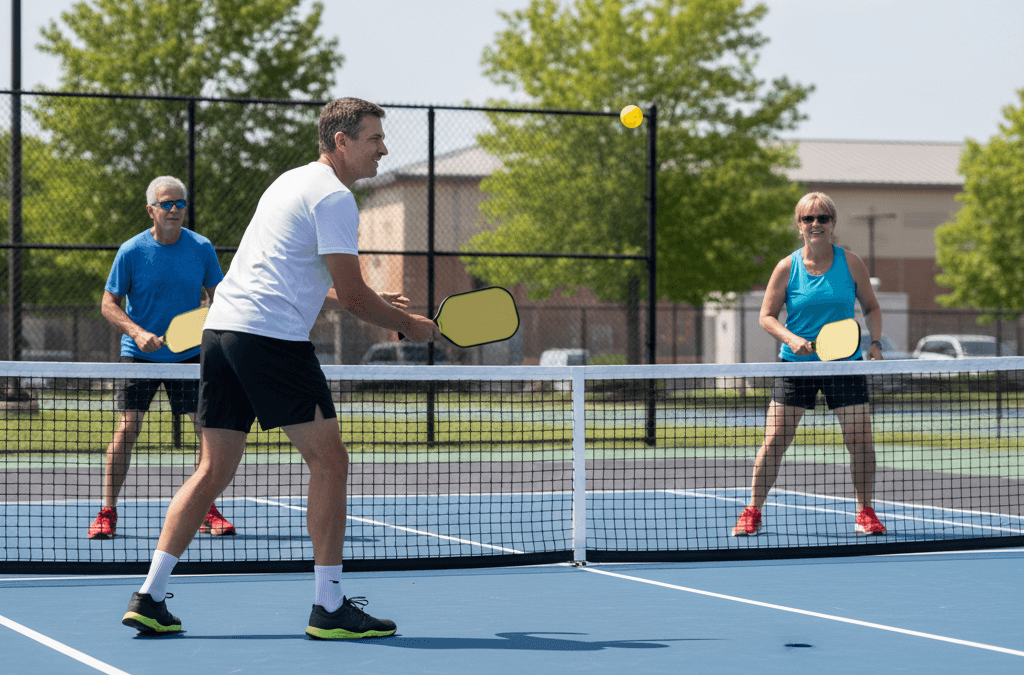
Over the past few years, pickleball has leaped from being a niche backyard game to a mainstream sport that’s dominating headlines, community centers, and social media feeds. In the United States alone, it has repeatedly been named the fastest-growing sport, with participation surging at astonishing rates.
According to the Sports & Fitness Industry Association (SFIA), pickleball grew by 51.8% from 2022 to 2023 and has expanded by 223.5% over the last three years. In 2024, there were approximately 19.8 million players in the U.S., a 45.8% increase from 2023. At the same time, the number of courts continues to climb: there are now more than 68,000 pickleball courts in the U.S. (including tennis courts with temporary lines) and dedicated facilities are increasing rapidly.
Globally, the market outlook is also explosive. A market report forecasts that the global pickleball market will grow from USD 2.2 billion in 2024 to USD 9.1 billion by 2034, at a compound annual growth rate (CAGR) of 15.3%.
Clearly, pickleball is no passing fad. The question becomes: why is everyone talking about it? What is driving this boom in 2025 and beyond? In the rest of this post, we’ll unpack what pickleball is, why it’s rising so fast, and what implications this has for players, brands, and manufacturers.
What Is Pickleball? A Beginner-Friendly Explanation
Origins
Pickleball was invented in 1965 on Bainbridge Island, Washington, by Joel Pritchard, Bill Bell, and Barney McCallum. The idea started as a family pastime—a fun court game combining elements of badminton, table tennis, and tennis. Over time, rules were formalized, a governing body was established, and the sport gradually spread into recreational centers, clubs, and eventually professional circuits.
Basic Rules & Gameplay
Pickleball is relatively easy to pick up, which contributes to its appeal. Here are the key rules and gameplay elements:
Court and Net: A pickleball court is 20 feet wide by 44 feet long (for both singles and doubles) — exactly the same size as a badminton doubles court. The net is 36 inches high at the posts and dips to 34 inches at the center.
Serving and Scoring: Games often go to 11 points (must win by 2). Only the serving side can score points. In doubles, each side has two serves except at the start of the game.
Double bounce rule: After the serve, the ball must bounce once on each side before volleys are allowed.
Non-volley zone (“kitchen”): There is a 7-foot non-volley zone (called the “kitchen”) on each side adjacent to the net, where players cannot volley.
Singles vs Doubles: While pickleball can be played in singles, most play is in doubles, which brings social dynamics and strategy.
Equipment
To play pickleball, you’ll need three core items: paddle, ball, and court (net system). Here’s more detail:
Paddle (Pickleball Paddle / Paddle)
- Typically made of composite materials (carbon fiber, fiberglass, polymer cores).
- Most paddles weigh between 7 and 9 ounces (≈ 198 to 255 grams).
- No strings — the hitting surface is solid.Ball (Wiffle-like ball / perforated plastic ball)
- Outdoor balls have larger holes; indoor balls have smaller holes.
- Approved weight ranges between 0.78 and 0.935 ounces.
- Bounce test: dropped from 78 inches, the ball should bounce between 0 and 34 inches.Court & Net
- As above, court is 20 × 44 feet.
- Net height 36 in at ends, 34 in at center.
- Many players convert tennis or basketball courts by overlaying lines or portable nets.
Comparison: Pickleball vs Tennis vs Badminton
Below is a comparison table illustrating how pickleball differs from tennis and badminton in key dimensions and game mechanics:
| Feature | Pickleball | Tennis | Badminton |
|---|---|---|---|
| Court Size | 20 ft × 44 ft | 36 ft × 78 ft (doubles) | 20 ft × 44 ft (doubles) |
| Net Height | 34 in (center) / 36 in (posts) | 36 in (center) / 42 in (posts) | 5 ft (center), ~5 ft 1 in (posts) |
| Ball / Shuttle | Perforated plastic ball | Pressurized felt tennis ball | Shuttlecock (feather or synthetic) |
| Scoring Format | Games to 11, win by 2 | 4 points → game, multiple sets | Games to 21 (typically), best of 3 |
| Serve | Underhand only | Overhand or underhand | Underhand (in modern play) |
| Volley Zone Rule | 7 ft non-volley “kitchen” zone | No such zone | No such zone |
| Required Movement / Intensity | Lower movement per point | Higher covering of court | Fast reflexes, jump, agility |
This table illustrates that pickleball combines elements of both tennis and badminton but simplifies movement and mechanics, making it accessible to a broad age range and skill levels.
Why Is Pickleball Booming in 2025?
What’s behind this surge in popularity? Let’s explore the major drivers.
1. ???? Fitness & Health Benefits
One major appeal is that pickleball offers a low-impact, high-reward workout. For many older adults or players with joint concerns, it’s less punishing than tennis but still provides cardiovascular benefits, improved agility, and reflex training.
Because the court is smaller and the balls are slower, players don’t have to sprint long distances.
The game still requires footwork, quick direction changes, hand-eye coordination, and balance — all beneficial for physical fitness.
Because of accessibility, beginners can start playing quickly, which reduces barriers to entry.
This combination of moderate exertion, lower injury risk, and fun makes pickleball attractive to a wide spectrum of ages and fitness levels.
2. ???? Social and Community Aspect
Pickleball is inherently social. Because matches are often doubles, and because many community centers or parks host casual play sessions, the sport becomes a social hub.
Many players join local clubs or “pickleball meetups” to find partners and build relationships.
Unlike solo sports, pickleball encourages mixed-age and mixed-gender play, making it ideal for family, friends, or community groups.
Because games are shorter and intermission opportunities happen, it’s easier to mingle, talk, and rotate partners.
This social factor strongly contributes to retention and word-of-mouth growth.
3. ????️ Infrastructure Growth
To support the boom, courts are springing up everywhere — in parks, recreation centers, gyms, and converted (or shared) tennis courts.
In 2024 alone, the number of dedicated pickleball facilities in the U.S. grew by 55% year-over-year.
Many municipalities are converting under-utilized tennis courts into multi-use spaces with pickleball lines.
Some reports estimate that $855 million+ investment is needed over the next 5–7 years in the U.S. to keep up with court demand.
As of the latest data, there are over 68,000 courts including temporary/converted courts.
Globally, similar trends are emerging — new clubs and courts are being built in Europe, Canada, Australia, and parts of Asia, riding on the U.S. momentum.
4. ???? Media, Branding & Investment
Pickleball is no longer just grassroots — big names, media platforms, and capital are entering the space.
Celebrities and professional athletes (e.g. LeBron James, Tom Brady) have invested in pickleball ventures or endorsed products, giving the sport visibility.
Social media plays a huge role: short video clips, highlight reels, reels/challenges help spark curiosity in people who never heard of pickleball.
Sponsorships, tournaments, merchandise — brands see opportunities to monetize.
Equipment launches, influencer campaigns, and social proof help fuel consumer demand.
5. ???? Equipment Innovation
As demand grows, so does innovation in paddle and gear technology.
Use of raw carbon fiber, honeycomb cores, high modulus carbon all pushing paddle performance forward.
Brands differentiate via surface textures, edge guards, vibration dampening, and weight optimization.
New designs for control, spin, power, durability cater to diverse player segments.
As manufacturing tools get more precise (CNC machining, better molds, quality control), product consistency improves, reducing defect rates and raising consumer confidence.
What This Trend Means for the Sports Industry
New Opportunities for Apparel & Accessories
Paddle sports apparel lines (moisture-wicking fabrics, UV protection) can expand into pickleball-specific gear.
Accessories—grips, overgrips, paddle covers, bags, cap/visors suited to pickleball—become niche product categories.
Cross-selling with tennis or padel markets is possible, given overlapping audiences.
Paddle Manufacturing & OEM Growth
Demand for high-quality, customizable OEM paddles is growing fast:
Global brands and startups alike will seek reliable factories with the capability to produce carbon-fiber paddles, apply UV printing, customize edge guards, and control tolerances.
Scalability, quality assurance, supply chain transparency, and IP protection will distinguish top-tier factories.
As the market matures, factories that can invest in R&D and new materials will win more clients.
How to Get Started with Pickleball
If you’re new to the sport or want to start a brand or club around it, here’s a practical guide.
Beginner Gear Selection Advice
| Feature | Recommendation | Why |
|---|---|---|
| Material | Start with composite (carbon fiber/fiberglass) paddle | Balances price and performance |
| Weight | Midweight (≈ 7.8–8.4 oz) | Easier to handle, less fatigue |
| Core Type | Polymer (honeycomb) or Nomex | Good durability and balance |
| Grip Size | Between 4 1/4″ and 4 3/8″ | Most comfortable for average adult hand |
| Edge Guard | Standard with good adhesion | Protects paddle rim during play |
For absolute beginners or recreational players, a paddle priced between USD 50–90 is reasonable. As players improve, they may upgrade to premium paddles in the USD 120–200+ range.
Recommended Budget & Entry Equipment
Paddle: USD 60–90
3-pack of balls: USD 10–20
Basic net kit: USD 80–150
Court access (community or club): often low cost or membership-based
Free Resources & Learning Aids
USA Pickleball website (rules, drills, local clubs)
YouTube channels: basic tutorials, drills, match footage
Pickleball meetups/platforms to find partners
Local clubs, parks & recreation programs
Trend Chart & Participation Growth (2020–2025)
Below is a simplified chart summarizing U.S. pickleball participation growth (data from SFIA / Statista / Pickleheads).
| Year | Estimated Number of Participants (U.S.) | YoY Growth Estimate |
|---|---|---|
| 2020 | 4.2 million | — |
| 2021 | (approx) 5–6 million (growth from baseline) | ~21% growth noted in some reports |
| 2022 | — | Reported jumps beginning 2022–2023 |
| 2023 | 13.6 million | ~ >100% over baseline |
| 2024 | 19.8 million | +45.8% YoY |
Conclusion
Pickleball’s ascent in 2025 is not accidental — it’s being driven by a rare combination of accessibility, fitness benefits, social appeal, infrastructure expansion, brand investment, and product innovation. For players, it offers a fun, inclusive, and competitive sport that’s easier to pick up than many others. For brands and manufacturers, it represents a booming category with huge upside.