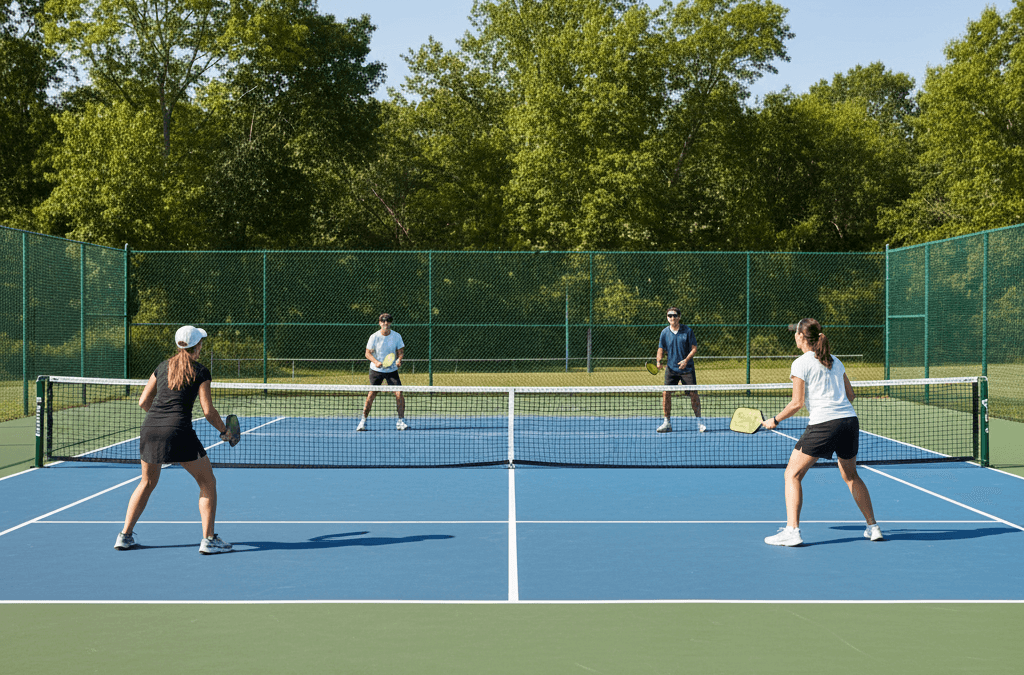
Pickleball has experienced a remarkable surge in popularity across the United States and globally over the past decade. According to the Sports & Fitness Industry Association (SFIA), pickleball participation grew from 3.1 million players in 2017 to 13.6 million in 2024, marking one of the fastest growth rates among all recreational sports. This expansion has created a significant demand for playing spaces.
However, the construction of dedicated pickleball courts has not kept pace with player demand. As a result, many communities and recreational facilities are exploring creative ways to utilize existing infrastructure—particularly tennis courts—for pickleball. This blog examines the feasibility of playing pickleball on a tennis court, providing an objective look at court dimensions, conversion methods, and practical considerations.
1. Pickleball vs. Tennis Court Dimensions
The first factor to consider is the difference in court size and layout.
| Specification | Pickleball Court | Tennis Court |
|---|---|---|
| Length | 44 feet (13.41 m) | 78 feet (23.77 m) |
| Width (Singles) | 20 feet (6.10 m) | 27 feet (8.23 m) |
| Width (Doubles) | 20 feet (6.10 m) | 36 feet (10.97 m) |
| Total Area | 880 sq ft (81.8 m²) | 2,808 sq ft (260.9 m²) |
A tennis court is therefore more than three times larger than a pickleball court. This size difference allows up to four pickleball courts to fit within one standard tennis court footprint.
Another important metric is the net height:
Pickleball nets are 36 inches (91.4 cm) high at the sidelines and 34 inches (86.4 cm) at the center.
Tennis nets measure 42 inches (106.7 cm) at the posts and 36 inches (91.4 cm) at the center.
The difference may appear small, but it significantly affects shot trajectory and pace. Lower nets encourage longer rallies and emphasize control, one of pickleball’s defining characteristics.
Pickleball also features a unique non-volley zone, commonly called “the kitchen,” extending 7 feet (2.13 m) from each side of the net. Tennis has no equivalent area, so court markings must be modified or added when adapting a tennis surface.
2. Why Tennis Courts Are Suitable
The United States Tennis Association (USTA) estimates there are over 270,000 tennis courts nationwide. Meanwhile, USA Pickleball reported fewer than 50,000 dedicated pickleball courts as of 2024. Converting tennis courts helps communities accommodate growing demand without major construction costs.
Tennis courts typically provide:
Durable asphalt or post-tensioned concrete surfaces compatible with pickleball balls (usually polymer wiffle balls).
Pre-existing fencing and lighting that meet recreational standards.
Adequate space and flatness for accurate marking and multiple layouts.
The combination of structural availability and cost-efficiency makes tennis courts an ideal foundation for shared-use facilities.
3. Conversion Methods and Cost Estimates
Temporary Layout
The simplest approach involves temporary lines applied using chalk, painter’s tape, or vinyl strips.
Cost: approximately USD $20–$50 per court.
Time required: less than one hour for setup.
Suitable for: schools, clubs, or weekend events.
Permanent Line Marking
Facilities that plan to host regular pickleball play often invest in painted lines.
Professional painting cost: USD $300–$800 per court (depending on materials and location).
Recommended line width: 2 inches (5 cm), as specified by USA Pickleball.
Color contrast: should differ from existing tennis lines to avoid visual confusion.
Net Systems
There are two main approaches:
Adjust the existing tennis net to 34 inches at the center (using a strap or temporary reel).
Install portable pickleball nets, which are 22 feet (6.7 m) wide and cost USD $150–$300.
Many multi-use facilities combine both methods to balance flexibility and regulation compliance.
Full Conversion
When a community decides to permanently replace tennis with pickleball, resurfacing and repainting may be necessary.
Estimated cost for full conversion: USD $25,000–$40,000 for a standard two-court layout.
Lifespan of resurfaced courts: 8–10 years under normal outdoor use conditions.
These costs remain significantly lower than new-build pickleball facilities, which can exceed USD $300,000 for indoor construction.
4. Layout Options: Multiple Courts per Tennis Surface
Because a tennis court covers roughly three pickleball courts in area, creative layouts are possible. The most efficient configuration fits four pickleball courts (two side-by-side on each half of the tennis court).
| Layout | Number of Pickleball Courts | Typical Usage Scenario |
|---|---|---|
| Single Overlay | 1 | Private home, small club |
| Two Courts Side by Side | 2 | Medium club |
| Four Courts Per Tennis Court | 4 | Public park or large complex |
When four courts are placed, players must manage spacing: USA Pickleball recommends a minimum 5-foot buffer between adjacent courts and at least 10 feet from fence lines.
5. Surface and Play Characteristics
Ball Behavior
Pickleball is designed for low bounce and moderate speed. The ball—a 26- or 40-hole polymer sphere weighing about 0.8 ounces—interacts differently depending on surface friction and hardness.
Asphalt: Standard outdoor surface; ball speed ≈ 26–30 mph for intermediate players.
Concrete: Faster rebound, less grip; recommended for experienced players.
Acrylic coatings (used on tennis courts): reduce impact stress and noise by 5–10 %.
Noise Considerations
Studies by Acoustics First Corporation show pickleball paddle-ball impact levels of 60–70 decibels at 100 feet—similar to normal conversation—but perceived as sharper than tennis. Some communities install sound-absorbing panels or limit play hours to address neighbor concerns.
6. Shared-Use Challenges
While the concept of dual-use courts is practical, several challenges exist:
Visual confusion: Multiple line colors can distract players. USA Pickleball recommends using contrasting colors and matte paint to reduce glare.
Scheduling: Tennis and pickleball groups often compete for the same time slots. Community recreation departments usually implement reservation systems or dedicated hours.
Equipment wear: Portable nets and temporary tapes require regular inspection; UV exposure can degrade materials within 12 months if unprotected.
Court surface stress: High traffic can shorten resurfacing intervals from 8 to 5 years. Maintenance budgets should plan for this added load.
7. Practical Benefits for Communities
Despite challenges, the benefits are substantial:
Accessibility: Over 80 % of U.S. municipalities already possess tennis courts (USTA Community Facilities Report, 2023).
Cost-effectiveness: Converting existing courts costs less than 10 % of building new ones.
Inclusivity: Pickleball appeals to a wide age range—from children to seniors over 65, who represent approximately 18 % of players (SFIA 2024).
Community engagement: Multi-use courts can increase overall facility utilization by 25–40 %.
The data suggests that shared-use courts are not merely a stopgap but a sustainable model for sport growth.
8. Recommended Specifications and Guidelines
| Parameter | USA Pickleball Standard | Notes |
|---|---|---|
| Court Dimensions | 20 ft × 44 ft | Including baselines and sidelines |
| Non-Volley Zone | 7 ft each side | Measured from net |
| Service Area | Divided by center line | Equal left/right sections |
| Net Height | 36 in (sides) / 34 in (center) | Portable or adjusted tennis nets acceptable |
| Line Color | Highly visible contrast | Avoid glossy finishes |
| Surface Slope | ≤ 1 % | Ensures drainage and safety |
Facilities should consult the “USA Pickleball Facility Development Manual (2023)” for detailed construction and conversion standards.
9. Real-World Examples
Several U.S. cities illustrate successful adaptations:
Seattle, WA: Converted 24 public tennis courts to shared-use spaces in 2022; usage hours rose by 60 %.
Naples, FL: Host of the US Open Pickleball Championship; many courts originated from repurposed tennis facilities.
Denver, CO: Community survey showed 90 % of residents supported dual-use courts to maximize park space.
These examples demonstrate how conversion is not only technically feasible but socially beneficial.
10. Safety and Maintenance Considerations
Safety standards for multi-use courts include:
Regular inspection for cracks > ¼ inch (6 mm).
Slip-resistant acrylic surface with minimum coefficient of friction of 0.5 (ASTM F2772).
Clear zone around each court of at least 3 feet (0.9 m).
Annual repainting to maintain line visibility and surface texture.
Maintenance cost averages USD $1,200 per court annually, primarily for cleaning, line retouching, and minor repairs.
11. Future Outlook
The trend toward repurposing tennis courts is expected to continue. According to the Tennis Industry Association, tennis participation in the U.S. grew only 2 % annually since 2020, while pickleball expanded over 25 % annually. Dual-use models allow both sports to coexist, offering flexibility to communities with limited space.
Looking ahead, urban planning and recreation departments are likely to design hybrid facilities from the outset, incorporating movable nets, adjustable lighting, and surface color schemes optimized for both games.
12. Conclusion
Playing pickleball on a tennis court is not only possible but widely practiced across the United States. The differences in court size and net height can be addressed through temporary or permanent modifications with reasonable costs. When managed properly, dual-use courts offer economic efficiency, community inclusiveness, and sustainable use of existing infrastructure.
As pickleball continues its rapid growth, converting tennis courts will remain one of the most practical solutions for cities, clubs, and schools to support recreational expansion while maintaining access for both sports.
❓Frequently Asked Questions (FAQ Section)
1. Can you play pickleball on a regular tennis court?
Yes, you can. A standard tennis court can fit up to four pickleball courts with temporary or painted lines.
2. Do I need special permission to play pickleball on a tennis court?
If it’s a public court, check with the local parks department. For private or club courts, always ask the facility manager first.
3. How do I mark pickleball lines on a tennis court?
You can use temporary tape, chalk, or removable paint. Permanent lines should follow USA Pickleball dimensions (20×44 feet).
4. Can I use a tennis net for pickleball?
Yes, but it needs adjustment. A tennis net is 36 inches high, while pickleball nets are 34 inches at the center. You can use a center strap or portable net to correct the height.
5. How many pickleball courts fit on one tennis court?
Usually, four pickleball courts fit across a single tennis court if space allows. For casual play, one or two courts are often enough.
6. Will pickleball damage tennis courts?
No significant damage occurs if you use proper balls and non-marking shoes. Avoid metal paddles or hard surfaces.
7. Can tennis players and pickleball players share the same court schedule?
Yes, many facilities use time-sharing systems to balance access between the two sports.
8. What equipment do I need?
Just a pickleball paddle, perforated ball, and a net. Many players also bring temporary court line tape for setup.
9. Why are tennis courts being converted for pickleball?
Pickleball’s popularity has surged — with over 13 million players in the U.S. (2024) — leading many clubs to adapt existing tennis facilities.
10. Is it expensive to convert a tennis court?
A full conversion (painting and nets) costs around $4,000–$10,000, while temporary setups can be done for under $300.