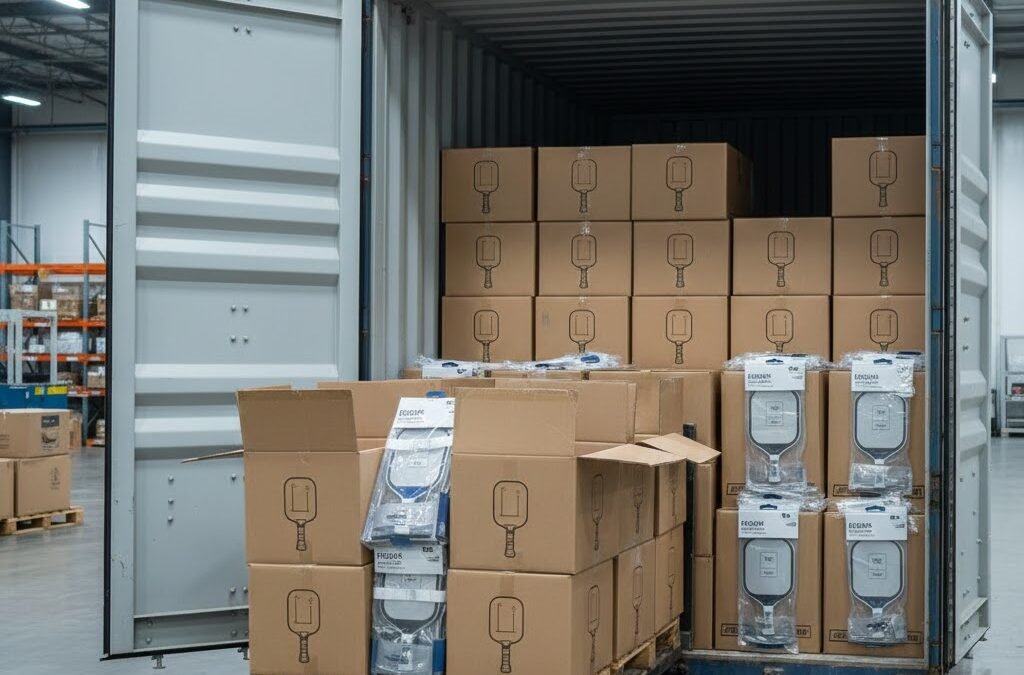
Shipping and logistics are a critical cost and risk factor in bulk pickleball paddle imports, often accounting for about 20% of landed cost depending on volume, destination, and transport mode. Key variables such as carton size (cm), net vs gross weight (kg), palletization, and Incoterms (EXW, FOB, CIF, DDP) directly affect freight rates, customs clearance efficiency, and delivery reliability. Poor logistics planning can cause shipment delays, damaged paddles, compliance issues, or unexpected duty exposure—even when product quality is acceptable.
1. Technical Background: Why Logistics Matter in Paddle OEM Sourcing
A pickleball paddle is a low unit price, high-volume, semi-fragile composite product. From a logistics perspective, it sits between sports equipment and consumer goods, with several unique characteristics:
Large dimensional volume (CBM) relative to unit value
Sensitivity to compression, moisture, and heat
Mixed materials (polymer core, carbon/fiberglass face, PU grip)
Typically shipped in retail-ready cartons, not industrial crates
For OEM buyers, logistics performance directly impacts:
Landed cost accuracy
Inventory planning
Retail launch timelines
Cash flow and duty exposure
Batch-to-batch consistency in delivery
Unlike samples or air-shipped prototypes, bulk paddle orders expose weaknesses in packaging design, carton optimization, and freight planning.
2. Common Shipping Methods for Bulk Paddle Imports
2.1 Sea Freight (FCL / LCL)
Sea freight is the dominant method for bulk pickleball paddle imports.
Typical usage:
Orders ≥ 1,000–1,500 paddles
Non-urgent production timelines
Stable seasonal demand
Key parameters:
Transit time: 20–40 days (China → US/EU)
Cost basis: CBM (cubic meter), not weight
Best suited for: FCL (Full Container Load),bulk order over 500 pcs
FCL vs LCL:
FCL: Lower damage risk, better cost predictability
LCL: Higher handling frequency, higher damage risk per carton
For paddles, FCL is preferred once volume exceeds 15–18 CBM.
2.2 Air Freight
Used primarily for:
Urgent replenishment
Marketing launch delays
Small initial brand orders
Constraints:
Cost is calculated by chargeable weight
(max of actual kg vs volumetric kg)Volumetric formula:
Length × Width × Height (cm) ÷ 6000
Due to large carton dimensions, air freight costs escalate quickly and are rarely viable beyond 200–300 paddles.
2.3 Express Courier (DHL / FedEx / UPS)
Typically limited to:
Samples
Pre-production confirmation units
Not recommended for bulk imports due to:
High per-unit cost
Limited carton size flexibility
Increased customs scrutiny
3. Packaging Design & Carton Optimization
3.1 Typical Paddle Carton Specifications
| Parameter | Common OEM Range |
|---|---|
| Units per carton | 50 paddles |
| Carton size | 65–70 × 45–50 × 30–35 cm |
| Net weight | 10–14 kg |
| Gross weight | 12–16 kg |
| Carton material | 5-ply corrugated |
Oversized cartons increase CBM rapidly and raise sea freight costs even if weight is low.
3.2 Carton Density & Load Efficiency
Shipping lines price on volume, not protection margin.
Engineering trade-offs:
Too loose → higher CBM, higher cost
Too tight → edge guard deformation, face compression
Best practice:
Carton fill ratio ≥ 85%
Compression-tested cartons (edge crush ≥ 7 kN)
Vertical paddle alignment to reduce face stress
4. Incoterms & Responsibility Allocation
4.1 Common Incoterms for Paddle Imports
| Incoterm | Seller Responsibility | Buyer Responsibility |
|---|---|---|
| EXW | Factory only | All logistics |
| FOB | Export + port delivery | Ocean + import |
| CIF | Ocean freight included | Import & delivery |
| DDP | Door-to-door | Minimal |
FOB is the most common for experienced OEM buyers, offering:
Cost transparency
Freight forwarder control
Better compliance oversight
- Buyers need to handle customs and drag the products from port to warehouse address
DDP simplifies operations but hides duty, VAT, and brokerage cost details, it is currently accepted by more and more customers
5. Impact on Performance & Product Integrity
Logistics affects more than delivery time—it directly impacts product condition.
5.1 Structural Risk Factors
Carton stacking > 5 layers → core compression
High humidity → grip swelling, adhesive weakening
Temperature > 45°C → resin softening (especially PP cores)
5.2 Typical Damage Modes
| Issue | Root Cause |
|---|---|
| Edge guard warping | Side compression |
| Face micro-cracks | Impact during transshipment |
| Weight variance | Moisture absorption |
| Cosmetic defects | Carton collapse |
Damage rates above 1.5–2% indicate logistics or packaging design issues.
6. Quality Control & Logistics Testing Methods
From a factory QA standpoint, logistics readiness should be validated before mass shipment.
6.1 Pre-Shipment Checks
Carton drop test (≥ 80 cm, ISTA-1A reference)
Gross weight tolerance: ±0.5 kg
Moisture barrier verification (PE inner bag)
6.2 In-Transit Risk Controls
Desiccant packs: 200–300 g per CBM
Container ventilation selection (dry vs standard)
Load photos before container sealing
6.3 Post-Arrival Sampling
Random carton opening rate: 2–5%
Visual + weight recheck
Edge guard & handle inspection
7. Purchasing & OEM Supplier Evaluation
When evaluating paddle factories, logistics capability matters as much as manufacturing.
7.1 Key Questions to Ask Suppliers
Do you optimize carton size per order?
Can you provide CBM estimates before production?
Do you support palletized vs floor-loaded containers?
Can you ship under buyer’s forwarder?
7.2 Common Sourcing Risks
Unrealistic CBM estimates
Hidden local port charges
Weak export documentation
Overloaded cartons to reduce carton count
A factory that controls logistics parameters demonstrates process maturity, not just production capacity.
8. FAQ
What is the most cost-effective shipping method for paddles?
Sea freight (FCL) once volume exceeds ~1,000 units.
How much does shipping add to paddle cost?
Typically USD 0.80–2.50 per paddle, depending on route and CBM efficiency.
Is FOB or DDP better for new brands?
FOB offers better long-term cost control; DDP suits first-time importers and those who doesnt want to handle complicated customs work
Do heavier paddles cost more to ship?
Volume matters more than weight in sea freight.
How can damage during shipping be reduced?
Optimized cartons, proper stacking, and moisture control.
Should paddles be palletized?
Optional for warehouse efficiency, but increases CBM slightly.
9. Final Practical Checklist for Bulk Paddle Imports
Confirm carton dimensions before production
Lock Incoterms in PO stage
Validate CBM vs unit count
Request drop-test packaging
Use desiccants for sea freight
Inspect post-arrival samples
Track damage rate per shipment
Review landed cost after each order