
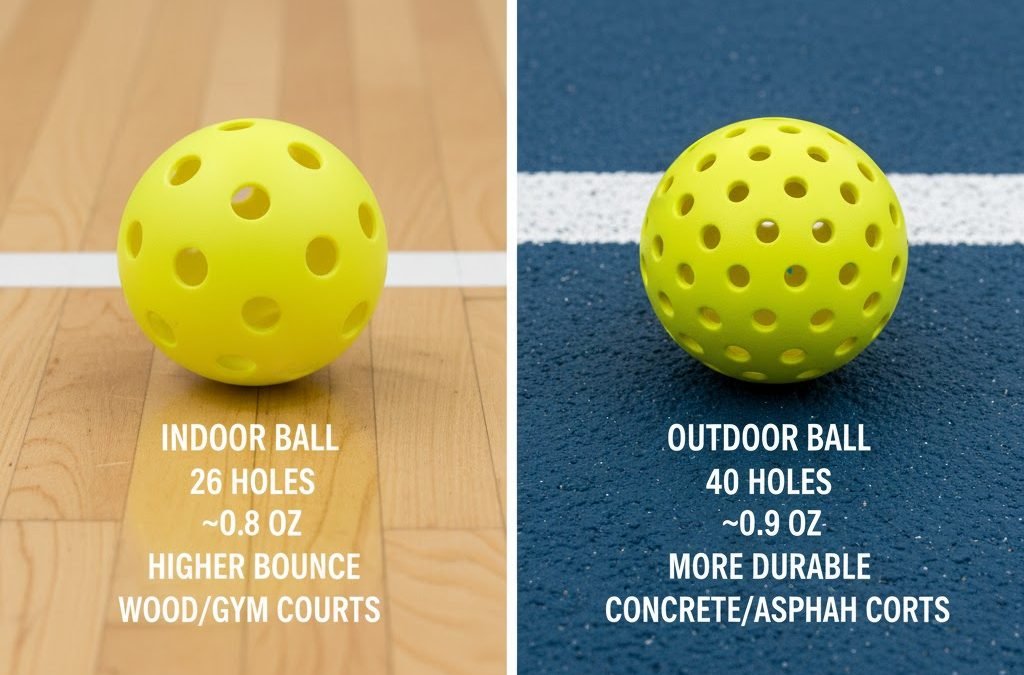
Pickleball balls are perforated plastic spheres used in the sport of pickleball. They are designed to be lightweight and durable, with a smooth surface and a specific number of holes to ensure consistent flight and bounce. The balls are divided into two main types: indoor and outdoor, each tailored to specific playing conditions.
???? Indoor Pickleball Balls
Material: Made from softer plastic, which allows for a gentler bounce and quieter play.
Hole Configuration: Typically have 26 larger holes, approximately 0.43 inches in diameter.
Weight: Lighter construction, making them easier to control and less prone to wind interference.
Bounce Characteristics: Higher and more consistent bounce due to the smooth, flat surfaces of indoor courts.
Durability: Less durable compared to outdoor balls; may wear out more quickly when used on abrasive surfaces.
Visibility: Often come in darker colors like blue or green to contrast with indoor court surfaces.
???? Outdoor Pickleball Balls
Material: Constructed from harder, more durable plastic designed to withstand rougher surfaces and outdoor elements.
Hole Configuration: Feature 40 smaller holes, approximately 0.282 inches in diameter, to reduce wind interference.
Weight: Slightly heavier, aiding in stability and control during play.
Bounce Characteristics: Lower and less consistent bounce due to varying outdoor surfaces and environmental factors.
Durability: More durable; designed to withstand exposure to UV rays and rough surfaces.
Visibility: Typically bright colors like neon yellow or green for better visibility in natural light.
| Feature | Indoor Pickleball Ball | Outdoor Pickleball Ball |
|---|---|---|
| Material | Softer plastic | Harder, more durable plastic |
| Hole Number | 26 | 40 |
| Hole Diameter | ~0.43 inches | ~0.282 inches |
| Weight | Lighter (~0.8 oz) | Slightly heavier (~0.9 oz) |
| Bounce | Higher and more consistent | Lower and less consistent |
| Flight Stability | Less affected by wind indoors | Designed to reduce wind interference outdoors |
| Durability | Less durable; wears faster | More durable; withstands UV and rough surfaces |
| Color / Visibility | Darker colors (blue, green) | Bright colors (yellow, neon green) |
| Sound / Playing Feel | Quieter, softer feel | Firmer, louder feel |
| Optimal Playing Surface | Indoor courts, gym floors, wood | Outdoor courts, concrete, asphalt |
| Manufacturing Notes | Can be injection molded (softer feel, seams) | Often rotationally molded (seamless, firmer, higher cost) |
???? Why Choosing the Right Ball Matters
Selecting the appropriate pickleball ball is essential for optimal performance. Here’s how the choice between indoor and outdoor balls impacts various aspects of the game:
???? 1. Ball Speed and Control
Indoor Balls: The lighter weight and larger holes result in a slower ball speed, allowing for more controlled shots and longer rallies.
Outdoor Balls: Heavier construction and smaller holes lead to faster ball speed, requiring quicker reflexes and more precise control.
???? 2. Bounce Characteristics
Indoor Balls: Higher and more consistent bounce on smooth indoor surfaces, facilitating predictable gameplay.
Outdoor Balls: Lower and less consistent bounce due to varying outdoor surfaces, which can affect shot accuracy and consistency.
???? 3. Playing Feel and Strategy
Indoor Balls: The softer material and higher bounce contribute to a quieter and more strategic game, with an emphasis on placement and finesse.
Outdoor Balls: The firmer construction and lower bounce lead to a faster-paced game, requiring power and quick reactions.
????️ 4. Court Surface Compatibility
Indoor Balls: Designed for use on smooth indoor courts, such as gym floors or indoor pickleball courts.
Outdoor Balls: Built to withstand the rigors of outdoor play on surfaces like concrete or asphalt.
✅ Tips for Selecting the Right Ball
Choosing the appropriate pickleball ball depends on various factors, including playing environment, skill level, and personal preference. Here are some guidelines to help you make an informed decision:
???? Indoor Play
Ball Type: Opt for indoor pickleball balls made from softer plastic with larger holes.
Considerations:
Provides a slower ball speed for controlled play.
Ensures a higher and more consistent bounce on smooth surfaces.
Contributes to a quieter game, reducing noise levels in indoor settings.
???? Outdoor Play
Ball Type: Choose outdoor pickleball balls constructed from harder, more durable plastic with smaller holes.
Considerations:
Offers faster ball speed, requiring quicker reflexes.
Provides a lower and less consistent bounce due to varying outdoor surfaces.
Designed to withstand exposure to UV rays and rough surfaces.
???? Skill Level Considerations
???? How Manufacturers Ensure Quality
The manufacturing process of pickleball balls significantly impacts their performance and durability. Two primary methods are used: injection molding and rotational molding.
???? Injection Molding
Process: Plastic material is melted and injected into a mold under high pressure, forming two hemispherical halves that are then fused together.
Characteristics:
Produces balls with seams.
Typically results in a softer feel and higher bounce.
Generally more cost-effective, making them suitable for bulk production.
???? Rotational Molding
Process: Plastic material is placed into a mold that rotates on multiple axes, allowing the material to evenly coat the interior surface.
Characteristics:
Produces seamless balls.
Results in a firmer feel and more consistent flight.
Typically more durable and offers better performance, but at a higher cost.
Both manufacturing methods aim to meet specific performance standards, ensuring that the balls are suitable for their intended playing environments.
???? Conclusion
Choosing the right pickleball ball significantly affects gameplay, control, and durability. Based on material, hole configuration, weight, and bounce:
Indoor Pickleball Balls:
Holes: 26 large holes (~0.43 inches)
Weight: ~0.8 ounces
Bounce: Higher and more consistent
Durability: Lasts ~50–100 hours of indoor play
Best For: Smooth indoor courts (wood, gym floors), beginners or players focusing on controlled rallies and quieter play
Outdoor Pickleball Balls:
Holes: 40 smaller holes (~0.282 inches)
Weight: ~0.9 ounces
Bounce: Lower and slightly less consistent
Durability: Lasts ~150–200 hours on hard outdoor surfaces
Best For: Concrete, asphalt, or outdoor hard courts; suitable for fast-paced games and windier conditions
Key Takeaway:
Use indoor balls exclusively on indoor courts to maximize control, bounce consistency, and quieter gameplay.
Use outdoor balls on hard outdoor surfaces to ensure durability, stable flight in wind, and consistent performance over longer sessions.
Choosing the correct ball type improves ball speed, control, shot accuracy, and player comfort, while also extending the ball’s lifespan according to the playing environment.
???? FAQs
Q: Can I use an indoor pickleball ball outdoors?
A: While it’s possible, it’s not recommended due to the ball’s design being optimized for indoor conditions.
Q: Are outdoor pickleball balls suitable for indoor play?
A: Outdoor balls may be used indoors, but their higher bounce and harder surface may affect gameplay.
Q: How can I tell if a pickleball ball is for indoor or outdoor use?
A: Check the number and size of holes, weight, and material hardness to determine the ball’s intended use.
Recent Comments