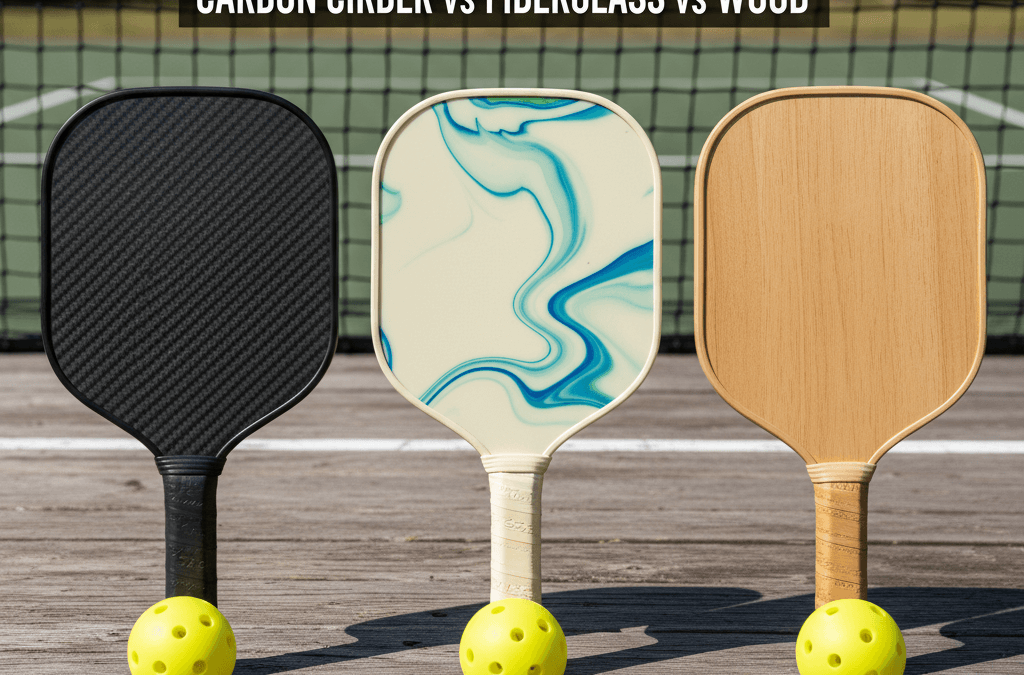
When choosing a pickleball paddle, the material is one of the most important factors that determines how you play, how long the paddle lasts, and how much it costs.
In short:
Carbon fiber paddles offer the best control, power, and durability but come with the highest price.
Fiberglass paddles provide a balance of control and pop at a moderate price.
Wood paddles are the cheapest and most durable for beginners or community use, but they lack touch and power.
Why Material Matters in Pickleball Paddles
The paddle material influences performance, weight, feel, and price. Here’s why it matters:
Power and Control – The surface material determines how the ball compresses and rebounds.
Carbon fiber has a stiff structure, providing excellent control and spin consistency.
Fiberglass offers a softer “pop,” delivering more power for aggressive shots.
Wood provides minimal control and is much heavier, which can cause fatigue over time.
Durability – Composite paddles (carbon or fiberglass) resist cracking and maintain performance longer. Wooden paddles may dent or chip easily, especially under high impact.
Weight and Handling –
Carbon fiber paddles usually weigh 7.5–8.2 oz, balancing power and control.
Fiberglass paddles range 7.8–8.5 oz, offering more pop but slightly less maneuverability.
Wooden paddles can weigh up to 10–12 oz, making them harder to swing quickly.
Price Factor – Material also affects the cost of the paddle:
| Paddle Material | Average Price (USD) | Typical User | Notes |
|---|---|---|---|
| Carbon Fiber | $120–$250 | Intermediate to Pro | Premium control & spin |
| Fiberglass | $60–$120 | Recreational to Intermediate | Good power & mid-range value |
| Wood | $20–$40 | Beginners, schools, or rentals | Heavy but durable |
Carbon fiber is expensive because it’s made with high-tensile T700 or 3K weave, requiring complex molding and high-pressure cold pressing. Fiberglass, while cheaper, still provides a composite feel at a lower cost. Wooden paddles remain the entry-level option for schools and public courts.
Carbon Fiber Paddles: High-Performance Choice
Features and Strengths
Rigidity & stiffness: Carbon fiber is inherently stiff, which helps in transferring energy efficiently. Many paddle makers describe carbon fiber as offering refined touch and feel because it absorbs some of the ball’s energy at impact.
Durability & longevity: Carbon fiber tends to retain its shape and resist wear better than fiberglass or cheaper composite surfaces. Many guides state that carbon fiber “holds the edge when it comes to long-term” durability.
Spin potential: The texture on raw carbon fiber surfaces can give improved spin performance. Analysts often note that carbon fiber has seen better spin stats in tests.
Consistency over time: Some forum users and testers claim carbon maintains spin better over years, whereas textured surfaces on fiberglass can wear down.
Drawbacks
Cost: Carbon fiber is more expensive in raw materials and manufacturing, so the end product is usually pricier than fiberglass or wood alternatives.
Less “pop” compared to fiberglass (in some configurations): Though carbon is efficient, fiberglass can sometimes give a livelier “pop” because of flex.
Potential for over-stiff feel: Some players might find carbon fiber paddles less forgiving or harder to “feel” soft shots.
Texture / grit wear: Even carbon surfaces are not immune: the grit (texturing) placed on carbon paddles (if present) may still degrade over time, though typically slower.
Carbon fiber paddles tend to be favored by intermediate-to-advanced players who want high performance, spin, responsiveness, and longevity. Because carbon is somewhat technology-intensive, carbon paddle models often occupy the upper price tiers in the market.
Fiberglass Paddles: Power with Flexibility
Features and Strengths
Better “pop” / liveliness: Fiberglass is more flexible (in many builds), which can deliver extra ball rebound or “pop” for aggressive shots. Many reviewers say it “provides you with the most power” in contrast to stiffer surfaces.
Good value: Often less expensive than carbon fiber, making it more accessible for many players. Usually price is 50-120 USD, while carbon fiber paddle can run highest 200+ USD.
Balanced feel: Some players describe fiberglass as “softer” or more comfortable on impact compared to very stiff carbon. For example: “fibreglass plays softer, has more pop and produces more spin than the carbon, but has a bit less control.”
Drawbacks
Durability concerns: Fiberglass surfaces are more prone to wear, especially on texturing (grit) added on top. Some players report loss of grit or spin ability within months.
Less consistency over time: Because of wear and deformation, performance may shift more than for carbon.
Lower spin / grip: Many spin tests tend to favor carbon, claiming that fiberglass generally “doesn’t get as good spin” as carbon in head-to-head comparisons.
Less premium perception: In buyer mindsets, fiberglass is sometimes seen as a more budget or mid-tier option rather than premium.
Typical Performance & Use Cases
Fiberglass paddles are often appealing to recreational or intermediate players who want a balance of performance and value. They are a good step-up from wood paddles, offering more liveliness and lighter weight but without the cost of full carbon fiber
Wood Paddles: Classic and Affordable
Features and Strengths
Low cost: Wood is cheap to source and manufacture, making wood paddles very affordable. Retail price is around 24-50 USD.
Toughness & durability in bulk use: For high-use venues (clubs, recreation centers) wood paddles can be replaced easily and are robust in the sense of “take a beating.”
Familiar, solid feel: Some players prefer the heavier, solid feel of wood for casual play.
For example, the Diller wood paddle (7-ply hardwood) has an average weight of 10 oz (range 9.0 to 10.6 oz) and is marketed for durable, long-lasting use in community centers. Similarly, Franklin’s “Activator” 7-ply wooden paddle is in the 9.5–10.5 oz range.
Drawbacks
Heavy weight: As seen above, wood paddles often exceed 9 oz. Many paddle guides state that most paddles above 9 oz are wooden ones.
Less control & finesse: Because of rigidity and weight, wood paddles are less forgiving and harder to maneuver, especially for soft shots or spin.
Limited performance ceiling: They don’t compete well in high-level play where spin, responsiveness, and weight advantage matter.
Bulk and balance limits: Wood material limits design flexibility (thin faces, hybrid skins) that composites allow.
Typical Performance & Use Cases
Wood paddles are primarily used by beginners, casual players, or institutions needing inexpensive mass paddles. They serve well where cost and durability in quantity matter more than peak performance.
Side-by-Side Comparison Table
| Characteristic | Carbon Fiber | Fiberglass | Wood |
|---|---|---|---|
| Typical Weight (paddle face portion) | Light to moderate (often part of lightweight designs) | Moderate | Heavy (often pushes total >9 oz) |
| Power / Pop | High (efficient) / moderate | Higher “pop” due to flex | Moderate to high (because of mass) |
| Control / Feel | High precision, more consistent | Good but less forgiving | Lower precision, stiffer feel |
| Spin / Gripping | Strong, especially raw carbon texture | Moderate, texture may wear | Low spin capability |
| Durability / Wear Resistance | Excellent | Moderate to good, but more wear on surface | Good for structural strength, but surface wear visible |
| Cost (face material) | High | Medium | Low |
| Best target users | Advanced / competitive / OEM premium lines | Intermediate / recreational | Beginners, schools, budget lines |
Performance by Weight and Impact
Weight plays a central role in paddle performance. According to paddle buyers’ guides, paddles under 7.3 oz tend to offer precision and control, while paddles over 8.5 oz offer more power.
Since wood paddles often exceed 9 oz, they bias toward power but at expense of agility. Meanwhile, composite materials (carbon or fiberglass) allow lighter designs while maintaining strength and structural integrity.
Material & Manufacturing Inside the Factory
From the perspective of a paddle factory or OEM, choosing material is not just about performance but about manufacturability, cost, supply chain, branding, and quality control. Below is an overview of manufacturing factors you should consider.
Manufacturing Processes & Lamination
Layup & lamination: For carbon fiber or fiberglass face skins, you typically lay woven fabric (or unidirectional plies) over the core and bond with resin (epoxy or other adhesives). Multiple plies may be used for strength, stiffness, or other performance tuning.
Cold-press vs heat/thermoforming: Some factories press the laminated paddle under heat to cure more fully; others cold-press and cure in ambient conditions. The method affects surface finish, bonding strength, and internal stresses.
Surface texturing / grit addition: To add spin/grit, factories often apply texture layers (e.g. sand, microballoons, or laser etching). The durability of texture varies by material and adhesive.
Edge guard and finishing: The edges need protection (edge guards) to prevent chipping. Also, branding, paint, and protective surface coatings are applied.
Quality control / testing: Factories test flatness, deflection, adhesion, surface finish, stiffness, and balance. For high-end paddles, spin testing and durability (hit tests) are also useful.
Cost & Material Sourcing
Raw material cost: Carbon fiber (especially high-grade) is more expensive; fiberglass is cheaper; wood is cheapest.
Supply consistency & lead times: Carbon fiber suppliers may have tighter lead times or supply fluctuations.
Waste and yield: Composite layups may generate scrap or rejects due to delamination, warping, or molding defects.
Brand differentiation: Using raw carbon, custom weave patterns, or proprietary fabric can help differentiate your brand/OEM offering.
Design Strategies & Hybrid Approaches
Many paddle makers use hybrid constructions (e.g. carbon + fiberglass layers) to balance cost and performance. Some integrate carbon skins over fiberglass or mix them in the face layup. That can moderate cost while retaining key benefits. Forum comments mention that some paddles “use a layer of fiberglass between layers of carbon fiber.”
From factory perspective, offering hybrid or gradient face options gives more SKUs and pricing tiers.
How to Choose Based on Your Playing Style
Players differ in priorities: power vs control, spin vs consistency, budget vs longevity. Below is a decision guide to help choose:
If you are competitive or want maximum performance → lean carbon fiber face designs (or high-tier hybrid)
If you are intermediate or want balanced performance and cost → fiberglass or carbon-fiberglass hybrids
If you are beginner or price-sensitive, or need bulk paddles for clubs → wood or simple fiber designs
Prefer lighter weight & high responsiveness → carbon is more amenable to lower weight builds
Want more “pop” or liveliness for flatter shots → fiberglass can add that dynamic
You can also use a decision tree (rough outline):
Do you expect to use the paddle many hours per week (or in tournaments)? → yes → carbon / premium; no → fiberglass / wood
Is spin and top-end control important to you? → yes → carbon
Is budget your priority? → wood or fiberglass
Do you seek brand / perceived premium appeal? → carbon or hybrid designs
Frequently Asked Questions (FAQ)
Q1: Which material offers the best spin?
In most tests, carbon fiber (especially raw-carbon textured faces) tends to outperform fiberglass in spin / RPM metrics
Q2: How long does each paddle material last?
Carbon fiber paddles can last multiple years with regular play.
Fiberglass paddles tend to wear surface textures faster under heavy use.
Wood paddles are structurally durable, though surfaces may show wear and chips earlier.
Guides suggest that composite paddles typically have greater longevity than basic wood paddles.
Q3: Can factories mix materials (hybrids)?
Yes — many factories design hybrid face layups combining carbon and fiberglass to balance cost and performance. This gives mid-tier options for OEM clients.
Q4: Does wood have any advantages today?
Mostly in cost-effectiveness, simplicity of manufacturing, and bulk availability. For recreational or entry-level markets, wood is still viable.
Q5: Is texture / grit more important than face material?
Texture helps with spin, but its durability depends heavily on the base material and bonding. A well-bonded texture on carbon tends to last longer than on fiberglass.
Conclusion
Choosing between carbon fiber, fiberglass, and wood for a pickleball paddle involves trade-offs. Carbon fiber is the highest performing and most durable, though at higher cost. Fiberglass offers lively feel and lower cost, but with more wear risk. Wood remains an affordable and robust option for entry-level or bulk use.
Recent Comments