
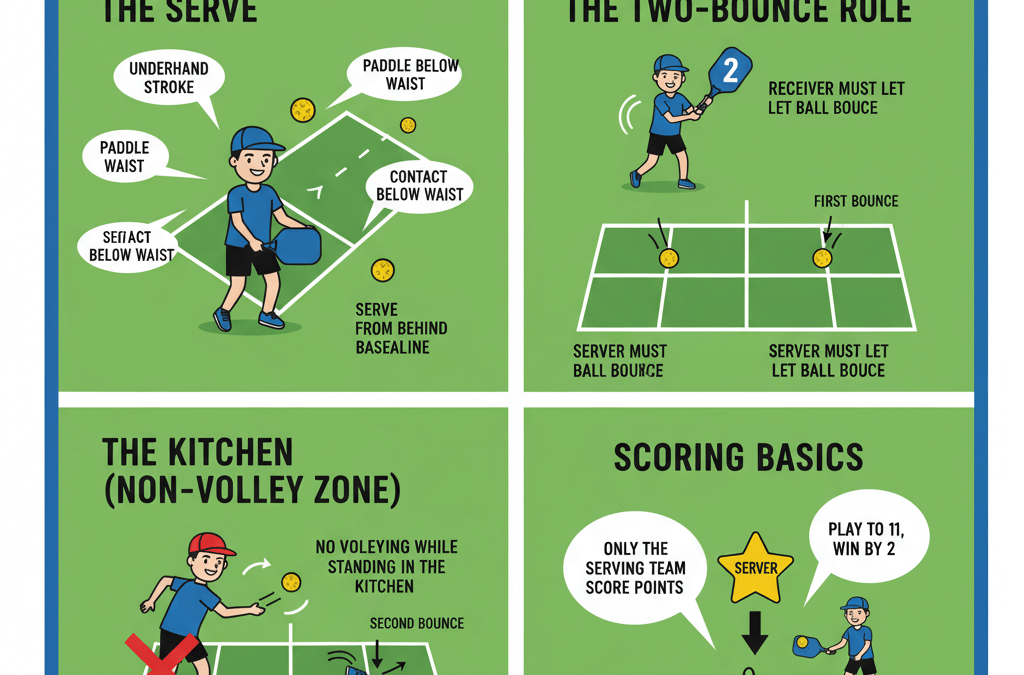
Pickleball is one of the fastest-growing sports in the world, combining elements of tennis, badminton, and ping-pong. In this complete guide, we’ll explain the 2025 rules, common mistakes, scoring, serving, faults, and beginner equipment tips.
By the end of this article, you’ll know exactly how to play a legal pickleball game, how to avoid faults, and what equipment to start with.
1. Why Pickleball? Growth, Appeal & Trends
???? Explosive Growth in Participation
In 2024, there were approximately 19.8 million pickleball players in the U.S.—a 45.8% increase from 2023.
Over the past three years, participation has surged by 311% (2021 → 2024).
According to SFIA / Pickleheads data, there are more than 68,000 dedicated pickleball courts across the U.S.
As the sport grows globally, many former tennis players have switched to pickleball for its lower physical strain and quicker learning curve.
2. Basic Court Setup & Equipment
Court Dimensions & Layout
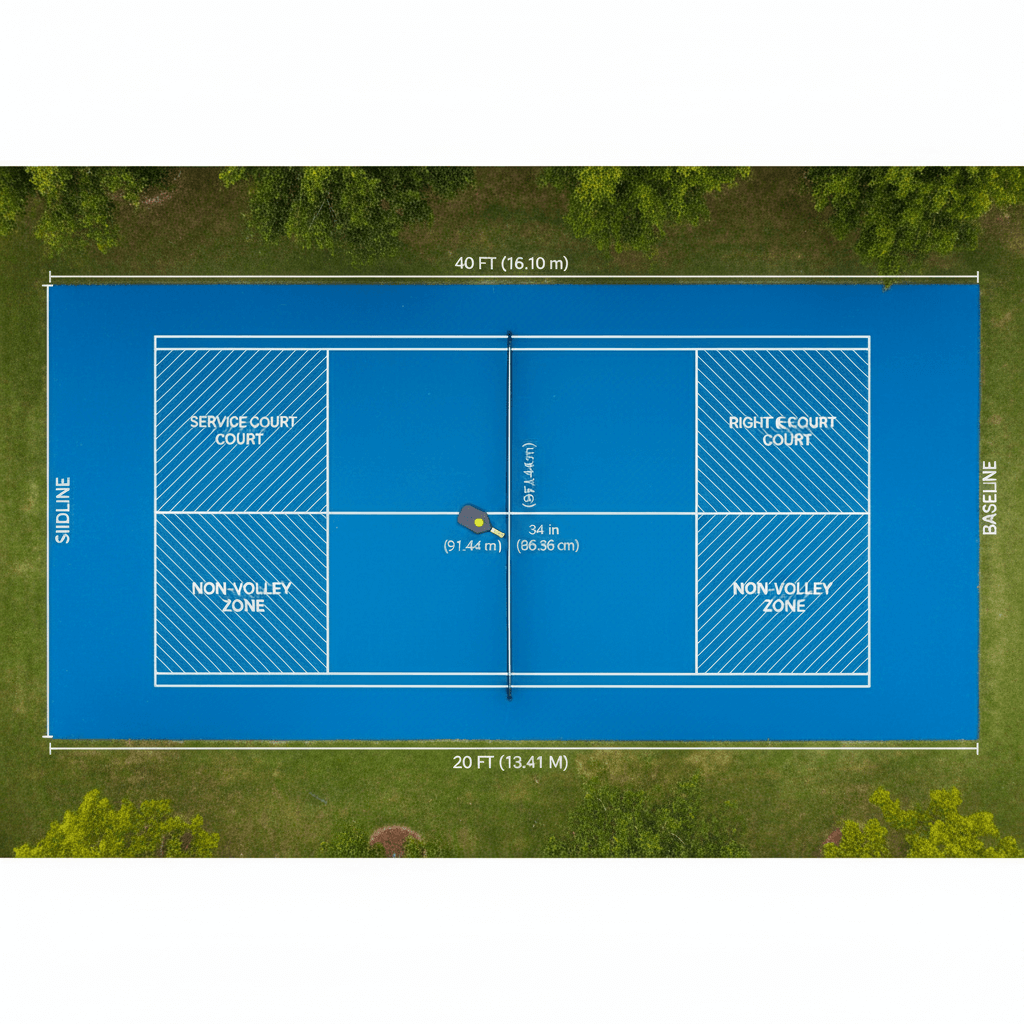
According to the 2025 USA Pickleball Official Rulebook, the standard court is:
20 ft wide × 44 ft long (6.10 m × 13.41 m) for both doubles and singles play.
The net height is 36 in (91.44 cm) at the sidelines and 34 in (86.36 cm) in the center.
Key zones include:
• Non-volley zone (“kitchen”): Extends 7 ft (2.13 m) on both sides of the net. Players cannot volley (hit the ball in the air) while standing in this zone.
• Baseline: The back boundary behind which serves must originate.
• Sidelines: The side boundaries marking the playable width.Equipment Requirements
Paddle: Made of wood, composite, or polymer materials, with no strict maximum dimension specified (so long as typical usage).
Ball: A perforated plastic ball with 26–40 holes (depending on indoor/outdoor). Must meet regulation specs in diameter, weight, bounce.
Shoes & Attire: Non-marking court shoes recommended; attire should allow freedom of movement.
3. How to Serve in Pickleball
Serving is one of the key elements causing confusion for beginners. Here are the rules and tips:
Underhand Serve Only
All serves must be underhand, with paddle contacting the ball below the waist (waist defined as the navel).
The server must keep both feet behind the baseline until after the ball is struck. Feet may not cross the baseline before contact.
Serving Position & Rotation
In doubles, each side begins with two servers (first server from one side, then the second server after a side-out).
The server must serve diagonally crosscourt into the opponent’s service court.
The serve must land beyond the non-volley line (i.e. not in the kitchen zone).
On the first server’s team: when the serving team’s score is even, the server serves from the right service court; when odd, from the left.
After a side-out, serve rotates to the other team.
2025 Rule Updates to Serving
Several clarifications have been made in the 2025 rulebook:
Rally scoring for doubles is now officially allowed: every rally can produce a point rather than only the server scoring (a departure from classic “side-out” scoring).
Some ambiguous serve rules (e.g. regarding serve carryover) now have clearer definitions.
One video summarizing the 5 most important 2025 rule changes is here:
4. Scoring Rules Explained
Understanding how points are scored is essential.
Traditional Scoring (Side-Out)
In traditional (side-out) scoring, only the serving team can score a point. If the serving team wins the rally, they score; if they lose, serve passes to the opponent.
Games are played to 11 points, win by 2 (or 15 or 21 in some tournament formats).
Rally Scoring (2025 Update)
The 2025 rulebook formally allows rally scoring in doubles, meaning every rally yields a point regardless of which team served.
The adopted format is intended to be simple and familiar for new players.
Scoring Sequence Example (Side-Out)
Here’s a sample flow (doubles, side-out scoring):
Team A serves → wins rally → Team A gets 1 point
Team A serves again (since they scored)
Team A loses rally → no point; serve passes to Team B
Team B serves, wins rally → Team B scores 1 point
| Rally # | Server | Winner | Score (A–B) | Notes |
|---|---|---|---|---|
| 1 | A | A | 1–0 | A keeps serve |
| 2 | A | B | 1–0 | no point, side-out |
| 3 | B | B | 1–1 | B serves next |
| 4 | B | B | 2–1 | B scored on own serve |
With rally scoring, each rally just adds a point to either side, so the flow is simpler.
Tip: For beginners, starting with rally scoring makes matches faster and more exciting.
5. Faults & Common Mistakes Beginners Should Avoid
A “fault” causes the rally to end with a point awarded to the opponent (or change of serve). Below are common ones:
Common Faults
Service faults
- Serve not underhand or paddle above waist.
- Server’s feet touching or crossing baseline before contact.
- Ball lands in the kitchen (non-volley zone).Volley faults
- Volley (hitting ball in air) while standing in the non-volley zone (kitchen).
- After the ball is volleyed, the player’s momentum carries them into the kitchen (momentum fault).Double bounce rule
- Each side must let the ball bounce once before volleying. If a volley is done prematurely, that is a fault.Out-of-bounds
- Hitting the ball outside the court lines (including over net but out of bounds).Hitting the net or net standards
- If the ball touches the net on a serve and lands in the proper service court, in some formats it’s a “let” (replay); elsewhere it’s a fault.
- Player or equipment touches the net during a rally.Other faults
- Striking the ball twice (double hit) or carrying / catching the ball on the paddle.
- Reaching over the net to hit the ball except in specific circumstances.
Common Mistakes by Beginners
Trying to volley too early (before two bounces).
Standing too close to the net (violating kitchen rule).
Serving incorrectly (e.g. overhand or from wrong box).
Failing to call “fault” correctly or disagreeing about lines.
Using a “Do & Don’t” list is helpful in your blog:
| ✅ Do | ❌ Don’t |
|---|---|
| Allow the ball to bounce once on each side before volleying | Volleying too early or from the kitchen |
| Serve underhand from behind baseline | Serve from wrong position or above waist |
| Call your own line faults honestly | Ask spectators to call lines (2025 prohibits this) |
| Foot-fault check: keep feet behind baseline until strike | Stepping on or over the baseline prematurely |
6. Advanced Rules & 2025 Updates You Should Know
As pickleball matures, small rule clarifications matter. Below are notable changes from the 2025 USA Pickleball Rulebook Change Document.
6.1 Simplified Act of Volley
The 2025 change removes “the swing” from the legal definition of a volley. This means a player may have some follow-through movement into the kitchen (so long as no fault), reducing ambiguity.
6.2 Spectator Line Calls Prohibited
The text changed from “Spectators should not be consulted” to “shall not be consulted”. Players may not consult, ask, or accept help from spectators on line calls.
6.3 Doubles Rally Scoring
As noted earlier, rally scoring is officially supported in doubles, simplifying scoring for all players.
6.4 Clarifications & Editorial Changes
Many changes are clarifications rather than wholesale rewrites—intended to reduce confusion and improve consistency across rules.
For full details, see the 2025 Rule Change Document from USA Pickleball.
7. Beginner Equipment & Paddle Tips
Once you know how to play, choosing the right paddle helps performance and comfort. Here are beginner-oriented suggestions:
Paddle Features for Beginners
Weight: A paddle weight between ~ 7.8 oz to 8.4 oz (≈ 220–240g) is often good for control and forgiveness. Avoid ultra-heavy paddles at the start.
Core / Surface Material:
• Polymer or composite cores provide softer feel and better control.
• Raw carbon or fiberglass surfaces can offer spin, but may sacrifice forgiveness.Grip & Handle: Choose a comfortable grip size (often 4¼”–4⅜”) that fits your hand.
Shape: A widebody paddle gives a larger sweet spot; elongated paddles give slightly more reach but reduce width.
Balance / Balance Point: A balanced or slightly head-light paddle is easier for beginners to maneuver.
8. Frequently Asked Questions (FAQ)
Q: Can you step into the kitchen after the ball bounces?
A: Yes—after the ball bounces, you may step into the non-volley zone to play a shot. But you may not volley (hit in the air) from inside it.
Q: What is the difference between singles and doubles rules?
A: Mostly scoring and serving rotation differences. The court dimensions and faults remain the same.
Q: How long is a typical pickleball game?
A: Around 15 to 25 minutes for a game to 11 (win by 2), depending on pace and scoring format.
Q: Can a serve hit the net?
A: If served so that it touches the net and lands in the correct service court, it’s considered a “let” (replay).
Q: What happens if players disagree about line calls?
A: The benefit of the doubt goes to the receiver’s side. Also, spectators must not be consulted for line calls per the 2025 update.
Recent Comments