
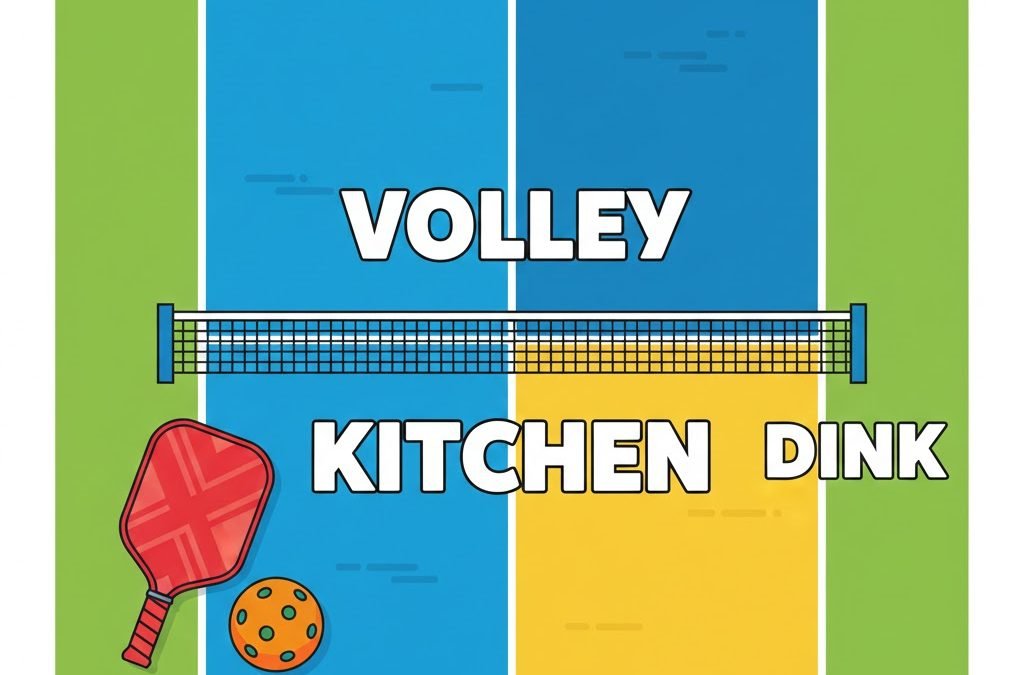
Pickleball is one of the fastest-growing sports in the world, blending elements of tennis, badminton, and ping-pong. Whether you’re just starting out or playing competitively, understanding the terminology is essential. Knowing these terms helps improve your strategy, communicate with partners, and enjoy the game more.
| Term | Definition |
|---|---|
| Paddle | The solid racquet used to hit the ball, made from wood, graphite, or composite materials. |
| Pickleball | The perforated plastic ball used in play, available in indoor and outdoor versions. |
| Court | A 20×44 feet playing area with a 36-inch high net at the sidelines and 34 inches at the center. |
| Non-Volley Zone (Kitchen) | The 7-foot area from the net where volleying is prohibited. |
| Net | The barrier dividing the two sides of the court. |
| Sideline | The boundary lines running along the length of the court. |
| Baseline | The back boundary line on each side of the court. |
2. Scoring Terms
| Term | Definition |
|---|---|
| Point | Scored when the opposing team commits a fault. |
| Rally | Sequence of shots played until a fault occurs. |
| Side Out | When the serving team loses the rally, giving the serve to the opponents. |
| Serve | The first shot of a point, hit underhand from behind the baseline. |
| Double-Bounce Rule | The ball must bounce once on each side before volleys are allowed. |
| Fault | Any action that stops play or violates rules (e.g., out-of-bounds, kitchen volley). |
3. Serving Terms
| Term | Definition |
|---|---|
| Underhand Serve | A legal serve where the paddle contacts the ball below the waist. |
| Serve Sequence | In doubles, both players on a team get a turn serving before a side out occurs. |
| Let | When a serve hits the net but lands in the proper service area; replay the serve. |
4. Shot Types
| Term | Definition |
|---|---|
| Volley | Hitting the ball before it bounces on your side of the court. |
| Dink | A soft shot landing in the opponent’s kitchen to force movement and create openings. |
| Drive | A fast, low shot intended to put opponents on the defensive. |
| Lob | A high, arcing shot aimed over an opponent’s head. |
| Third Shot Drop | A strategic shot, usually on the third hit, landing softly in the kitchen. |
| Smash | A powerful downward shot, often to finish a point. |
| Block | A defensive volley that redirects the ball without swinging hard. |
| Roll Shot | A gentle shot that rolls over the net to land in the kitchen. |
5. Player Positions
| Term | Definition |
|---|---|
| Baseline Player | Stays near the back of the court, focusing on returns and positioning. |
| Net Player | Moves near the net to attack and intercept volleys. |
| Doubles Formation | Player positioning strategies in doubles (e.g., side-by-side, stacking). |
| Stack | Both partners switch positions to cover the court efficiently. |
| Poach | Moving across the court to intercept a shot intended for your partner. |
| Erne | Jumping or moving outside the sideline to volley near the net. |
6. Common Violations
| Term | Definition |
|---|---|
| Kitchen Violation | Stepping into the non-volley zone while volleying. |
| Foot Fault | Serving with feet outside the proper boundary. |
| Out-of-Bounds | Hitting the ball outside the court lines. |
| Net Fault | Contacting the net with the paddle, body, or clothing. |
7. Paddle & Equipment Terms
| Term | Definition |
|---|---|
| Grip | The handle covering that provides comfort and control. |
| Edge Guard | Protective strip around the paddle’s edge. |
| Paddle Face | The hitting surface of the paddle. |
| Paddle Core | The inner material of the paddle, such as polymer, Nomex, or aluminum honeycomb. |
| Weight | Paddle weight affects speed, control, and comfort. |
| Length | Paddle length influences reach and leverage, often 15-17 inches. |
| Width | Paddle width affects sweet spot and control, usually 7-8 inches. |
| Sweet Spot | The optimal area on the paddle face for effective shots. |
8. Strategy & Tactics
| Term | Definition |
|---|---|
| Placement | Positioning the ball to make it difficult for opponents to return. |
| Angle | Hitting shots at angles to create openings. |
| Court Awareness | Knowing where players and open spaces are on the court. |
| Rallying | Engaging in sustained back-and-forth shots. |
| Shot Selection | Choosing the best type of shot based on the situation. |
| Momentum | Using ball speed, spin, and movement to gain advantage. |
9. Miscellaneous & Slang
| Term | Definition |
|---|---|
| Paddle Tap | A gesture of encouragement by tapping paddles with your partner. |
| Let | Replaying a serve that touches the net but lands in the correct area. |
| Ace | A serve that is not returned by the opponent. |
| Grinder | A player who excels at long rallies. |
| Rally Killer | A shot that ends a long rally effectively. |
| Spin | The rotation on the ball that affects its trajectory. |
| Topspin | Forward rotation causing the ball to dip quickly. |
| Backspin | Reverse rotation slowing the ball and making it bounce lower. |
| Flick | A quick, soft shot, often used in dinks. |
| Overhead | Hitting the ball from above the head, usually a smash or lob. |
10. Why Learning Pickleball Terms Matters
Understanding these terms can improve your gameplay and court communication. Beginners may struggle to keep up during coaching or social games, while advanced players can use strategic terms to coordinate better in doubles matches. Mastering the language of pickleball also helps in tournament settings, where referees and official rules use these terms extensively.
Conclusion
Pickleball is easy to learn but challenging to master. Knowing the essential terms—from basic rules and scoring to advanced strategies—will give you an edge and make your games more enjoyable. Keep this guide handy as a pickleball reference, and soon you’ll be speaking the language of the court like a pro.
Recent Comments