
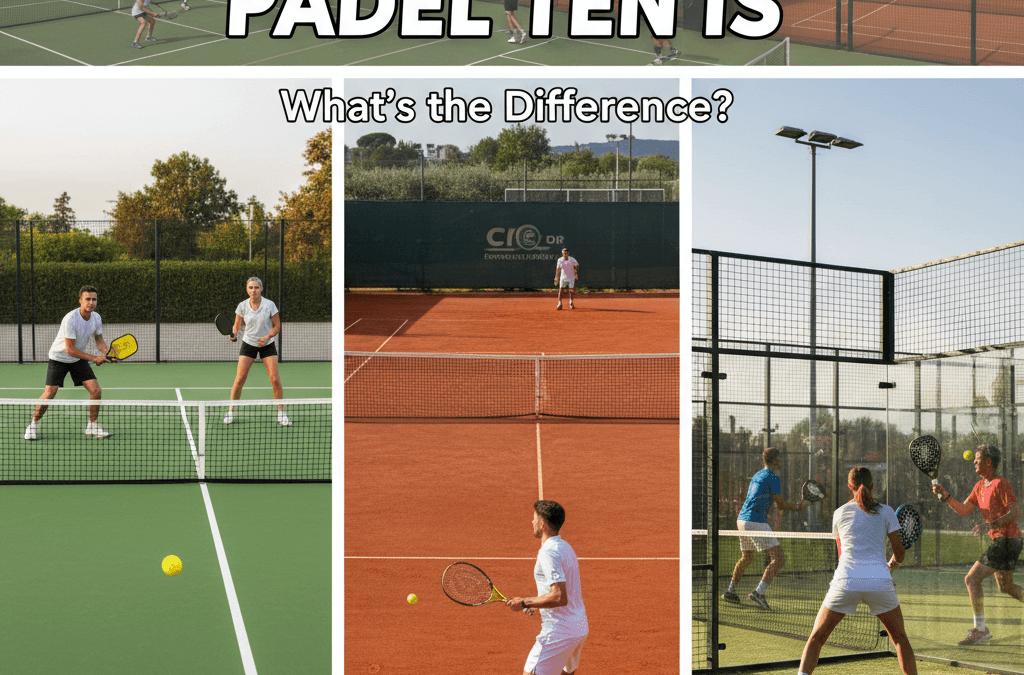
Over the past decade, racquet sports have evolved beyond traditional tennis. Newcomers like pickleball and padel tennis are taking over courts across the U.S. and Europe.
Although all three sports use rackets, balls, and nets, their rules, equipment, and playing styles are very different.
Understanding these differences helps players choose the right sport — and helps brands or clubs spot new market opportunities. Let’s take a closer look at how pickleball, tennis, and padel tennis compare.
II. Origins and Popularity
Each sport has a unique history that explains why it’s popular in different parts of the world.
| Sport | Origin | Popular Regions | Growth Trend |
|---|---|---|---|
| Tennis | 19th century, United Kingdom | Global | Stable, Olympic sport |
| Padel Tennis | 1969, Mexico (popularized in Spain) | Spain, Italy, Latin America | Fastest-growing in Europe |
| Pickleball | 1965, Washington, USA | USA, Canada | Fastest-growing in North America |
the number of pickleball players in the U.S. grew 158% between 2020 and 2023, reaching 13.6 million players.
Meanwhile, data reports over 30,000 padel courts worldwide as of 2023, with particularly strong expansion in Spain and Italy.
Tennis remains the most established, played by over 87 million people globally .
III. Court Dimensions and Setup
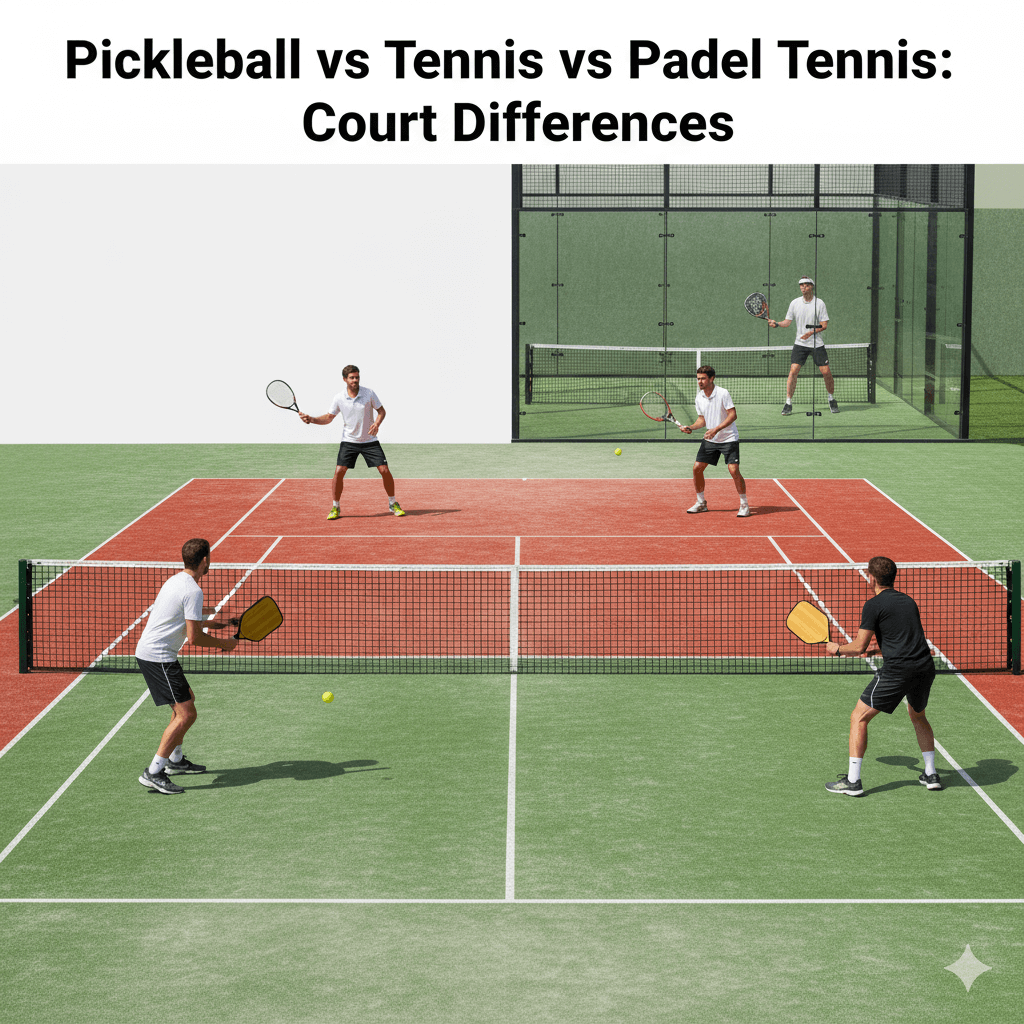
One of the main visual differences among the three sports lies in the court size and structure.
| Sport | Court Size | Net Height | Surface Type |
|---|---|---|---|
| Tennis | 23.77m × 8.23m (singles) / 10.97m (doubles) | 0.91m | Clay, grass, hard court |
| Padel Tennis | 20m × 10m (enclosed with glass walls) | 0.88m | Artificial turf or concrete |
| Pickleball | 13.41m × 6.10m | 0.86m | Hard or concrete surface |
Padel courts are surrounded by glass and mesh, allowing the ball to bounce off walls, while tennis and pickleball are played on open courts.
Pickleball’s smaller dimensions make it perfect for compact spaces, which is one reason for its rapid spread across community centers and schools.
IV. Equipment: Racket and Ball Differences
Each sport uses a completely different type of racket or paddle.
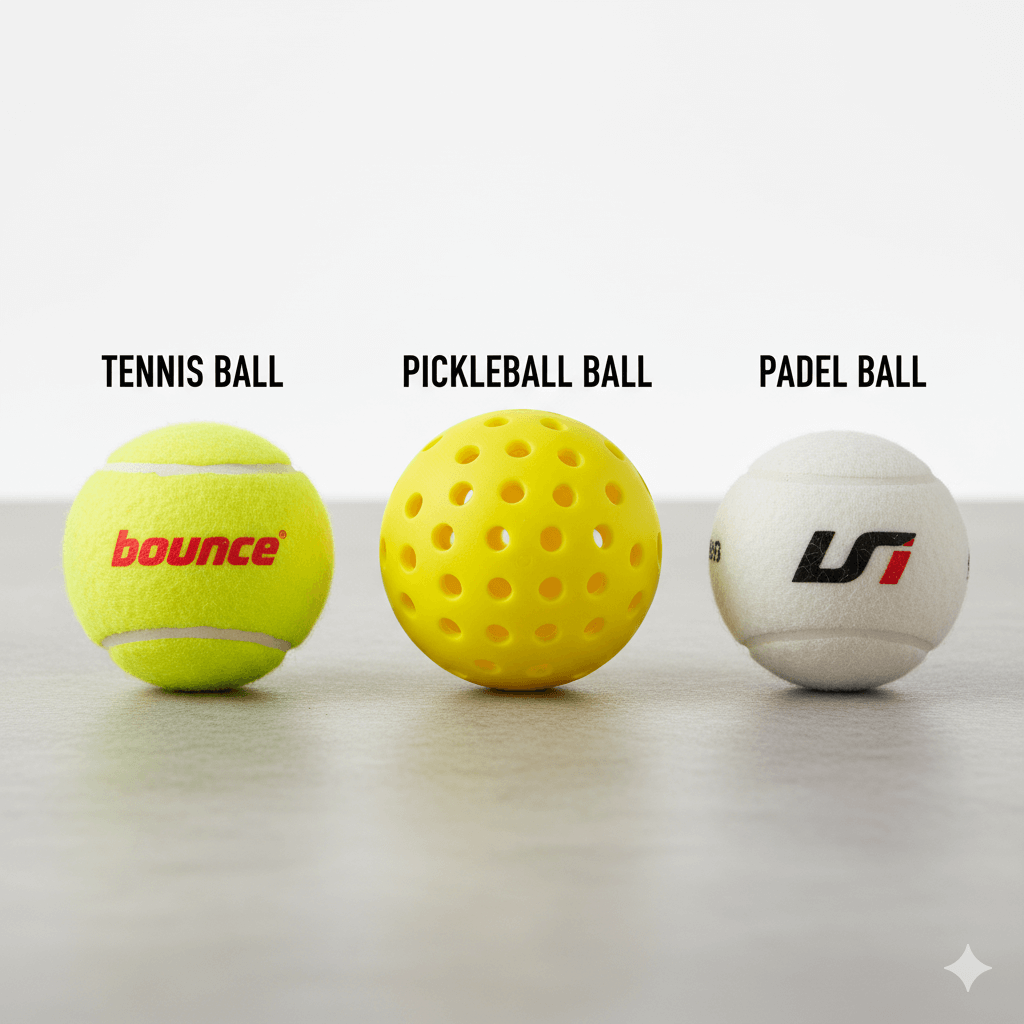
| Sport | Racket Type | Ball Type | Material |
|---|---|---|---|
| Tennis | Strung racquet | Felt-covered rubber ball | Graphite or aluminum frame |
| Padel Tennis | Solid racket with holes | Pressurized ball (smaller than tennis) | Carbon fiber or fiberglass with EVA foam core |
| Pickleball | Flat solid paddle (no strings) | Plastic ball with holes | Fiberglass, graphite, or T700 raw carbon surface with polymer honeycomb core |
Tennis racquets rely on string tension for control and power.
Padel rackets, like those made from carbon or fiberglass, combine stiffness and elasticity through EVA foam cores.
Pickleball paddles — including advanced models from LIXI Pickleball— are built using lightweight polymer cores and carbon surfaces to improve spin and control.
If you compare them side by side, you’ll notice that pickleball paddles are shorter and wider than padel rackets, offering more maneuverability for quick volleys.
V. Gameplay and Rules Overview
Despite looking similar, the three sports have distinct rules and scoring systems.
Tennis uses the traditional 15–30–40–game scoring system, with either singles or doubles matches. Players serve overhand.
Padel follows tennis scoring but is always played in doubles. Serves are underhand, and balls can bounce off the walls, adding a strategic dimension.
Pickleball uses rally scoring to 11 points. Serves are underhand, and players must stay out of the non-volley zone (“the kitchen”) near the net.
These differences affect speed and strategy.
Pickleball rallies are typically slower and require precise placement, while tennis involves higher velocity and longer groundstrokes. Padel blends both — it’s social, tactical, and very fast-paced once mastered.
VI. Difficulty and Learning Curve
For beginners, learning curve matters. Here’s a general overview:
| Sport | Learning Difficulty | Physical Intensity | Typical Rally Length |
|---|---|---|---|
| Pickleball | Easy | Low–Medium | Long (10–20 hits) |
| Padel Tennis | Medium | Medium | Moderate (6–10 hits) |
| Tennis | Hard | High | Short (3–6 hits) |
Pickleball’s smaller court and underhand serve make it beginner-friendly.
Padel, while more dynamic, still allows players to keep the ball in play longer thanks to wall rebounds.
Tennis, however, demands greater strength, speed, and technique — making it a lifetime sport for those willing to practice.
VII. Popularity and Market Growth
The racquet sports market has seen explosive change in the past five years.
Pickleball: According to SFIA’s 2024 report, pickleball participation rose to 13.6 million U.S. players — the fastest-growing sport in America.
Padel Tennis: The Global Padel Report 2023 noted over 30,000 courts and 10 million players worldwide. Spain and Italy alone account for over 60% of global participation.
Tennis: Remains the largest with 87 million global players (ITF), but growth is steady rather than explosive.
The biggest business trend?
Many pickleball paddle and padel racket factories are now offering OEM/ODM customization for brands targeting niche markets.
Custom designs, carbon fiber surfaces, and branded packaging help small brands stand out in this expanding market.
VIII. Which Sport Should You Try?
Here’s how to decide which one fits you best:
| Preference | Recommended Sport | Why |
|---|---|---|
| New player or senior | Pickleball | Easy to learn, minimal strain |
| Social player | Padel Tennis | Always doubles, fun and strategic |
| Competitive athlete | Tennis | Demanding, global tournaments |
| Limited space | Pickleball | Small court, easy setup |
| Tech-driven or brand innovator | Pickleball / Padel | High growth + OEM customization options |
If you run a sports brand or pro shop, this insight also helps in product planning.
The fastest-growing gear categories in 2024 were carbon fiber pickleball paddles and high-end padel rackets with 3K or 18K carbon finishes — both available from manufacturers like LIXI Sports
IX. The Business Perspective: OEM Opportunities
From a manufacturing angle, the differences between these sports mean very different product specs.
| Product | Core Thickness | Material Option | MOQ (Factory) |
|---|---|---|---|
| Pickleball Paddle | 13mm–16mm | Fiberglass / T700 Raw Carbon / 3K Carbon | 300 units |
| Padel Racket | 36–38mm EVA foam | 12K / 18K Carbon / Kevlar / Fiberglass | 200 units |
| Tennis Racket | Hollow carbon frame | Graphite / Aluminum | 500 units |
Factories like LIXI Sports provide OEM/ODM services, including:
Custom surface graphics (UV printing, watermarks)
Custom molds and EVA hardness
Personalized edge guards and handle wraps
Branded packaging and logistics solutions
These services help brands build premium differentiation and enter markets faster.
X. FAQ
Q1: Which sport is easiest to learn — pickleball, padel, or tennis?
A: Pickleball is generally the easiest. The court is smaller, serves are underhand, and rallies last longer, making it beginner-friendly.
Q2: What’s the main difference between a pickleball paddle and a padel racket?
A: A pickleball paddle is flat and solid without holes, while a padel racket has a thicker EVA foam core and perforations to reduce air resistance.
Q3: Can tennis players easily switch to pickleball or padel?
A: Yes. Tennis players often adapt quickly to both sports because of similar strokes, but they need to adjust to smaller courts and different pacing.
Q4: Which sport is growing the fastest?
A: Pickleball leads growth in North America, while padel is expanding fastest in Europe and Latin America.
Q5: What’s better for small clubs — pickleball or padel?
A: Pickleball requires less space and lower installation costs, making it ideal for multi-purpose gyms and community centers.
XI. Conclusion
While tennis remains the world’s most recognized racquet sport, pickleball and padel tennis are transforming the market.
Pickleball offers accessibility and community appeal.
Padel brings social play and modern design.
Tennis continues to be a global sport of endurance and skill.
Recent Comments