A pickleball paddle’s design directly affects power, control, and comfort — the three key performance metrics that define player experience. Equipment innovation has accelerated as players seek better balance between speed and precision.
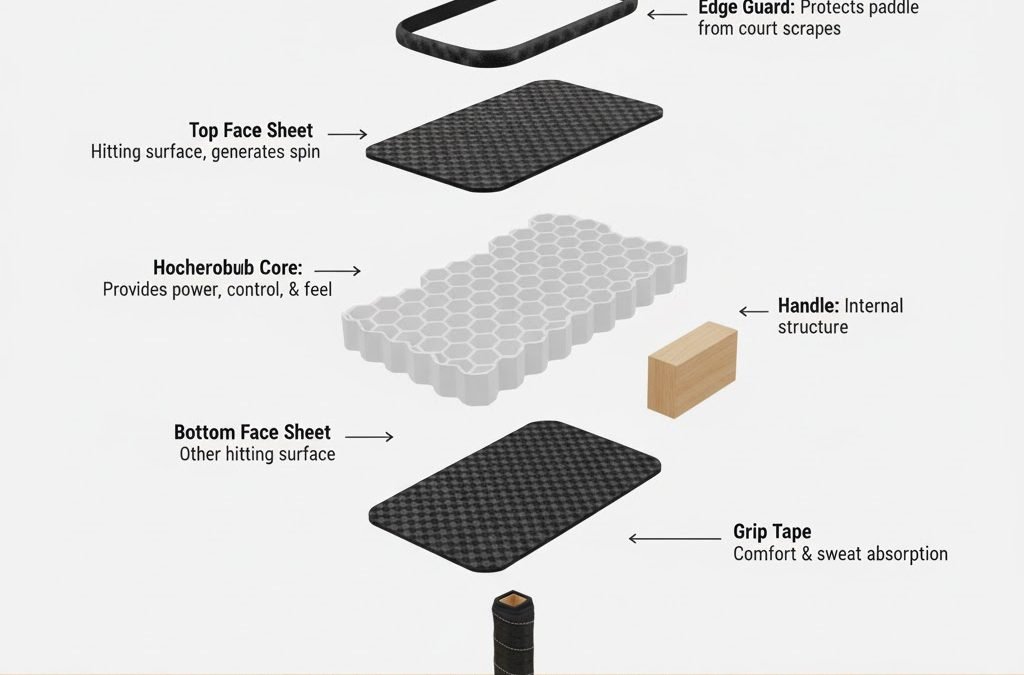
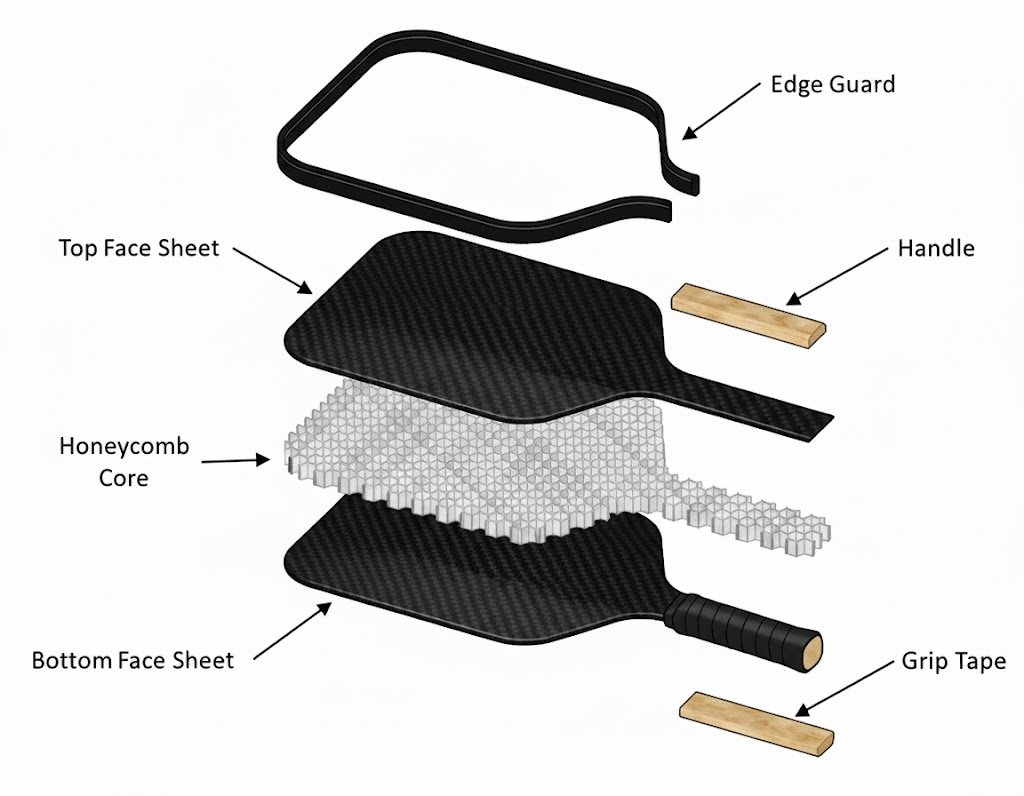
Each component — core, surface, edge guard, handle, and grip — serves a specific function in shaping a paddle’s performance. For example:
The core influences control and pop.
The surface impacts spin and shot accuracy.
The handle affects stability and comfort.
Modern paddles use composite materials like polypropylene honeycomb /EPP and carbon fiber, improving durability by up to 25% over older wood or aluminum models .
II. Main Components Overview Table
| Part / Region | Typical Materials / Options | Primary Function | Performance Effects / Trade-offs |
|---|---|---|---|
| Face (surface) | Carbon fiber, graphite, fiberglass, composite, Kevlar | The contact surface with the ball | Impacts spin, control, stiffness, feel, durability |
| Core (interior) | Polypropylene (polymer honeycomb),EPP Nomex, aluminum honeycomb | Structural backbone; absorbs impact | Power, dampening, control, weight, stiffness |
| Edge Guard / Edge Frame | Plastic, TPU, thermoplastic, edgeless designs | Protects edges from damage | Slight weight increase, affects balance; protects core |
| Throat / Transition | Composite or reinforced layers | Joins the head to handle; structural support | Affects stiffness, torsion resistance |
| Handle / Grip | Wood core, composite, PU, overgrip wraps | How the player holds the paddle | Comfort, vibration absorption, slip prevention |
| End Cap / Butt Cap | Plastic, rubber, custom logo inserts | Seals the bottom, fine-tunes balance | Impacts weight distribution, finishing look |
III. Face (Paddle Surface)
Materials & Construction
The face (or face sheet) is the outer surface on each side of the paddle that contacts the ball. A typical paddle is constructed as a sandwich: face + core + face. The face sheets handle bending stiffness, while the core handles shear stiffness.
Common face materials include:
Carbon fiber / raw carbon — high stiffness, excellent energy transfer, good for spin and control
Graphite — similar to carbon fiber in many paddles; sometimes interchangeable in marketing
Fiberglass / glass composite — more flexible, tends to produce more “pop” / power, less forgiveness
Kevlar or hybrid composites — for special blends of stiffness and vibration control
Composite blends — combining layers to tailor stiffness, vibration, or durability
Over recent years, many paddle makers have shifted toward carbon fiber (or raw carbon) faces, especially in higher-end models, citing better spin potential, softer feel, and more forgiving sweet spots.
Performance Impacts & Trade-offs
Spin & friction: The texture, grit, or micro-roughness of the face can influence how much “bite” the paddle gets on the ball. Carbon faces often allow more versatile spin.
Stiffness and energy transfer: A stiffer face transfers more energy back to the ball (more speed), but reduces damping (you may feel more vibration)
Feel and control: Fiberglass tends to feel softer and more “pop,” while carbon tends to feel firmer but more controllable
Durability: Carbon tends to resist surface wear better; fiberglass sometimes delaminates earlier under high stress
Sweet spot size and forgiveness: Designs with raw carbon and specific layups often aim for larger sweet spots.
A paddle with a carbon face might allow a player to get more spin and feel, while a fiberglass paddle might be more forgiving for power shots but less forgiving on off-center hits.
IV. Core (Inside Structure)
Core Types & Materials
The core is the interior structure sandwiched between the face sheets. It plays a central role in absorbing impact, distributing force, and determining many dynamic properties of the paddle.
Common core types:
Polypropylene (Polymer / PP honeycomb) — Currently the most popular core type in pickleball paddles. Most modern paddles (~99%) use this material.
Nomex honeycomb — A paper / aramid material treated with resin to create a lightweight, stiff core. It was more common in earlier paddles; still used in lower-cost or specialized designs.
Aluminum honeycomb — Less common now, heavier, more rigid, sometimes used in more budget designs or niche paddles.
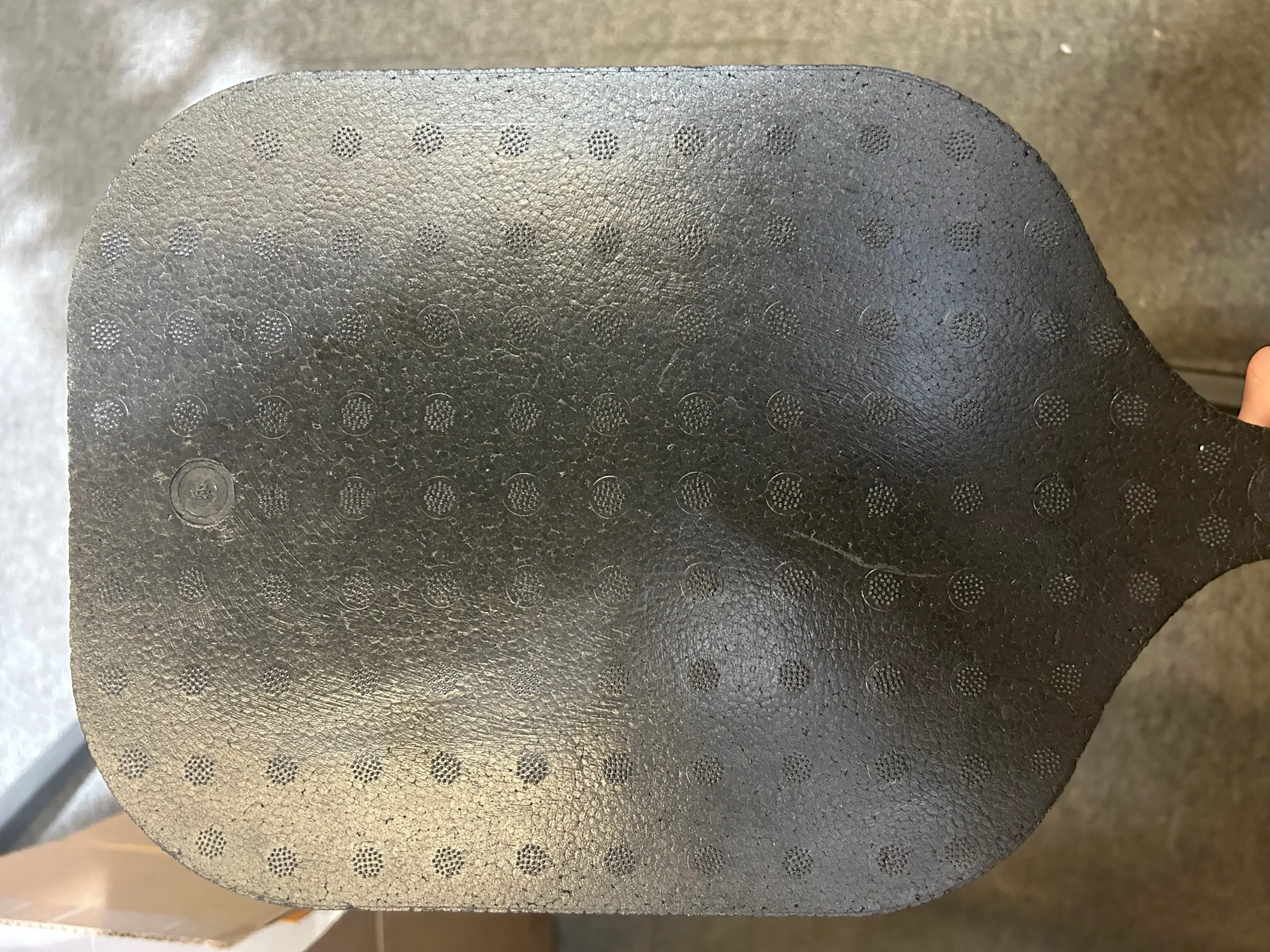
EPP core — a new and environmental material used by CRBN and many brands, compared to other cores like PP, it is recyclable and reduces core breakage, but it lacks power when hitting based on feedbacks and costs higher.
Core Thickness & Its Effects
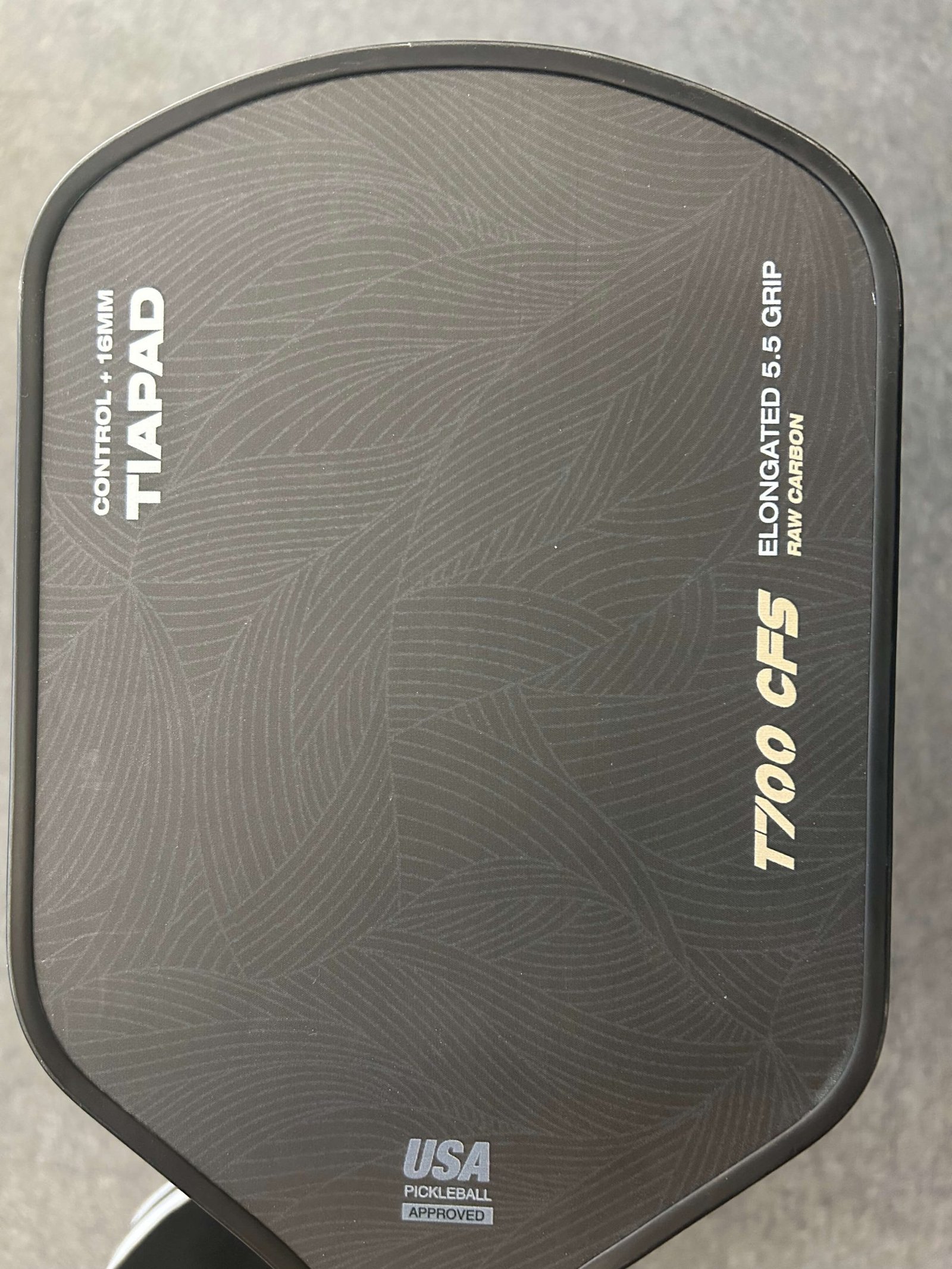
Core thickness (often expressed in mm) is another key variable. Many paddles come in 13 mm, 14 mm, 15 mm, 16 mm, etc. The thickness influences stiffness, control vs. power balance, and feel.
Thinner cores (e.g. ~12–14 mm) tend to deliver more pop / responsiveness, but less damping and a smaller sweet spot.
Thicker cores (e.g. ~15–16 mm) give more control and a smoother feel, with better dampening, but less maximum pop.
Some brands market paddles by balancing power and touch based on core thickness choices.
Trade-offs and Guidelines
Polymer cores tend to give a more balanced feel—good mix of power, control, and vibration absorption.
Nomex cores can be very stiff and responsive but less forgiving (vibrations)
Aluminum cores are less common now because of weight and noise
EPP core paddle delivers more control and less noise when playing.
In practice, for a paddle factory looking to deliver high performance, a polymer honeycomb core in 14–16 mm range is often considered the sweet spot for many players.
V. Edge Guard / Edge Frame
Purpose & Design Choices
The edge guard (or edge frame) wraps around the outer boundary of the paddle’s face and core. Its role is to protect the edges from impacts, abrasion, and damage when the paddle hits a surface or is accidentally dropped.
Some designs go toward an edgeless or flush edge, where protection is internal or added via thin tape.
Edge guard materials commonly include:
Thermoplastic polyurethanes (TPU)
Lightweight plastics
Rubberized materials
Custom-colored or branded plastics for aesthetics
Performance Consequences & Trade-offs
Weight and balance: Edge guards add mass, which slightly shifts balance and contributes to the paddle’s swing weight
Sweet spot reduction: The guard may marginally encroach on the active face area, reducing the “ideal hit zone”
Durability: Strong protection extends the life of the paddle
Aesthetic / branding opportunities: The edge guard area can be used for design accents or logos
Many manufacturers balance between protection and minimal weight/bulk. Some “edgeless”(unibody) paddles rely on internal reinforcement or thin edge tape to maintain durability while minimizing weight.
VI. Throat / Transition Area
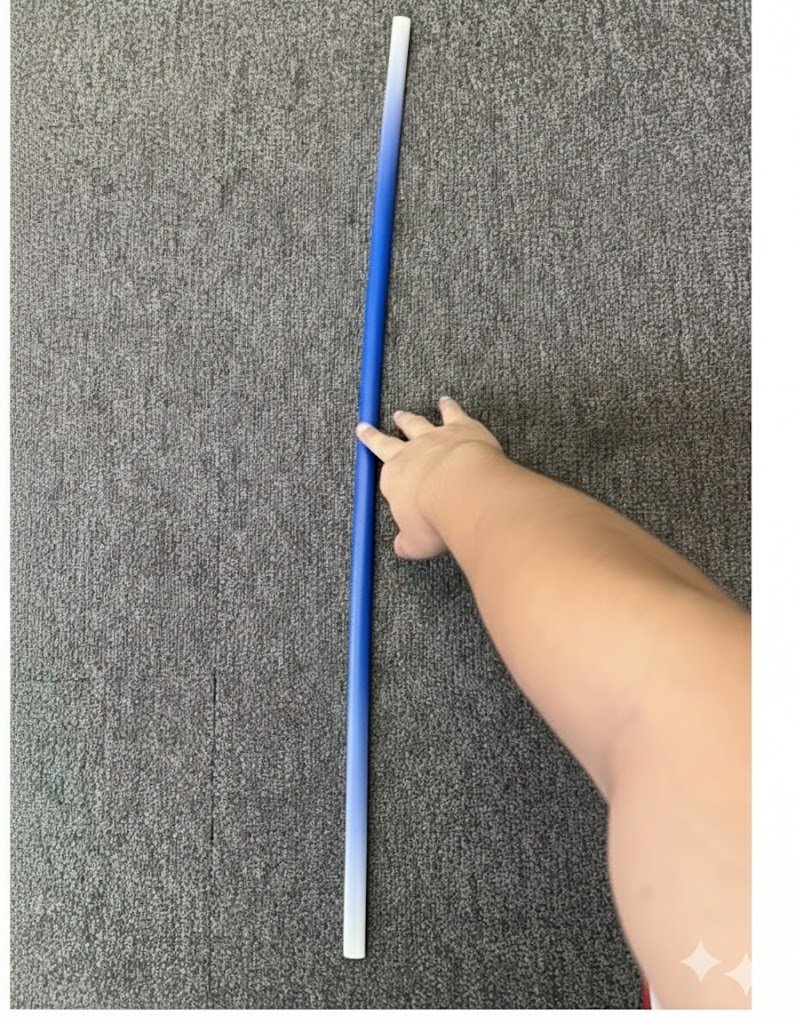
The throat (or neck / transition area) is the region where the face/head section narrows and connects to the handle. Not all paddles have a very pronounced throat, but many do, for structural and design reasons.
Functions & Effects
Structural reinforcement: The throat can help manage stress from bending or twisting.
Torsional stiffness: A well-designed throat can help resist twisting forces, giving more consistent hits off-center.
Weight distribution: The throat is part of the internal structure and affects how weight is distributed along the paddle.
Aesthetic and branding: The throat area is often used for branding lines, cutouts, or design elements.
From a factory perspective, the throat design is a useful place to adjust stiffness or to embed reinforcing fibers (e.g. carbon strips) to enhance stability.
VII. Handle & Grip
Handle Core & Shape
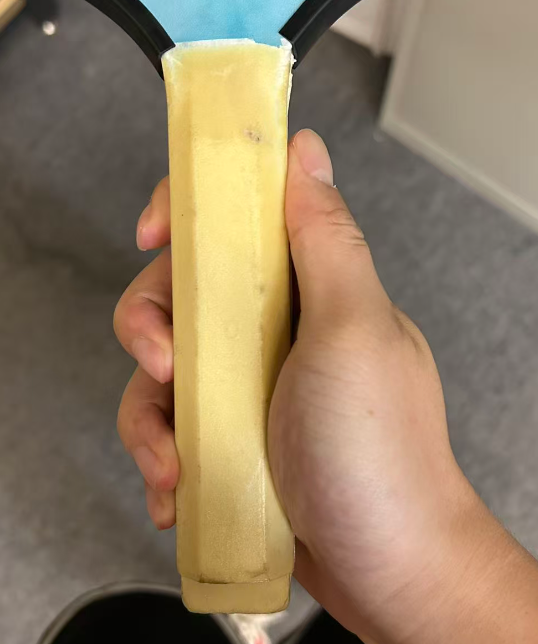
Underneath the grip wrap, the handle often has a structural core (wood, composite, or hollow core) to provide shape and stiffness. The handle geometry (round, oval, or slightly ergonomic) influences how it feels in hand.
Grip Materials & Wraps
The outer visible parts of the handle include the grip wrap and possibly an overgrip. Common materials:
Polyurethane (PU) wraps — common, absorb sweat, comfortable
Perforated grips or cushioned layers
Overgrip tapes — can be added, replaced
Ribbing or texture for anti-slip
A proper grip ensures control, reduces vibration, and helps prevent slipping during play.
Grip Size & Adjustment
Grip size (circumference) matters. One typical grip size is ~4.45 inches circumference. If a grip is too small or too big, players often add or remove wrap or use overgrips to adjust.
Table for grip sizes:
| Hand Circumference (in) | Suggested Grip Size |
|---|---|
| ~4.0 – 4.5 in | Standard 4.25–4.5 in circumference |
| Larger hands | Add overgrip or choose thicker grip base |
A well-fitted grip reduces wrist strain and improves shot consistency.
VIII. End Cap / Butt Cap
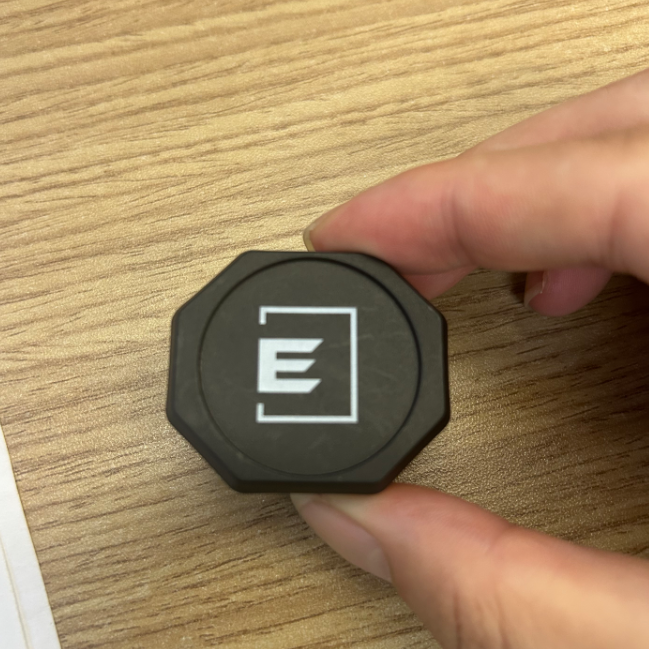
The end cap (butt cap) is the small piece at the bottom of the handle that closes off the interior. Its functions include:
Sealing the handle end to prevent dust/moisture ingress
Providing a finishing look
Fine-tuning the balance: adding or subtracting a small amount of weight here shifts balance slightly toward the hand
Branding opportunities—many paddles place logos or model names on the end cap
Though often overlooked, the end cap plays a subtle role in the paddle’s weight balance and aesthetics.
IX. Why Paddle Anatomy Matters for Performance
When you combine face, core, edge, throat, handle, and end cap design decisions, the result is the paddle’s overall performance envelope. Here’s how those parts interact:
Power: Often driven by stiff faces + thin cores + higher mass in the head
Control & forgiveness: Encouraged by softer faces, thicker cores, dampening in the handle
Spin: Affected by face texture, grip, and fine control of micro-contact
Vibration & feel: Dependent on core damping, grip material, and face stiffness
Balance & maneuverability: Determined by weight distribution among parts
Durability: Strong edge guards, quality bonding, and reinforced transitions help longevity
For example, a paddle with a 16 mm polymer core, raw carbon face, minimal edge guard, and a well-damped grip may offer a balance of control and spin while maintaining durability.
Manufacturers often test many prototypes varying one element at a time. Standards such as the USA Pickleball Equipment Standards Manual require paddles to meet specifications (for example, surface finish, gloss, and new PBCoR test for power) if they want the paddle approved for sanctioned competitions.
X. How to Choose or Customize Your Paddle
Player-Level Recommendations
| Player Level | Recommended Core | Face Material | Thickness | Grip | Trade-offs to Accept |
|---|---|---|---|---|---|
| Beginner / casual | Polymer core | Composite or fiberglass | 14–16 mm | Standard grip + overgrip | Forgo maximum spin or ultra-light weight |
| Intermediate / all-round | Polymer core | Raw carbon or carbon | 15–16 mm | Cushioned grip, well-fitted | Slightly less pop than ultra-thin |
| Advanced / spin-control | Polymer or hybrid core | Raw carbon or carbon with special layups | 14–15 mm | Custom wrap, high tack | May feel firm; less damping |
| OEM / brand development | Custom polymer core | Multiple face options | Range prototypes | Flexible grip options | Balance cost vs performance trade-offs |
Customization Tips (For Factory / OEM)
Prototype variation
Create several versions varying one dimension (e.g. core thickness ±1 mm) while keeping others constant to isolate effects.Weight tuning
Use tungsten tape in corners, throat, or handle ends to fine-tune balance and swing weight. This method is commonly used in paddle customization.Layup optimization
Adjust fiber orientation, ply sequence, or grit patterns (e.g. “spray grit” vs sand texture) to influence spin and feel.Edge / edgeless trade-off
Offer both guarded and edgeless versions; test durability vs weight penalty.Handle / grip modularity
Allow variations in grip width or cushioning levels for different player preferences.Testing & certification
Ensure your final designs comply with USA Pickleball’s Equipment Standards to get the “USA Pickleball Approved” seal for sanctioned play.Feedback loops
Use feedback from player testing to iterate: e.g. “this version feels stiff” → soften by adjusting face layups or core glue layers.
By combining the anatomical insights with empirical testing and performance feedback, your factory can optimize paddle models for target market segments.
XI. Sample Paddle Comparison Table
To illustrate how parts combine, here is a sample comparison of three hypothetical paddle designs:
| Model | Face Material | Core Type & Thickness | Edge Design | Grip | Characteristics / Target |
|---|---|---|---|---|---|
| Model A | Raw carbon | Polymer honeycomb, 15 mm | Minimal edge guard | Standard PU wrap | Balanced, spin/control hybrid |
| Model B | Fiberglass composite | Polymer, 16 mm | Full TPU edge guard | Cushioned grip | More forgiving, good for beginners |
| Model C | Carbon + hybrid layup | Polymer, 14 mm | Edgeless | Thin overgrip | Max spin & responsiveness for advanced players |
XII. Conclusion & Next Steps
Understanding the anatomy of a pickleball paddle is not just academic—it’s foundational for making better choices (as a player) or better designs (as a factory). Each part—face, core, edge guard, throat, handle, and cap—contributes to the final performance, and the trade-offs matter.
XIII. FAQ
Q: What are the main parts of a pickleball paddle?
A: The main parts are face, core, edge guard, throat/transition, handle/grip, and end cap. Each part plays a role in performance and durability.
Q: Which core type is best for pickleball paddles?
A: Today, polymer (polypropylene honeycomb) cores are used in ~99% of paddles because they balance power, control, and vibration absorption.
Q: How does core thickness affect paddle performance?
A: Thinner cores (12–14 mm) tend to give more pop and responsiveness, while thicker cores (15–16 mm) favor control and damping.
Q: Should I choose a carbon face or fiberglass face?
A: Carbon faces provide better spin, stiffer feel and larger sweet spots, while fiberglass faces generally offer more “pop” but less forgiveness.
Q: Does the edge guard matter?
A: Yes, it protects the paddle from damage but adds weight and slightly affects balance. Some designs use edgeless construction or thin edge tape to save weight.
Recent Comments