
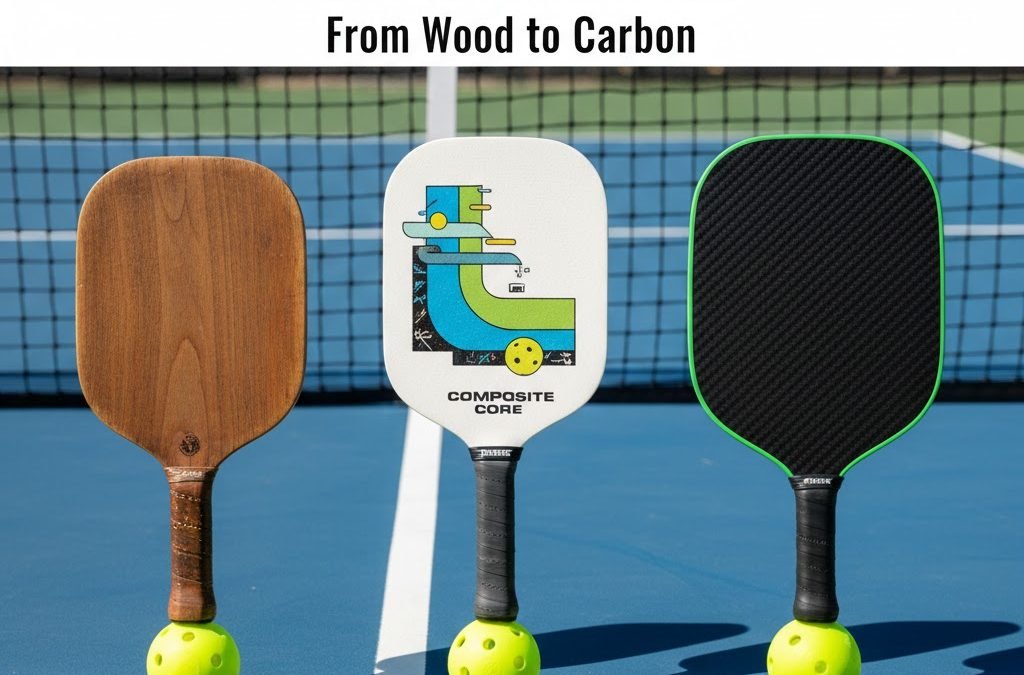
Pickleball paddles have evolved from simple wooden boards to advanced carbon fiber designs. Early wooden paddles were heavy, rigid, and offered a small sweet spot, limiting control and power. Over time, manufacturers introduced composite paddles with polymer cores and fiberglass faces, reducing weight and improving responsiveness. Today, carbon fiber paddles dominate the market, providing superior stiffness, lighter weight, larger sweet spots, and enhanced control—transforming both player performance and paddle manufacturing standards.
1. The Early Days: Wooden Pickleball Paddles
In the beginning, pickleball paddles were simple and made from wood. The sport itself was invented in 1965 on Bainbridge Island, Washington.
One of the earliest paddles was developed by Barney McCallum in his basement using plywood. These wooden paddles weighed around 13 ounces (≈ 369 g) and were comparatively heavy by modern standards.
Advantages of wooden paddles
Low cost to produce (wood is readily available)
Durable and robust (less fragile)
Familiar construction, easy to prototype
Disadvantages of wooden paddles
Heavy weight, limiting swing speed and control
Narrow sweet spot
Less forgiving on mishits
Poor power-to-weight ratio
Difficulty in customizing shape or surface texture
Because of those drawbacks, performance-oriented players and innovators began to search for better materials as the game matured.
2. The Rise of Composite Materials: Fiberglass and Polymer Cores
As pickleball gained traction in the 1980s and 1990s, manufacturers began experimenting with composite materials. The paradigm shifted from solid wood to paddles that used a polymer honeycomb core with composite face layers (often fiberglass).
These designs fundamentally improved paddle performance. The typical structure became:
Core: polypropylene (PP) honeycomb or polymer core
Faces (both sides): fiberglass, sometimes with thin overlays
Edge guard / frame: to protect core edges
This design allowed paddles to be lighter, more responsive, and better balanced than solid wood. Some of these composite paddles were introduced in the 1990s.
Performance improvements
Lower mass → faster swing speed
Better control and feel due to vibration damping
More control over shape, thickness, face texturing
Larger sweet spot, because the core + face structure can flex beneficially
A rough comparative table helps show how wooden vs composite designs stack up:
| Feature | Wooden Paddle | Composite (Fiberglass + Poly Core) |
|---|---|---|
| Typical Weight | ~11–14 oz (≈ 311–397 g) | ~7–9 oz (≈ 198–255 g) |
| Sweet Spot | Small, rigid | Larger and more forgiving |
| Power-to-Weight | Low | Much improved |
| Durability | Good (solid) | Depends on core sealing & face adhesion |
| Customizable Shapes/Textures | Limited | High flexibility |
Because of these gains, composite paddles gradually became the mainstream choice for mid- to high-level players, and many brands adopted this technology.
3. The Carbon Fiber Revolution: Performance Meets Precision
In recent years, the paddle market has shifted further toward carbon fiber (graphite / raw carbon) faces over composite alternatives. Carbon fiber offers a better stiffness-to-weight ratio, more precise energy transfer, and finer control over blade behavior.
Why carbon fiber?
Higher stiffness per unit mass than fiberglass
Better responsiveness and “pop”
Stronger structural integrity (less flex where undesired)
More consistent performance across high-volume production
Many high-end paddles now use T700 carbon, 3K / 18K carbon weave, or hybrid carbon-fiberglass blends. Some manufacturers use raw carbon (uncoated carbon weave) which allows tactile feel and thinner paint, sometimes yielding better control.
Carbon fiber paddles are often manufactured via thermoforming or cold-pressing techniques to bind the carbon skins with the core material under high pressure and temperature.
Comparisons of modern paddle faces:
| Feature | Fiberglass Face | Carbon Fiber Face |
|---|---|---|
| Stiffness / Rigidity | Moderate | High |
| Weight impact | Slightly heavier | Usually lighter or same |
| Energy return (pop) | Good | Superior |
| Vibration damping | Good | Needs design tweaks (dampeners) |
| Cost | Lower | Higher |
| Durability under impact | Adequate | Better in most cases |
Today’s high-performance paddles often incorporate carbon face + polymer core or carbon face + foam core, combining stiffness, weight savings, and shock absorption.
4. Modern Innovations: Core Thickness, Pressing Techniques, and Structural Design
Beyond the face material, paddle performance depends heavily on core thickness, pressing technique, and internal structural design.
Core Thickness Evolution
Modern paddles often fall in thickness between 13 mm to 19 mm. Thicker cores tend to enhance power and forgiveness, thinner cores better for touch and control. Many OEMs now offer customization in thickness (e.g. 13 mm, 16 mm, 19 mm) depending on player preference.
Pressing Techniques
Cold-pressed (low temperature, high pressure): reduces internal stress and yields more consistent geometry and “sweet spot” feel
Thermoforming / hot press: uses heat and pressure to meld carbon faces to cores, common in many high-end paddles
Vacuum bag + resin infusion: used in advanced composite manufacturing
Choice of pressing method can influence paddle flatness, internal adhesion, warpage, and consistency across units.
Core + Face Structural Design
Innovations include:
Multi-layer carbon + fiberglass hybrid faces
Internal ribs or stringers for stiffness
Surface textures (e.g. micro grooves, “spin” texture)
Edge guard / bumper innovations to protect face edges
Optimized weight distribution (e.g. adding mass to the handle or edge)
A comparative table summarizing a few paddle design variables:
| Variable | Typical Range / Options | Impact on Performance |
|---|---|---|
| Core Thickness | 13 mm, 16 mm, 19 mm | Thicker = more power & forgiveness; Thinner = more touch |
| Press Method | Cold-pressed, Thermoformed | Cold-pressed often yields better consistency |
| Face Material | Fiberglass, Carbon, Hybrid | Carbon offers more stiffness / pop |
| Texture / Grooves | Smooth, Micro-groove, Sanded | Impacts spin, control |
| Weight (Total) | 7–9 oz (≈ 198–255 g) | Lower weight = faster swing speed, but less mass behind shots |
If your factory can offer cold-pressed carbon paddle with a 16 mm PU core and custom texture, that is a strong selling point for discerning brands.
5. What the Future Holds: Sustainable and Smart Materials
As the pickleball market matures, new trends and material innovations are emerging. Some of the directions include:
Sustainable / Eco-Friendly Materials
Bio-based resins and recyclable composite materials
Natural fiber composites (e.g. flax, hemp) in combination with carbon
Reducing waste in manufacturing and lightweighting
Smart / Adaptive Materials
Embedded sensors for tracking shot speed, vibration
Hybrid materials that adapt stiffness or damping
AI-optimized blade geometries to maximize sweet spot
Market Projections
The global pickleball equipment market is projected to reach USD 9.1 billion by 2034, rising from USD 2.2 billion in 2024, with a CAGR of 15.3%
In the U.S., pickleball participation grew 51.8% from 2022 to 2023, and has increased over 223.5% in three years
In 2024, there were 19.8 million pickleball participants in the U.S., representing a 45.8% year-over-year growth
These trends suggest strong demand for premium and innovative paddle designs, particularly in developed markets.
6. Choosing Your Next Paddle Manufacturer
For brand owners, distributors, or OEM buyers, selecting the right paddle factory is crucial. Here are key evaluation criteria and questions you should ask:
Key Criteria & Questions
| Aspect | What to Verify | Why It Matters |
|---|---|---|
| Material Expertise | Can they work with carbon, fiberglass, raw carbon skins? | Not all factories have experience with advanced materials |
| Pressing Capability | Do they support cold-press, thermoforming, vacuum infusion? | Ensures consistent quality and yields |
| Custom Thickness / Design | Can they produce 13/16/19 mm, custom face textures, internal ribs? | Flexibility is essential to differentiate your brand |
| QC & Consistency | What is their rejection rate? Do they measure face flatness, weight variance? | Ensures your consumers get consistent quality |
| Minimum Order Quantity (MOQ) | What is their MOQ per model? | Smaller brands may need lower MOQs |
| Lead Time & Logistics | What are their lead times for prototypes / mass production? | Delays can harm market entry timing |
| Intellectual Property (IP) & Tooling | Do they protect your design, do you own molds or jigs? | Prevents design leakage and preserves your brand IP |
7. Conclusion
The evolution from wood to modern carbon-fiber pistols (paddles) reflects how technological progress has driven performance improvements in pickleball. Originally, wooden paddles served the hobbyist era well, but they lacked the sophistication, weight savings, and responsiveness that modern players demand.
Composite paddles (polymer core + fiberglass face) brought a massive leap in weight reduction, feel, and customization. Then carbon fiber technology raised the bar further, enabling stiffer, lighter, and more precise paddles. Today’s innovations in core design, pressing techniques, and smart materials suggest that the paddle is still an area of active growth and differentiation.
Recent Comments