
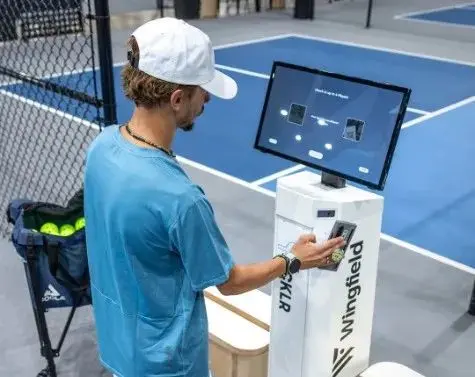
Artificial intelligence (AI) has permeated nearly every industry, from healthcare to entertainment. Now, it’s making waves in the world of sports—and pickleball, America’s fastest-growing pastime, is no exception. While AI’s role in sports often conjures images of robot athletes or automated referees, its current application in pickleball is far more practical—and transformative.
The Picklr, a leading name in pickleball facilities, has partnered with German tech company Wingfield to integrate AI-driven analytics into the sport. This collaboration marks a pivotal shift in how players train, compete, and improve. But what does this mean for the future of pickleball?
Wingfield initially made its mark in tennis, developing cutting-edge software to analyze player performance through video tracking, stroke analysis, and interactive training tools. Now, the company has pivoted to pickleball, leveraging its expertise to address the unique demands of the sport.
At the heart of this innovation is a specialized AI-powered machine installed at select Picklr facilities. The device uses cameras and sensors to track every aspect of gameplay, from ball speed and trajectory to shot placement and grip technique. “It’s not just about recording matches,” explains Austin Wood, co-founder and Chief Visionary Officer of The Picklr. “This system provides actionable insights that players and coaches can use to refine strategies and accelerate skill development.”

How AI Enhances Player Performance
For pickleball enthusiasts, the real value lies in the data. Wingfield’s software generates comprehensive reports detailing:
Shot Accuracy: Percentage of shots landing in optimal zones.
Ball Dynamics: Speed, spin, and height analysis.
Movement Patterns: Player positioning and court coverage.
Skill Benchmarks: Comparisons against skill levels (e.g., DUPR ratings).
“Imagine having a digital coach that identifies weaknesses you didn’t even know existed,” says Wood. “AI doesn’t replace human intuition—it enhances it.” Players can review their performance post-match, share clips with coaches, or even create highlight reels for social media.
Resolving Conflicts and Elevating Fair Play
One unexpected benefit of AI integration is its potential to reduce on-court disputes. By recording matches and analyzing line calls, the system offers an objective perspective on contentious plays. This feature is particularly valuable in recreational leagues and tournaments where referees aren’t always present.
Additionally, the technology enables players to simulate professional scenarios. For example, a beginner can study how elite athletes handle specific shots or positioning, bridging the gap between amateur and pro-level play.
The Picklr’s Vision: Democratizing Advanced Training
Historically, advanced performance analytics were reserved for elite athletes with access to expensive coaching. The Picklr-Wingfield partnership aims to democratize this resource. “Our goal is to make high-level training accessible to everyone,” Wood emphasizes.
Members at AI-equipped Picklr locations can store their match data in Wingfield’s cloud-based platform, tracking progress over time. Coaches use this information to tailor lessons, while players gain clarity on areas needing improvement. Early adopters have reported measurable gains in their DUPR scores, a standardized rating system for pickleball.
Challenges and Future Prospects
While the technology is promising, its adoption isn’t without hurdles. Only three Picklr facilities currently offer AI integration, primarily due to the cost of hardware and software development. However, Wood remains optimistic: “This is just the beginning. As the system evolves, we’ll see more clubs adopting AI to stay competitive.”
Looking ahead, potential advancements could include real-time feedback via wearable devices or AI-generated training regimens. There’s even speculation about AI-assisted tournament scheduling or dynamic court reservations based on player skill levels.
Conclusion: AI’s Role in Shaping Pickleball’s Future
The fusion of AI and pickleball isn’t about replacing human elements—it’s about amplifying them. By providing data-driven insights, resolving disputes, and making elite training accessible, AI is poised to elevate the sport to unprecedented heights.
As Wood aptly states, “This isn’t a gimmick. It’s a tool that will redefine how we play, learn, and grow in pickleball.” For players and facilities alike, embracing this technology could mean the difference between staying stagnant and soaring to new levels of excellence.
Recent Comments