Pickleball’s popularity is booming in the U.S. and worldwide. To ensure fair play, the USA Pickleball Association (USAPA) sets official paddle standards covering size, weight, surface, noise, and bounce.
For brands, manufacturers, and tournament players, understanding these standards—including the PBCOR limit of 0.43, certification process, and costs—is essential. This article explains the standards, common misconceptions, and how OEMs can ensure compliance.
II. What Are USAPA Paddle Standards?
USAPA paddle standards define the specifications that any competitive paddle must meet. These standards cover physical dimensions, weight, surface properties, noise limits, and rebound behavior. By adhering to these standards, players are guaranteed consistent performance, while manufacturers gain credibility and access to tournament markets.
For more details, refer to the official USA Pickleball Equipment Standards.
Core USAPA paddle parameters:
| Standard Category | Technical Requirement | Description |
|---|---|---|
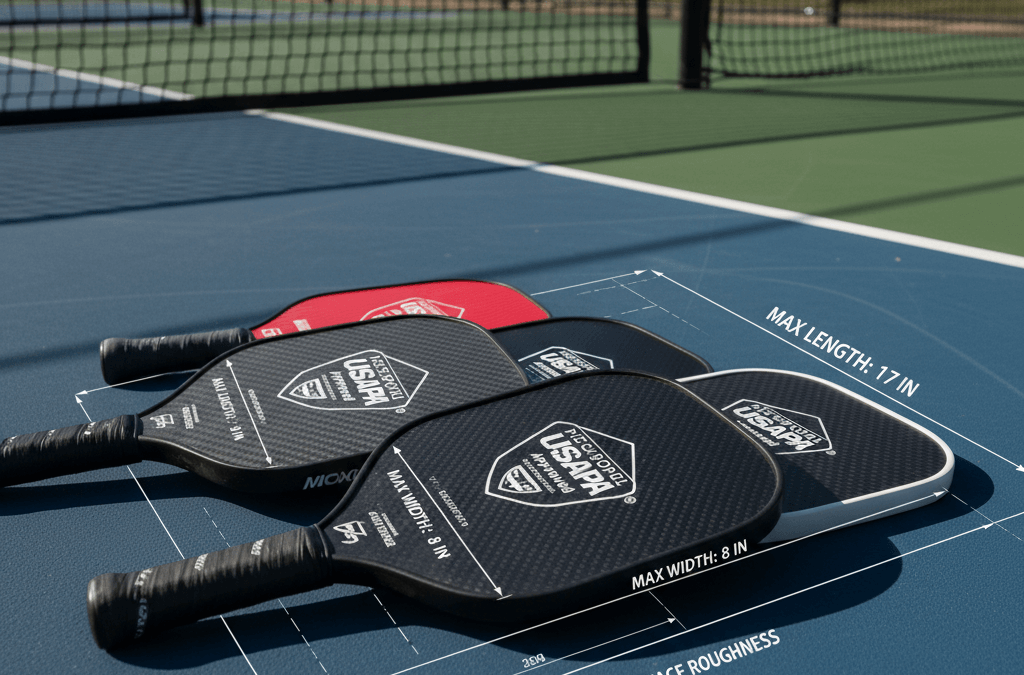
| Paddle Length | ≤ 17 inches | Combined length + width ≤ 24 inches |
| Paddle Weight | No fixed limit | Typically 7.0–8.5 oz |
| Surface Roughness | ≤ 30 µm RMS | Ensures controlled spin |
| Reflectivity | Not highly reflective | Prevents mirror-like finish |
| PBCOR (Rebound Coefficient) | ≤ 0.43 | Limits excessive bounce |
| Noise Level | ≤ 85 dB | Ensures community safety during play |
Adhering to these standards guarantees that paddles provide a fair and consistent playing experience for all participants.
III. Understanding the PBCOR ≤ 0.43 Requirement
One of the most critical standards is the PBCOR, or Pickleball Coefficient of Restitution. This metric measures how much the ball rebounds off the paddle compared to its incoming speed. In simple terms, it indicates how “bouncy” a paddle is.
USAPA specifies that a paddle must have a PBCOR ≤ 0.43 to pass certification. A higher PBCOR gives a player an unfair advantage because the ball rebounds faster, making shots harder to predict. Testing involves high-speed cameras and sensors that measure the ball’s velocity before and after impact.
Typical PBCOR values by paddle type:
| Paddle Type | Material | Typical PBCOR | USAPA Result |
|---|---|---|---|
| Fiberglass + PP Core | Glass Fiber | 0.38–0.41 | ✅ Pass |
| Raw Carbon (T700) | Carbon Fiber | 0.40–0.42 | ✅ Pass |
| Kevlar/Graphite Hybrid | EVA Foam | 0.43–0.45 | ❌ Fail |
For manufacturers, controlling PBCOR is vital. Materials like carbon fiber and honeycomb cores can easily exceed 0.43 if not properly engineered. Factory pre-testing helps ensure paddles pass certification on the first attempt.
IV. How USAPA Tests and Approves Paddles
Sample Submission:
Brands or OEM manufacturers prepare paddle samples, typically 12 units per model.
Samples must be representative of the final production version, including all materials, surface coatings, and core structure.
Manufacturers submit samples along with an application form and technical specifications to USAPA-approved labs.
Laboratory Testing:
Dimensional Measurement: Length, width, and thickness are measured using precision calipers and gauges to ensure the paddle does not exceed 17 inches in length or a combined length + width of 24 inches.
Weight Verification: Paddles are weighed using calibrated digital scales.
Surface Roughness: Measured with a surface profilometer to confirm ≤30 µm RMS, ensuring consistent spin control and compliance.
PBCOR (Rebound Test): High-speed cameras and velocity sensors measure the ball’s speed before and after impact to calculate the rebound coefficient. Paddles must achieve PBCOR ≤ 0.43.
Noise Test: Sound meters measure impact noise to ensure ≤85 dB.
USAPA Review:
The laboratory submits a detailed test report to USAPA.
USAPA verifies that all specifications comply with official paddle standards. Any non-compliance must be corrected before approval.
If necessary, USAPA may request additional samples or clarification on manufacturing methods.
Listing on the Approved Paddle List:
Once all criteria are met, the paddle is officially listed on the USAPA Approved Paddle List.
This listing allows the paddle to be used in official tournaments and gives the brand recognition in competitive markets.
Paddles remain on the approved list as long as design or material changes are documented and re-approved annually.
By following this process, brands and manufacturers ensure that their paddles are compliant, tournament-eligible, and trusted by players worldwide. Additionally, pre-testing during production can help identify potential compliance issues early, reducing the risk of failure and costly re-testing.
V. USAPA Certification Cost and Timeframe
USAPA certification involves both administrative and laboratory fees. Below is an estimated breakdown based on current industry practices:
| Cost Item | Estimated Fee (USD) | Description |
|---|---|---|
| Application Fee | $200–$350 per model | Paid to USA Pickleball for review |
| Lab Testing Fee | $150–$300 | Includes PBCOR, size, surface, and noise testing |
| Annual Renewal Fee | $50–$100 | Required to maintain listing |
| Sample Shipping | $30–$50 | Manufacturer covers shipping |
Timeframe: The certification process generally takes 4–6 weeks from sample submission to approval. OEMs can submit samples on behalf of brands to streamline the process.
VI. Requirements for Passing USAPA Certification
To pass certification, a paddle must meet the following technical criteria:
| Test Item | Requirement | Test Method |
|---|---|---|
| Paddle Size | ≤17 in, length + width ≤24 in | Caliper measurement |
| Weight | Within reasonable range | Precision scale |
| Surface Roughness | ≤30 µm RMS | Surface roughness tester |
| PBCOR | ≤0.43 | High-speed rebound test |
| Noise Level | ≤85 dB | Decibel meter |
| Reflectivity | Not mirror-like | Visual inspection |
If any criterion fails, the paddle will not be approved. Pre-testing during manufacturing significantly reduces the risk of failure.
VII. Why USAPA Standards Are Important
For Players:
Ensures a fair competitive environment.
Prevents “overly bouncy” paddles from giving an unfair advantage.
For Brands:
USAPA certification signals quality and credibility.
Certified paddles can be sold for tournament play.
For OEM Manufacturers:
Ensures paddles meet regulatory and competitive standards.
Early compliance reduces certification failures and costs.
VIII. How Manufacturers Ensure Compliance
Manufacturers implement quality control measures to comply with USAPA standards:
Surface Roughness Control: Ensures ≤30 µm to prevent unfair spin.
PBCOR Pre-Testing: Monitors rebound behavior ≤0.43 before sending samples to labs.
Quality Manufacturing: Maintains structural stability, minimizing stress and warping.
Precision CNC Molds: Keeps paddle dimensions within tolerance.
Noise Testing: Ensures impact noise ≤85 dB.
LIXI Sports Advantage:
Uses cold/hot pressing and T700 raw carbon for stability.
Offers internal PBCOR testing for OEM clients.
Supports USAPA sample submission.
Produces paddles with 13mm–16mm honeycomb cores compliant with all standards.
IX. Common Misconceptions About USAPA Certification
| Misconception | Clarification |
|---|
| Only paddle size matters | PBCOR and surface roughness are equally critical. A paddle can meet size requirements but still fail certification if PBCOR exceeds 0.43 or roughness exceeds 30 µm. |
| OEM factories cannot apply | Manufacturers can submit samples on behalf of brands. But the approval is done under the name of the”brand owner” not the factory. |
| Certification only needs to be done once | USAPA approval requires annual updates. Paddles must remain on the approved list to maintain tournament eligibility. |
| All players must use USAPA-certified paddles | Certification is only required for official tournament play. Recreational players may use non-certified paddles. |
X. FAQ Section
Q1: What is the maximum PBCOR allowed by USAPA?
A1: 0.43 or lower. Paddles exceeding this limit will fail certification.
Q2: How much does it cost to certify a pickleball paddle?
A2: Typically $200–$350 for application, plus $150–$300 for lab testing. Annual renewal costs $50–$100.
Q3: How long does USAPA approval take?
A3: Generally 4–6 weeks from sample submission to approval.
Q4: Can OEM manufacturers submit for approval?
A4: Yes. OEMs can submit on behalf of brands, including pre-certification preparation and testing.
XI. Conclusion
USAPA certification ensures fair play and establishes a paddle’s credibility in the competitive pickleball market. The PBCOR ≤ 0.43 limit is a critical factor in certification, alongside paddle dimensions, surface roughness, and noise. Brands and OEM manufacturers that plan ahead by monitoring these parameters can significantly reduce the risk of certification failure.
For OEM manufacturers, controlling PBCOR, surface roughness, and dimensions during production ensures compliance and supports smooth approval.
Recent Comments