
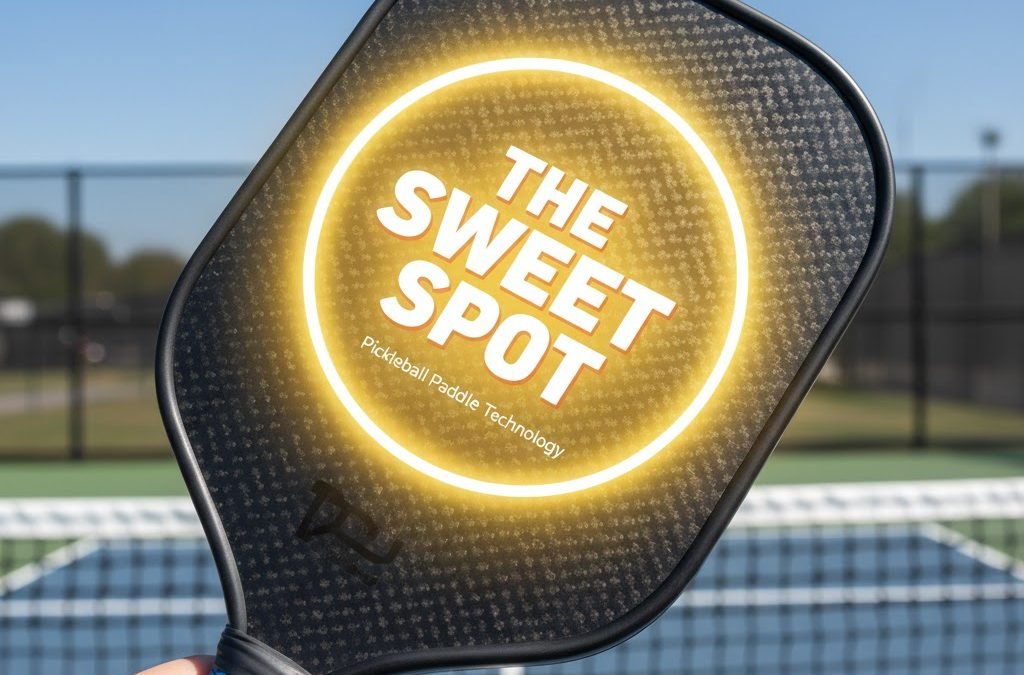
When you hit a ball with a paddle, the location you contact it determines how much energy transfers, how much vibration you feel, and how consistent your shot will be. That ideal impact area is called the sweet spot. A paddle with a well-designed sweet spot gives you more power, better control and fewer mis-hits.
II. What Is a Sweet Spot in Pickleball Paddles?
The sweet spot is the region on the paddle face where ball impact produces the greatest energy transfer, minimal vibration and optimal shot outcome. In physics terms this often corresponds to the “center of percussion” (cp) of the paddle system. On a given paddle, the effective sweet spot depends on how the mass is distributed, how the paddle flexes, and how the user holds it. While many players refer to the geometric centre, in fact the true sweet spot may be slightly off-centre depending on the paddle’s design and balance.
III. Why the Sweet Spot Matters
The sweet spot affects performance in four key ways:
Power: Striking within the sweet spot means more of your swing energy goes into the ball rather than being absorbed by vibration or flex.
Control: With less unpredictable flex or after-shock vibration, the shot outcome is more consistent and easier to place.
Comfort / injury prevention: Off-centre hits transmit more shock to the arm. A large usable sweet-spot reduces chances of fatigue or strain.
Forgiveness: Especially for recreational or beginner players, a larger sweet spot means more margin for error. According to analysis by Players Pickleball, beginner-friendly paddles emphasise a wide sweet spot to reduce the rate of mishits.
Thus, for players and for paddle manufacturers alike, maximising and optimising the sweet spot is a key design and marketing differentiator.
IV. Key Factors That Influence the Sweet Spot Size and Location
Here are the four major factors that influence how big and how effective the sweet spot is on a pickleball paddle: paddle face shape & size; weight distribution & balance; core material & structure; face material & surface properties.
1. Paddle Face Shape and Size
The size and shape of the paddle face are very direct influences on the sweet-spot region.
Wide-body paddles (where the paddle face has expanded wings on each side of the handle) provide increased surface area and tend to produce a larger usable sweet-spot region.
Uniform-width (or equal-width) paddle faces—i.e., the width remains consistent from near the top to near the handle—generally produce the largest sweet spot, located slightly higher on the face, and provide high forgiveness.
Elongated faces (narrower width but longer length) tend to have a sweet spot that is narrower and placed higher up the face—which demands more precision in contact.
In summary: if you want a paddle whose sweet spot is large and forgiving, pick a wide or uniform-width face. If reach or specialty shots are more important, you may accept a narrower sweet-spot.
2. Weight Distribution & Balance Point
Where the mass of the paddle lies and how it is balanced influences how large and how accessible the sweet spot is.
Head-heavy paddles (more mass towards the paddle-head) deliver more power but may reduce perceived forgiveness (the sweet-spot zone feels narrower).
Head-light paddles (mass shifted toward the handle) increase maneuverability, often giving a more comfortable sweet-spot region for volleying and net play.
Even-balance paddles attempt a middle ground where the sweet-spot is more centrally located and usable for multiple shot types.
Scientific modelling shows that the location of the center of percussion (sweet spot) depends on mass moment of inertia and weight rather than simply the geometry of the face.
Thus by strategic weight placement (in the handle, face, or perimeter), manufacturers can influence how wide and how usable the sweet‐spot region is.
3. Core Material and Structure
The material and internal structure of the paddle (its core) determine stiffness, vibration damping, rebound responsiveness and thus sweet‐spot behaviour.
Polymer (e.g., polypropylene honeycomb) cores are common and provide a balanced mix of flexibility and responsiveness. They support a wide usable sweet-spot by absorbing some vibration and making the paddle more forgiving.
Foam or EPP cores may offer softer feel but sometimes at expense of rebound responsiveness and may reduce perceived sweet-spot size. (While specific comparative data is limited for pickleball, product reviewers note differences.)
Stiffer cores (e.g., Nomex, aluminium or hybrid cores) provide faster rebound but often reduce margin for off-centre hits and thus the effective sweet-spot region may be narrower.
Also, thickness of the core matters: a thicker core (e.g., 16 mm vs 13 mm) tends to damp vibration more and thus broadens the “usable” sweet-spot zone.
4. Face Material & Surface Properties
The paddle face material (carbon fibre, fibreglass, composite hybrids) and surface texture (grit, sanded finish) influence sweet-spot performance.
Carbon fibre faces (especially high-grade such as T700) give uniform stiffness across the face, which helps maintain a consistent sweet-spot region.
Fibreglass or composite faces may offer higher rebound but may deliver less uniform behaviour across the face, reducing forgiveness for off-centre hits.
Surface texture (grit) primarily affects spin, but also how well the ball engages the paddle face at the sweet spot. A rough face in the sweet zone offers enhanced spin and control; off the sweet spot the spin and feel drop more noticeably.
Thus, combining a uniform face material and consistent surface finish helps enlarge the functional sweet-spot for real-world play.
V. How to Find the Sweet Spot on Your Paddle
Knowing about the sweet spot is one thing; locating it and using it is another. Here are practical methods:
Tap the paddle face at various points: a “solid” contact (minimal vibration, good rebound) likely indicates the sweet-spot zone.
Bounce-test: drop a ball or lightly hit the face at different zones—where rebound velocity is highest and feel is most “comfortable” is likely near the sweet‐spot.
Use a “sweet-spot training paddle” (with a smaller hitting zone) to improve precision and awareness of contact point. These are especially useful for beginners and intermediates.
Mark the paddle face (e.g., with tape or chalk) your best-feel contact zone after playing, then aim your strokes to hit within that zone more consistently.
If you are a manufacturer or tester: use vibration sensors or high-speed impact testing to map the low-vibration/ high-rebound zone across the face (lab testing). For example, robotic testing on racquets shows the zone of minimal vibration corresponds to sweet-spot.
By routinely practising hitting the sweet spot and choosing a paddle whose sweet-spot aligns with your shots, you improve your consistency, reduce mis-hits and enhance comfort.
VI. How Manufacturers Optimize the Sweet Spot
From the perspective of a factory or brand building paddles, here is how to specifically optimise the sweet-spot in design and manufacturing:
Design face geometry for area and shape – Choose wide-body or uniform width designs if targeting high forgiveness segments; ensure the width/length dimensions give a large flat impact region.
Adjust weight distribution and balance point – Fine-tune handle length, internal weight (foil, edge strips, inserts) to shift the balance point to head-light or even-balance for maximum usable sweet-spot for beginners; or head-heavy for advanced power paddles (accepting narrower sweet-spot).
Select core material and thickness – Use a polymer honeycomb core (e.g., 16 mm thickness) for broad usability; for performance/elite paddles consider stiffer cores but refine other variables to maintain sweet-spot usability.
Choose face material and surface processing – Use high-grade carbon fibre (e.g., T700) or consistent composites to create uniform stiffness; apply consistent surface texture (grit) to maximise ball engagement throughout the sweet-spot region.
Edge and perimeter engineering – Incorporate perimeter reinforcement or weighted edges to reduce vibration from off-centre hits and expand the usable sweet-spot zone (i.e., shots near but outside the ideal zone still behave well).
Prototype testing and validation – Use vibration analysis, impact mapping, rebound testing and mass moment of inertia calculations (e.g., using the formula from rigid-body dynamics) to identify the center of percussion and measure how wide the effective sweet-spot zone is.
Quality control and consistency – Ensuring production tolerances (core bonding, face lamination uniformity, edge guard placement) remain tight so that sweet-spot performance is consistent across units—not just in prototype but in production runs.
VII. How to Choose a Paddle Based on Sweet Spot Needs
Here’s actionable advice:
Beginners / high-forgiveness seekers: Choose a paddle with a uniform width or wide-body face, polymer core (PP/honeycomb), and an even or head-light balance point. These give the largest and most forgiving sweet-spot.
Intermediate / seeking more power: Choose a paddle with a little more head-weight or slightly narrower sweet-spot, stiffer core (carbon, thinner core) but still consider shape and face uniformity to maintain usable forgiveness.
Control-oriented / touch players: Choose head-light or even-balanced paddle, possibly with a textured carbon face, moderate sweet-spot size but very consistent feel and maximised control for net play.
In one summary: if you want the largest, most tolerant sweet-spot, go for uniform-width design + even or head-light balance + polymer core + carbon face. If you prioritise power and are confident in your technique, you may accept a smaller sweet-spot in exchange for speed or spin.
VIII. Conclusion: Designing for the Perfect Sweet Spot
The sweet spot is not just a “marketing term” — it is a measurable, design-driven zone of optimal impact that depends on geometry, weight distribution, materials and manufacturing precision. From a player’s standpoint, hitting consistently in that zone means more power, better control, fewer mis-hits and less fatigue. From a factory or brand standpoint, optimising the sweet spot offers a real competitive advantage and design story.
If you’re manufacturing paddles, emphasise how you engineer the sweet-spot: the face shape, balance point, core thickness, surface material, edge reinforcement and quality control all matter. When you communicate that level of technical credibility on your website/blog, you build trust with brands, retailers and end-users.
For players shopping for a paddle, choose according to your skill level and style: more forgiveness if you’re developing, more precision/power if you’re experienced. And remember: a good sweet-spot design means you spend less time compensating
Recent Comments