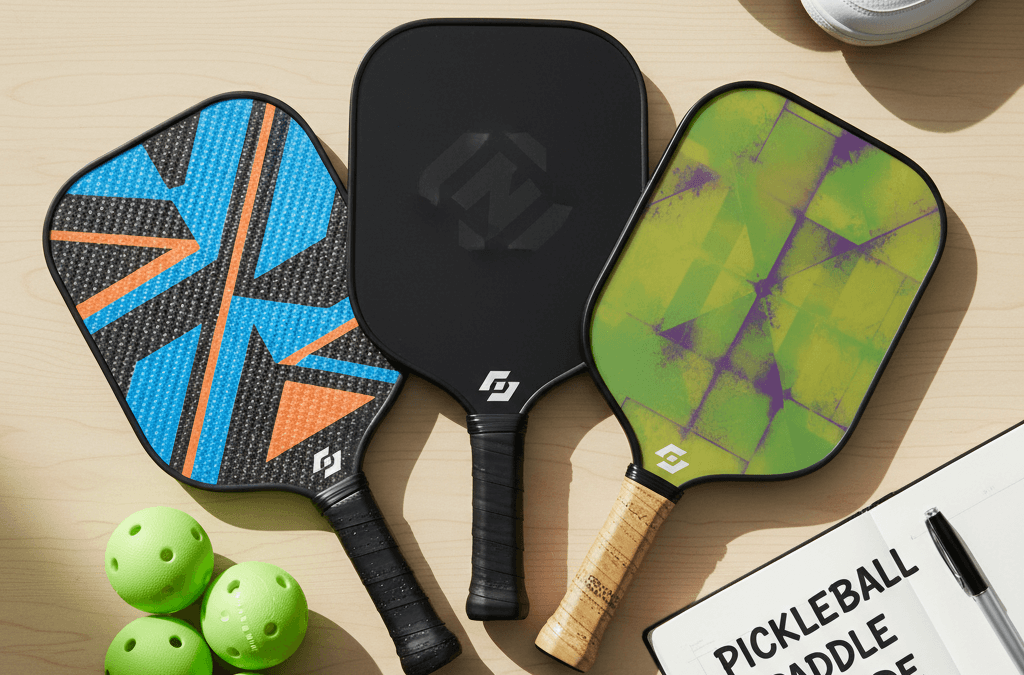
A high-quality pickleball paddle is characterized by its ability to balance control, power, comfort, and durability. Key factors influencing paddle performance include:
Surface Material: Affects spin, control, and durability.
Core Structure: Influences power, feel, and noise.
Weight and Balance: Determines swing speed and fatigue.
Handle Length and Grip: Impacts comfort and technique.
Manufacturing Quality: Ensures consistency and longevity.
II. Paddle Surface Materials: From Fiberglass to Advanced Raw Carbon
The paddle surface significantly influences control, spin, and durability. Common materials include:
1. Fiberglass
Ideal for: Beginners.
Characteristics: Affordable, easy to manufacture, provides good power but slightly less control.
Manufacturing Process: Typically cold-pressed.
2. Carbon Fiber
Ideal for: Intermediate players.
Characteristics: Offers better control and lighter weight.
Manufacturing Process: Can be cold-pressed or hot-pressed.
3. T700 Raw Carbon
Ideal for: Advanced players.
Characteristics: High friction surface increases spin; durable and lightweight.
Manufacturing Process: Often hot-pressed to enhance structural stability.
Note: Surface roughness should not exceed the paddle core’s critical value of 0.43 to maintain compliance with USAPA standards.
4. 3K / 12K / 18K Carbon Fiber
3K Carbon: Slightly rough, more forgiving for control.
12K Carbon: Medium density, balanced control and power.
18K Carbon: Soft touch, best for power-focused advanced players.
Table 1: Paddle Surface Comparison
| Material Type | Control | Power | Durability | Texture | Market Usage |
|---|---|---|---|---|---|
| Fiberglass | ★★★ | ★★★★ | ★★★ | Smooth | Medium |
| T700 Raw Carbon | ★★★★★ | ★★★ | ★★★★ | Rough | Very High |
| 3K Carbon | ★★★★ | ★★★ | ★★★★ | Slightly rough | High |
| 12K Carbon | ★★★ | ★★★★ | ★★★★ | Medium rough | Medium |
| 18K Carbon | ★★ | ★★★★★ | ★★★ | Soft touch | Niche |
III. Core Thickness and Material: The Hidden Engine of Paddle Performance
The core of a paddle determines its power, control, and feel. Thickness and material choice are crucial.
1. Thickness
13mm Core: More power, slightly less control.
16mm Core: Better control, slightly less power.
2. Core Materials
PP Core (Polypropylene Honeycomb): Mainstream choice in the market; light, stable, and quiet.
EPP Core (Expanded Polypropylene): Softer and more flexible; provides longer dwell time on the ball; offers better control but less power.
Table 2: Core Material Comparison
| Core Type | Feel | Control | Power | Noise | Durability |
|---|---|---|---|---|---|
| PP Core | Firm | ★★★★ | ★★★★ | Louder | ★★★★ |
| EPP Core | Soft | ★★★★★ | ★★★ | Quiet | ★★★★ |
IV. Weight and Balance: How It Affects Your Performance
Paddle weight impacts swing speed, control, and fatigue:
Light paddles (7.2–7.6 oz): Easier to control, reduce fatigue, ideal for defensive or technical play.
Heavy paddles (8.0–8.5 oz): Provide more power but can tire the arm faster.
Balance: Head-heavy paddles provide extra momentum, while evenly balanced paddles give more maneuverability.
V. Handle Length and Grip Comfort
Long Handle (around 7.3 inches): Best for two-handed shots and better leverage.
Short Handle: Offers faster wrist movements, good for quick reactions.
PU Grip Wrapping: Improves comfort, reduces slip, and minimizes fatigue.
Proper handle design is essential to prevent injuries and maintain consistent performance.
VI. Sweet Spot and Paddle Face Design
Most paddles have rectangular faces, and sweet spot design depends on:
Face Size and Width: Larger faces offer a bigger sweet spot.
Core Structure: Honeycomb density and uniformity.
Surface Tension: Higher friction increases effective sweet spot area.
A well-designed sweet spot reduces mishits and improves ball control.
VII. Quality Indicators for Brands
1. Hot Press vs Cold Press
Hot Press: Increases structural stability and improves durability.
Cold Press: Simpler process but may result in less consistent bonding.
2. PP cell Core Options
Size: 8mm, 10mm.
Colors: Black, White, and custom options.
Density and Compression: Can be tailored for power or control.
3. Additional Quality Indicators
Surface Adhesion Precision: Ensures durability of the paddle face.
Weight Consistency and Balance Testing: Maintains uniform performance across units.
UV Print and Scratch-Resistance Inspection: Preserves aesthetic quality.
VIII. How to Choose the Right Paddle for Your Play Style
| Player Level | Recommended Surface | Core | Thickness | Notes |
|---|---|---|---|---|
| Beginner | Fiberglass | PP | 13mm | More power, forgiving |
| Intermediate | Raw Carbon | PP | 16mm | Balanced control |
| Advanced | T700 / Kevlar | PP | 16mm | Max control and spin |
IX. Why Choosing the Right OEM Manufacturer Matters
Partnering with a reliable OEM ensures:
Consistent Quality: Across all units.
Customization Options: Surface material, PPcell core, thickness, color.
Packaging and Logistics Support: For brand delivery.
Access to Professional Craftsmanship: Supports brand reputation.
Independent R&D Team: Ensures innovation and quality control.
USAPA Certification: Compliance with official standards.
Frequently Asked Questions (FAQ)
Q1: What makes a good pickleball paddle?
A: A good pickleball paddle balances control, power, and comfort. Key factors include surface material, core structure, weight, handle grip, and manufacturing quality.
Q2: Which paddle surface material is best for beginners?
A: Fiberglass is ideal for beginners because it is affordable, easy to manufacture, and provides good power with a forgiving feel.
Q3: What is the most common core material for pickleball paddles?
A: PP Core (Polypropylene Honeycomb) is the most common choice due to its lightweight, stability, and quiet performance.
Q4: How does paddle weight affect performance?
A: Lighter paddles (7.2–7.6 oz) provide easier control and reduce fatigue, while heavier paddles (8.0–8.5 oz) offer more power but can tire the arm faster.
Q5: Why is partnering with a certified OEM important?
A: A certified OEM ensures consistent quality, compliance with USAPA standards, access to R&D capabilities, and customizable manufacturing options.
Q6: What is T700 Raw Carbon and why is it used?
A: T700 Raw Carbon is a type of carbon fiber with a rough surface to increase spin and power. Its roughness must remain below the PBcore critical value of 0.43 to maintain compliance with USAPA rules.
Conclusion
A high-quality pickleball paddle is the result of careful material selection, precise core design, proper weight and balance, ergonomic handle construction, and reliable manufacturing practices.
Players benefit from a paddle that matches their skill level and playing style—Fiberglass for beginners, PP or EPP cores for control, and T700 Raw Carbon for advanced spin and power.
OEM brands gain from partnering with factories that provide hot-pressed surfaces, customizable PPcell cores, R&D support, and USAPA-certified testing.
Recent Comments