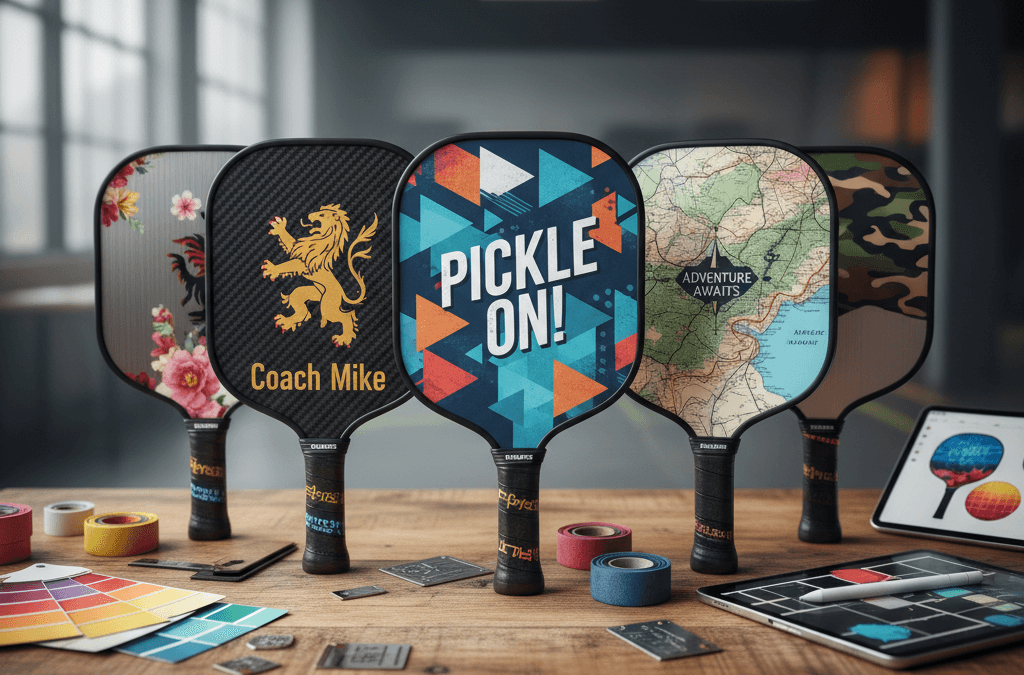
In 2025, OEM and ODM customization have become the core strategies for pickleball paddle brands to stand out in an increasingly competitive market.
Customization allows brands to differentiate through surface materials, cores, handles, edge guards, grip leather, rubber rings, and bottom caps — turning a simple paddle into a signature product.
II. Surface Customization: The Material Defines Performance
| Surface Material | Features | Typical Use | Spin Level | Durability |
|---|---|---|---|---|
| Fiberglass (Glass Fiber) | Softer feel, adds control and power rebound | Cold-pressed paddles | ★★☆ | ★★☆ |
| Carbon Fiber (Standard) | Balanced stiffness and control | Mid-tier to pro paddles | ★★★ | ★★★★ |
| T700 Raw Carbon Fiber | Higher tensile strength, maximum spin | Premium paddles | ★★★★★ | ★★★★★ |
| 3K/12K/18K Carbon Fiber | Textured weave, stable control | Professional level | ★★★★ | ★★★★★ |
Fiberglass is often used in cold-pressed paddles, providing a slightly elastic touch and excellent control. To increase spin, the surface is typically coated with fine particles — improving friction between paddle and ball.
This makes fiberglass a preferred choice for recreational players or brands targeting mid-tier markets.
Carbon fiber, on the other hand, offers more stiffness and responsiveness. The T700 Raw Carbon Fiber is essentially a high-grade type of carbon fiber, known for its natural texture and friction without paint coating.
Raw carbon paddles are favored by competitive players because they generate more spin and have better energy transfer.
Trend Insight (2025): More factories are offering hybrid surfaces—for example, T700 carbon on one side and fiberglass on the other—to fine-tune performance for different play styles.
III. Core Innovation: EPP + EVA vs Traditional PP Honeycomb
The paddle core determines power, control, and sound. Over the past few years, brands have moved from simple polypropylene (PP) honeycomb to more complex combinations such as EPP (expanded polypropylene) and EVA (ethylene-vinyl acetate).
1. Comparison of Core Materials
| Core Type | Structure | Feel | Power | Durability | Typical Use |
|---|---|---|---|---|---|
| PP Honeycomb | Polypropylene honeycomb | Crisp, controlled | ★★★★★ | ★★★★ | Professional, power paddles |
| PP + EVA (Joola Gen3/4) | PP honeycomb with EVA wrap | Firm with bounce recovery | ★★★★★ | ★★★★★ | High-end tournament paddles |
| EPP + EVA | EPP core surrounded by EVA | Softer, stable | ★★★★ | ★★★★★ | All-round paddles |
| EPP Only | Single EPP foam | Light, quiet | ★★★ | ★★★★ | Beginner/intermediate paddles |
The strongest structure remains the PP honeycomb, especially in Joola Gen3 and Gen4 paddles, which combine PP with EVA for enhanced rebound.
The EVA around the PP helps the paddle recover faster after impact, generating more power and consistency.
Next is EPP + EVA, which improves stability and durability while offering a softer touch.
Finally, EPP-only paddles are lightweight and quieter — ideal for players seeking comfort or for training models.
Factory Insight: Many OEM factories are now experimenting with multi-layer EPP + EVA composites to achieve a balance between power and shock absorption, a growing trend in 2025.
IV. Handle and Grip Customization: Comfort Meets Control
The handle defines how a paddle feels in the player’s hand — affecting swing control, comfort, and two-handed performance.
1. Handle Length Options
| Type | Length | Best For |
|---|---|---|
| Standard Handle | ~5 inches | Most players |
| Elongated Handle | 5.5–7.3 inches | Two-handed backhands |
| Short Handle (Widebody) | <5 inches | Quick reaction near the net |
Elongated handles are increasingly popular among tennis-to-pickleball transition players, as they allow for two-handed backhands and better leverage.
Factories can customize handle molds to suit brand preferences or ergonomic designs.
2. PU Leather and Grip Customization
PU leather is now the mainstream choice for its anti-slip surface and high torque resistance.
Top factories, like those in Guangdong, use exclusive PU wrapping techniques that prevent breakage or twisting under torque — a common issue in cheap OEM paddles.
Grip diameter, texture, and color can all be personalized to create a branded look and feel.
V. Edge Guard and Bottom Cap Customization
Edge guards protect the paddle from impact and define its outline aesthetics.
In 2025, customization goes beyond color — factories now allow custom mold shapes, engraving, and mixed materials.
1. Edge Guard Options
| Type | Material | Function |
|---|---|---|
| Standard TPU Edge Guard | Thermoplastic | Shock protection |
| Reinforced Edge Guard | TPU + carbon tape | Enhanced strength |
| Custom Molded Edge | Factory-designed mold | Aesthetic branding |
The bottom cap is another small but powerful branding element. Brands can add laser logos, engraved initials, or rubber logos with color accents.
This level of detail helps paddles look premium, particularly for display and unboxing experiences.
VI. Graphic Printing and Logo Design
A paddle’s visual design is often what captures buyers first.
In 2025, printing technology allows for UV printing, watermarks, and heat transfer graphics — all customizable even in small batches.
| Printing Method | Advantages | MOQ |
|---|---|---|
| UV Printing | High precision, vibrant colors | 100–200 pcs |
| Heat Transfer | Durable, affordable | 300 pcs |
| Watermark Logo | Subtle, premium look | 500 pcs |
OEM Tip: Using UV-printed graphics + T700 raw carbon texture gives a premium aesthetic without sacrificing friction — a strategy many top-tier brands use.
VII. Packaging and Branding Elements
Premium packaging is no longer optional. Brands now invest in custom boxes, paddles covers, hang tags, and instruction cards to elevate their perceived value.
| Packaging Option | Description | Benefit |
|---|---|---|
| Custom EVA Bag | Shaped to fit paddle | High-end retail look |
| Printed Box with Logo | Full-color packaging | Branding consistency |
| Eco Recycled Packaging | Sustainable materials | Environmental marketing |
Insight: According to PaddleMarket Research (2025), paddles with customized packaging have 27% higher perceived value at retail compared to standard OEM white boxes.
VIII. Why Customization Drives Brand Success
In a market where players have endless choices, customization = differentiation.
Brands that design paddles with unique looks, materials, and performance profiles build stronger recognition and higher retention.
Key Advantages:
Better market segmentation (pro, mid-tier, beginner lines)
Stronger brand identity via consistent color/material theme
Improved user loyalty through personalized features
Increased retail value due to premium perception
IX. OEM/ODM Collaboration: Turning Concepts into Products
Modern factories no longer act only as suppliers — they are R&D partners.
A professional OEM/ODM factory provides:
Mold design & modification
Surface & core material selection
Logo, packaging & branding support
Small-batch prototyping
Quality inspection (PBCOR < 0.43, roughness, weight, and balance tests)
Brands can focus on marketing and distribution, while factories handle technical production and compliance.
X. Conclusion
By 2025, customization defines competitiveness in the pickleball industry.
From T700 carbon surfaces to EPP + EVA cores, from elongated PU handles to laser-logo bottom caps, every detail matters.
For brands aiming to stand out, partnering with an experienced OEM/ODM factory ensures not only reliable production — but also a distinctive identity in the global pickleball market.