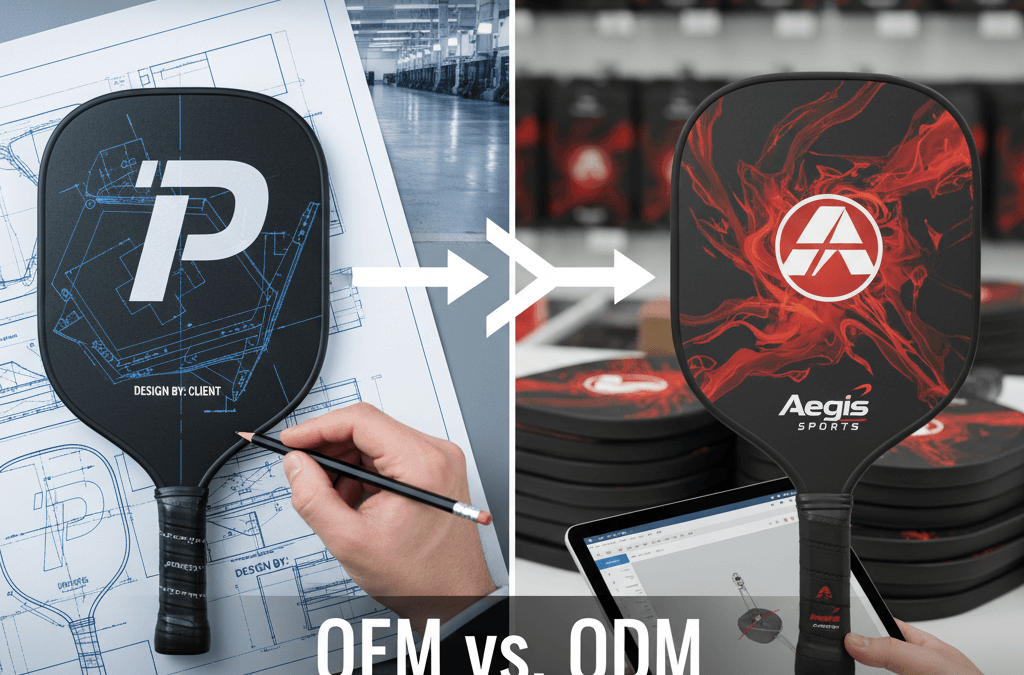
Summary: OEM gives you full control over paddle design. ODM lets you start faster with existing factory designs. This article compares both models across cost, time, MOQ, and brand control so you can pick the right path for your business.
Understanding OEM and ODM Manufacturing for Pickleball Paddles
What Does OEM Mean in Pickleball Paddle Manufacturing?
OEM stands for Original Equipment Manufacturing. You design the paddle. The factory builds it to your exact specifications.
You choose every detail: paddle shape, face material, core type, thickness, weight, balance, handle size, color, graphics, and packaging. The pickleball paddle factory follows your dieline or mold. No other brand can sell the same paddle.
OEM is the right choice if you want a unique product that stands out from competitors.
What Does ODM Mean in Pickleball Paddle Manufacturing?
ODM stands for Original Design Manufacturing. The factory already has paddle designs ready. You pick one and add your brand name, logo, and colors.
The factory handles the engineering. The paddle structure, core, and materials are already tested. You do not need to design from scratch.
ODM is the right choice if you want to launch a brand quickly with lower upfront work.
Key Differences Between OEM and ODM Production Models
| Factor | OEM | ODM |
|---|---|---|
| Design source | You provide drawings | Factory has existing designs |
| Shape options | Any shape you design | Limited to factory’s existing molds |
| Development time | 7–30 days for samples | No sample needed (existing product) |
| MOQ | 200 units (cold press) | Often lower, 100–200 units |
| Brand uniqueness | 100% unique | Shared design with other brands |
| Upfront work | High (design + testing) | Low (add logo only) |
OEM Pickleball Paddle Manufacturing: Full Control Over Your Brand Product
How OEM Production Works From Design to Mass Production
Step 1: You create a dieline file (.dxf or .ai) with your paddle shape and handle design.
Step 2: The factory reviews your design and recommends materials — fiberglass or carbon fiber face, PP honeycomb core thickness, resin type.
Step 3: A playable prototype is made in 7 days. You test weight, balance, and feel.
Step 4: After approval, production begins. Lead time: 25–30 days for 200–2,000 units.
Step 5: QC checks every batch — weight, thickness, graphic adhesion, edge quality.
Advantages of OEM for Brand Differentiation
- No other brand can copy your exact paddle shape
- You control weight, balance, and performance tuning
- Your packaging, graphics, and branding are unique
- Customers see your paddle as a distinct product, not a generic model
Challenges of Developing Fully Custom Paddle Designs
| Challenge | Why It Matters |
|---|---|
| Design takes more time | You must create and test your own dieline |
| Multiple prototypes may be needed | Each round of changes adds 5–7 days |
| Minimum order is higher | 200 units minimum for cold press |
| You carry all the design risk | If the paddle does not sell, inventory is yours |
ODM Pickleball Paddle Manufacturing: Faster Product Launch With Existing Designs
How ODM Manufacturing Helps Brands Enter the Market Quickly
With ODM, there is no design phase. You select a paddle from the factory’s catalog. You choose the color, add your logo, and order.
The factory already knows the paddle’s weight, balance, and playing characteristics. No guessing. No prototyping delays.
Benefits of Using Existing Paddle Structures and Technologies
| Benefit | What It Means for Your Brand |
|---|---|
| Faster launch | From order to shipping in 25–30 days |
| Proven designs | The paddle has been tested in real production |
| Lower development cost | No sample or engineering fees |
| Easier to predict costs | Factory knows exact material and labor costs |
When ODM Is the Better Choice for New Brands
ODM makes sense when:
- You are launching your first pickleball paddle brand
- Your budget is limited and you need to control costs
- You want to test the market before investing in custom designs
- You need to launch quickly to meet a seasonal deadline
OEM vs ODM Pickleball Paddle Manufacturing Comparison
Design Ownership and Product Customization
ODM paddles share the same core structure with other brands. Only colors and logos are different. OEM paddles are entirely your own — no other brand can use your dieline or mold.
Development Time and Sample Speed
| Model | Sample Time | Design Work Required |
|---|---|---|
| OEM (cold press) | 7 days | You provide dieline, select materials |
| OEM (thermoformed) | 2–3 weeks | You provide dieline + pay for mold |
| ODM (cold press) | No sample needed | Pick from catalog, add logo |
| ODM (thermoformed) | No sample needed | Pick from catalog, add logo |
MOQ Requirements and Initial Investment
| Model | Typical MOQ | Initial Investment (est.) |
|---|---|---|
| OEM cold press (fiberglass) | 200 units | $1,300–$2,000 |
| OEM cold press (carbon fiber) | 200 units | $2,500–$3,000 |
| OEM thermoformed | 500–1,000 units | $5,000–$15,000 |
| ODM cold press | 100–200 units | $600–$1,500 |
| ODM thermoformed | 200–500 units | $1,500–$5,000 |
Cost Control and Production Efficiency
OEM costs more per unit during the first batch because materials and processes are new. ODM costs less because the factory already knows how to build that paddle efficiently.
Brand Differentiation and Market Competition
ODM paddles can look similar to other brands using the same factory design. If your customers compare your paddle side by side with a competitor, they may notice the same shape and construction. OEM avoids this issue entirely.
Which Manufacturing Model Is Better for Different Brand Stages?
Startups: Why ODM Can Reduce Launch Risks
Your first goal is to get a product on the market and start selling. ODM removes the risk of designing a paddle that may not sell. You can launch with a proven product, gather customer feedback, and improve later.
Growing Brands: Combining ODM With Custom Improvements
Once you have sales data, you can start making small changes. Change the surface material. Adjust the weight. Add ceramic sand infusion. These improvements make the paddle more your own without the full cost of OEM development.
| Stage | Recommended Model | Why |
|---|---|---|
| First launch | ODM | Lowest risk, fastest to market |
| After 3–6 months | ODM with custom changes | Improve based on feedback |
| Established (2+ years) | OEM | Full brand ownership |
Established Brands: Why OEM Provides More Competitive Advantage
If you have an existing customer base and steady sales, OEM gives you protection. Competitors cannot copy your exact paddle. You build brand equity around a product that only you sell.
Customization Options Available Through OEM Pickleball Paddle Manufacturing
Custom Paddle Shape and Mold Development
Cold press: you provide a dieline, no mold needed. Shape changes cost nothing. Thermoformed: a steel mold costs $1,000–$1,500 per shape.
Carbon Fiber, Fiberglass, and Composite Surface Selection
| Material | OEM Available | ODM Available |
|---|---|---|
| Fiberglass | Yes | Yes |
| 1 carbon + 2 fiberglass | Yes | Yes |
| 3K carbon fiber | Yes | Depends on catalog |
| 12K / 18K carbon fiber | Yes | Depends on catalog |
| T700 cloth weave | Yes | Depends on catalog |
Core Material Options Including PP Honeycomb and EPP
PP honeycomb is standard for both OEM and ODM in cold press construction. Thickness: 13, 14, or 16 mm. Cell size: 8 or 10 mm. EPP core is used mainly in thermoformed construction but can be used in cold press on request.
Weight, Balance, Thickness, and Performance Tuning
OEM allows full control: target weight 210–240 g, balance point adjustable, handle length 4.5–5.5 inches. ODM uses the factory’s standard weight and balance for each catalog model.
Custom Graphics, Logo, and Packaging Design
Both OEM and ODM allow custom UV printing on the paddle face. Custom retail packaging is available for both models. MOQ for custom packaging: 500 units.
How ODM Pickleball Paddle Development Accelerates Time-to-Market
Selecting Proven Paddle Structures From Existing Designs
The factory’s ODM catalog includes paddles that have already been produced, tested, and shipped. You know the final weight, balance, and durability before placing your first order.
Modifying Colors, Branding, and Performance Features
ODM does not mean zero customization. You can change: grip color, edge guard color, end cap design, UV print graphics, and packaging. Minor performance changes — like adding ceramic sand surface or changing grip thickness — are often available.
Reducing Product Development Costs for New Brands
ODM eliminates sample costs, engineering review time, and design iteration rounds. Your total product development cost: the paddle price + graphic design + logo. No sample fee, no mold fee.
Common Mistakes Brands Make When Choosing OEM or ODM Suppliers
Choosing ODM Only Based on Lowest Price
The cheapest ODM paddle may use lower-density core or thinner face sheets. These cost less to produce but fail faster. Check the specifications, not just the price.
Developing Full OEM Products Without Market Validation
A brand that spends $3,000 on a custom OEM paddle without testing the market first takes unnecessary risk. Most successful brands start with ODM or a small OEM batch (200 units) to validate demand.
Ignoring Factory R&D and Engineering Capability
A factory with strong R&D can help you improve your OEM design or customize an ODM model. Check whether the factory has in-house engineers who understand composite materials, not just production workers.
How to Choose the Right Pickleball Paddle Manufacturer in China
Evaluate Factory Production Capacity and Experience
Ask about: monthly cold press capacity (100,000 units is standard for a mid-size factory), number of years in paddle production, and existing brand clients.
Check Material Expertise and Product Development Ability
A good factory stocks multiple face materials and core types. They should recommend the right material for your target market — not push you toward whatever they have in stock.
Confirm Sample Development and Quality Control Process
| Question | What to Look For |
|---|---|
| How long for a sample? | 7 days for cold press |
| Can I test the sample before bulk? | Yes, playable prototype |
| What QC checks do you run? | Weight, thickness, graphic adhesion, edge quality |
| What is your defect rate target? | Under 3% |
Why Work With a China OEM/ODM Pickleball Paddle Manufacturer?
Access to Advanced Composite Material Supply Chains
China’s composite material supply chain is mature. PP honeycomb, carbon fiber fabric, epoxy resin, and UV inks are all available locally. This keeps material costs low and lead times short.
Faster Prototype Development and Flexible MOQ
Cold press OEM samples in 7 days. MOQ as low as 200 units for cold press. ODM orders can be even smaller. This flexibility allows brands of any size to enter the market.
Professional Support From Concept to Mass Production
The factory assists with material selection, dieline optimization, weight tuning, graphic placement, packaging design, and logistics. You do not need to be a paddle engineering expert to launch a successful brand.
OEM + ODM Hybrid Strategy: The Best Approach for Many Brands
Starting With Proven ODM Platforms
Launch your first paddle using an ODM base. Keep costs low. Test the market. Learn what your customers want.
Adding Custom Features for Brand Differentiation
On your second order, add custom features: change the surface material, upgrade to carbon fiber, add ceramic sand for spin, or adjust the core thickness. The paddle becomes more your own over time.
Transitioning Into Fully Custom OEM Development
Once you have sales data and customer feedback, design your own paddle from scratch. Create a dieline that matches your brand’s ideal shape and performance targets. The factory that supported your ODM launch can now produce your OEM design.
| Phase | Model | Investment | Risk |
|---|---|---|---|
| Launch (Month 1) | ODM | Low | Low |
| Improve (Month 3–6) | ODM + custom changes | Medium | Low |
| Own (Month 6–12) | OEM | Higher | Medium |
FAQ About OEM and ODM Pickleball Paddle Manufacturing
What is the difference between OEM and ODM pickleball paddles?
OEM paddles are fully custom — your design, your dieline, your mold. ODM paddles are existing factory designs with your brand name and colors added.
Is OEM more expensive than ODM?
Yes. OEM requires design work, prototyping, and engineering review. ODM uses existing factory designs with lower upfront cost. Per-unit pricing is similar once production begins.
Which option is better for a new pickleball brand?
ODM is better for most new brands. It reduces startup cost, speeds up launch, and removes design risk. Once you have sales data, you can move toward OEM.
Can a brand start with ODM and move to OEM later?
Yes. That is the most common path. Many successful brands started with an ODM model, learned the market, and then developed their own OEM paddle.
What MOQ is required for OEM pickleball paddles?
200 units for cold pressed paddles. Thermoformed OEM paddles typically require 500–1,000 units due to mold costs.