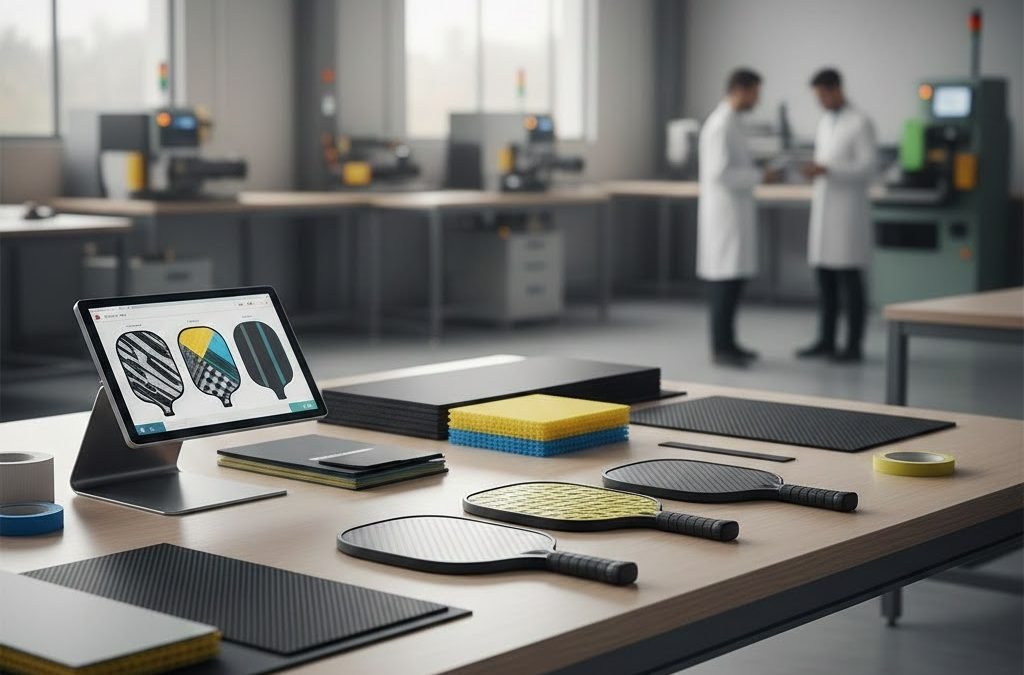
The global pickleball market has experienced rapid growth over the past decade. According to industry reports, the U.S. pickleball player base has exceeded 36 million players, with an annual growth rate of over 10–15%. As demand increases, more entrepreneurs, sports brands, and distributors are looking to launch their own pickleball paddle brands.
For most new and growing brands, OEM manufacturing in China is the most practical and scalable way to enter the market. We will explain, step by step, how to build a pickleball brand using OEM manufacturing, from product positioning to technical specifications, cost structure, and quality control.
Building an in-house manufacturing facility for pickleball paddles requires significant investment. A typical paddle production line involves:
Raw material sourcing (carbon fiber, fiberglass, polypropylene honeycomb)
Cold press or thermoforming equipment
CNC cutting and edge finishing
Surface printing and curing
Assembly and quality inspection
The initial capital expenditure can easily exceed RMB 1–2 million, not including labor and R&D costs.
OEM manufacturing eliminates these barriers by allowing brands to:
Launch products within 60–120 days
Avoid heavy upfront equipment investment
Focus on branding, marketing, and sales
Scale production flexibly based on demand
For brands entering the U.S. or EU markets, OEM manufacturing also provides access to factories that already understand market standards, player preferences, and compliance requirements.
Understanding OEM vs ODM in Pickleball Paddle Manufacturing
Before working with a factory, brands must understand the difference between OEM and ODM.
OEM (Original Equipment Manufacturer)
Brand selects from existing structures and mold, and replace with their logo
Factory produces according to brand requirements
Brand owns logo, design, and market positioning
ODM (Original Design Manufacturer)
Brand provides ready-made designs and structures/mold structure, factories produce mold based on clients requirements.
Brand mainly customizes logo and packaging
Slower launch but more uniqueness
For most serious pickleball brands aiming for long-term growth, OEM is preferred because it allows:
Material selection control and faster launch
Performance tuning
Quality ensured due to previous mass production
Step 1: Define Your Pickleball Brand Positioning
Successful pickleball brands do not try to serve everyone. Before selecting materials or molds, you must define:
Target Market
Recreational players: value forgiveness and durability
Intermediate players: balance of control and power
Advanced players: precision, spin, and feel
In the U.S. market, over 70% of paddle sales fall into the mid-range segment (USD 80–150 retail), making it a strategic entry point for new brands.
Price Strategy
Your target factory cost should generally be:
20–30% of final retail price (excluding marketing and logistics)
Example:Retail price: USD 120
Target factory cost: USD 25–35
Step 2: Choosing the Right Pickleball Paddle Specifications
Paddle Shape and Core Thickness
Common paddle thickness options include:
13mm–14mm: more power, faster response
16mm: improved control, larger sweet spot
According to player feedback and sales data, 16mm paddles account for over 60% of premium paddle sales in the U.S., especially among control-focused players.
Core Material
Polypropylene honeycomb is the industry standard
Cell size typically ranges from 6–8mm
Density affects feel, vibration, and durability
Higher-density cores improve control but increase weight slightly.
Surface Materials
| Material Type | Characteristics | Typical Target User |
|---|---|---|
| Glass Fiber | Softer feel, lower cost | Beginners |
| Carbon Fiber | Balanced performance | Intermediate |
| T700 Raw Carbon | Higher friction, control | Advanced |
| T800 Carbon | Stiffer, faster response, high price | Competitive |
USA Pickleball allows textured surfaces, but prohibits added grit coatings that detach during play. OEM factories must ensure surface texture is integrated into the material or printing process.
Handle Length and Grip
Standard handle lengths:
5.0–5.3 inches: one-handed players
5.5–6 inches: two-handed backhands
Grip circumference typically ranges from 4.125–4.375 inches, aligned with U.S. market preferences.
Step 3: Custom Branding Options for OEM Pickleball Paddles
Branding significantly impacts perceived value. OEM factories typically offer:
Logo Application Methods
UV printing (durable and color-accurate, most commonly used)
Screen printing (cost-effective for large volumes)
Water transfer (complex patterns)
Structural Customization
Edge guard color matching
Custom bottom caps
Matte or glossy surface finish
Packaging
Custom printed cartons
EVA paddle covers
Retail-ready barcodes and labels, hanger
A well-executed branding package can increase perceived retail value by 20–30%, even when paddle structure remains unchanged.
Step 4: MOQ, Tooling, and Cost Structure Explained
Minimum Order Quantity (MOQ)
Typical OEM MOQs:
Existing mold: 200–500 units
Custom mold: 1,000–2,000 units
Custom molds usually require:
One-time tooling cost: USD 1,000–6,000
Lead time: 15–30 days
Cost Breakdown (Typical OEM Paddle)
| Cost Component | Percentage |
|---|---|
| Raw materials | 35–40% |
| Labor | 20–25% |
| Manufacturing overhead | 15–20% |
| Packaging | 5–10% |
| QC and scrap | 3–5% |
Understanding this structure helps brands negotiate realistically and avoid quality compromises.
Step 5: Quality Control and Compliance for International Markets
Quality control is critical for brand credibility. Reputable OEM factories implement:
In-Process QC
Core bonding strength tests
Weight tolerance: ±5g
Thickness tolerance: ±0.3mm
Final Inspection
Visual surface defects
Edge guard alignment
Handle adhesion test
Compliance Standards
CPSIA requirements for consumer products
Consistent QC ensures batch-to-batch stability, which is essential as brands scale from hundreds to thousands of units.
Common Mistakes New Pickleball Brands Make with OEM Manufacturing
Choosing factories based solely on price
Ignoring material traceability
Changing specifications frequently during production
Underestimating lead time for peak seasons
These mistakes often result in inconsistent quality and delayed launches.
Final Thoughts
OEM manufacturing provides a clear, proven path to building a pickleball brand without excessive risk. By defining your brand positioning, selecting the right specifications, understanding cost structures, and working with an experienced factory, you can launch a competitive product and scale sustainably.
In a market that continues to grow year after year, brands that invest in quality, consistency, and long-term OEM partnerships will stand out.
FAQ
What is the MOQ for OEM pickleball paddles?
For existing molds, the typical MOQ is 200–500 units. For fully custom molds, MOQ usually starts from around 1,000 units, with a one-time tooling cost.
How long does OEM pickleball paddle production take?
Sample development usually takes 15–20 days. Mass production typically takes 30–45 days. Custom molds may require additional lead time.
Can OEM pickleball paddles meet USA Pickleball standards?
Yes. OEM paddles are manufactured to comply with USA Pickleball equipment guidelines, including size limits and approved surface texture requirements.
What paddle thickness is most popular in the U.S. market?
Sixteen millimeter paddles are currently the most popular choice, as they provide better control and a larger sweet spot.
What materials are commonly used in OEM pickleball paddles?
Most OEM paddles use polypropylene honeycomb cores combined with glass fiber or carbon fiber surfaces. Premium models often use T700 raw carbon.
How much does it cost to produce a custom pickleball paddle?
Typical OEM factory costs range from around USD 10 to 35 per paddle, depending on materials, construction, and order volume.
Is OEM manufacturing suitable for new pickleball brands?
Yes. Many new brands start with small production runs to test the market and gradually scale up as demand increases.
What information should a brand prepare before contacting an OEM factory?
Brands should prepare their target price range, basic paddle specifications, estimated order quantity, and branding requirements such as logos and packaging.