Why UV Graphic Chipping Has Become a Common Challenge in Pickleball Paddle Manufacturing
Understanding Graphic Peeling and Chipping Issues on Paddle Surfaces
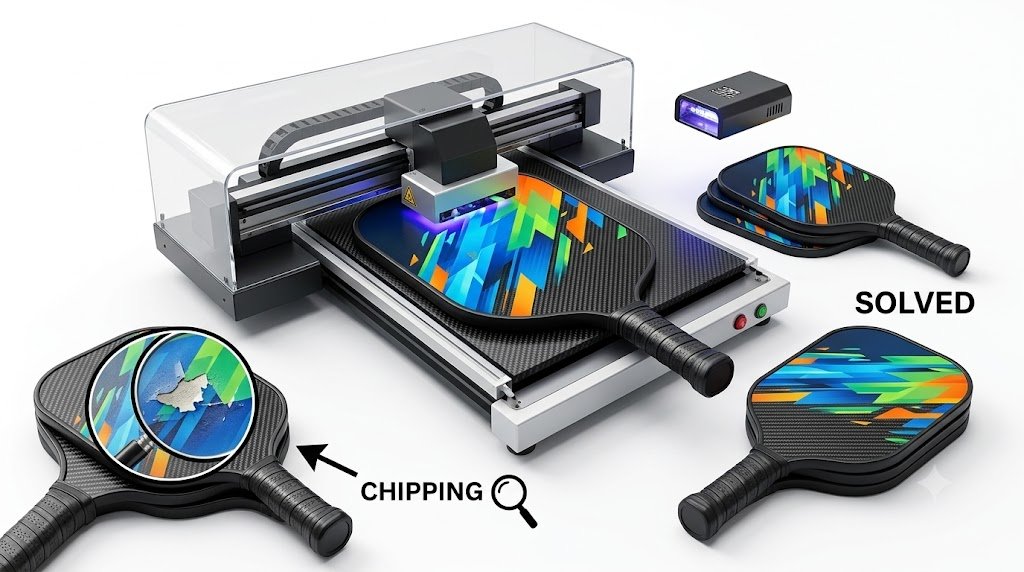
UV graphic chipping occurs when the printed design separates from the paddle face. It starts at the edges — usually within 2–4 weeks of regular play. The graphic lifts, peels, or chips off in small flakes.
The root cause is adhesion failure between the UV ink and the composite surface. Fiberglass and raw carbon fiber behave differently. Fiberglass is prone to chipping. Raw carbon fiber is not.
Why Surface Durability Matters for OEM and Private Label Brands
Graphic failure directly affects brand perception. A chipped paddle face signals poor quality. Customers leave negative reviews. Return rates increase.
For B2B buyers, graphic durability is a specification requirement — not just a cosmetic preference. Brands sourcing from OEM factories must verify surface adhesion before committing to bulk orders.
The Impact of Graphic Failure on Customer Experience and Brand Reputation
| Outcome | Short-Term Impact | Long-Term Impact |
|---|---|---|
| Visual defect at unboxing | Immediate return | Brand avoided |
| Chipping after 2 weeks of play | Negative review | Reduced repurchase rate |
| Inconsistent graphic quality across batch | Distributor complaints | Lost wholesale accounts |
Fiberglass vs. Raw Carbon Surface: Differences in Graphic Adhesion Performance
Surface Characteristics of Cold-Pressed Fiberglass Pickleball Paddles
Fiberglass surfaces are smooth and non-porous after cold pressing. The epoxy resin fills all surface irregularities during lamination. The result: UV ink has limited mechanical grip.
UV graphic applied directly to a cold-pressed fiberglass surface chips easily. The ink sits on top of the epoxy layer. Impact from ball contact and edge scraping dislodges the graphic.
Surface Characteristics of Raw Carbon Fiber Pickleball Paddles
Raw carbon fiber has a woven texture. The weave creates peaks and valleys at the microscopic level. UV ink flows into these valleys during printing. Once cured, the ink is mechanically locked into the weave structure.
Raw carbon fiber does not require a painted or coated surface. The graphic bonds directly to the weave. Impact forces are distributed across the fiber structure rather than concentrated at an adhesive interface.
Why Carbon Fiber Surfaces Require Different Graphic Treatment Processes
| Surface Type | Texture | Ink Bonding Mechanism | Chipping Risk |
|---|---|---|---|
| Fiberglass (smooth) | Flat, sealed by epoxy | Chemical adhesion only | High |
| Raw Carbon Fiber | Woven, textured | Mechanical + chemical | Low |
| Painted fiberglass | Smooth paint layer | Adhesion to paint | Very high |
The data is clear: raw carbon fiber naturally resists graphic chipping. Fiberglass requires additional surface engineering to achieve the same result.
Main Causes of UV Graphic Chipping During Pickleball Paddle Production
Insufficient Surface Preparation Before Printing
The most common cause. Fiberglass surfaces emerge from the press with residual mold release agents or epoxy bloom. If the surface is not cleaned and activated, UV ink cannot bond.
Required preparation for fiberglass: solvent wipe + 180-grit light abrasion + adhesion promoter.
Poor Ink Adhesion Between Graphics and Composite Materials
UV ink is formulated for specific surface energy levels. Fiberglass surfaces typically have low surface energy (30–35 dynes/cm) after curing. UV ink requires ≥38 dynes/cm for reliable adhesion.
Raw carbon fiber has higher surface energy due to the exposed fiber texture. It naturally meets the adhesion threshold without treatment.
| Surface | Surface Energy (dynes/cm) | UV Ink Adhesion |
|---|---|---|
| Raw fiberglass (as-pressed) | 30–35 | Poor |
| Abraded fiberglass | 38–42 | Good |
| Raw carbon fiber (as-pressed) | 40–45 | Good |
High Pressing Temperature and Lamination Stress
Cold pressing operates at room temperature, so thermal stress is minimal. However, the 80–150 ton compaction force creates residual stress in the surface layer. When UV ink is cured, shrinkage mismatch between ink and substrate can cause micro-cracking. Those micro-cracks propagate into visible chipping during play.
UV Coating Compatibility with Fiberglass and Carbon Fiber Surfaces
Some UV coating systems are designed for porous substrates (wood, paper). They do not flex with the paddle face during ball impact. A rigid coating on a flexible fiberglass face cracks immediately.
Surface Engineering Solutions for Improving Graphic Durability
Surface Cleaning and Activation Before UV Printing
Standard pre-treatment sequence for cold-pressed fiberglass:
- Solvent wipe (isopropyl alcohol or acetone) — removes mold release and residue
- Light abrasion (180–220 grit sandpaper) — creates mechanical anchor points
- Adhesion promoter application — raises surface energy to ≥38 dynes/cm
- Primer coat — seals the surface and provides a UV-compatible base layer
Raw carbon fiber typically requires only step 1 and step 4.
Optimizing Primer Layers for Better Ink Bonding
Two primer types work on cold-pressed composite surfaces:
| Primer Type | Best For | Adhesion Improvement |
|---|---|---|
| Solvent-based adhesion primer | Fiberglass | +200–300% vs. unprimed |
| UV-curable primer | Both | +150–250% vs. unprimed |
Solvent-based primers outperform UV-curable primers on fiberglass because they penetrate the epoxy surface layer. UV-curable primers sit on top and rely on chemical bond only.
Selecting the Right UV Ink System for Composite Paddle Surfaces
| Ink Type | Flexibility | Adhesion to Fiberglass | Adhesion to Raw Carbon |
|---|---|---|---|
| Standard rigid UV ink | Low | Poor | Moderate |
| Flexible UV ink | High | Good | Excellent |
| LED-curable flexible ink | High | Good | Excellent |
Flexible UV ink is required for cold-pressed paddle applications. The ink must bend with the face sheet during ball impact without cracking.
Protective Coatings and Finishing Treatments for Long-Term Durability
| Coating Type | Abrasion Resistance | Flexibility | Application |
|---|---|---|---|
| UV-curable topcoat | High | Moderate | Roller or spray |
| Polyurethane clear coat | Very high | High | Spray |
| Matte finish coating | Moderate | High | Spray |
For fiberglass paddles: apply a flexible PU clear coat over the UV graphic. This adds a protective layer that absorbs impact energy before it reaches the ink-substrate interface.
Cold Press vs. Hot Press: How Manufacturing Process Influences Graphic Performance
How Cold Pressing Affects Surface Structure and Graphic Adhesion
Cold pressing produces a dense, sealed epoxy surface on fiberglass. No heat is used. The epoxy cures slowly, creating a smooth, glass-like finish. This surface is chemically inert — UV ink has nothing to grip.
Hot pressing (thermoformed) produces a slightly rougher surface because the epoxy flows differently under heat. Graphic adhesion is marginally better on hot-pressed fiberglass, but the difference is small.
Advantages and Limitations of Cold Pressed Fiberglass Paddle Production
Cold pressing keeps production costs low and MOQ at 200 units. The tradeoff: fiberglass surface requires extra treatment steps for reliable graphic adhesion. These steps add $0.50–$1.00 per paddle and 1–2 days to production lead time.
Why Process Control Is Critical for Consistent Bulk Orders
Surface treatment consistency is the biggest challenge in bulk production. If one paddle in a batch receives insufficient abrading or a missed solvent wipe, that paddle will chip. QC must verify at least 5% of each batch with cross-cut adhesion testing.
How Raw Carbon Fiber Paddles Require Specialized Surface Treatment
Challenges of Printing Directly on Carbon Fiber Texture
The weave texture creates uneven ink coverage. Ink pools in the valleys and sits thin on the peaks. This produces a “dry print” appearance on the weave peaks — the black carbon shows through the graphic.
Solution: apply a white or light-colored primer layer to fill the weave valleys before printing. This creates a flat, uniform printing surface while preserving the weave appearance in unprinted areas.
Managing Carbon Fiber Weave Patterns and Ink Coverage
| Weave Type | Ink Coverage Challenge | Recommended Solution |
|---|---|---|
| 3K weave (dense) | Minimal show-through | Single primer coat |
| 12K weave (coarse) | Visible peak-valley difference | Double primer coat |
| 18K weave (wide) | Uneven color saturation | Primer + flood coat |
Balancing Premium Appearance with Graphic Durability
Raw carbon fiber already resists chipping — no special surface engineering needed. The focus shifts to appearance: how to print graphics without hiding the weave pattern that customers pay a premium for.
Best approach: use translucent UV inks that allow the carbon weave to show through the graphic. This preserves the premium look while adding full-color branding.
Quality Control Methods for Preventing UV Graphic Failure in Mass Production
Cross-Cut Adhesion Testing for Paddle Surface Graphics
ASTM D3359 cross-cut test. A grid of 25 squares is cut through the graphic into the substrate. Tape is applied and pulled off. Result is rated 0B (worst) to 5B (best).
| Rating | Adhesion | Acceptance for OEM |
|---|---|---|
| 5B | No peeling | Accept |
| 4B | <5% removed | Accept |
| 3B | 5–15% removed | Conditional |
| 2B or below | >15% removed | Reject |
Minimum acceptable rating for bulk production: 4B.
UV Aging and Wear Resistance Testing
Simulate 6 months of play in a laboratory setting:
- UV exposure: 200 hours in QUV chamber (ASTM G154)
- Abrasion: 500 cycles with CS-10 wheel, 500 g load (ASTM D4060)
- Impact: drop ball test from 30 cm height, 100 repetitions
Graphic must survive all three tests with no visible chipping or peeling.
Batch Inspection Standards for OEM Pickleball Paddle Production
| Check Point | Method | Frequency |
|---|---|---|
| Pre-print surface energy | Dyne pen test | Every 100 paddles |
| Cross-cut adhesion | ASTM D3359 | 5% of each batch |
| Visual inspection | 4x magnification | 100% of production |
| Accelerated aging | QUV 200 hr | Per material change |
Surface Customization Options for OEM Pickleball Paddle Brands
Full Surface UV Printing for Custom Branding
Full-color UV printing covers the entire paddle face — logos, patterns, gradients. Compatible with both fiberglass (with primer) and raw carbon fiber. Minimum 200 units per design.
Matte, Glossy, and Textured Surface Finishes
| Finish | Appearance | Durability | Best For |
|---|---|---|---|
| Glossy | Shiny, vibrant | Moderate | Fiberglass with protective coat |
| Matte | Flat, non-reflective | High | Raw carbon fiber |
| Textured (ceramic sand) | Rough, grippy | Very high | Spin-focused paddles |
Combining Graphics with Carbon Fiber and Fiberglass Performance Requirements
The graphic layer sits between the face sheet and a protective topcoat. Proper sequencing: face sheet → primer → UV graphic → protective clear coat. This sandwich structure protects the graphic from direct impact while allowing the face sheet to flex naturally.
Choosing the Right Surface Solution for Your Pickleball Paddle Project
When to Choose Fiberglass Surface Construction
- Target wholesale price under $10
- Customers are beginners or recreational players
- You can invest in surface preparation (primer + protective coat)
- Branding priority is cost-effective customization
When to Choose Raw Carbon Fiber Surface Construction
- Target wholesale price $8–$15
- Long-term graphic durability is a selling point
- Premium appearance (weave texture visible through graphic)
- Customers expect 12–24 month paddle lifespan
How OEM Factories Help Optimize Performance, Appearance, and Cost
A reliable pickleball paddle factory like Lixisports provides surface engineering support during the development phase — surface energy testing, primer selection, adhesion validation before mass production. This eliminates the trial-and-error approach that leads to graphic failure in bulk orders.
Common Mistakes Brands Make When Sourcing Custom Pickleball Paddles
Focusing Only on Paddle Appearance Instead of Surface Engineering
A vibrant graphic means nothing if it chips off in two weeks. Prioritize surface preparation and protective coating specifications in your sourcing documents.
Ignoring Material Compatibility During Product Development
Fiberglass + UV ink without primer = guaranteed chipping. Raw carbon + standard rigid UV ink = cracked graphic. Material compatibility must be validated before committing to a production process.
Skipping Prototype Testing Before Mass Production
Always request 10–20 sample paddles with final graphic and coating specifications. Run cross-cut adhesion and abrasion tests. Approve production only after samples pass.
FAQ
Why do pickleball paddle graphics peel or chip?
Insufficient surface preparation is the primary cause. Fiberglass surfaces are smooth and non-porous. UV ink cannot bond without abrasion, primer, or adhesion promoter. Raw carbon fiber resists chipping because the weave structure mechanically locks the ink in place.
Are carbon fiber paddles harder to print than fiberglass paddles?
No. Carbon fiber is easier to print on because the weave texture provides mechanical grip for UV ink. Fiberglass requires extra surface treatment steps to achieve the same adhesion level.
How can manufacturers improve UV graphic adhesion?
Clean the surface with solvent. Abrade with 180–220 grit sandpaper. Apply an adhesion promoter or primer. Use flexible UV ink. Add a protective clear coat. For fiberglass specifically: skip none of these steps.
What tests should OEM buyers request before bulk production?
Cross-cut adhesion test (ASTM D3359, minimum 4B rating), UV aging (200 hours QUV), and abrasion resistance (500 cycles, CS-10 wheel). Require test results in your factory audit checklist.