Understanding Polypropylene Honeycomb Core in Pickleball Paddle Manufacturing
What Is a Polypropylene Honeycomb Core?
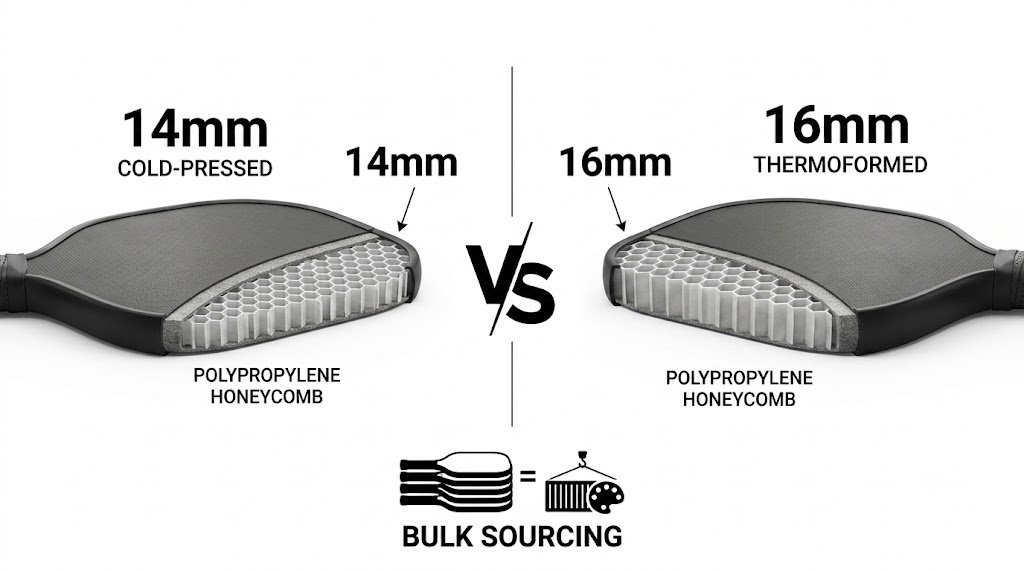
PP honeycomb core is a hexagonal cell structure made from polypropylene plastic. It sits between the two face sheets of a pickleball paddle. The cells are typically 8 mm or 10 mm in diameter. The core determines the paddle’s weight, power, feel, and durability.
PP honeycomb is lightweight. It does not absorb moisture. It resists degradation from repeated impact. These properties make it the standard core material for cold-pressed paddles manufacturing.
Why PP Honeycomb Has Become the Standard Core Material for OEM Pickleball Paddles
Three reasons:
Cost. PP is the cheapest core material available for paddle production. Raw material cost is stable. Supply chain is mature.
Weight consistency. PP honeycomb panels can be produced with ±0.3 mm thickness tolerance across production batches. Weight variation stays within ±5 g before CNC finishing.
Compatibility. PP honeycomb bonds well with fiberglass and carbon fiber face sheets using standard epoxy systems. No special adhesives or surface treatments are needed for cold press.
| Core Material | Cost per Paddle | Weight Control | Cold Press Suitability |
|---|---|---|---|
| PP Honeycomb | Low | ±5 g | Excellent |
| EPP Foam | Medium | ±7 g | Not typical |
| Nomex Honeycomb | High | ±3 g | Thermoformed only |
Key Core Specifications Buyers Should Evaluate Before Bulk Ordering
| Specification | Typical Range | Why It Matters |
|---|---|---|
| Thickness | 13 mm, 14 mm, 16 mm | Determines weight and feel |
| Cell size | 8 mm, 10 mm | Affects stiffness and bonding |
| Density | 70–100 kg/m³ | Controls overall paddle weight |
| Thickness tolerance | ±0.3 mm | Affects final weight consistency |
| Cell wall thickness | 0.08–0.12 mm | Core crush resistance |
14mm vs. 16mm PP Honeycomb Core: Technical Specification Comparison
Thickness Difference Between 14mm and 16mm Honeycomb Core
The physical difference is 2 mm. That 2 mm changes the paddle’s behavior significantly.
| Spec | 14 mm Core | 16 mm Core |
|---|---|---|
| Total paddle thickness | ~14.5–15 mm (with face sheets) | ~16.5–17 mm (with face sheets) |
| Core weight (per paddle) | ~35–40 g | ~40–48 g |
| Panel stiffness | Higher | Lower |
| Ball compression | Less pocketing | More pocketing |
Fiberglass cold-pressed paddles in both 14 mm and 16 mm are priced the same. The thickness option does not change wholesale cost from Lixisports.
Cell Size, Density, and Material Structure Considerations
Cell size and density are independent of thickness. A 14 mm core can use 8 mm cells. A 16 mm core can also use 8 mm cells. The choice depends on the target weight and stiffness.
| Cell Size | Typical Use | Effect |
|---|---|---|
| 8 mm | Standard for both 14 mm and 16 mm | More cell walls = stiffer core |
| 10 mm | Lightweight builds, budget lines | Fewer walls = softer, lighter |
Density range: 70–100 kg/m³. Lower density reduces weight but increases core crush risk during pressing. Higher density adds weight but improves durability.
Weight Difference and Its Impact on Paddle Performance
A 16 mm core adds 5–8 g of weight compared to a 14 mm core using the same cell size and density.
Target final weight for cold-pressed paddles: 225 g ±5 g. This target is achievable with both thicknesses by adjusting face sheet weight and resin content.
| Thickness | Core Weight | Face Sheets + Resin | Final Paddle Weight |
|---|---|---|---|
| 14 mm (8 mm cell) | ~37 g | ~188 g | 225 g ±5 g |
| 16 mm (8 mm cell) | ~44 g | ~181 g | 225 g ±5 g |
The 16 mm paddle shifts more weight to the core, slightly lowering swing-weight. The 14 mm paddle has proportionally more weight in the face sheets, slightly increasing swing-weight.
Performance Comparison: 14mm vs. 16mm Pickleball Paddle Core
Power Output: Which Core Thickness Generates More Ball Speed?
14 mm core. Stiffer structure. Less energy absorbed during ball impact. More energy returned. Higher ball speed off the face.
16 mm core. Softer structure. More energy absorbed during impact. Lower ball speed. The tradeoff: better feel.
| Core Thickness | Ball Speed (same input force) | Energy Return |
|---|---|---|
| 14 mm | Higher | ~85–90% |
| 16 mm | Lower | ~75–82% |
Control and Touch: Why 16mm Cores Are Preferred by Many Players
The 16 mm core compresses more on impact. The ball stays on the face longer — approximately 1–2 milliseconds longer than 14 mm. This longer dwell time gives players more control over shot direction and spin.
16 mm is preferred for soft game play — dinks, drops, and resets. The thicker core dampens the impact force, reducing the chance of popping the ball up.
Sweet Spot Size and Forgiveness Comparison
Core thickness does not change the physical size of the sweet spot. Sweet spot is determined by paddle shape and face construction.
However, 16 mm cores feel more forgiving. The added compression absorbs off-center hit vibration. Players perceive a larger effective hitting area even though the actual zone is the same.
| Factor | 14 mm | 16 mm |
|---|---|---|
| Actual sweet spot size | Shape-dependent | Shape-dependent |
| Perceived forgiveness | Lower | Higher |
| Off-center hit feedback | Harsher | Softer |
Vibration Absorption and Playing Comfort
16 mm cores absorb more vibration. The thicker cell structure acts as a mechanical filter. High-frequency vibrations from ball impact are attenuated before reaching the handle.
Players with arm sensitivity — tennis elbow, wrist strain — report less discomfort with 16 mm paddles.
14mm PP Honeycomb Core: Recommended Applications for OEM Projects
Ideal Market Positioning for 14mm Pickleball Paddles
14 mm paddles fit the power-oriented segment. Faster ball speed appeals to players who drive the ball aggressively. Market positioning: responsive, fast, high-energy.
Suitable Player Groups and Product Categories
- Intermediate to advanced players who generate their own power
- Players transitioning from thermoformed paddles who want a familiar stiff feel
- Budget-conscious brands launching a first product line
When Should Brands Choose 14mm Core for Private Label Production?
Choose 14 mm when:
- Your target customers are experienced players who prioritize power
- You want a thinner profile that looks closer to premium thermoformed paddles
- You plan to pair it with raw carbon fiber face for maximum stiffness
16mm PP Honeycomb Core: Recommended Applications for OEM Projects
Why 16mm Has Become a Popular Choice for Premium Paddle Lines
16 mm has become the default thickness for many mid-range and premium cold-pressed lines. Reason: it offers the best balance of control and comfort. Most recreational and club-level players prefer the softer feel.
Suitable Player Groups and Performance Expectations
- Beginners and intermediates looking for control
- Senior players or those with arm sensitivity
- Club-level players who play 3–5 times per week and value comfort
When Should Brands Choose 16mm Core for Bulk Manufacturing?
Choose 16 mm when:
- Your target market is recreational and club players (largest buyer segment)
- You are positioning the paddle as “control-oriented” or “comfort-focused”
- You want to differentiate from budget 14 mm offerings at a similar price point
14mm vs. 16mm PP Honeycomb Core: OEM Cost and Production Considerations
Material Consumption and Manufacturing Cost Differences
Material cost difference between 14 mm and 16 mm core is minimal. The PP honeycomb sheet is the same density. The 2 mm extra thickness adds approximately $0.10–$0.15 per paddle in raw material.
Cold press production cost is identical regardless of thickness. The lamination process, press time, and CNC cutting are the same. No mold changes needed.
Impact on Paddle Weight, Balance, and Final Product Pricing
Wholesale price is the same for both thicknesses. The choice is driven by market positioning, not production cost. Brand markup can be identical.
How Core Thickness Influences MOQ and Production Planning
MOQ for both thicknesses: 200 units. No extra lead time for thickness selection. The same PP honeycomb supplier provides both 14 mm and 16 mm sheets. Switching thickness mid-production requires only a material change, not a line retool.
How to Choose Between 14mm and 16mm PP Honeycomb Core for Your Brand
Define Your Target Market and Customer Price Segment
| Market Segment | Recommended Thickness | Reasoning |
|---|---|---|
| Entry-level recreational | 16 mm | Control + comfort for new players |
| Club / regular players | 16 mm | Longer play sessions need comfort |
| Power players / younger | 14 mm | Faster ball speed |
| Senior / arm-sensitive | 16 mm | Vibration absorption |
| Tournament / competitive | 14 mm or 16 mm | Depends on play style preference |
Match Core Thickness with Surface Material and Paddle Construction
14 mm pairs well with raw carbon fiber — both are stiff. The combination produces high power output. 16 mm pairs well with fiberglass — both are softer. The combination maximizes control and comfort.
| Face Material | Best Core Match | Reason |
|---|---|---|
| Fiberglass | 16 mm | Soft face + soft core = max control |
| Raw Carbon Fiber | 14 mm | Stiff face + stiff core = max power |
| Carbon Fiber + Ceramic Sand | Either | Surface texture adds spin independently |
Work with an OEM Factory to Optimize Paddle Specifications
The best approach: request sample paddles in both thicknesses with the same face material. Test weight, balance, and playing feel. Make the decision based on actual playtesting feedback from your target customers, not specifications alone.
Common Mistakes When Sourcing PP Honeycomb Pickleball Paddles
Choosing Core Thickness Based Only on Price
Both thicknesses cost the same wholesale. Choosing 14 mm to “save money” is not a valid reason. The decision should be based on player fit and market positioning.
Ignoring Core Density and Manufacturing Quality
Thickness is not the only variable. Low-density core (70 kg/m³) can crush during pressing, causing face sheet delamination. Always specify density range in your sourcing agreement.
Overlooking Compatibility Between Core, Carbon Fiber Face, and Edge Guard
PP honeycomb bonds well with fiberglass and carbon fiber. But if you add an edge guard, the adhesive must be compatible with PP. Request peel test data from your OEM before committing to large volume.
OEM Customization Options for PP Honeycomb Core Pickleball Paddles
Custom Paddle Thickness and Core Structure Development
Beyond 14 mm and 16 mm, custom thicknesses (13 mm, 15 mm, 18 mm) are available. Minimum order for custom thickness: 500 units. Development time: 2–3 weeks for sample.
Combining PP Honeycomb Core with Carbon Fiber, Fiberglass, or Hybrid Faces
All face materials are compatible. The lamination process is the same. No retooling needed. Your OEM can produce multiple SKUs using the same core but different face materials, enabling a tiered product line.
Custom Weight, Balance, Handle Design, and Branding Solutions
Customization options available from Lixisports:
- Target weight: 210–240 g (adjustable via core density and resin content)
- Balance point: custom (head-light, head-heavy, or neutral)
- Handle length: 4.5–5.5 inches
- Grip: custom color, logo printing
- End cap and edge guard: custom color, silicone band
- Packaging: PE bag + bubble + master carton, or custom retail packaging with UPC, Amazon label
Why Choose a Professional Pickleball Paddle OEM Manufacturer
Advanced Core Processing and Lamination Technology
Cold-pressed PP honeycomb paddle production requires precise pressure control (80–150 tons) and consistent epoxy application. Lixisports operates dedicated cold press lines with 100,000-unit monthly capacity.
Quality Control for Large Volume Production
QC checkpoints: incoming PP honeycomb sheet inspection, post-lamination panel thickness check, post-CNC dimensional inspection. Weight sampled at 20% AQL rate. Critical dimensions checked 100%.
Supporting Brands from Prototype Development to Mass Production
Sample turnaround: 7 days. Bulk production: 30 days for 2,000 units. Low MOQ: 200 units for standard specifications. Technical support provided for dieline design, material selection, and packaging development.
FAQ About 14mm and 16mm PP Honeycomb Core Pickleball Paddles
Is 16mm always better than 14mm pickleball paddle?
No. 14 mm is better for power-oriented players. 16 mm is better for control and comfort. Neither is universally superior. The right choice depends on the target player’s skill level, play style, and physical needs.
Which core thickness is better for beginners and intermediate players?
16 mm. Softer feel, more control, less vibration. Beginners benefit from the forgiving nature of a thicker core. As players advance, some switch to 14 mm for increased power.
What is the recommended MOQ for custom PP honeycomb pickleball paddles?
200 units from Lixisports for standard specifications. Custom thickness or density may require 500 units.
Can manufacturers customize honeycomb density and thickness?
Yes. Density can be specified between 70 and 100 kg/m³. Thickness can be customized from 13 mm to 18 mm. These adjustments allow fine-tuning paddle weight and playing characteristics.