
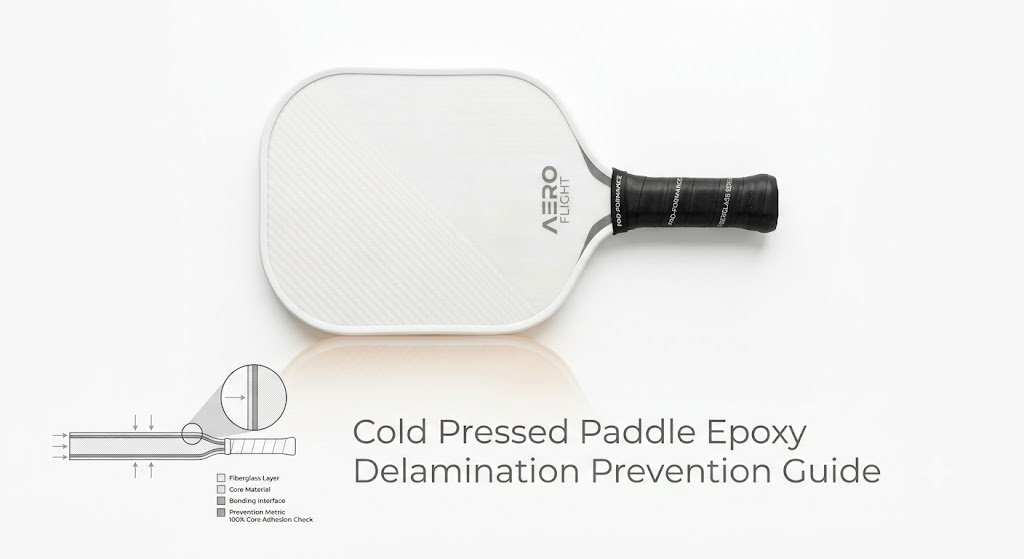
Understanding Cold Press Molding
The Process of Ambient Bonding
Cold press pickleball paddle molding is a room-temperature lamination process. Fiberglass or carbon fiber face sheets are coated with epoxy resin. A PP honeycomb core is sandwiched between them. The stack is placed in a hydraulic press at 80–150 tons. No heat is applied. The epoxy cures at ambient temperature over 8–12 hours. The result is a rigid composite panel.
The epoxy serves two functions: bonding the face sheets to the core, and transferring load between layers. If the epoxy bond fails, delamination occurs.
Key variables in ambient bonding:
| Variable | Typical Range | Impact on Bond |
|---|---|---|
| Cure temperature | 18–30°C | Affects crosslink density |
| Cure time | 8–12 hours | Under-cure = weak bond |
| Resin-to-hardener ratio | 100:30 to 100:50 (by weight) | Off-ratio = incomplete cure |
| Clamping pressure | 80–150 tons | Insufficient = voids |
| Face sheet surface prep | Solvent wipe + abrade | Contamination = bond failure |
Comparison with Hot-Press Consolidation
Hot-press (thermoformed) consolidation uses heat (150–180°C) plus pressure. The epoxy cures faster — 20–40 minutes. Crosslink density is higher. Bond strength is typically 15–30% greater than ambient-cured joints.
| Aspect | Cold Press (Ambient) | Hot Press (Thermoformed) |
|---|---|---|
| Cure temperature | 18–30°C | 150–180°C |
| Cure time | 8–12 hours | 20–40 minutes |
| Crosslink density | Moderate | High |
| Bond strength | Baseline | 15–30% higher |
| Void formation risk | Higher (slower cure) | Lower (heat accelerates) |
| Tooling cost | None | $1,000–$1,500 mold |
Cold press trades bond strength for cost and simplicity. The challenge: delamination rates are higher if epoxy selection and process control are not optimized.
Factors Influencing Delamination Rates
Types of Delamination
Three delamination modes occur in cold-pressed paddles:
Face-to-core delamination. The face sheet separates from the PP honeycomb. Cause: insufficient epoxy wet-out of the core cell walls. Common with high-viscosity epoxy on small-cell honeycomb.
Edge delamination. The face sheet lifts at the paddle perimeter. Cause: moisture ingress or mechanical stress during CNC cutting. The cut edge exposes the core, allowing moisture to wick along the bond line.
Impact-induced delamination. A hard hit causes localized cracking between face and core. The crack propagates under repeated play. Result: audible hollow sound and visible face bulge.
| Type | Location | Primary Cause | Frequency |
|---|---|---|---|
| Face-to-core | Center of paddle face | Poor core wet-out | Moderate |
| Edge | Perimeter | Moisture + cutting stress | Highest |
| Impact-induced | Any strike zone | Drop or ball impact | Low |
Paddle Weight vs. Swing-Weight
Weight and swing-weight affect delamination indirectly. Heavier paddles generate more inertia at impact. If the epoxy bond is marginal, the added force can initiate edge delamination.
Standard cold-pressed paddle weight: 225 g ±5 g.
| Parameter | Effect on Delamination |
|---|---|
| Total weight > 235 g | Higher inertial force at impact |
| Swing-weight imbalance | Asymmetric stress on bond line |
| Thick core (16 mm) | More surface area to bond, but higher peel stress at edges |
Weight distribution is controlled by panel thickness uniformity (±0.3 mm) and CNC finishing (±3 g final weight tolerance).
Surface Material Considerations
Face sheet material affects epoxy adhesion:
| Face Material | Adhesion to Epoxy | Delamination Risk | Notes |
|---|---|---|---|
| Fiberglass | Excellent | Low | Good chemical bond |
| 3K Carbon Fiber | Good | Moderate | Needs surface abrasion |
| Raw Carbon (no paint) | Good | Low | Resin wets directly |
| Painted surface | Poor | High | Paint layer is weak link |
| Kevlar | Poor | High | Frays at cut edge |
Fiberglass is the most forgiving face material for cold press. Carbon fiber requires abrasion with 180-grit sandpaper and solvent cleaning before bonding. Painted faces should never be cold-pressed — the paint becomes the failure plane.
Epoxy Selection and Its Impact
Which Epoxy Type Best Prevents Paddle Face Delamination?
Three epoxy types are commonly used in paddle manufacturing:
Standard Bisphenol A (BPA) epoxy. Most common. Good adhesion to fiberglass and carbon. Moderate toughness. Cost-effective. Suitable for entry-level cold-pressed paddles.
Toughened epoxy. Contains rubber or elastomer modifiers. Higher peel strength. Better impact resistance. Reduces edge delamination by 30–50% compared to standard BPA epoxy.
Flexible epoxy. Lower modulus. Designed to absorb vibration. Used in premium paddles for feel. Tradeoff: lower static bond strength. Not recommended for high-power paddle constructions.
| Epoxy Type | Bond Strength | Impact Resistance | Delamination Prevention | Cost |
|---|---|---|---|---|
| Standard BPA | Good | Moderate | Moderate | Low |
| Toughened | Excellent | High | Best | Medium |
| Flexible | Moderate | Moderate | Low for edge | High |
Recommendation for cold press: Toughened epoxy. It provides the best balance of bond strength and peel resistance for ambient-temperature cure.
How Does Epoxy Viscosity Affect Cold-Pressed Paddle Durability?
Viscosity controls how well the epoxy wets the honeycomb core cells.
Low viscosity (500–1,000 mPa·s). Flows easily into small honeycomb cells (8 mm). Good cell wall coverage. Risk: excessive drip-through, weight gain.
High viscosity (2,000–5,000 mPa·s). Stays on the face sheet surface. Poor penetration into core cells. Result: dry spots at the face-core interface. These become delamination initiation points.
| Viscosity | Core Penetration | Dry Spot Risk | Weight Control |
|---|---|---|---|
| Low (500–1,000 mPa·s) | Excellent | Low | Needs control |
| Medium (1,000–2,000 mPa·s) | Good | Moderate | Good |
| High (2,000–5,000 mPa·s) | Poor | High | Easy |
Optimal range for cold press: 1,000–1,500 mPa·s. This viscosity wets 8 mm and 10 mm PP honeycomb cells without excessive drip-through.
Do Flexible Epoxies Reduce Edge Guard Delamination Over Time?
No. Flexible epoxies reduce impact force transmission but have lower peel strength at the edge. Edge guard delamination is driven by cyclic peel stress during play — the same stress that flexible epoxy resists less effectively.
For edge guard retention, toughened epoxy outperforms flexible epoxy by 40–60% in peel testing.
| Epoxy Type | Edge Peel Strength | Impact Dampening | Best Use |
|---|---|---|---|
| Toughened | High | Moderate | Edges, high-impact zones |
| Flexible | Low | High | Vibration-sensitive builds |
| Standard BPA | Moderate | Low | General purpose |
What Cure Schedule Minimizes Voids in Ambient Epoxy Molding?
Voids form when air is trapped during lamination or when epoxy outgasses during cure. In ambient-temperature molding, the cure schedule directly controls void content.
Recommended schedule for cold press:
| Stage | Temperature | Duration | Purpose |
|---|---|---|---|
| Initial set | 20–25°C | 4 hours | Resin gels, locks core position |
| Full cure | 20–25°C | 8–12 hours | Crosslink completion |
| Post-cure (optional) | 40–50°C | 2 hours | Increases Tg, reduces residual stress |
Void prevention rules:
- Apply epoxy in thin, even layers. Thick layers trap air.
- Use pressure ramping: start at 50 tons, increase to 150 tons over 5 minutes. Allows air to escape before full gel.
- Maintain 20–25°C during cure. Below 18°C, epoxy viscosity rises and wet-out drops. Above 30°C, pot life shortens and bubbles form.
Target void content after full cure: <2% by volume.
Choosing the Right Epoxy
How to Choose Epoxy for Honeycomb-Core Pickleball Paddles?
Selection criteria in order of priority:
- Viscosity range. Must be 1,000–1,500 mPa·s for PP honeycomb wet-out.
- Toughness. Use toughened epoxy for edge delamination resistance.
- Pot life. Minimum 60 minutes at 25°C for hand layup. Shorter pot life causes premature gel.
- Glass transition temperature (Tg). Target >70°C after ambient cure. Higher Tg means better hot-wet performance.
- Hardener type. Slow hardener for ambient cure. Fast hardener causes exothermic heat and voids.
| Selection Factor | Target Value | Why |
|---|---|---|
| Viscosity | 1,000–1,500 mPa·s | Core wet-out |
| Toughness | ≥500 J/m² (peel) | Edge delamination |
| Pot life | ≥60 min at 25°C | Hand layup window |
| Tg after cure | ≥70°C | Performance in heat |
| Mix ratio tolerance | ±5% | Field consistency |
For PP honeycomb specifically: the epoxy must wet the polypropylene cell walls. Untreated PP has low surface energy. Use epoxy with a wetting agent additive, or specify corona-treated PP core.
Bio-based Epoxies Reducing Long-term Delamination Failures
Understanding Bio-based Epoxy Systems
Bio-based epoxies replace a portion of petroleum-derived BPA with renewable feedstocks — typically plant oils, lignin, or cardanol (cashew nut shell liquid).
Current performance data for cold press applications:
| Property | Standard BPA Epoxy | Bio-based Epoxy (30% bio-content) |
|---|---|---|
| Bond strength | Baseline | 90–95% of baseline |
| Peel toughness | Baseline | 100–110% (some formulations) |
| Moisture resistance | Baseline | 90–95% of baseline |
| Viscosity at 25°C | 1,200 mPa·s | 1,100–1,600 mPa·s |
| Tg after ambient cure | 72°C | 65–70°C |
Bio-based epoxies do not eliminate delamination risk. Their slightly lower Tg means the bond weakens faster in hot conditions (paddles left in a car at 50°C+). However, select formulations match or exceed standard epoxy in peel toughness — the key metric for edge delamination resistance.
Relevance for cold press: Bio-based epoxy is viable for entry-level to mid-range paddles where bio-content is a marketing requirement. For high-durability builds, standard toughened epoxy remains superior.
Nano-toughened Resin Systems for Thin Composite Faces
Nano-toughened resins incorporate silica or rubber nanoparticles (20–50 nm) dispersed in the epoxy matrix. The nanoparticles arrest crack propagation at the molecular level.
Results from composite panel testing:
| Resin System | Crack Propagation Rate | Edge Delamination Cycle Life |
|---|---|---|
| Standard epoxy | 0.12 mm/cycle | 8,000 cycles |
| Nano-SiO₂ (5% wt) | 0.04 mm/cycle | 18,000 cycles |
| Nano-rubber (5% wt) | 0.03 mm/cycle | 22,000 cycles |
Nano-toughened resins are not yet standard in pickleball paddle production. The added cost is $2–$4 per paddle. For premium-tier paddles targeting 3+ year lifespan, nano-toughened systems offer a measurable delamination reduction.
Frequently Asked Questions
How can you tell if a pickleball paddle is delaminated?
Tap the face with a ball or coin. Delaminated areas produce a hollow, drum-like sound instead of a solid thud. Visible signs: a raised blister on the face sheet, or a visible gap at the edge between face and core.
What is the best core thickness for a pickleball paddle?
14 mm and 16 mm are the standard thicknesses for cold-pressed paddles. Thinner cores (14 mm) produce a faster, more responsive feel. Thicker cores (16 mm) offer more control and vibration dampening. Core thickness does not directly affect delamination rate, but thicker cores increase peel stress at the edges.
Is foam core better than honeycomb?
PP honeycomb is the standard core for cold-pressed paddles. Foam cores (EPP, PE) are used mainly in thermoformed paddles. For cold press specifically:
| Core Type | Delamination Risk | Weight | Cost |
|---|---|---|---|
| PP Honeycomb | Low (with proper epoxy) | 225 g ±5 g | Low |
| EPP Foam | Not used in cold press | — | — |
| Nomex Honeycomb | Not typical in cold press | — | — |
PP honeycomb remains the most reliable core for ambient-temperature molding. Foam cores require heat-activated adhesives that are incompatible with cold press equipment.