Key Takeaways
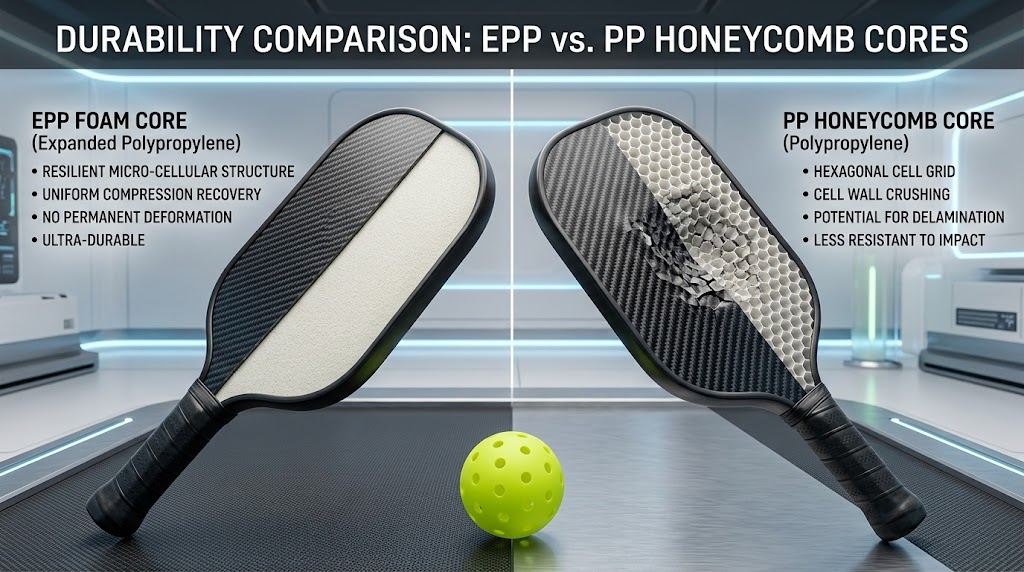
- Yes — EPP cores last longer in one key way: they don’t crush like honeycomb cores do.
- A crushed honeycomb core never heals. The dead spot stays forever.
- EPP cells compress and bounce back. The paddle feels the same in month twelve as on day one.
- EPP has weak edges, so it needs an EVA foam wall. It also costs more than honeycomb.
- Build quality matters as much as the core. A bad EPP build fails faster than a good honeycomb paddle.
- Test before you buy: tap the face, check the weight, press the edge.
Most buyers ask about EPP for one reason: they have seen honeycomb paddles go dead. Does the higher price of EPP actually buy a longer-lasting paddle? Yes — with one exception and one warning about build quality. Here is the full picture.
The Short Answer: Yes, in One Specific Way
EPP cores beat PP honeycomb cores in one clear way: they don’t crush. A honeycomb core takes hard hits over and over. Slowly, its thin walls fold in and stay folded. That zone of the paddle goes soft — a dead spot — and it never comes back.
EPP works differently. Its foam cells compress when the ball hits, then push back to their original shape. The core keeps the same feel for the life of the paddle. That one difference is the whole durability story.
What “Durable” Actually Means in a Paddle
“Durable” covers four different things:
- Face durability — does the surface keep its grip? That’s the face, not the core.
- Edge durability — does the rim survive court hits? That’s the edge wall.
- Core durability — does the inside keep its bounce? That’s the core question.
- Bond durability — do the layers stay glued? That’s factory process.
EPP wins number 3 and helps number 4, because solid foam has no empty channels where cracks can spread. But face, edge, and glue work are separate choices. Spec them all — don’t assume “EPP” fixes everything.
What Core Crush Really Is
Core crush is not normal wear. It is damage. When a hard smash hits a honeycomb paddle, the thin plastic walls inside the core fold in. They don’t fold back. That spot loses its support, and the face above it goes soft.
It gets worse over time. Once one zone crushes, nearby hits load the walls around it even harder. The dead spot grows. Players often think the paddle is “breaking in.” It isn’t. It is breaking down.
And there is no fix. Crushed walls don’t spring back. No repair brings that zone back. The paddle’s feel is changed for good.
How PP Honeycomb Cores Crush
A honeycomb core is a grid of thin plastic walls with hexagonal holes. This design is light and cheap — that’s why the industry used it for years. But those thin walls are also its weak point. A hard hit pushes all its force into a small zone, and a wall that thin has nowhere to go but inward.
The signs are easy to spot: the paddle “went dead,” serves lose pop, the sweet spot feels smaller, and the sound turns dull where the core gave up.
Why EPP Cores Don’t Crush
EPP is not a grid of walls. It is a solid foam full of tiny sealed air pockets. When the ball hits the face, the pockets under it squeeze. When the ball leaves, they push back to full size.
The key trait here is bounce, not hardness. EPP can take thousands of hits and still recover every time. There is no wall to fold, no pocket that stays flat. So the paddle sounds and plays the same season after season — no dead spots, no fade.
The One Thing EPP Doesn’t Win
Here is the honest part. Bare EPP is soft at the edge. Hit near the rim and the paddle feels mushy. Honeycomb, on a bare-core basis, actually has a harder edge.
The fix is well known: inject an EVA foam wall around the core during molding. The wall is usually 5–6 mm wide. It makes the rim solid, extends the sweet spot, and seals the edge. But it adds a step — and EPP costs more than honeycomb sheet. That’s why EPP paddles sit in the premium tier.
So the full trade is simple: EPP wins on core durability. Honeycomb wins on price. Neither wins the edge on its own — both need edge engineering.
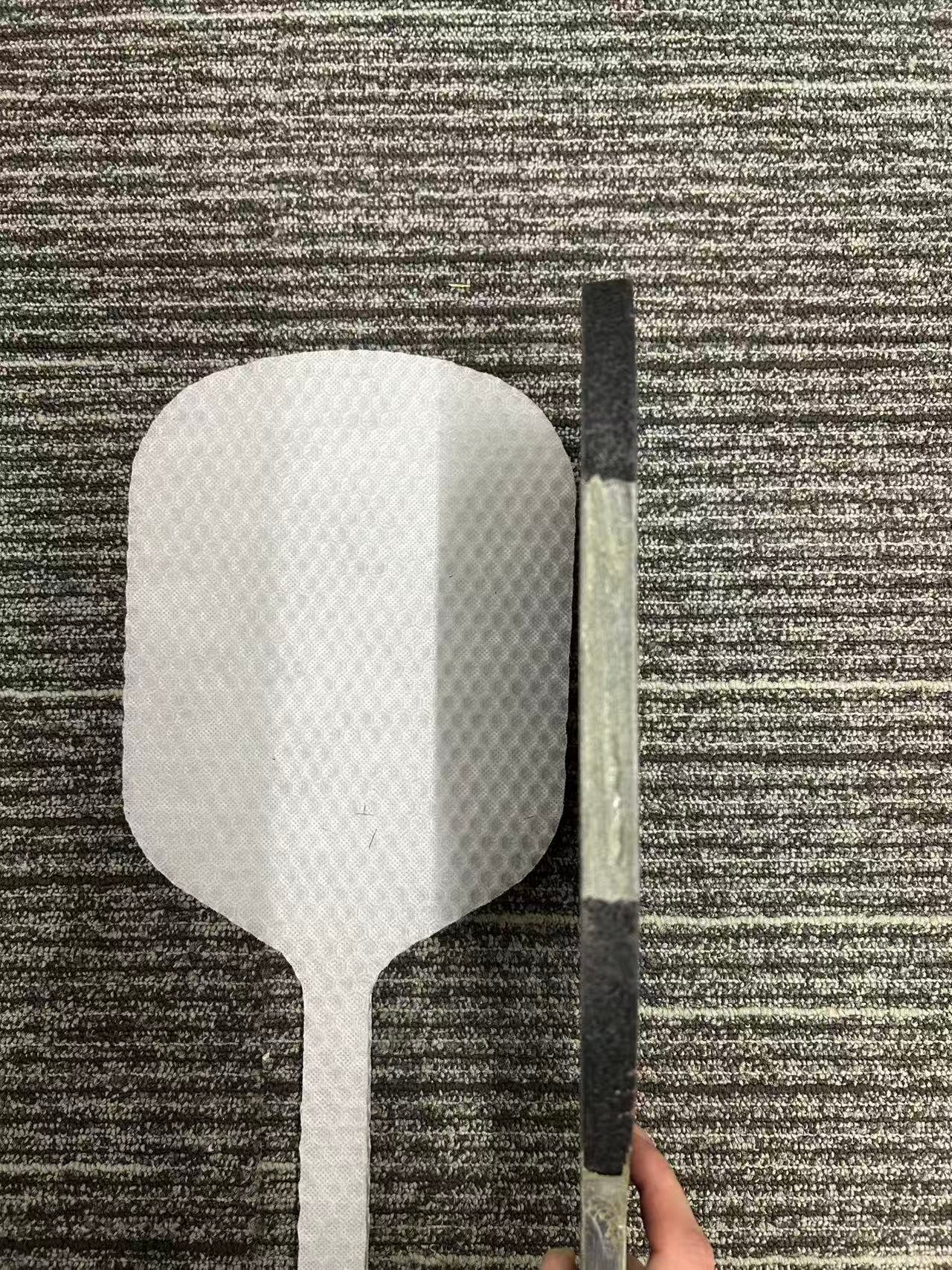
pp core vs EPP core
Build Quality Matters More Than the Core Name
Core material sets the ceiling, not the floor. A cheap, low-density EPP core in a sloppy build will fail faster than a well-made honeycomb paddle. Density drift, bad resin cure, and skipped checks are factory problems — no core label can fix them.
What good build quality looks like on paper:
- Density stated in g/L and checked per batch. This is the best sign of a consistent core.
- One-piece thermoformed construction. No glue line at the edge to fail.
- Documented face-to-core bonding. This is where delamination starts or doesn’t.
- Weight held within tolerance (225 g ±5 g, or ±2–3 g). Weight drift means density drift.
Ask suppliers about the process, not just the material. This is where it helps to work with a dedicated EPP core pickleball paddle manufacturer — one that molds its own cores, runs batch density reports, and can send cutaway samples. Then you can check the claims instead of trusting them.
How to Check for Core Crush Before You Buy
On samples, before you order:
- Tap test. Tap across the face with a knuckle. A dry, even sound means a solid core. Dull spots mean voids or damage already there.
- Weight check. Weigh the sample. If it misses the target, the core density is off — and uneven density leads to uneven wear.
- Edge press. Press the rim with your thumb. Solid is good. Flex or creak means a weak edge wall.
- Cutaway sample. Ask for a paddle cut in half. It shows the core, the edge wall, and the layers in one look.
In production, after you order:
- Inspect with dead zones listed as major defects, not cosmetic ones.
- Get weight reports per batch to catch density drift before it ships.
- Run drop tests — drop the paddle on its edge from about 1.5 m a few times.
Core crush is preventable. But the material alone doesn’t prevent it — the material plus a controlled process does.
What Core Crush Costs You
A dead paddle in a customer’s hands turns into one of three things: a warranty replacement, a refund, or a customer who never buys again. The third one costs the most.
The hidden costs add up too. “Went dead after two months” is a one-star review pattern that scares off new buyers. Clubs stop reordering when a fleet fades mid-season. And your team burns hours on “is my paddle dead?” tickets.
This is the business case for EPP: the extra cost at the factory is offset by the warranty and churn costs you avoid. For brands selling to clubs, coaches, and heavy players — the people most likely to crush a honeycomb core — the math clearly favors EPP.
Durability Expectations by Build
| Build | Core crush risk | Edge strength | How long it lasts | Best fit |
|---|---|---|---|---|
| EPP + EVA perimeter | Very low | High | Life of the face and grip | Premium lines, clubs, hard hitters |
| PP honeycomb + EVA perimeter | Medium | High | Good — until it crushes | Value and mid-price lines |
| Hybrid foam builds | Low to medium | High | Good | Mid-to-premium lines |
The honest read: EPP with an EVA wall is the most crush-resistant build you can buy. Honeycomb with a good wall is a solid product — right up until its one weak spot shows up. Hybrids sit in between, and their durability depends on the foam spec behind them.
FAQ
Does EPP really last longer than PP honeycomb?
On the core, yes. EPP cells bounce back from hits instead of folding in for good. Face and grip wear are about the same on both builds — the core is where they differ.
Can a crushed core be fixed?
No. Crushed honeycomb walls never recover, and no repair brings the zone back. Prevention is the only strategy: right spec, right process.
Is EPP better against drops and edge hits?
Not on its own — bare EPP edges are softer than honeycomb’s. The EVA wall does that job. With a good wall, EPP paddles handle drops as well as any thermoformed paddle.
Which build should a club buy?
EPP + EVA perimeter. Clubs hit hard and often — exactly the pattern that finds honeycomb’s weak spot first. Fewer replacements pay back the premium.
Final Checklist: Durability Questions for Your RFQ
- Core density in g/L — a number, not a range.
- Edge wall: EVA, width in mm.
- Face-to-core bonding process.
- Weight tolerance: 225 g ±5 g, or ±2–3 g.
- Cutaway sample available.
- Dead zones listed as major defects in inspection.
- Weight reports per batch.
- Warranty terms for early core failure.
- USA Pickleball Equipment Standards Manual
Durability isn’t a slogan — it’s a list of specs you verify. EPP gives you the stronger core. Make sure the build around it deserves it.