Key Takeaways
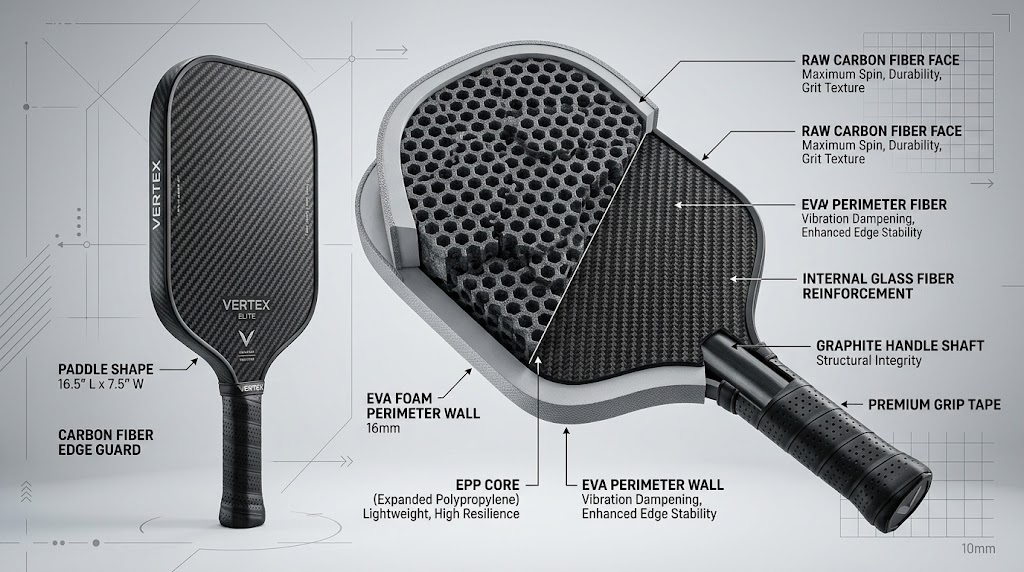
- EPP cores win on durability (no collapse), feel (quieter), and weight control. Bare EPP edges are soft and need an EVA perimeter. EPP is a premium-priced build.
- EPP is not “better than honeycomb” — it is different, and it suits some price tiers better than others.
- The deciding questions are about your target player and price point, not about which material is newer.
- Verify density (g/L), perimeter construction and weight tolerance before ordering — the label alone proves nothing.
Almost every buyer asking about EPP wants the same thing: an honest read on whether it is worth the premium. This article gives that read. It lists what EPP genuinely does better, what it gives up, where it belongs on your line, and where it does not pay. No marketing framing — just the trade-offs a brand owner needs before choosing a core.
A Balanced Look: No Core Is Perfect
Every paddle core is a set of trade-offs. PP honeycomb is cheap and proven but can crush. Soft foam is affordable but dead. EPP is durable and quiet but costs more and cannot stand alone at the edge. Treating any core as “the best” is a mistake; treating it as “the right fit for this price tier and player” is how winning lines are built.
The Advantages: What an EPP Core Does Better
Three advantages separate EPP from honeycomb: it does not collapse, it plays quieter, and it is light, strong and recyclable. Each one maps to a real buying reason rather than a spec-sheet abstraction.
Advantage #1: EPP Cores Don’t Collapse
The Failure It Removes
PP honeycomb cores can crush permanently where the player hits hardest. Over months, a soft dead spot forms and the paddle “goes dead.” EPP is closed-cell foam: cells compress under impact, then recover. There is no thin wall to break.
What That Means for Your Brand
Fewer dead-paddle complaints, fewer warranty replacements, and a paddle that plays the same in month one and month twelve. For clubs, coaches and tournament programs, this consistency is the strongest single reason to choose EPP.
Advantage #2: Quieter in the Hand, Easier on the Arm
Less “Ting,” More Feel
Honeycomb’s hollow channels resonate, producing a higher-pitched “pop” and sharper off-center vibration. Closed-cell EPP absorbs that high-frequency vibration before it reaches the hand.
Who Notices It Most
Players with elbow or wrist sensitivity, and anyone hitting for hours. A 30-second demo — same swing, two paddles — is usually enough for a customer to feel the difference. Quiet is one of the few paddle benefits that sells itself.
Advantage #3: Light, Strong and Recyclable
Light and Strong
EPP has a high strength-to-weight ratio. A 16 mm EPP build lands around 225 g without fragile walls, and density is tuned at molding to hold a tight weight window (±5 g standard, ±2–3 g on a Precision Program).
Recyclable
EPP is a single-resin material (polypropylene), recyclable without layer separation. That gives sustainability-positioned brands a genuine, non-greenwashed claim.
The Limitations: What EPP Gives Up
Premium Price
EPP costs more than honeycomb at the same quality tier. The retail delta is real: foam-core paddles command the USD 100–250 tier, while honeycomb anchors the value wall.
Not a “Feeling” Upgrade for Everyone
The damped, quiet feel is a benefit to most players — but players who love a lively, springy, “poppy” honeycomb response may read EPP as less exciting. It is a different feel, not a universally preferred one.
The Edge-Rigidity Problem (and How EVA Perimeter Fixes It)
Bare EPP Is Soft at the Rim
EPP alone lacks edge rigidity. Hit near the rim of a bare EPP paddle and the response goes mushy. This is the one genuine structural weakness of the material.
The Fix: An EVA Perimeter Wall
Modern thermoformed builds inject an EVA foam wall (typically 5–6 mm) around the core. That wall stiffens the rim, extends the sweet spot and seals the edge. A quality EPP paddle is never “EPP only” — it is EPP core plus EVA perimeter. If a supplier’s spec sheet lists EPP without a perimeter line, that paddle will underperform at the edges. This is also the point where working with a dedicated EPP foam core pickleball paddle manufacturer pays off: a factory that molds its own cores and injects its own EVA walls controls the whole structure, so the edge fix is engineered in rather than added on.
Cost and Positioning: EPP Is a Premium Build
The B2B Price Reality
At OEM MOQ 200 pcs, a thermoformed EPP + raw carbon + EVA perimeter paddle lands around USD 25–40 / pc FOB. That maps to a USD 100–250 retail paddle. Below that price band, an “EPP” label usually signals low-density foam or a compromised build.
Where It Sits on Your Line
Use EPP for your premium and tournament tiers. Keep honeycomb or budget foam for your value tier. Trying to make EPP hit a USD 79 retail price forces corners that destroy the advantages above — a thin core, a low-density foam, or a painted face that hides the compromise.
Appropriate Applications: Where EPP Belongs (and Where It Doesn’t)
| Fits EPP well | Does not need EPP |
|---|---|
| Premium brand flagships | Entry-level / first-paddle lines |
| Club and training fleets | Budget retail under USD 100 |
| Tournament / power-focused builds | Giveaway and promo paddles |
| Sustainability-positioned brands | Lines where weight matters more than feel |
The pattern: EPP pays off where durability, consistency and ergonomics justify a premium. It does not pay off where price is the only decision factor.
EPP vs the Alternatives: One Honest Comparison Table
| Factor | EPP core | PP honeycomb | Soft foam (EVA/PU) |
|---|---|---|---|
| Durability | Excellent — no collapse | Fair — can dead-spot | Poor to fair |
| Feel | Crisp, damped, quiet | Lively, springy | Soft, muted |
| Edge rigidity (bare) | Weak — needs EVA wall | Weak — needs edge guard | Weak |
| Weight control | Excellent (density-tuned) | Good | Good |
| Recyclability | Yes (single resin) | Yes | Varies |
| Cost tier | Premium | Mid | Low |
| Best use | Flagship, clubs, tour | Value-to-mid lines | Budget lines |
Read it honestly: EPP wins on durability and quiet; honeycomb wins on price and lively feel; soft foam wins only on cost. Your tier decides the winner.
How to Decide: A Four-Question Test for Your Brand
- Who is the player? Power hitters, clubs and elbow-sensitive players justify EPP. First-timers do not feel the difference.
- What is the retail price? Above USD 100, EPP can carry the price. Below USD 100, it cannot — the build would have to be hollowed out.
- What is the story? If your brand sells consistency, ergonomics or sustainability, EPP supports the claim. If you sell pure value, honeycomb supports it better.
- What does the warranty say? If dead-paddle claims have cost you money, EPP is the direct fix.
Four honest answers give you the core. If three or more point to EPP, it belongs in your line.
FAQ: Is EPP Actually Better? Does It Lose Power? Is the Extra Cost Worth It?
Is EPP actually better than honeycomb?
Better for specific goals — durability, quiet, consistency — and at premium price points. Not better for budget lines or players who prefer a lively honeycomb feel. “Better” depends on the fit.
Does EPP lose power?
No. At equal density and thickness, EPP returns similar energy to honeycomb, delivered in a damped wave. Players sometimes read the quieter feel as less power; on hard drives it holds up.
Is the extra cost worth it?
If your line targets the premium tier, clubs or tournament players — yes, the durability and feel justify it. If your line competes under USD 100 retail, the cost is not worth it.
Why do EPP paddles need an EVA perimeter?
Bare EPP edges are soft. The EVA wall stiffens the rim and extends the sweet spot. EPP + EVA perimeter is the complete build; EPP alone is not.
Is EPP USAP legal?
Yes. USAP rules govern dimensions, weight and surface, not core material. Certification is filed by the brand using USAP-compliant samples.
Final Checklist: EPP Specs to Confirm Before Ordering
- Core density in g/L, stated as a number — not just “EPP.”
- Perimeter construction: EVA wall, width in mm.
- Thickness: 14 or 16 mm.
- Weight tolerance: 225 g ±5 g, or ±2–3 g Precision Program.
- Face material and grade stated separately from the core.
- MOQ, sample lead time and production lead time in writing.
- Foam datasheet and batch density report promised with the PO.
- Sample for tap, edge-press and play testing.
EPP is a strong core with clear trade-offs. Choose it where it pays, verify what you order, and let the paddle’s fit — not the label’s novelty — make the sale.