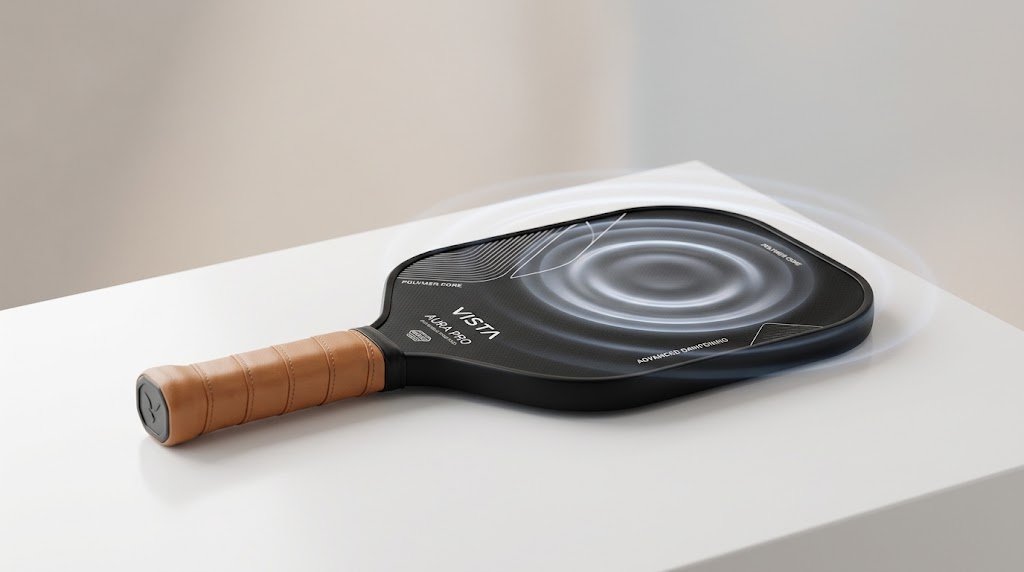
Play pickleball a few times a week and you know the feeling. A hard drive lands on your paddle face, and the shock travels straight into your wrist and elbow. Some paddles soak that up. Others pass it right along.
This guide covers where paddle vibration comes from, how an EPP foam core handles it, and whether the “arm-friendly” label is real physics or just marketing.
The Short Answer: Yes, Foam Damps Vibration Better Than Honeycomb
A foam core paddle vibrates less than a polypropylene (PP) honeycomb paddle. That is not a slogan. It is material science.
Honeycomb cores are thin plastic walls full of air cells. They are light and stiff, and stiff materials pass energy along fast. So the shock reaches your hand sooner.
EPP — expanded polypropylene — works differently. It is a solid mass of tiny closed cells. When a ball hits the face, the cells compress and spring back. That cycle turns sharp impact energy into small amounts of heat. Less energy left over means less buzz in your hand.
So yes: if vibration is your pain point, foam is the stronger core.
Where Paddle Vibration Comes From: Face, Core and Handle
Vibration starts at contact and moves through three layers:
- The face. Carbon fiber is stiff and passes shock quickly. Fiberglass flexes more and softens the hit.
- The core. This is the main filter. It decides how much energy dies inside the paddle and how much reaches your hand.
- The handle. The grip absorbs whatever is left. Grip size, material, and length all matter.
One more thing: off-center hits vibrate far more than sweet-spot hits. Foam cores make the sweet spot bigger, so fewer mishits sting and each hit sends less shock.
How EPP Foam Absorbs Shock: Closed-Cell Damping Explained
EPP starts as small plastic beads, molded with steam into a solid core. Each bead is full of tiny sealed cells holding air.
On impact, the ball presses into the face for a few milliseconds. The foam cells under that spot compress, absorb energy, and push back. Some energy returns as rebound — your power. The rest turns into heat and disappears.
This is called damping. Honeycomb walls bounce energy back and forth, which is why they buzz. Foam converts the energy instead of echoing it. Two specs control how much damping you get:
- Density, measured in grams per liter (g/L). Paddle cores usually run 30–90 g/L, with 40–60 g/L common. Higher density means firmer support. Lower density means a plusher feel.
- Thickness. A 16 mm core damps more than a 14 mm core — the shock travels farther through foam.
Most EPP paddles add an EVA foam perimeter wall, 5–6 mm wide, around the edge. Bare EPP edges are soft and can dent, so the wall protects the rim — and damps edge hits too.
Vibration Damping Compared: EPP vs PP Honeycomb vs Foam-Injected Perimeter
Not all “foam” paddles are the same. Three builds dominate the market:
| Build | How It Damps | Feel | Best For |
|---|---|---|---|
| Full EPP foam core | Closed-cell foam absorbs shock across the whole face | Plush, smooth, stable | Comfort seekers and seniors |
| PP honeycomb + foam-injected perimeter | Foam only in the rim; center cells stay hollow | Crisp center, softer edge | Familiar feel, softer edges |
| Pure PP honeycomb | Air cells echo energy; face and grip do the softening | Crisp, lively, more buzz | Power players |
The ranking is simple. A full foam core damps the most — the whole core works as one shock absorber. A foam-injected perimeter only protects the edge; the center still acts like a honeycomb. So when a brand claims “arm-friendly,” check which build it actually uses.
Arm Fatigue and Tennis Elbow: What Actually Helps (and What Doesn’t)
Tennis elbow is irritation of the tendons on the outside of the elbow. Repeated shock plus a tight grip is what irritates them. A comfort paddle helps — but it is one input, not a cure.
What actually helps:
- Lower vibration. A damping core reduces the shock that reaches the tendon on every hit.
- Mid weight, not ultra-light. Ultra-light paddles make your arm swing harder for depth. Around 225 g suits most players.
- A bigger grip or a softer wrap. A thin grip forces you to squeeze harder. More grip force means more tendon load.
- Clean contact. Sweet-spot hits avoid the worst shock, and foam’s bigger sweet spot helps.
What doesn’t help: expecting the paddle to fix everything. Bad technique and five sessions a week still cause trouble. A comfort paddle lowers the load. It does not remove it. The honest pitch is “less vibration, easier on your arm.”
Why Senior and Recreational Players Feel the Difference Most
Two groups notice foam cores the most.
Senior players are a fast-growing share of the pickleball market. Tendons lose some elasticity with age, and recovery slows down. For them, less vibration is often the difference between playing three times a week and resting on ice packs.
Recreational players hit off-center more often. Every mishit on a stiff honeycomb sends a sharp ring through the handle. A foam core turns most of those into soft thuds. Beginners benefit too: the bigger sweet spot forgives misses and keeps learning fun.
Strong players with clean technique may not feel much. For everyone else, it shows up by the third game.
Arm-Friendly as a Positioning Play: How Comfort Paddle Brands Use EPP
Some brands saw this trend early. Their play:
- Lead with comfort words: “arm-friendly,” “shock-absorbing,” “easy on the joints.”
- Target the growing 50+ demographic.
- Keep performance credible. EPP still returns energy well, so the paddles play, not just feel.
For a brand planning its own comfort line, the supplier matters more than the slogan. Damping comes from real density control and molding quality, and those are factory decisions. That is the practical case for working with an EPP pickleball paddle manufacturer that molds its own cores in house: you get batch density reports, cutaway samples, and paddles you can test before the “arm-friendly” label goes on.
The Trade-Off: What You Give Up for Comfort
Foam cores have downsides. Know them before you sell.
- Less crisp feedback. Damping soaks up the sharp “pop” sound and feel. Some players love the plushness. Power players may find it muted.
- Slightly more weight. A solid foam core weighs a bit more than a hollow honeycomb. Most comfort builds land near 225 g, give or take 5 g — playable, but not the lightest.
- Molding cost. EPP needs steam molding and density control, so it costs more than basic honeycomb. Even so, an OEM paddle from a China factory typically lands at USD 25.00–40.00 per piece FOB. Comfort stays affordable.
None of these kill the idea. Comfort paddles just fit a specific player profile — and your marketing should say so.
How to Verify the Comfort Claim Before You Sell It
If you plan to sell one, verify before you advertise. Ask the factory for:
- Density reports in g/L for the actual production batch, not just the datasheet.
- A cutaway sample so you can see the foam core and EVA wall inside.
- A playtest sample — use it for two weeks of real games.
- An off-center hit test. Hit the edge, tip, and throat. A good comfort paddle stays quiet on all three.
- Weight and thickness tolerance in writing, such as 225 g ± 5 g and 14 or 16 mm.
Practical numbers: samples take 7–15 days, production of 2,000 pieces takes about 35 days, and the OEM minimum order is 200 pieces. That makes a comfort line a low-risk test.
FAQ: Best Core for Tennis Elbow? Do Heavier Paddles Reduce Vibration? Is EPP Good for Beginners?
What is the best paddle core for tennis elbow?
A full foam core — EPP or EVA — absorbs shock across the whole hitting zone. Pair it with 16 mm thickness, a mid weight near 225 g, and a proper grip. See a doctor if pain lasts — a paddle helps, but it is not medical treatment.
Do heavier paddles reduce vibration?
Extra mass absorbs some shock, but heavy paddles add swing weight — and swing weight is what tires your arm. The better answer is a mid-weight paddle with a damping core.
Is EPP good for beginners?
Yes. Beginners miss the sweet spot often, and EPP’s bigger sweet spot turns those misses into soft, stable hits. That makes learning easier on the arm and the confidence.
Final Checklist: Arm-Friendly Specs to Confirm Before Ordering
Before you order a comfort paddle from any factory, confirm:
- Core type: full EPP foam, not just foam-injected edges
- Core density stated in g/L, with batch reports
- Thickness: 16 mm for maximum damping (14 mm for faster feel)
- Weight around 225 g ± 5 g
- EVA perimeter wall 5–6 mm for edge protection and damping
- Cutaway sample reviewed
- Two-week playtest passed, including off-center hits
- Marketing stays honest: “less vibration,” not “cures pain”
Check all eight boxes and you can stand behind the arm-friendly label — with physics, not just advertising.