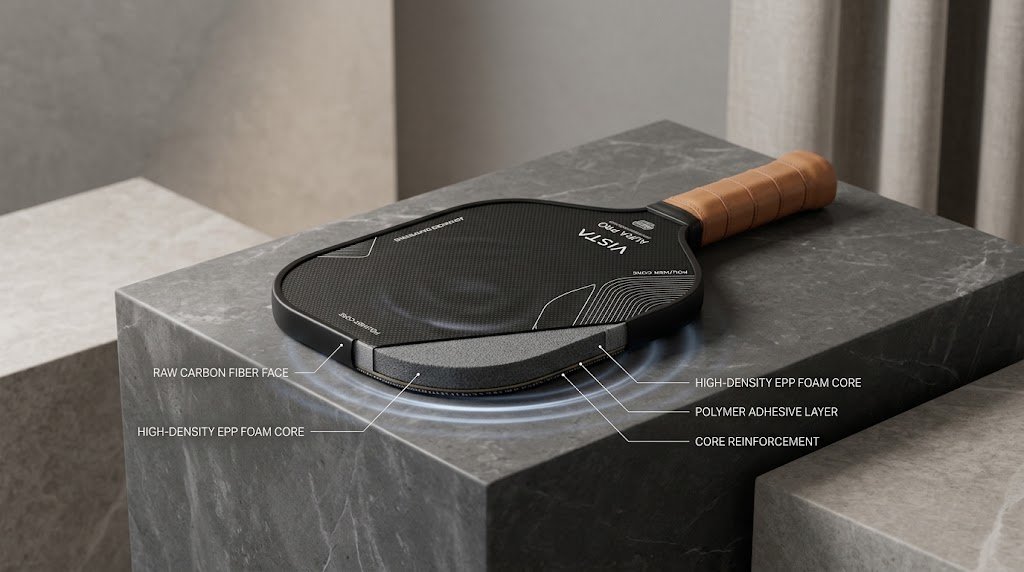
Short version: yes. EPP suits premium brands — but only if “premium” means durability, comfort, and consistent quality. It does not suit brands whose premium story is “the paddle this touring pro uses,” because almost no touring pro plays EPP today.
Below: what premium buyers pay for, where EPP delivers and where it falls short, launch costs, and the specs to lock down with your factory.
The Short Answer: Yes, If Premium Means Durable and Comfort-Positioned
Premium paddles sell for USD 100.00–250.00 at retail. Buyers in that range want a paddle that plays well for years, feels good on the arm, and does not die in month eight.
That is exactly what EPP is built for. Expanded polypropylene is a molded foam core that resists crushing, damps vibration, and holds its spec from batch to batch. Those three traits map directly onto what a premium customer expects.
The catch: EPP will not win the pro-endorsement game. It wins the quality game.
What “Premium” Actually Sells in Paddles Today
Look at what the USD 100.00+ shelf actually promises. Across major brands, the premium pitch comes down to a few concrete claims:
- Durability. A paddle that survives a season of hard play without dead spots.
- Comfort. Less vibration, a bigger sweet spot, easier on the arm.
- Consistency. Paddle number 500 plays like paddle number 1.
- Trust signals. USAP listing, a real warranty, clean product documentation.
Notice what is missing: star power. Most premium shoppers have played honeycomb paddles and watched them go soft. The repeat purchase rides on how the last paddle aged, not on who endorses the new one.
Why EPP Supports a Premium Story: Durability, Comfort, Consistency
Durability. Honeycomb cores fail by crushing. Thin plastic walls collapse over time, first around the edge and sweet spot — that is what “dead spot” means. EPP’s closed cells hold air under pressure and spring back after every hit. The core does not take a compression set, so age hits it far more slowly.
Comfort. As covered in detail across our EPP guides, closed-cell foam converts impact energy into heat instead of echoing it through the handle. Players feel a plush, stable hit with less buzz — a purchase reason for the fast-growing 50+ segment, not a bonus.
Consistency. Honeycomb cores are cut from sheets, and density varies with glue lines and cell quality. EPP is molded per core at a controlled density, stated in grams per liter (g/L). Batch density reports can prove paddle 500 matches paddle 1. That is a premium claim you can defend.
The Honest Gaps: Where EPP Falls Short of a Premium Spec
A premium line lives or dies on whether the product matches its price tag. So here are the gaps, stated plainly:
- Feel. EPP damps the sharp “pop” that advanced players tune their game around. The hit is plush and quiet. Some players read that as refined; others read it as muted. Either way, it is real.
- Pro pedigree. Almost every pro tour paddle uses a polypropylene honeycomb core, often with foam injections. If your brand story leans on tour results, EPP gives you nothing to point at.
- Weight. A solid core weighs a bit more than a hollow one. Comfort builds land near 225 g, give or take 5 g. Fine for most buyers, but not for speed addicts.
- Supplier base. Far fewer factories mold EPP cores in house than cut honeycomb. Fewer suppliers means less price leverage — and more reason to pick the right one.
None of these are hidden. Put them on the table in development and design around them.
Price, Margin and MOQ: What an EPP Line Costs to Launch
The math works, and here are the working numbers.
Factory cost: OEM EPP paddles run USD 25.00–40.00 per piece FOB, depending on density, face material, and finishing. Basic honeycomb builds land closer to USD 15.00–25.00 — the gap is steam molding and density control.
Retail: the comfort-durability segment sells at USD 100.00–250.00. Take a middle case: buy at USD 32.00, retail at USD 190.00. After shipping, duty, and channel margins, there is room for real marketing spend — this is not a razor-margin product.
Launch requirements: MOQ is typically 200 pieces. Samples take 7–15 days. A production run of 2,000 pieces or fewer takes about 35 days. In practical terms, one small production run validates the line — far less capital than a multi-SKU launch.
Differentiation: Where a Premium Brand Can Win Against the Pro Lines
Pro-endorsed brands fight over the same shelf with the same honeycomb builds. EPP lets a brand walk around that fight.
The openings are specific:
- Durability-first positioning. “The paddle that doesn’t go dead” is a claim honeycomb brands cannot copy without attacking their own core material.
- Comfort for the 50+ market. Biggest demographic, most arm complaints, least served by tour-focused marketing.
- Warranty as a weapon. More on this below — a longer warranty is only safe to promise if the core can back it up.
- Verifiable quality. Batch density reports and cutaway samples turn “premium” from an adjective into evidence.
This is where the supplier decision gets sharp. Those claims only hold if the factory molds cores in house and controls density batch to batch — the practical case for working with an EPP core paddle manufacturer rather than a trading company reselling stock honeycomb molds. In-house molding makes the quality story auditable.
Who Buys It: Target Players and Channels for an EPP Premium Line
The buyer profile is clear from the material’s strengths:
- Senior and returning players. They feel vibration most, value durability, and replace paddles less often — which makes warranty cost predictable.
- Recreational improvers. Bigger sweet spot, forgiving on mishits, priced as an upgrade from their first USD 80.00 paddle.
- Players with arm issues. Tennis elbow sends people searching; EPP shows up in every honest answer.
Fitting channels: club pro shops, paddle specialty retailers, physical therapy and sports-rehab clinics, and club gifting programs. These reward a durability story far more than a tournament story — and they reorder steadily once the paddle proves itself.
Warranty: Why EPP Makes a Longer Warranty Safer to Promise
Honeycomb-core paddles typically carry 6 to 12 months, and the fine print often excludes “core crushing” — precisely the failure customers experience.
EPP changes the math. Core crush barely exists in molded EPP. The core either holds shape or shows visible abuse damage, which the warranty excludes cleanly. That makes a 1- or 2-year warranty a defensible promise, not a gamble.
Two guardrails keep it affordable: exclude cosmetic wear and abuse, and require normal play conditions. Claim rates then stay low enough that the warranty costs less than the margin it protects.
How to Build the Line: EPP Specs to Confirm With Your OEM
Lock these specs in the development stage, in writing:
- Core density, stated in g/L for production batches, with batch reports — not just a datasheet.
- Core thickness: 16 mm for maximum comfort and damping, 14 mm for a faster feel.
- Finished weight: 225 g ± 5 g, measured per paddle, not per batch.
- EVA perimeter wall: 5–6 mm, protecting the soft EPP edge and damping rim hits.
- Face material: carbon fiber for control and a premium hand feel; fiberglass if cost matters more.
- Cutaway samples of the actual production core, so you can see what you are selling.
- USAP listing: core material is unrestricted under current rules, but certification is the brand’s job, not the factory’s. Budget the time for it.
Samples take 7–15 days. Judge them over two weeks of real play before approving production.
FAQ: Is EPP Too Soft for Pros? Is the Premium Retail Price Justified?
Is EPP too soft for advanced players?
Soft is the wrong word. EPP damps vibration and returns energy well, but it lacks the crisp feedback advanced players use to shape shots. Most touring pros stay on honeycomb for that reason. EPP is not a lesser product — it is a different one, built for comfort and durability rather than tournament feel.
Is the premium retail price justified?
Justified by what the buyer gets: a core that does not crush, less vibration at the elbow, and documented consistency. Compare that to a USD 150.00 honeycomb paddle that goes soft in eight months, and the gap closes fast. What the price cannot buy is tour credibility — EPP does not have it yet.
Final Checklist: Launch Questions to Settle Before You Commit
- Positioning: durability and comfort premium, not pro-endorsement premium
- Core density in g/L confirmed, with batch reports
- 16 mm core, 225 g ± 5 g, EVA wall 5–6 mm — all in writing
- Cutaway and playtest samples reviewed over two weeks
- Factory molds cores in house — no resold stock molds
- FOB price confirmed at USD 25.00–40.00 with MOQ 200
- Retail price set in the USD 100.00–250.00 band with margin math done
- Warranty terms drafted against actual core failure modes
- USAP listing scheduled on the brand’s side
Settle those nine and an EPP line is a defensible premium product — priced on evidence, not adjectives.