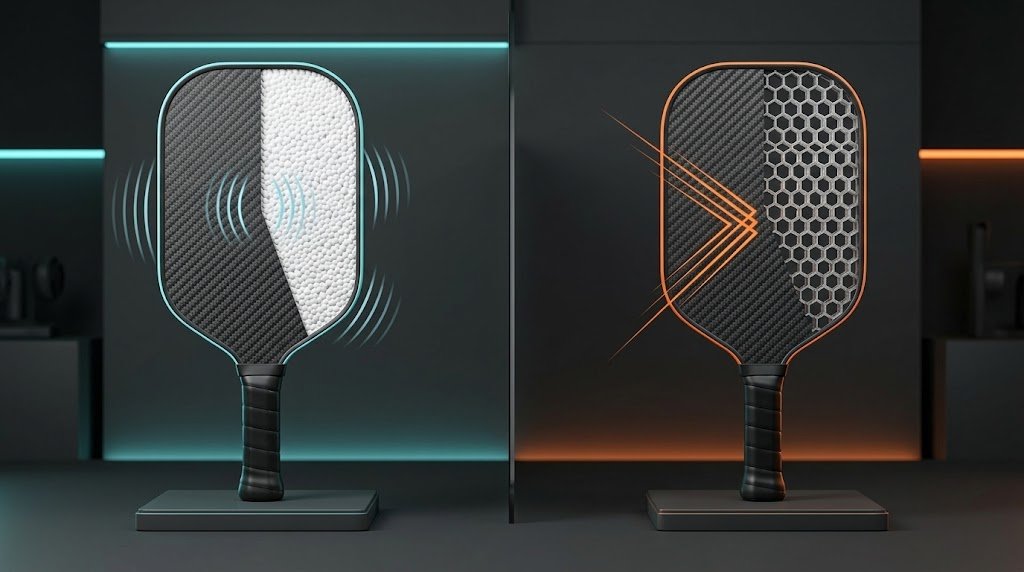
No core is better by default. EPP wins SKUs that sell comfort and durability; PP honeycomb wins SKUs that sell price and power. Picking the core before the SKU is how brands end up with the wrong paddle and a returns problem.
Below: eight decision rows — weight, feel, vibration, durability, cost, manufacturing, positioning, target customer — and where each core costs or earns you money.
The Short Answer: “Better” Depends on the SKU You’re Building
Three variables decide the core: retail price, the feel your reviews will describe, and who reorders.
EPP fits the USD 100.00–250.00 band and arm-care buyers. PP honeycomb fits entry lines under USD 100.00 and power-first buyers. Fix the SKU first.
How to Read This Comparison: Eight Rows, One Decision
Each of the eight rows follows the same three steps: what differs in the material, what that does to the finished paddle, and what it costs or earns your brand.
Two naming points before you read, because sloppy naming breaks briefs:
- PP honeycomb + EVA injection (Gen 3/4 style): honeycomb core, foam at the perimeter and sometimes the throat.
- EPP foam core + EVA perimeter (Gen 5 style): molded EPP replaces the honeycomb entirely.
Both sell as “hybrid” and “foam core,” though they behave and price differently. Keep them apart in your brief.
1. Weight — What Each Core Does to Your Spec Sheet
Material. EPP is molded at a chosen density, so a light core is a design choice. PP honeycomb is cut from sheets: light but stiff.
Effect on the paddle. Both cores reach 225 g ± 5 g. Premium lines tighten the same target to ± 2–3 g.
Brand cost and benefit. The real difference is the weight budget. A light EPP core frees grams for the face and EVA edge, which makes target weight and balance easier to hit together. Tight tolerance is a second cost tier, so name it — ± 5 g or ± 2–3 g — in the contract.
2. Feel — The Dimension That Becomes Reviews and Returns
Material. PP honeycomb walls are stiff and spring back fast, giving a crisp pop. EPP cells compress and damp the impact, giving a muted response.
Effect on the paddle. PP reads as power. EPP reads as control.
Brand cost and benefit. This is a returns issue, not a taste issue. Feel mismatch drives more returns than manufacturing defects do. Put “explosive power” copy on a damped core and reviews fill with “too soft.” Put “control” copy on a crisp core and they fill with “not enough power.” Align copy with core, or budget for returns.
3. Vibration — Which Core Unlocks Arm-Friendly Positioning
Material. EPP’s closed cells convert impact energy into heat instead of passing it through. Honeycomb walls bounce energy along toward the handle.
Effect on the paddle. EPP cuts the shock reaching the wrist and elbow. The gap is large enough to feel, not just to measure.
Brand cost and benefit. Vibration is the one row that creates a whole product line. EPP lets you build arm-friendly or senior ranges instead of attacking pro lines head-on. One caveat: arm fatigue also comes from weight, balance, and grip. Claim damping, not a cure.
4. Durability — The Warranty Math Behind Each Core
Material. PP honeycomb fails by fatigue. Thin cell walls collapse under repeated impact — that is a dead spot, and it cannot be repaired. EPP cells rebound and hold shape over a long service life.
Effect on the paddle. PP loses response gradually; EPP keeps its feel.
Brand cost and benefit. A long warranty is only safe on a core that holds shape. Most honeycomb warranties run 6 to 12 months with core crushing excluded — the failure buyers actually hit. EPP supports 1 to 2 years credibly. But material alone does not make a good paddle: back the claim with X-ray inspection, compression tests on production samples, ball-cannon testing, and batch QC reports.
5. Cost — FOB, MOQ and Where the Margin Lives
Material. Face and construction cost ladders roughly like this: fiberglass around USD 4.60; T700 woven around USD 8.50–9.00; 3K, 12K and 18K constructions around USD 9.20–12.40; hot-pressed molded construction around USD 12.80–13.20. Samples cost about 1.5× the batch price. MOQ runs 200 pieces. Tooling runs about USD 1,200.
Effect on the paddle. EPP adds molding cost on top of that ladder; honeycomb is cut and bonded, which is cheaper.
Brand cost and benefit. EPP must be absorbed by a USD 100.00–250.00 retail band. Below USD 100.00 the numbers do not close — core cost eats the margin before marketing gets any. Above that line, the difference is small against a higher price point.
6. Manufacturing — Process Fit, Lead Time and Capacity
Material. PP honeycomb runs on cold press or hot press, so entry is fast. EPP’s home is integrated hot-press molding with EVA injection.
Effect on the paddle. Sample lead time runs 10–15 days. Production of 2,000 pieces or fewer takes about 35 days. Monthly capacity on a working line is around 80,000 pieces.
Brand cost and benefit. Process fit decides delivery more than material specs do. Pressing a honeycomb supplier for a Gen 5 timetable wastes weeks. Ask “how many EPP lines have you run this year?” instead of “do you support EPP?” — a custom EPP pickleball paddle manufacturer answers that with capacity numbers, not with a yes.
7. Positioning — What Price Ladder Each Core Can Carry
Material. The core sets the claims the paddle can survive.
Effect on the paddle. EPP supports comfort, quiet, and longevity claims. PP supports power, response, and value claims.
Brand cost and benefit. Keep a banned-claim list. EPP should never claim maximum power — reviewers contradict it in week one. PP should never claim “two years, no deformation” — that invites the claims your exclusion page rules out. A mismatched claim costs trust across the whole line, which costs more than the core price difference.
8. Target Customer — Who Buys It and Who Reorders
Material. Core choice maps to buyer behavior more than demographics.
Effect on the paddle. PP suits new brands, promo SKUs, and club or bulk orders. EPP suits mid-to-premium lines, arm-care buyers such as seniors and high-frequency players, and eco-positioned brands, since EPP is recyclable.
Brand cost and benefit. Repeat-purchase logic differs. A PP buyer reorders on price and your next launch. An EPP buyer reorders on “two years in, it still feels the same.” Price lines need constant promotion; longevity lines need a durable core and a real warranty.
The Master Comparison Table (Copy This Into Your Product Brief)
| Row | PP Honeycomb | EPP Foam Core |
|---|---|---|
| Weight | 225 g ± 5 g; grams go to stiffness | 225 g ± 5 g; grams free for face/edge |
| Feel | Crisp pop, reads as power | Damped, reads as control |
| Vibration | Passes shock toward the handle | Closed cells absorb it |
| Durability | Wall fatigue, dead spots | Cells rebound, holds shape |
| Cost | Cut and bond, lower | Molded, higher; needs USD 100.00+ retail |
| Manufacturing | Cold or hot press, quick start | Integrated hot press, EVA injection |
| Positioning | Power, response, value | Comfort, quiet, longevity |
| Target customer | Entry, promo, club | Mid-premium, arm-care, eco |
Which Core for Which SKU: Three Brand Scenarios
Entry brand, USD 79.00–99.00 retail. PP honeycomb, fiberglass face, value copy. EPP does not fit the margin here.
Comfort line, USD 149.00–199.00 retail. EPP core with a 5–6 mm EVA perimeter wall, carbon face, comfort and warranty copy. This is the cleanest EPP business case.
Two-SKU brand, USD 120.00 and USD 179.00. Run both cores in one program: PP for the power SKU, EPP for the comfort SKU, sharing handle, grip, and packaging. One factory, two cores, one ladder covering both buyer types.
Red Flags When a Supplier Pitches One Core as Always Better
- “EPP is simply stronger than honeycomb.” Ignores feel, price, and buyer.
- “PP honeycomb never goes dead.” Contradicts fatigue in thin plastic walls.
- No cutaway sample offered, only studio photos.
- Datasheets quoted, batch reports unavailable.
- One core recommended even after you describe a sub-USD 100.00 SKU.
- PP plus EVA injection and EPP plus EVA perimeter both called just “foam core.” Sloppy naming predicts sloppy specs.
FAQ
Is EPP too soft to sell to strong players?
It is a different product, not a lesser one. Position it as control and comfort and it sells to buyers who feel vibration. Most touring pros stay on honeycomb, which is fine — they are not your comfort customer.
Can one factory run both cores?
Yes, if it has hot-press molding plus foam cutting and injection. Running both cores in one program keeps handle, grip and packaging common.
Is EPP worth it for a new brand?
Only above USD 100.00 retail. Below that, put the budget into a better face or a tighter weight tolerance on a honeycomb build.
Final Checklist: Eight Questions to Put in Your RFQ
- Weight spec and tolerance tier: ± 5 g or ± 2–3 g?
- Which core for which SKU, stated line by line?
- Copy alignment: does each claim match the core’s feel?
- Core density in g/L, with batch reports?
- Warranty term matched to real core failure modes?
- Face material tier and its cost line per unit?
- Sample lead time, 2,000-piece lead time, monthly capacity?
- Tooling cost and sample pricing at 1.5× batch?
Answer those eight in writing and the core decision stops being an argument — it becomes a spec.