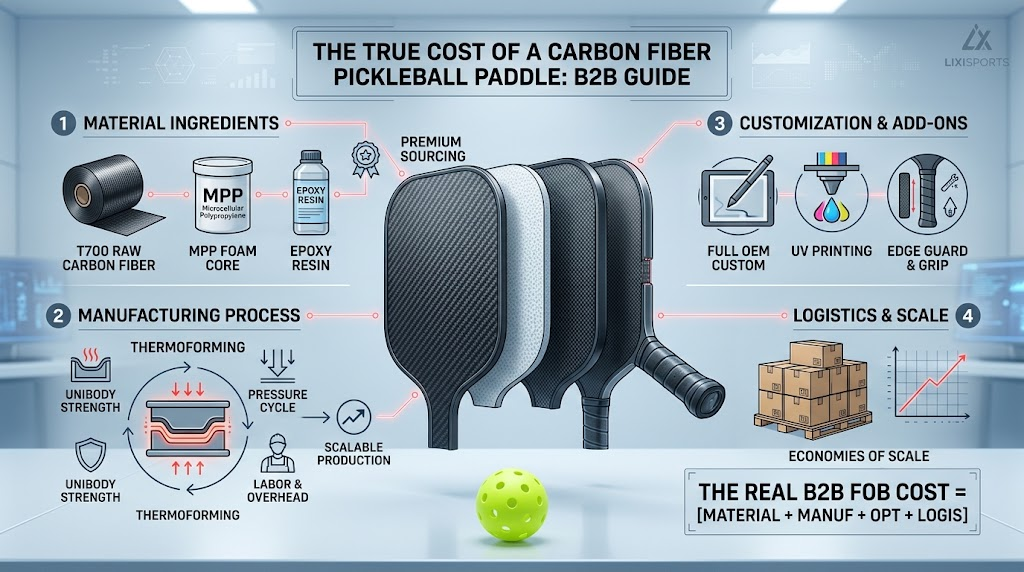
Summary: The factory price of a carbon fiber paddle is only the starting point. True cost adds volume-tier pricing, one-time tooling, USAP certification, QC, ocean freight, duties and tariffs, and a defect reserve. For a typical 2,000-unit order, landed cost runs 35–50% above FOB. This guide breaks down each layer, shows how construction choices move unit price, and ends with the questions to put in your RFQ.
Why “True Cost” Matters: The Factory Price Is Only the Starting Point
Two buyers can order identical paddles from the same factory and pay 40% different costs per unit. The difference is not negotiation skill. It is everything that happens outside the quotation.
A factory quote covers materials, labor and margin at one tier of one construction. It excludes:
- Tooling and molds for your design
- Certification testing
- Third-party inspection
- Ocean freight and destination charges
- Duties and tariffs
- Defect, return and warranty replacement costs
Procurement teams that compare only factory prices select the wrong supplier. The correct comparison is landed cost per sellable unit. This guide shows how to build that number.
The Price Ladder: What Structure, Process and Design Actually Cost
Paddle pricing is a ladder. Each step up adds material, process time or both.
| Ladder step | What changes | Relative unit cost (fiberglass cold-pressed = 1.0x) |
|---|---|---|
| Fiberglass face, cold pressed | Entry construction | 1.0x |
| 1 carbon + 2 fiberglass plies | First carbon layer | ~1.3–1.4x |
| T700 raw carbon, cold pressed | Premium fiber, standard process | ~1.8–1.9x |
| 3K / 12K / 18K woven carbon | Weave aesthetics, more material | ~2.0–2.3x |
| Thermoformed, 1 carbon + 2 fiberglass | Molded process premium | ~1.6x vs same layup cold-pressed |
| Thermoformed T700, standard generation | Premium fiber + molded process | ~2.5x |
| Thermoformed later generations (EPP/MPP cores, foam edges) | Core upgrades, added process steps | ~3.5–4.5x |
| Kevlar hybrid face | Specialty fiber | ~3.5x |
Three takeaways:
- Face material is the biggest single driver. The jump from fiberglass to T700 roughly doubles the material cost of the face.
- Thermoforming adds a fixed premium over cold pressing for the same layup — typically 50–60%.
- Core and edge upgrades compound. EPP cores, EVA layers and foam-injected edges each add incremental cost on top of the face and process.
Design features add cost on top of the ladder: shaped throats and one-piece molded contours, sandblasted or textured surfaces, reinforced PU handles, and custom edge structures. Each is a small line item. Together they can move the unit price another 10–15%.
Volume Tiers and MOQ: How Batch Size Moves the Unit Price
Factories quote in tiers. A typical structure:
| Order quantity | Price behavior |
|---|---|
| Sample (1–5 pcs) | ~1.5x the volume price — samples carry full setup and handling |
| 200–2,000 pcs | Small premium over volume price, typically 3–5% |
| 2,000+ pcs | Best factory price |
| 5,000+ pcs | Further step discounts; setup costs fully amortized |
Sample pricing deserves attention. A sample at 1.5x volume price is normal and refundable against a first order at many factories. A sample at 3x volume price signals a factory that does not want small-buyer work.
Tier gaps also tell you where the factory’s cost floor sits. If the 200-piece price is 40% above the 2,000-piece price, the factory is heavily setup-driven. If the gap is under 5%, production is efficient at small batches — relevant if you plan to reorder in waves.
One-Time Costs: Samples, Tooling, Molds and Design
These costs do not repeat on reorders. They belong to the program, not the unit.
| Item | Typical range (illustrative) | Notes |
|---|---|---|
| Pre-production samples | 1.5x unit price, often credited | Order 2–3 per design |
| Printing setup / artwork plates | Low three figures per design | One-time per graphic |
| Custom shape mold (new geometry) | Low-to-mid four figures | Owned and archived per NDA |
| Custom handle or edge structure | Mid four figures | Includes prototype iterations |
| 3D renderings and dielines | Often free at OEM/ODM factories | Confirm before ordering |
Two rules for one-time costs:
- Amortize them across the first order. A USD 4,000 mold over 2,000 units adds USD 2.00 per paddle. Over 500 units it adds USD 8.00 — the same mold makes a small order uneconomical.
- Get tooling ownership in writing. Custom molds should be your property, sealed and archived, transferable on request.
Testing, Compliance and USAP Certification Costs
If you sell into the US market, certification is not optional for sanctioned play.
| Cost item | What to expect |
|---|---|
| In-house pre-testing (roughness, deflection, weight) | Usually included by the factory |
| USAP submission fee | Charged per model, typically a few hundred dollars |
| Test samples for submission | 2–3 units per model at sample pricing |
| Retesting after design changes | Full fee again — freeze the design first |
Two budgeting notes:
- Certification is per model, not per order. A line of four shapes means four submissions.
- Design changes after submission invalidate the approval. Lock artwork and structure before filing.
BSCI, ISO9001 or SGS factory audits, when required, are factory-level costs that competent manufacturers absorb. Request the certificates before quoting, not after.
QC and Inspection: The Cost of Catching Defects Early
Quality control costs little. Missing it costs a lot.
| QC layer | Typical cost | What it buys |
|---|---|---|
| Factory in-line QC | Included | Weight, balance, finish checks per batch |
| Factory final AQL inspection | Included | Documented per-lot results |
| Third-party pre-shipment inspection | ~USD 300–600 per visit | Independent verification, 1–2 days on site |
| Per-lot QC report | Should be free | Data trail for claims |
The factory’s per-lot QC report is the highest-value free document in the transaction. It should cover weight distribution, balance data and surface finish sampling. A factory that cannot produce it is not running batch-level QC — regardless of what the website says.
From FOB to Landed Cost: Freight, Duties and Tariffs
This is where factory price and true cost diverge fastest.
First, what FOB actually includes. A factory’s ex-works (EXW) price ends at the factory gate. Under FOB terms, the seller adds China-side origin charges into the quoted price:
| Origin charge | What it covers |
|---|---|
| Inland trucking | Factory to port of departure (e.g., Shenzhen to Yantian) |
| Export customs declaration | China export clearance and documentation |
| Terminal handling (THC) | Port loading, container handling |
| Documentation fees | Bill of lading, packing list, certificate of origin |
At volume these are a small per-unit amount. On small LCL shipments they are material — one reason small orders carry disproportionate landed-cost percentages. Confirm with the factory whether the quote is EXW or FOB; the gap is real money.
Second, how you ship. In practice, suppliers work with partner freight forwarders and offer several routes:
| Shipping option | Speed | Relative cost | Who clears customs and pays duty | Best for |
|---|---|---|---|---|
| Express courier (UPS / FedEx / DHL) | 3–7 days door-to-door | Highest — charged by chargeable weight | Consignee (you) clears and pays duties on arrival, unless the sender pre-pays | Samples, urgent replacements, first small test orders |
| Air freight via forwarder | 5–10 days | High | Your broker or the forwarder’s destination agent | Launch stock, small orders where speed matters |
| Sea freight, FOB terms (LCL or FCL) | 25–40 days | Lowest | Buyer’s customs broker clears; duty billed directly to you | Volume orders when you have a US broker |
| DDP via forwarder | 30–45 days | Mid — freight, duty, clearance bundled into one quote | Forwarder handles transport, clearance and duty prepayment end-to-end | Buyers without a customs broker who want one price and no customs paperwork |
The express/DDP trade-off is simple: express buys speed at the highest per-kg cost, and the consignee still handles clearance. DDP buys convenience — one all-in quote, zero customs work for you — but the forwarder builds margin into the bundled price and sea legs take weeks. For a 2,000-unit paddle order (roughly 500 kg, 4.5 CBM), express is uneconomical; the real decision is FOB sea freight versus DDP.
Third, the duty layer on top:
| Cost layer | How it is calculated | Typical magnitude |
|---|---|---|
| US duties | HTS-classified rate on customs value | Verify the current code and rate with your broker |
| Section 301 / additional tariffs (China-origin) | Percentage on customs value | Rates have changed repeatedly — confirm at booking |
| Destination charges, customs bond, brokerage | Per shipment | Fixed per entry — significant on small orders |
| Inland freight to your DC | Per shipment | Route-dependent |
Two structural notes:
- Carton math matters. 2,000 paddles ship as 40 cartons, roughly 500 kg and 4.5 CBM. That volume is LCL territory; consolidating to a full container with a larger order drops per-unit freight sharply.
- Tariff rates on China-origin sporting goods have moved multiple times. The number in your last spreadsheet is stale. Price the duty at booking, and ask whether the factory offers non-China production (e.g., Vietnam) for tariff planning.
The Cost Nobody Quotes: Defects, Returns and Warranty Replacements
Every batch ships with some defect rate. Budget for it.
| Cost element | How to estimate |
|---|---|
| Expected defect rate | Ask the factory for batch data; sub-1% structural is reasonable for a controlled line |
| Replacement unit cost | Factory price + expedited freight |
| Reverse logistics | Return freight often exceeds unit value — most programs scrap defectives locally |
| Customer service and reputation cost | The real number. One delamination review wave costs more than the entire QC budget |
The cheapest defect strategy is a tight specification: defined tolerances (weight ±5g standard, ±2–3g precision), documented per-lot QC, and warranty terms written before the first order. Paying USD 0.30 per unit more for a factory with real QC is cheaper than any warranty program.
A Worked Example: Total Cost Per Unit for a 2,000-Unit Order
Illustrative figures for a 2,000-unit order of thermoformed T700 raw-carbon paddles with custom graphics, standard molds, USAP certification for one model. All numbers marked illustrative — substitute your own quote.
| Cost element | Assumption | Per-unit cost |
|---|---|---|
| Factory unit price (2,000+ tier, FOB Shenzhen — includes China inland trucking, export clearance and origin THC) | Quoted | USD 21.00 |
| Samples (3 pcs, credited) + print setup | Amortized over 2,000 | USD 0.15 |
| USAP submission + test samples, one model | Amortized over 2,000 | USD 0.60 |
| Third-party inspection, one visit | USD 500 ÷ 2,000 | USD 0.25 |
| FOB total | USD 22.00 | |
| Ocean freight (LCL, 4.5 CBM to US West) | ÷ 2,000 | USD 0.55 |
| Duty + tariffs (assume 30% combined on FOB value) | USD 22.00 × 30% | USD 6.60 |
| Destination charges + brokerage + inland | USD 1,200 ÷ 2,000 | USD 0.60 |
| Landed cost per unit (FOB sea route) | ~USD 29.75 |
Landed cost is 35% above the factory price — with standard tooling. Add a USD 4,000 custom mold and the same order lands around USD 31.75, a 51% premium over factory price.
If the same order moves to a DDP quote, the freight, duty, brokerage and destination lines collapse into one forwarder price. Expect to pay for the convenience: a DDP all-in figure above USD 30.00 per unit is normal on this order size. DDP wins on workflow (no broker, no customs paperwork), FOB wins on cost and control.
The percentages, not the dollars, are the lesson. Freight and duty scale with the customs value; inspection and setup are fixed and dilute with volume. This is why the same paddle gets cheaper per unit at 5,000 pieces even when the factory price barely moves.
How to Get an Honest Quote: What to Ask Before You Commit
Suppliers answer the questions you ask. Ask these:
- “Quote at two tiers.” Get 500 and 2,000+ pricing to see the setup sensitivity.
- “What is excluded from this price?” Packaging, handles, surface texture, edge guards and print methods are common exclusions.
- “What does the sample cost, and is it credited?”
- “Which QC data ships with each lot?” Weight, balance, finish — in writing.
- “What is your batch defect rate on this construction?” A number or an evasion.
- “Who owns the mold, and where is it stored?”
- “Which port, and what is the carton configuration?” You need this for freight math.
- “Is certification testing included or billed separately?”
A supplier who answers with specifics at this stage will answer with specifics when a batch is late.
FAQ
Is a higher MOQ always cheaper per unit?
Mostly yes, but the savings are front-loaded. The 200-to-2,000 tier gap is small; the big per-unit wins come from diluting fixed costs (tooling, inspection, freight consolidation) across more units.
Why did my quote jump after changing the face material?
Face material is the largest single cost driver. Moving from fiberglass to T700 roughly doubles face material cost. Woven 12K/18K adds weave cost on top.
Are samples negotiable?
Sample pricing at ~1.5x unit price is standard and often credited against the first order. Ask for the credit in writing.
Who pays for USAP certification — the factory or the buyer?
Submission fees are typically paid by the brand, since approval stays with the brand. Factory-side pre-testing and test samples should be supported by the manufacturer.
Can I reduce tariff costs?
Three routes: confirm the correct HTS classification, time purchases against tariff schedules, or ask your factory about non-China production capacity. Vietnam capacity exists precisely for this reason.
How much should I budget for defects?
Reserve 1–2% of units. If actual rates run higher, the specification and QC terms — not the reserve — are the problem.
Final Checklist: Cost Questions to Put in Your RFQ
- Unit price at 500 / 2,000 / 5,000 pcs, per construction under consideration
- Sample price and credit policy
- One-time costs listed separately: setup, molds, design support
- Certification cost per model and who pays
- Per-lot QC report contents, confirmed in writing
- Third-party inspection access policy
- Carton configuration and port of departure for freight quoting
- Tooling ownership and storage terms
- Defect definitions, claim windows and batch-level remedy thresholds
- Payment terms and currency