Key Takeaways
- EPP stands for expanded polypropylene — a closed-cell bead foam used as a paddle’s core.
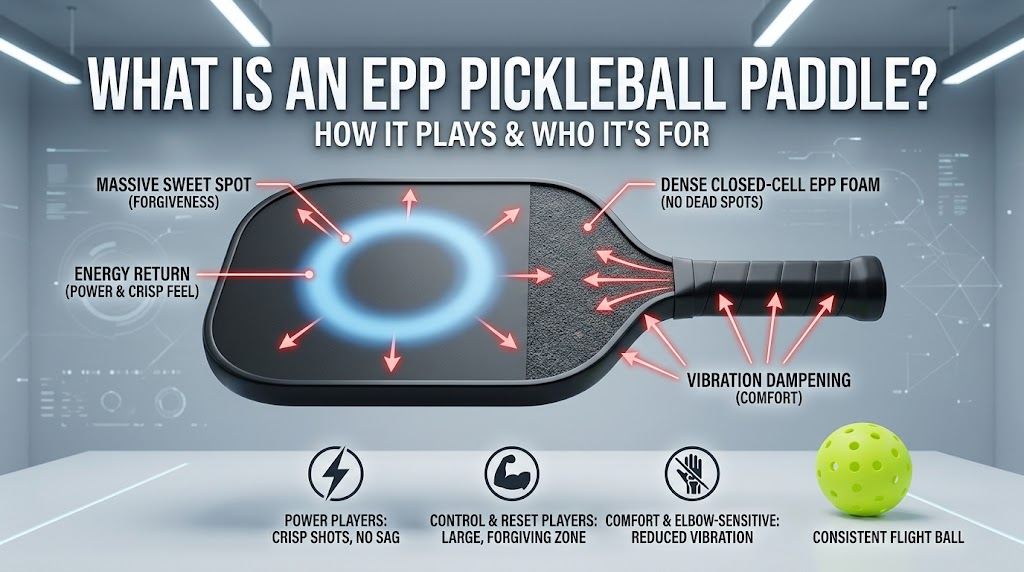
- EPP is light, recovers its shape after impact, and does not crush the way traditional foams do.
- Bare EPP lacks edge rigidity. The fix in modern thermoformed paddles is an EVA foam-injected perimeter wall.
- EPP vs PP honeycomb is not “better vs worse.” They play differently: EPP is crisper and quieter, PP is softer and more forgiving.
- EPP builds pair naturally with raw carbon faces. Most premium thermoformed paddles on the US market today are EPP + raw carbon.
- Buy-side verification: ask for density (g/L), thickness, foam datasheet, and the perimeter foam spec — not just the word “EPP”.
- Manufacturing reality: thermoforming, 225 g ±5 g, 14/16 mm typical, MOQ 200 pcs, 10-day samples, ~35 days for a 2,000-pc run.
EPP keeps showing up on retail shelves and spec sheets. Premium thermoformed paddles launch with it almost by default. But most brand owners can’t articulate why it’s different from a PP honeycomb core — and many factories are happy to keep it that way. This guide is the working definition: what EPP actually is, how it’s built into a paddle, how it plays, what it can’t do alone, and how to make sure you’re actually getting it when you order.
What “EPP” Actually Means
Expanded Polypropylene, in One Sentence
EPP is expanded polypropylene — a closed-cell foam made by expanding polypropylene beads with steam inside a mold. The result is a rigid, energy-absorbing foam with a defined density (typically 30–90 g/L for sports applications) and near-zero water absorption.
Why This Foam Ends Up in Pickleball Paddles
Three properties matter on a pickleball court:
- High strength-to-weight ratio. The foam is light but does not collapse on hard hits. A 16 mm EPP core comes in well under a denser honeycomb build.
- Shape recovery. EPP beads flex and return. After thousands of impacts, the core keeps its profile. PP honeycomb, by contrast, can permanently indent or shear at the sweet spot over time.
- Damping. The closed-cell structure absorbs vibration, which translates to a quieter, less “tingy” paddle and lower hand fatigue on long sessions.
That’s the recipe: light, durable, quiet. It is also recyclable as a single-resin material, which is why sustainability-positioned brands prefer it.
How an EPP Paddle Is Built
The Three Layers: Face, Core, Edge
A modern thermoformed EPP paddle is a sandwich. The face is usually raw carbon (T700, 3K, 12K, or 18K weave). The core is the EPP foam block, cut and CNC-shaped. The perimeter is where the build gets interesting.
Why Thermoforming Matters Here
Thermoforming wraps the entire paddle as a single piece. The carbon skins bond directly to the EPP core, and the edge becomes a continuous wrap. No edge guard, no glue line, no seam. That geometry is what lets the EVA foam perimeter wall exist at all.
The EVA Foam-Injected Wall
EPP alone is too soft at the edge. Edge strikes would compress and deaden the response. The fix is a closed-cell EVA foam injected around the paddle’s perimeter during molding — a 5–6 mm ring that:
- Adds rigidity at the edge so off-center hits still feel solid.
- Expands the effective sweet spot by stiffening the perimeter.
- Absorbs vibration that would otherwise reach the wrist.
This is the same principle used in Gen 3 (PP honeycomb) builds — the EVA wall is the difference between a “soft” paddle and a “responsive” one. EPP without an EVA wall is a different product, and not one most players would prefer.
How the Core Works When You Hit the Ball
Compression, Recovery, Energy Return
On contact, the ball presses the carbon face inward. The load transfers through the face into the EPP core. Two things happen simultaneously:
- The core compresses microscopically at the impact zone.
- The closed-cell structure pushes back as the ball leaves the face.
The push-back is what gives EPP its characteristic crisp, dry feel. You do not feel the ball “sit” on the face the way you would with a softer foam; you feel it leave quickly. Energy return on a thermoformed EPP paddle is high and consistent across the face, because the foam density is uniform throughout.
Why This Translates to “Crisp” and “Quiet”
Crisp = quick rebound. Quiet = low vibration. Both come from the same physical property: EPP is a damped but elastic foam, not a springy one. Compared with PP honeycomb, the sound profile is lower-pitched and the hand feedback is more solid than springy.
What EPP Does Well: It Doesn’t Crush
Long-Term Shape Stability
PP honeycomb cores can permanently deform. Players report a “dead spot” developing over months of play. EPP does not have this failure mode at normal playing intensities — the bead structure returns to its original shape.
Vibration and Hand Fatigue
EPP dampens higher-frequency vibration better than honeycomb. For players with elbow or wrist sensitivity — or for clubs running long training sessions — this is a real ergonomic point worth marketing.
Weight Control at 16 mm
A 16 mm EPP paddle typically lands around 225 g ±5 g without heroic engineering. Thinner builds are easy to dial. For brands targeting the 8.0–8.5 oz (227–241 g) market window, EPP gives a stable platform.
What EPP Can’t Do Alone: The EVA Perimeter Story
Bare EPP Edges Are Soft
Take an EPP-only core, no perimeter reinforcement, and hit near the edge. The paddle feels mushy, and the response drops off. This is the single biggest reason “EPP” alone is not a complete spec.
The Modern Solution: EVA Foam-Injected Wall
The thermoformed build wraps an EVA ring around the EPP core at the edge. The wall thickness is typically 5–6 mm. The result:
- Edge strikes feel solid.
- Sweet spot extends toward the perimeter.
- Vibration is absorbed at the edge before it reaches the handle.
If a supplier is selling “EPP paddle” without mentioning the EVA perimeter, ask. They are either cutting a corner or selling an older-generation build.
How to Verify on a Data Sheet
A credible spec sheet should show:
- Core material and density (e.g., EPP, 40 g/L).
- Perimeter foam (EVA, 5–6 mm width).
- Total thickness (14 / 16 mm typical).
- Face material and grade (e.g., raw carbon T700, 3K weave).
If only “EPP core” appears with no perimeter foam line, push back.
EPP vs PP Honeycomb: How It Feels in One Table
| Attribute | EPP + EVA perimeter | PP honeycomb + EVA perimeter |
|---|---|---|
| Weight at 16 mm | ~225 g typical | ~225 g typical |
| Feel on contact | Crisp, quick rebound | Softer, more dwell time |
| Sound profile | Lower, drier | Slightly higher, more “pop” |
| Vibration damping | High | Moderate |
| Long-term shape | Recovers, no permanent indent | Can develop dead spots |
| Forgiveness at edge | High (with EVA wall) | High (with EVA wall) |
| Cost tier | Premium | Premium / mid-premium |
| Best fit | Power players, hot weather, clubs | Control players, soft-hand feel |
EPP is not “better.” It is a different feel. Brands targeting control-and-dwell should default to PP honeycomb. Brands targeting power-and-crispness should default to EPP. Both should specify an EVA perimeter.
Who Should Sell an EPP Paddle
Premium-Positioned Brands
EPP + raw carbon thermoformed is the current US retail default for the USD 150–250 paddle tier. If your brand is competing at that level, you need an EPP option in the line.
Clubs and Pro Shops Buying in Volume
Clubs value the durability and vibration damping. For training paddles that take abuse, EPP’s shape recovery is a real long-term value story.
Promotional / Gift Paddle Buyers
EPP’s environmental story (single-resin recyclable foam) is a clean sustainability message for ESG-positioned buyers. It’s not a stretch — it’s literally the material’s property.
Less Suitable Use Cases
Budget retail below USD 80 — EPP + raw carbon cannot hit that price without hollowing out the build. Beach/casual paddles where weight matters more than feel — go with a heavier PP honeycomb build. Entry-level beginners — they will not feel the difference; a budget PP build serves them fine.
What an EPP Build Costs (and How Long It Takes)
Pricing Reality (B2B)
A thermoformed EPP + raw carbon + EVA perimeter paddle at MOQ 200 lands roughly in the USD 25–40 / pc FOB range depending on:
- Carbon grade (T700 vs T300 / 3K vs 12K).
- Surface finish (raw vs coated grit, ceramic sand).
- Grip and edge options.
- Custom mold amortisation across the run.
Prices below USD 25/pc almost certainly mean the EPP spec has been compromised. Prices above USD 45/pc usually indicate low-volume amortisation or premium finishing.
Lead Times
- Sample: 7–15 days from PO + payment.
- Production (≤ 2,000 pcs): ~35 days from sample approval.
- Production (> 2,000 pcs): schedule by capacity — confirm with the factory.
- Capacity: a serious thermoforming line runs 80,000+ paddles per month; smaller lines will queue.
MOQ
MOQ 200 pcs is the industry default for thermoformed custom builds. Lower MOQs usually mean standard-spec inventory, not a real custom build.
How to Check You’re Getting Real EPP
Documents to Request
- Foam datasheet — material grade, density (g/L), bead size, supplier.
- Density verification — actual measured density on the production batch (not just spec).
- Perimeter foam spec — EVA material, width (typically 5–6 mm), density.
- Process confirmation — thermoforming line, temperature, pressure range.
- Sample cutaway — a sliced sample showing core, perimeter, face layers is the strongest visual proof.
On-Site or Sample Tests
- Weight check — confirm against the agreed 225 g ±5 g. Drift beyond ±5 g suggests density inconsistency.
- Tap test — a uniform, dry tap sound across the face indicates a uniform core. Dull zones suggest voids or uneven density.
- Edge press — pressing the edge with a thumb should feel solid. Flex or creak suggests no EVA wall or a weak perimeter.
- Drop test — repeated drops from ~1.5 m onto a hard floor. Edge damage patterns reveal build quality quickly.
A supplier that resists any of these checks is signaling risk.
FAQ
Is EPP the same as EVA?
No. EPP is expanded polypropylene (the core). EVA is ethylene-vinyl acetate foam (the perimeter wall in most modern thermoformed builds). They serve different functions in a paddle.
Is EPP better than PP honeycomb?
Neither is universally better. EPP plays crisper and dampens more vibration. PP honeycomb plays softer with more dwell time. Both can be excellent — they target different feel preferences.
Do all EPP paddles have an EVA perimeter?
Quality thermoformed EPP builds do. If a supplier advertises “EPP core” with no perimeter foam line on the spec, push for clarification.
What thickness should I order?
14 mm for control-and-finesse positioning. 16 mm for power-and-stability positioning. Most US premium brands default to 16 mm.
What’s the typical weight?
225 g ±5 g is the standard OEM window. A “Precision Program” at ±2–3 g is available for tournament-grade builds.
Does EPP make a paddle quieter?
Yes. EPP dampens higher-frequency vibration better than honeycomb. The paddle sounds lower-pitched and feels less “tingy” on contact.
Can I customize the shape, grip, and edge?
Yes. Custom molds, grip circumference (4.0″ / 4.25″ / 4.5″), grip length, edge color, and end cap are all in the standard OEM scope. Confirm mold cost and amortisation up front.
Final Checklist: EPP Specs to Confirm Before Ordering
Before signing a PO on an EPP build, lock these on the spec sheet:
- Core material: EPP, with density in g/L.
- Perimeter foam: EVA, width 5–6 mm.
- Total thickness: 14 or 16 mm.
- Face: raw carbon (grade + weave specified separately).
- Weight tolerance: 225 g ±5 g standard, or ±2–3 g Precision Program.
- Surface: raw / ceramic-sand-infused (mesh size, color).
- Grip circumference, edge style, end cap.
- Sample lead time: 7–15 days.
- Production lead time for your quantity.
- Foam datasheet and batch density report attached to the PO.
If any of these are missing, treat the quote as preliminary. Real OEM documentation locks every line.
Related reading on lixisports.com:
For OEM/ODM EPP builds, MOQ 200 pcs, samples in 10 days — email lixifirm@outlook.com.