18K carbon fiber: a wider band, not a stiffer face
One 18K tow holds 18,000 filaments. Spread flat, it becomes the widest weave used on a paddle face. It gives the softest catch and the calmest exit speed of the woven carbons. It adds no stiffness and no spin of its own.
What it is
- It is a tow count. One tow holds 18,000 filaments.
- The fiber is the same as 3K of the same grade.
- It is usually spread flat into a wide band.
Where it wins
- It gives the softest catch of the woven faces.
- It spreads one impact over more fiber.
- It calms the vibration that reaches your hand.
- A wide matte band reads as a premium face.
Where it loses
- It adds no stiffness of its own.
- It exits slower, not faster, than 3K.
- Spreading adds process cost over plain 12K.
- It needs a tight heat-press window.
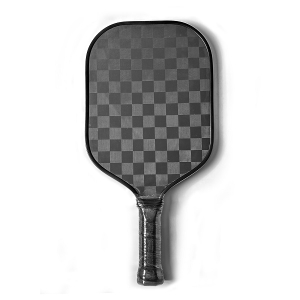
18K counts yarn, not quality
A carbon fiber tow is a bundle of continuous filaments. The “K” means a thousand, so an 18K tow holds 18,000 filaments. That is the whole meaning of the number.
The filaments inside a 3K tow and an 18K tow are identical. Same 5–7 µm diameter, same standard-modulus PAN fiber, same ~230 GPa stiffness. What changes is how many are bundled together before weaving, and how wide that bundle is flattened. A 18K tow is a thicker yarn. A thicker yarn gives a coarser cloth, and a coarser cloth costs less per kilogram.
| Tow count | Filaments | Tow width | Typical woven weight | Common home | Fiber cost / kg |
|---|---|---|---|---|---|
| 1K | 1,000 | 1–2 mm | 60–90 g/m² | Aerospace prepreg, instrument panels | Highest |
| 3K | 3,000 | 2–3 mm | 200–280 g/m² | Paddle faces, bike frames, cosmetic panels | High |
| 6K | 6,000 | 3–4 mm | 250–400 g/m² | Sporting goods, tubes, drone arms | Middle |
| 12K | 12,000 | 4–8 mm | 300–800 g/m² | Wind blades, automotive panels, paddle faces | Low |
| 18K | 18,000 | 6–10 mm | 400–800 g/m² woven · 120–300 g/m² spread tow | Paddle faces, industrial laminates, pipes | Low |
| 24K / 50K | 24,000 / 50,000 | 10–20 mm | 600–1,200 g/m² | Wind blades, pressure vessels, pultruded profiles | Lowest |
Tow widths, woven weights and the cost ranking are industry-typical ranges, not one mill's datasheet. The number that does not move is filament diameter: standard-modulus PAN carbon runs 5–7 µm across every tow size. The count changes the yarn, not the fiber.
“18K carbon face” on a product page tells you two things: the yarn size and the look of the cloth. It does not tell you the fiber grade, the number of plies, the resin or the core. It does not tell you whether the paddle is any good.
How a fat tow becomes a wide flat band
An 18K tow leaves the fiber line as a round bundle 6–10 mm across. Before it is woven into a paddle face, it is usually pressed flat. That step is called spreading.
The same tow, before and after spreading
Spreading turns a cheap industrial bundle into a thin ply. It is also extra process, so it costs more than the same tow left round.
Weave cell on the face, same scale
The panel widths are not to scale with each other. The pattern inside each panel is.
Six steps from fiber to laminate
Precursor
Polyacrylonitrile (PAN) fiber is spun and held under tension. This is where the fiber's stiffness is set, long before anyone counts tows.
Carbonization
The fiber is heated in stages up to roughly 1,000–1,500 °C. Everything except carbon burns off. Bundles leave the line as 3K, 12K, 18K or 24K tows.
Surface treatment and sizing
The tow is treated so resin will bond to it, then coated with a thin coupling layer called sizing. Sizing choice changes the finished laminate and is rarely mentioned in paddle copy.
Spreading
Rollers flatten the round tow into a wide tape, usually 20–40 mm across. A flat band builds a thinner ply and leaves almost no crimp. An 18K face is almost always a spread tow face.
Weaving
Warp and weft bands are interlaced on a loom. Plain weave crosses every other band; triaxial weave adds a third direction. This decision creates the visible pattern on the face.
Prepreg and layup
The cloth is impregnated with epoxy, stacked in plies and cured under heat and pressure. Face, core and edge become one part. A paddle's stiffness is decided here, not by the K number.
The six figures that describe an 18K face
These are the values worth asking a supplier for. Anything beyond this is usually a brand name for one of them.
The definition. Six times a 3K tow, and the reason the weave cells are so wide.
Identical to 3K fiber of the same grade. Put one filament from each under a microscope and you cannot tell them apart.
A 12K tow leaves the line at 4–8 mm. The fatter bundle is what makes the cloth heavier and the weave coarser before any spreading happens.
The same tow pressed flat. A flat band builds a thinner ply and cuts the crimp that costs in-plane stiffness.
What a player actually sees. Roughly four times the cell of a 3K twill, and the main reason brands market 18K as a premium-looking face.
Modulus belongs to the fiber, not the tow count. An 18K standard-modulus face is not stiffer fiber than a 3K one. It is the same fiber, arranged differently.
Modulus and filament diameter are industry-generic values for standard-modulus PAN carbon fiber. Areal weights, tow widths and spread widths are typical commercial ranges. Ask any supplier for their own mill certificates.
18K against the cloths it competes with
Four face materials sit in the same price conversation. The differences that matter are crimp, uniformity and how soft the face feels on contact.
| Property | 3K twill | 12K woven | 18K spread tow | Unidirectional (UD) |
|---|---|---|---|---|
| Filaments per tow | 3,000 | 12,000 | 18,000, flattened | 12K–50K |
| Look on the face | Fine ~2 mm checkerboard | Bold ~5 mm checkerboard | Wide ~9 mm matte band | Flat black sheet, no pattern |
| Crimp (fiber waviness) | Highest of the four | Lower than 3K | Almost none | None |
| Feel on contact | Crisp, quick to leave | Softer, longer dwell | Softest of the woven faces | Depends on the stack above it |
| Uniformity across the face | Most uniform | Less uniform, more scatter | Widest cells, least uniform | Uniform along the fiber axis |
| Relative cloth cost | High | Low | Middle — spreading adds process | Low |
| Chosen when you want | Maximum bite and a fine classic grain | Dwell and a bold face at low cloth cost | Plush touch, vibration calm, a flagship look | Maximum stiffness per gram in one axis |
Crimp and uniformity comparisons are standard composites practice. Every interlacement bends the fiber slightly, and bending costs in-plane stiffness. Industry studies put the loss for a plain-weave laminate at roughly 10–20% against the same fiber laid straight. Spreading cuts that loss, but it does not put the stiffness back above a straight UD ply.
Where 18K loses on a paddle face
- A 9 mm cell is the least uniform face you can buy. The contact point can land on a flat band or in the dip between two of them. Off-centre hits scatter more than on a tight 3K twill.
- Wide bands leave wide resin pockets. At every crossover the weave traps a pool of resin. That is why an 18K woven laminate typically shows lower in-plane tensile strength than a 3K twill made from identical fiber.
- Spreading costs money. A spread 18K band is a plain 18K tow plus a process step plus more handling scrap. It is a more expensive input than a plain 12K cloth, even though the tow itself is cheaper.
The fiber is the same as a 3K face. The cloth is not, and the laminate follows the cloth.
Where 18K actually lives
Before it reached a paddle face, 18K was an industrial tow. Pickleball is a rounding error in its demand, and that is what keeps the yarn cheap.
Wind turbine blades
Blade spars run tens of metres long and are built from thick, wide plies. Cost per kilo and layup speed beat a cosmetic weave every time. Large-tow volumes come from this market.
Pipes and pressure vessels
Hydrogen tanks, CNG cylinders and composite pipes are wound or pultruded from large tows. The fiber runs straight, with no weave and no crimp at all.
Automotive structural panels
Roofs, driveshafts and battery enclosures use 18K and heavier tows in fast-curing presses. Cycle time dominates; appearance is secondary unless the carbon is left visible.
Hulls, masts and foils
Marine laminates mix wide woven skins for toughness with UD for stiffness. The woven layer is there to take impact, not to look pretty.
Bike frames and sports gear
Bicycles, hockey sticks and archery limbs. Visible 18K and 3K weaves are used cosmetically here too. Paddle brands copied that logic.
Machine tools and rollers
Parts that need damping more than stiffness. A wide spread ply spreads vibration across more material, which is the same property a paddle face borrows.
Material references are listed at the end of the market-evidence section.
What 18K does on a paddle
Four things an 18K face changes, in the order a player notices them.
Longest catch
A wide flat band gives more than a woven yarn does. The face deflects further before it pushes back, so the ball stays a fraction longer. Players feel this on drops, dinks and resets.
Wider energy spread
One impact load reaches more fiber, so the face extends its stiffness further toward the edge. Off-centre hits lose less energy and the paddle twists less in the hand.
Calmer vibration
Wide bands absorb the high-frequency shake that a dense fine weave passes straight through. Less of it reaches the handle, which is why arm-friendly lines are built on this face.
Visual signal
A wide matte band photographs as a flagship face. That is why brands put 18K on their tournament line. It is a commercial reason, not a mechanical one.
Contact and load spread
Contact behaviour at the same swing speed
Illustrative, not a measurement. Deflection is exaggerated — the core, not the cloth, controls most of it.
How far one impact spreads
Same energy, different area. Wider spread means less stress in any one spot.
What we build behind an 18K face
Face
18K spread tow carbon fiber, usually one surface ply over a T700 or 12K structural ply. Raw, matte or sealed, your call — raw bites more, sealed lasts longer cosmetically.
Core
Polypropylene honeycomb, usually 16 mm. A 16 mm core pairs with an 18K face because both push the same way: more dwell and more forgiveness.
Construction
Thermoformed unibody with foam-injected edges is the usual match, because the face is already priced as a flagship part. Cold-pressed is possible but gives up the edge foam.
Weight and size
225 g ± 5 g is our standard window, with ± 2–3 g on precision builds. Shapes from 16.5 × 7.5 in hybrid down to junior 350 × 170 mm.
Surface treatment
Raw matte band, grit-sprayed or a printed finish. This decision changes spin and wear far more than the tow count does.
Handle
PU-wrapped, grip circumference 101 / 105 / 108 mm. Elongated handles available for two-handed backhands.
An 18K face does not make a paddle stiffer. Stiffness comes from the laminate stack, the resin and the core. Swapping a 3K face for an 18K face on the same core changes the feel a little and the look a lot.
The heat-press window is narrow
A spread band is thin and wide. Air escapes it easily in one direction and badly in the other. That means the press cycle has to be tuned per cloth weight, and the scrap rate on a first run is higher than on a plain 3K face.
Budget for a pre-production sample. It is the cheapest place to find out that your cure profile needs a change.
Four brands shipping 18K faces today
Four production paddles with an 18K face at four price points, from USD 69.99 to USD 174.95. The spec line each brand publishes on its own product page is the evidence.
Diadem — Edge 18K Power
Face: 18K carbon fiber · Thermoformed construction · Hybrid or elongated handle · USAPA approved · USD 174.95
Diadem's own product page reads: “Featuring a thermoformed construction, an 18K carbon fiber face, and options for a larger sweet spot or an elongated handle, this paddle delivers explosive power and durability.”
What it shows: an 18K face sitting on a thermoformed body at the top of a brand's line. The face is one spec among several that set the price.
View on diademsports.comChorus — Shapeshifter HX
Surface: 3D 18K cubic carbon fiber, triaxial weave · Layers: 18K surface, T700 ply, fiberglass backstop · Unibody, foam edges · USD 159.99
Chorus states: “the unique 3D 18K cubic carbon fiber surface on a unibody mold with foam edges… top tier spin in all directions due to the flexibility of the wide triaxial weave… it's that stable, yet flexible 18K surface that increases the dwell time the ball spends on the paddle before it exits.” The same page names a Toray T700 ply as the second layer.
What it shows: a brand using the wide tow for a third weave direction, not just a bigger cell. The triaxial layout is how you get uniform bite on a face this coarse.
View on choruspickleball.comPello — PXII 18K
Face: 18K woven T800 spread tow carbon fiber · Core: 13 mm polypropylene · USAPA approved · USD 139.99
Pello's build sheet lists “Paddle Face: 18K Woven T800 Carbon Fiber” and the page copy says the 18K face “improves ball pocketing and grip” and “offers more feel and longer dwell time than the PXI”. The PXI, the same brand's 3K model, is listed at USD 99.99.
What it shows: one brand selling 3K and 18K side by side and placing 18K above it in feel, not in stiffness. Their own words are about pocketing and dwell, which is what the material actually does.
View on pello.lifeniupipo — Drift 18K
Face: 18K carbon fiber, 0°/90° weave · Spray grit surface texture · Vibration-damping handle · USAPA approved · USD 69.99
niupipo's own listing says the paddle is “crafted with 18K carbon fiber”, that “the unique 0°/90° weave design absorbs vibrations and provides instant rebound”, and that the “spray grit texture… increases ball friction by over 30%”.
What it shows: a large-volume brand putting 18K on a sub-USD 100 paddle. If 18K were a premium tier, this paddle could not exist at this price.
View on niupipo.comThe same face spec, across a 2.5× price range
| Brand | Model | Face spec, in the brand's own words | List price |
|---|---|---|---|
| Diadem | Edge 18K Power | “18K carbon fiber face”, thermoformed | USD 174.95 |
| Chorus | Shapeshifter HX | “3D 18K cubic carbon fiber”, triaxial weave | USD 159.99 |
| Pello | PXII 18K | “18K woven T800 spread tow carbon fiber” | USD 139.99 |
| niupipo | Drift 18K | “18K carbon fiber”, 0°/90° weave | USD 69.99 |
Four paddles, one face material, prices spanning 2.5×. What changes between them is the core, the number of plies, the construction and the brand. The tow count is the one thing that stays the same. A brand selling 18K cheaper than another brand sells 3K is telling you the K number is not a price ladder.
Who should buy an 18K face, and who should not
Buy 18K if you sell touch, forgiveness and an arm-friendly story. Do not buy 18K if you sell exit speed, spin numbers or a low landed cost. Match the face to the brief before the sample stage, because none of this is fixable afterwards.
| Your buying situation | What an 18K face actually gives you | Our advice |
|---|---|---|
| A flagship control paddle, retail USD 180–250+, sold on soft touch and a wide sweet spot | The longest dwell of any woven face and the widest load spread. It also looks like the most expensive face in a product gallery. | Buy 18K spread tow. |
| A power-first line sold on pop and exit speed | The least pop of the woven carbons. An 18K face absorbs and holds; it does not throw the ball back. | No. Specify 3K raw or fiberglass. |
| An arm-friendly or senior line, sold on less shock in the hand | The most vibration damping of the carbon faces, because the load is spread across more fiber and less of it reaches the handle. | Buy 18K, pair it with a 16 mm core. |
| A high-volume value line at retail under USD 100 | Nothing you can pay for. Spreading is an extra process step, and the press window is narrow enough to raise your scrap rate on a first run. | No. Use glass fiber or entry carbon. |
| A first order from a new brand with a tight budget | A material with a higher minimum buy and a steeper learning curve than 3K, on top of tooling you have not paid for yet. | Not yet. Prove the shape on 3K first. |
| A paddle sold on a spin number | Spin comes from surface roughness, not cell width. A raw 3K face bites harder than a sealed 18K one. | No. Specify raw 3K twill. |
Alternatives we quote the most: raw 3K twill for maximum bite at the lowest cloth cost. 12K woven when you want a bold face without paying for spreading. An 18K surface ply over a 12K or UD structural layer when you want the 18K look without an all-18K stack. Send us your retail price and the player you are chasing. We will quote the build that fits.
Material references: filament diameter, modulus and manufacturing sequence follow the general descriptions in the Wikipedia entry on carbon fibers and the fiber documentation published by Toray Composite Materials America. Weave and crimp behaviour is standard composites engineering.
Four things 18K will not do for you
We sell 18K faces, so check this list against our own quote.
Read this before you specify 18K
- It will not make a paddle stiffer. An 18K standard-modulus face is the same fiber as a 3K face of the same grade. Stiffness comes from the ply count, the angles, the resin and the core.
- It will not make a paddle faster. The long catch that players like on dinks is the same property that slows the ball off the face. If your buyer wants pop, this is the wrong material.
- It is not a premium fiber, and it is not a uniform face. A 9 mm cell is the coarsest surface you can buy, and a fat tow leaves a fat resin pocket. Off-centre consistency is worse than on a tight 3K twill.
- It will not rescue a cheap core. An 18K skin over a thin, dead core plays like a thin, dead core. Money is better spent on core and construction first, cosmetics last.
Summary: 18K is the softest and calmest carbon face, and the least uniform one. Buy it when your customer is buying touch and forgiveness. Skip it when your customer is buying speed.
What an 18K build costs, and how it ships
FOB pricing by build tier, published for OEM orders. These are the ranges we quote.
| Tier | Typical build | FOB price | MOQ |
|---|---|---|---|
| Entry | Fiberglass face, EVA core | USD 8.00–15.00 / pc | 500+ |
| Mid carbon | 3K carbon face, mid EVA core | USD 15.00–35.00 / pc | 300+ |
| Premium | 18K spread tow face, multi-layer core, thermoformed | USD 35.00–65.00 / pc | 200+ |
| Flagship | Ceramic-sand surface, full custom, 18K over UD | USD 50.00–100.00 / pc | 100+ |
An 18K build usually lands in the USD 180–250 retail band. Below USD 100 retail, glass fiber and entry carbon are the realistic faces.
Packed and shipped
Each paddle goes into a PE bag, then a bubble bag, then a printed colour box if you want one. Master carton is 650 × 500 × 350 mm, 50 pieces per carton, around 12.5 kg.
Tell us the destination and we will quote CIF as well as FOB, with the carton dimensions on the invoice so your forwarder can plan.
What you can change
Weave (3K, 6K, 12K, 18K, spread tow, triaxial), face colour and print, core thickness 10–16 mm, core material, edge guard colour and logo, handle length and grip circumference, surface treatment, weight window, shape and your own packaging artwork.
The 18K cloth itself is a stock material. The way it is laminated, cut and finished is where your product becomes yours.
What we can actually prove
Every check below runs in our plant, on your order. No lab claims we cannot show paperwork for.
X-ray inspection
Every production batch goes through X-ray. It shows voids, resin-rich pockets, core deformation and delamination — the failure modes a wide weave can hide under a matte finish.
Compression and batch testing
Paddles from each batch are loaded and checked, with results logged against the batch record. You can ask for the report for your order.
Ball-impact tester
Our cannon-style rig fires balls at the face at controlled speed to check for face cracking, edge separation and core crush before we ship.
In-house USAP and PBCoR pre-check
We screen dimensions, surface roughness and bounce against the published standard before submission. Certification itself is issued to the brand owner, not to us.
Batch QC reports
Weight, thickness, balance point, grip circumference, surface roughness and visual inspection are recorded per batch and travel with the shipment.
Mill and origin documents
We buy carbon cloth on your bill of materials and pass on the mill's own documents. Material claims stay with the brand that specified them.
Questions buyers actually send us
Is an 18K face better than a 12K face?
Then is 18K the top of the range?
Will an 18K face make the paddle stiffer?
Will an 18K face give more spin?
Why do players describe 18K as a soft face?
Does an 18K face really help with arm pain?
Which core should I put behind an 18K face?
Do you use Toray T800 or T700 carbon fiber?
Can you match a specific weave look and cloth weight?
What are your MOQ and lead times?
Tell us the face, we will quote the paddle
Send the weave, the cloth weight, the core, the shape and the surface finish you want. We will come back with FOB and CIF pricing, a sample lead time, and an honest note on anything in your spec that will not do what you expect.
Prefer email? lixifirm@outlook.com — we reply within 24 hours.