Glass fiber: cheap, tough, and three times as flexible as carbon
Glass fiber is a cheap, tough reinforcement. It bends about three times as far as carbon under the same load. On a paddle it gives a soft feel, easy power and a heavier face. It is not stiff, and spin has to come from the surface treatment.
What it is
- It is an inorganic reinforcement. It is not a metal.
- It comes as filaments drawn from a controlled glass recipe.
- It needs a resin to hold it. Fiber plus resin is the composite.
Where it wins
- It is the cheapest reinforcement.
- It bends about three times as far as carbon.
- It gives a soft feel and easy power.
- It survives club and rental use.
Where it loses
- It is not stiff, so control is coarser than carbon.
- It is about 40% heavier at the same thickness.
- Bare glass does not grip the ball.
- Spin depends on the grit treatment.
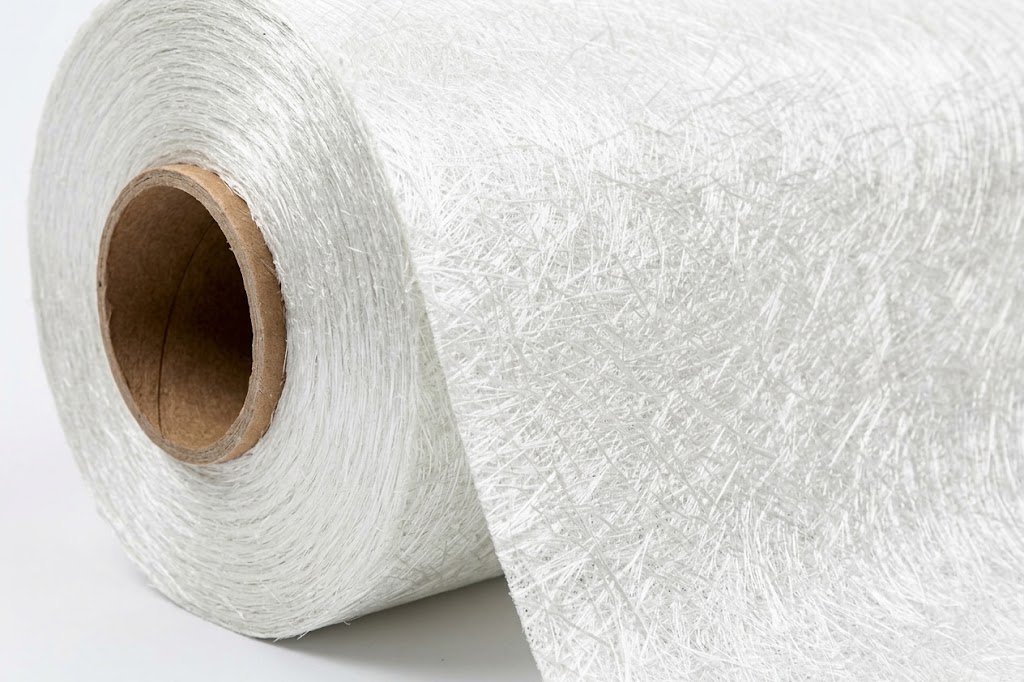
What glass fiber actually is
Glass fiber is an inorganic reinforcement. It is not a metal. Workers melt a specific glass recipe, then pull the melt through micro-nozzles into continuous filaments a few micrometres thick.
Bulk glass is brittle. A glass filament is not. Glass breaks because tiny surface flaws concentrate stress. A filament 10 µm across carries far fewer flaws in the same cross-section. Strength rises from about 50 MPa in a window pane to about 3,400 MPa in the drawn fiber. That beats most structural steel wire at the same cross-section.
It is a reinforcement, not a finished material
You cannot make a paddle face from fibers alone. The fiber carries the load. A resin matrix holds the fibers in place and moves stress between them. The finished sheet is a composite. The long name is glass-fiber reinforced polymer, or GFRP.
A "fiberglass" paddle is a glass fiber fabric bonded with epoxy or another resin. The fiber type, the fabric weight and the resin all change the playing feel.
Why "E-glass" and not window glass
Ordinary soda-lime glass contains sodium. Sodium conducts electricity and attacks the fiber surface over time. Reinforcement glass leaves it out. The grade is E-glass. The "E" originally stood for electrical insulation.
The recipe is tightly controlled. Silica forms the glass network. Alumina and lime add durability. Boron oxide lowers the melting point, so the melt can be drawn into fine filaments without breaking.
A typical E-glass recipe
| Oxide | Share by weight | What it does |
|---|---|---|
| SiO₂ — silica | 52–56% | Forms the glass network; gives strength and chemical stability |
| CaO — lime | 16–25% | Improves durability and lowers melt viscosity |
| Al₂O₃ — alumina | 12–16% | Raises strength and water resistance |
| B₂O₃ — boron oxide | 5–10% | Cuts melting temperature; makes fine filaments drawable |
| MgO — magnesia | 0–5% | Adjusts viscosity and surface condition |
| Na₂O + K₂O | < 0.8% | Kept deliberately low — this is what makes it "alkali-free" |
Typical ranges for commercial E-glass. Exact recipes vary by producer and are usually proprietary.
From sand to fabric, in six steps
Melting
Raw minerals are melted in a furnace at roughly 1,400–1,500 °C until the batch is uniform and bubble-free.
Drawing
The melt flows through bushing plates drilled with hundreds of micro-nozzles. Filaments are pulled out at high speed and quenched with water spray.
Sizing
A thin coating called sizing goes on immediately. It stops the filaments from rubbing each other. It also carries the coupling agent that bonds glass to resin later.
Strand and yarn
Filaments are gathered into strands, then twisted into yarn or wound as roving. The mill picks the form it needs for the fabric.
Weaving
Yarn goes onto a loom and is woven into fabric in a chosen pattern and weight. Some yarn is chopped and needled into a mat instead.
Composite forming
The fabric is impregnated with resin, laid into the paddle stack, and cured under heat and pressure. Most of the real cost sits in this step.
The glass itself is not the expensive part. Silica sand is cheap. What you pay for is the drawing, the sizing chemistry, the weaving, and the curing press time.
Five numbers that define how glass fiber behaves
These five values explain every practical consequence: the soft feel, the power, the extra weight and the limits.
A 10 µm filament holds roughly 0.27 N before it breaks. Thousands of them bundled together carry the load across a paddle face.
Low for a reinforcement. The fiber bends easily under load. That is the root of the soft feel and the trampoline power.
About 40% heavier than standard carbon fiber per unit volume. Same face thickness means a heavier paddle face.
It stretches a long way before it snaps. Glass fails as a crack, not as a shatter. The material is tough and forgiving.
Textile-grade filament. Thin filaments flex more without breaking. Thick filaments cost less to draw.
Far above any service temperature a paddle sees. Glass fiber does not creep or soften in a hot car or on a summer court.
Industry-typical values for commercial E-glass at room temperature. Suppliers publish their own datasheets; always quote fiber grade and sizing when comparing.
Glass fiber next to carbon fiber and aramid
All three fibers reinforce a plastic. They trade strength, stiffness, weight and price in very different ways.
| Property | E-glass | Carbon (standard modulus) | Aramid |
|---|---|---|---|
| Tensile strength | 3,100–3,800 MPa | 3,500–4,500 MPa | 2,900–3,600 MPa |
| Elastic modulus | 72–76 GPa — flexible | ~230 GPa — stiff | 70–110 GPa |
| Density | 2.54–2.62 g/cm³ | 1.75–1.80 g/cm³ — lightest | 1.44 g/cm³ |
| Strain to failure | ~4.7% — stretches | ~1.5–2.0% | ~2.5–4% |
| Failure mode | Progressive cracking, stays together | Brittle; can snap or delaminate | Fibrillates, absorbs impact |
| Cost, order of magnitude | The cheapest of the three | Several times the price per kg | Between the two |
| Electrical behavior | Non-conductive | Conductive | Non-conductive |
| Moisture / UV | Fiber itself is stable; the resin is the weak link | Fiber stable; resin same limitation | Absorbs moisture over long exposure |
Modulus is the line that matters most. Glass fiber bends about three times as far as carbon under the same load. Every playing characteristic in the next section follows from that.
Where glass fiber loses, honestly
Stiffness. Low modulus means less precision at impact. A carbon face returns a sharper, more repeatable response. A glass face returns a rounder one. Players who want maximum control and spin will outgrow glass fiber.
Weight. At the same face thickness, glass adds mass. That matters on a 225 g paddle. It is why carbon dominates the premium tier.
If your product brief is "the most precise paddle on the market", glass fiber is the wrong answer and we will say so. It is the right answer when the brief is power at a price the market can actually buy.
"Glass fiber" covers four different materials
The grade decides strength, corrosion resistance and price. Almost all paddle faces use E-glass or occasionally ECR-glass.
| Grade | Strength / modulus | Why it exists | Where it shows up |
|---|---|---|---|
| E-glass | ~3,400 MPa / 72–76 GPa | The all-round general-purpose grade, over 90% of world production | Paddle faces, boats, wind blades, pipes, circuit-board substrate |
| ECR-glass | ~3,600 MPa / ~80 GPa | Boron-free, much better acid resistance and longer fatigue life | Pipes, tanks, marine, and paddles sold into humid or coastal markets |
| S-glass | ~4,700 MPa / 86–90 GPa | Magnesium-aluminosilicate; high strength where weight is critical | Aerospace, ballistics, high-end sports, some premium composites |
| C-glass | Lower strength | Formulated to resist chemical attack | Surface veils and corrosion barriers — rarely a structural face |
Cost order, cheapest first: E-glass, C-glass, ECR-glass, S-glass. A higher grade buys strength and durability, not feel. The modulus moves only slightly, so the trampoline character stays similar.
The same fiber can make two very different faces
A buyer who specifies only "fiberglass surface" has not specified the material. Weave pattern, fabric weight and resin content move the stiffness and the feel more than the fiber grade does.
Three weave patterns used on paddle faces
Weave pattern controls how the yarns interlock; fabric weight controls mass and stiffness.
Why a mill asks you three questions before quoting fabric
Fabric weight
Sold in oz/yd² or g/m². A 4 oz face is light and lively; an 8 oz face is heavier and stiffer. Most cold-pressed paddles sit in the 4–6 oz band.
Weave and yarn
Plain weave gives the tightest, most stable sheet. Twill drapes better around edges. Satin delivers the smoothest outer surface. Yarn linear density (tex) sets how visible the weave is.
Sizing chemistry
The coupling agent on the fiber must match the resin. Epoxy-sized fabric bonds properly with epoxy resin. A mismatch causes delamination, and nothing outside shows it.
Resin content
Fiber and resin carry load together. Too much resin makes the face heavy and weak; too little leaves dry spots. Reputable suppliers control this by weight and report it per batch.
The same material runs other industries at far larger scale
Wind turbine blades
The largest single market for glass fiber. Blades up to 100 m use E-glass laminates because stiffness per dollar beats everything else.
Boat hulls
Chopped-strand mat and woven roving have built fiberglass hulls for seventy years. This industry proved the material lasts in water.
Pipes and tanks
Filament-wound glass fiber handles corrosive fluids where steel would rust through, usually in ECR or C-glass grades.
Circuit boards
The FR-4 board inside almost every electronic device is woven E-glass fabric bonded with epoxy. That is the same chemistry as a paddle face, in a different form.
Glass fiber is not a niche sports material. It is one of the most widely used engineering materials in the world. A paddle face is a small, demanding application of it.
Now the pickleball part
Pickleball is a hard plastic ball hit at short range. The game rewards a face that can flex, store energy and give it back. A low-modulus glass face does exactly that.
Face deflection at impact
Schematic, not to scale. Deflection is exaggerated to make the difference visible.
Why the ball leaves faster
A stiff face returns the ball quickly. It does not store much energy. A flexible glass face bends deeper. It stores more of the impact energy in the fiber and resin, then releases it in the same instant. The result is a paddle that hits hard without a hard swing.
That is why glass fiber paddles are the classic choice for players who want power but do not generate it themselves.
Why it feels softer on the arm
The same deflection absorbs vibration before it travels up the handle. Players call glass "soft", "forgiving" and "less punishing", especially after a long session.
Touch shots still work. The feedback is rounder than carbon. The ball stays on the face a fraction longer and the response is less sharp.
Cold pressing is the norm
Glass fiber faces are usually cold pressed. Workers stack fabric and core, glue them under pressure at room temperature, then trim. There is no high-temperature press cycle, so tooling cost and lead time are lower.
Custom shapes do not need a mold change. A cutting line drawing is enough.
The surface is treated for spin
Bare glass fabric is too smooth to grip a plastic ball. Production faces are grit-sprayed to add friction. The grit grade decides the spin and how fast the surface wears.
Spin on a glass paddle lives in the surface treatment, not in the fiber.
The weak point is the handle
On cold-pressed glass paddles, the joint between face stack and handle fails first. A PU handle fixes it. PU is molded polyurethane, mechanically bonded instead of glued.
This is a production detail, not a marketing feature. It only shows up in warranty numbers.
| Parameter | Standard build | Notes |
|---|---|---|
| Face material | Woven E-glass fabric, grit-sprayed | 4–6 oz/yd² typical for a lively face |
| Core | Polypropylene honeycomb, 13 mm or 16 mm | 16 mm = softer, more control; 13 mm = faster release |
| Edge | Edge band or bumper, color matched | Protects the laminate from court scrapes |
| Weight | 225 g ± 5 g | Precision weighting available to ± 2–3 g on request |
| Handle | PU, grip circumference no. 0/1/2 = 101 / 105 / 108 mm | PU handle reduces the classic cold-press break at the throat |
| Junior build | 160–170 g, 350 × 170 mm, 13 mm | Smaller face and lighter swing for young players |
| Women's build | 207–220 g | Same face, lighter core and handle package |
| Cold-press capacity | Up to 100,000 paddles per month | Single line, in-house trimming and assembly |
Standard numbers for our cold-press glass line. Thickness, weight and surface treatment are all adjustable against a target retail price.
Pick glass when the retail price is fixed and the paddle has to survive club, school and rental use. It is the wrong material for a brief built on spin and precision. That brief belongs to carbon.
Brands already selling glass fiber paddles
Six production paddles from six established brands. Every one runs a glass face. Each spec line is quoted from the brand's own product page.
Franklin Sports Signature Series
MaxGrit textured fiberglass face · 13 mm / 16 mm polypropylene core
Franklin's flagship line uses a textured glass face with MaxGrit surface technology, built to add spin and damp vibration while the glass layer keeps the sweet spot large.
What it shows: a glass face can carry a brand's premium line when the surface treatment is engineered properly.
View on franklinsports.com ↗Selkirk AMPED Pro Air
FiberFlex+ glass fiber face · honeycomb core
Selkirk's AMPED series uses a multi-layer glass fiber face it calls FiberFlex+. A thick honeycomb core balances energy return against a softer, damped feel.
What it shows: glass fiber at a premium price point, sold on feel and power rather than cost.
View on selkirk.com ↗HEAD Radical Elite
Fiberglass composite hitting surface · 15 mm core · 230 g
HEAD specifies a fiberglass composite face on a widebody 15 mm frame, and describes the material in its own spec sheet as the source of a softer feel with easy power.
What it shows: a racquet-sport major treats glass fiber as a technical choice and states the consequence in plain words.
View on head.com ↗Paddletek Bantam TS-5 Pro
UV-coated textured fiberglass face · 14.3 mm core
Paddletek uses a UV-coated textured glass face on this model for spin control and durability, and pairs it with its own vibration-control layer.
What it shows: coating technology on a glass face is how brands close the spin gap against carbon.
View on paddletek.com ↗JOOLA Essentials Dash
Sandblasted fiberglass surface · 10 mm core
JOOLA's entry line uses a sandblasted glass surface for durability and grip, aimed squarely at players in their first season.
What it shows: the same material strategy at the bottom of the price ladder. Sandblasting instead of costly coatings.
View on joola.com ↗Franklin Sports X-1000 Series
Fiberglass surface layer · polypropylene honeycomb core
A high-volume workhorse: glass surface layer over a honeycomb core with a reinforced edge band, sold through mass retail and used heavily in club and rental settings.
What it shows: the durability argument — glass faces survive institutional use that premium surfaces would not.
View on franklinsports.com ↗Who should buy a glass fiber paddle, and who should not
Buy glass when volume, durability and a fixed price ceiling are what you are managing. Do not buy glass when your customer is paying for spin, stiffness or a premium feel. Glass is the cheapest credible route into this sport and the wrong tool for a performance claim. Match the face to the brief before the sample stage, because none of this is fixable afterwards.
| Your buying situation | What a glass face actually gives you | Our advice |
|---|---|---|
| A new brand entering pickleball with one launch model | A proven, forgiving build at a price you can launch at. Nothing in the material will surprise you or your customers. | Buy glass. |
| The paddle goes into club, school or rental programmes | A face that survives institutional use. It scratches where a brittle face would chip or shatter, and it is cheap to replace. | Buy glass. |
| You need a credible paddle under a fixed price ceiling — mass retail, promo, first-season buyers | The lowest-cost route to a real, USAP-ready paddle. Glass shapes do not need a mould, so a new outline costs you a drawing, not a tool. | Buy glass. |
| Your customers pay for spin by name and compare surface texture | A glass face has to be gritted or coated to bite. Left bare, it is the lowest-spin face you can ship. | No. Specify a raw carbon face. |
| You are building a premium hero model above your volume line | A glass face undercuts your own pricing story, and the stiffness gap shows up immediately in the feel on court. | Not for the hero model. Carbon. |
| Your brand identity is “the lightest, stiffest paddle” | Glass bends roughly three times as far as carbon under the same load. That is the material's selling point, running in reverse. | No. Wrong material for that claim. |
Alternatives we quote the most: a raw carbon face when spin is the headline. Carbon for a hero model that has to feel crisp. But if you need a heavy-duty institutional paddle at the bottom of the FOB ladder, this is already the cheapest credible route, and we will say so instead of upselling you. Send us your retail price and the player you are chasing. We will quote the build that fits.
Material reference sources: physical property ranges above are the industry-typical published values for E-glass, and the manufacturing sequence follows standard reinforcement-fiber practice. For background reading see glass fiber and the composites division of a major producer such as Owens Corning.
Where the money goes, and what that means for you
Glass fiber is cheap as a raw material. That does not make a cheap paddle. The cost sits downstream of the fiber.
The cost stack, in order of size
1. Labor and press time. Stacking, gluing, pressing, trimming and assembly dominate. This is why plant efficiency moves your price more than material choice.
2. Resin system. Quality epoxy costs several times what a commodity resin does, and it decides delamination behavior.
3. Surface treatment. Grit spraying or coating is a separate process step with its own yield losses.
4. Fabric. Real, but the smallest of the four at paddle scale. Upgrading from 4 oz to 6 oz fabric is a minor cost line.
Packing and shipping, as we build it
Default pack: one PE bag plus a bubble sleeve per paddle.
Master carton: 650 × 500 × 350 mm, 50 paddles per carton, about 12.5 kg gross.
Packing format, carton print and inner packaging are all customizable — retail-ready packaging changes the carton count, so give us the retail spec before we quote freight.
Freight estimation is much more accurate when you tell us whether the goods ship retail-packed or bulk-packed.
What can be customized on a glass fiber paddle
Shape, without a mold
Cold pressing does not require a shape mold. Send a cutting line drawing and we quote from it.
Face graphics and logo
Printed graphics or logos on the face, plus branded grip tape, edge band, end cap and silicone band.
Thickness and weight
13 mm and 16 mm as standard, custom thickness on request. Weight held to ±5 g, or ±2–3 g on a precision build.
What we can actually prove about a glass fiber build
Material claims are easy to print. These are the checks that produce a document you can put in front of your own customer.
X-ray structure inspection
Confirms core bonding and internal structure before a batch moves to assembly. Finds voids and cold joints that a visual check cannot see.
Compression test on shipment samples
Paddles pulled from the production lot are pressed and measured, so the face and core strength on the pallet matches the approved sample.
Cannon impact test
A ball is fired at controlled speed into the face to test impact resistance and surface durability, including how the grit treatment holds up.
USAP / PBCoR pre-check
We pre-screen builds against the current USAP and PBCoR limits so a submitted sample is not rejected on a technicality. Final certification is issued to the brand, not the factory.
Batch QC report
Every batch ships with measured weight, thickness and dimension records, traceable to the production date.
Sample in about 7 days
Sampling on the cold-press glass line runs roughly 7 days. A 2,000-piece order runs about 30 days. Minimum order 200 pieces.
Certification bodies issue marks to brands. We supply the pre-tested sample and the measurements; the mark itself is yours.
What buyers ask about glass fiber
Is "composite" the same as fiberglass?
Mostly, in paddle marketing. "Composite" is a general word for any fiber-and-resin material. When a paddle brand says composite face, it usually means a glass fiber face. But it can also mean a blend, because some builds mix glass and carbon layers. Ask for the fiber type and fabric weight in writing, because the word composite alone tells you nothing about performance.
How much cheaper is glass fiber than carbon fiber?
Glass reinforcement costs a small fraction of standard-modulus carbon per kilogram at the raw material level. The difference is multiples, not percent. At finished-paddle level the gap narrows, because press time and labor dominate the cost stack. Glass saves you most in material and least in process. Where it pays is a lower retail price with a credible product.
Does a glass fiber face break more easily?
No. The opposite is usually true. E-glass stretches about 4.7% before failure, roughly three times as far as standard carbon fiber. It absorbs impact instead of shattering, and it cracks instead of snapping cleanly. That is why glass builds hold up in club and rental use. The real failure risk on cold-pressed paddles is the handle joint, not the face. That is why we use a molded PU handle.
Can a glass fiber paddle get USAP approval?
Yes. Certification is based on measured performance: deflection, coefficient of restitution, surface roughness and dimensions. It is not based on the face material. Many approved paddles use glass faces. We pre-test builds against the current limits so your sample is not rejected on a technicality. The certification is issued to your brand, and we provide the sample and the measurements behind it.
13 mm or 16 mm core — which should I order?
A thick core is softer and more controlled. A thin core releases faster and gives more power. On a glass face the effect compounds, because the face is already flexible. 13 mm suits players who want pop; 16 mm suits players who want control and comfort. Most new brands launch one of each and let the market decide.
What fabric weight should my face use?
Most cold-pressed glass paddles sit in the 4–6 oz/yd² band, roughly 135–203 g/m². Light fabric gives a livelier, more flexible face. Heavy fabric adds mass and stiffness. If a supplier cannot tell you the fabric weight, they are not specifying the material. We quote fabric weight as part of every paddle specification.
Can you print our graphics on a glass fiber face?
Yes — printed graphics directly on the face, plus your logo on grip tape, edge band, end cap and silicone band. Send artwork in vector format. Note that heavy face printing plus grit spraying has to be sequenced correctly, or the print wears off before the grit does. We will tell you the trade-off before you commit to a design.
What is the MOQ and the lead time?
Minimum order 200 pieces. Sampling runs about 7 days on the cold-press glass line. An order of 2,000 pieces runs around 30 days. Above that we quote lead time against the actual quantity and season. Cold-press capacity is up to 100,000 paddles a month.
Do you also make carbon fiber paddles?
Yes. Carbon and foam-core builds run on a separate line. We make both, so we can tell you which one fits your price point instead of pushing the one we happen to have. Carbon fiber paddle manufacturing covers that side.
How do I tell a good glass fiber face from a cheap one?
Four questions: which grade (E-glass, ECR, S-glass), which fabric weight in oz or g/m², which resin system, and how the surface is textured. A supplier who can answer all four is specifying a material. A supplier who answers only "fiberglass" is quoting a price, not a product. Send us the same four questions — we answer them on every quotation.
Tell us your target retail price
Send us your price ceiling, target player and market, and we will come back with the glass fiber build that fits it — fabric weight, core thickness, surface treatment and packing included. If carbon is the better answer for your brief, we will say so.
Prefer email? lixifirm@outlook.com · reply within 24 hours · MOQ 200 pcs · samples in about 7 days