PP honeycomb: the paddle core most brands already use
Polypropylene honeycomb is the core inside the majority of pickleball paddles. It is light, it is cheap, and it is tunable. It is not a face material, and it does not add power by itself. Its stiffness comes from the shape of the cells, not from the plastic.
What it is
- It is polypropylene, a commodity thermoplastic.
- It is the core, not the face.
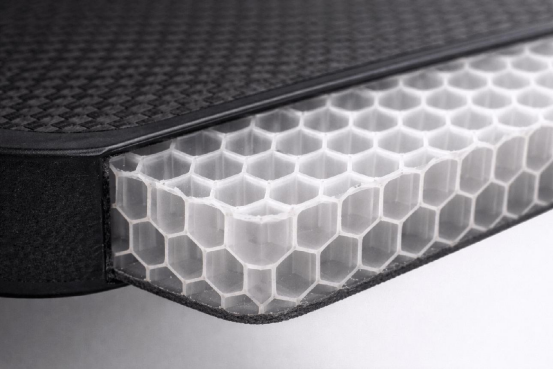
- It is extruded into hexagonal cells, then bonded between two faces.
- Density is set by cell size and wall thickness.
Where it wins
- It is the cheapest core in volume production.
- The cells carry the load, so most of the core is air.
- Cell size, wall and depth are all tunable.
- The supply chain is mature and lead times are short.
Where it loses
- The polymer is soft, so the core adds no pop on its own.
- It softens near 80 °C and can creep under load.
- Untreated PP does not bond well to the face.
- It sets rebound, but it never sets spin.
Polypropylene is a commodity plastic, and that is the point
PP is made from propylene. It is the lightest of the common plastics, it is cheap, and it moulds easily. In a paddle it is never used as a solid block. It is used as a honeycomb.
PP is a semi-crystalline thermoplastic. It melts near 165 °C, it resists water and most chemicals, and at 0.90 g/cm³ it is lighter than water. Its weak point is stiffness. Solid PP has a tensile modulus of about 1.5 GPa, which is around 1% of carbon fiber. A PP core is stiff only because a honeycomb puts the material where it is needed and leaves air everywhere else.
| Property | Value | What it means in a core |
|---|---|---|
| Density | 0.90–0.91 g/cm³ | The lightest common plastic. A solid PP core would still be light, but it would be soft. |
| Melting point | 160–170 °C | It sets the ceiling on any curing or laminating step in the build. |
| Service temperature | About 80 °C for a core | A closed container in the sun can reach this. Above it, the walls soften. |
| Tensile modulus | About 1.5 GPa | The polymer is soft. Geometry is what makes a core stiff. |
| Water absorption | Under 0.03% | The core does not take on water and does not swell. Foam cores can. |
| Chemical resistance | Good | It survives cleaning agents, adhesives and most solvents. |
| UV resistance | Poor without stabilizers | It has to stay sealed inside the paddle, under the faces and edge. |
| Surface energy | Low | Adhesive does not grab untreated PP. Every bond line needs a treatment step. |
| Recycling code | 5, easy to regrind | Trim scrap can go back into the line rather than to waste. |
Solid resin values are standard published figures for polypropylene homopolymer. The 80 °C service figure is the working limit quoted for PP honeycomb cores, not for solid PP.
“PP honeycomb” and “polymer honeycomb” are not always the same thing. Some brands write “polymer” because the core is nylon, PC or a blend, and some write it because the spec sheet does not say. If the polymer is not named, ask. Density and cell size decide how the paddle plays, but you should still know what you are buying.
How a sheet of plastic becomes a core
A honeycomb core is extruded, expanded and bonded. Every step moves the two numbers that decide how the paddle feels.
Cell size and wall thickness
Cell size and wall thickness set core density. The polymer only decides the temperature limit.
Geometry sets the density
One polymer, three products. The cell geometry is the specification.
Six steps from pellet to sandwich
Compounding
PP pellets are mixed with colour, a UV stabilizer and sometimes a nucleating agent. The additive package is where most of the weather resistance comes from.
Extrusion
The melt is pushed through a die to make a thin sheet with a half-hexagon profile. Wall thickness is set here, at the die, in microns.
Expansion
The profiled sheet is folded and joined so the walls meet at the hexagon junctions. Stacking these sheets builds the block.
Slicing
The block is cut to the core depth the paddle needs, usually 13 mm or 16 mm. Cutting clean walls matters: a crushed wall is a soft spot on the face.
Bonding
The core is bonded between two face sheets under heat and pressure. This is the step where a weak PP bond becomes a delamination six months later.
Finishing
The sandwich is trimmed to shape, the edge is guarded or foam-injected, and the handle is fitted. Face, core and edge are now one part.
The six figures that describe a PP core
These are the values to ask a supplier for. Four of them decide how the paddle plays. Two decide whether it survives the trip.
The number that predicts feel. It counts the polymer only, not the air, so a honeycomb core is far lighter than solid PP. Suppliers quote the same figure as 60–90 kg/m³.
The across-flats width of one hexagon. Larger cells compress further under the ball, so the core feels softer and holds it longer.
Measured in microns, not millimetres. Two cores with the same 8 mm cells behave differently if one has 40 µm walls and the other has 70 µm.
The working temperature quoted for PP honeycomb. Above it the walls soften and creep. Foam and nylon cores tolerate more heat.
The core does not swell or take on water. This is a real advantage over foam in humid markets and in wet storage.
The two depths we cut most. A 10 mm core is available for thin, fast builds. Deeper core means more forgiveness at the same weight.
Core density, cell size, wall thickness and the 80 °C limit are industry working ranges published by PP honeycomb suppliers, and they vary by supplier and region. We set cell geometry per order rather than publishing one fixed number.
A PP core against the cores it competes with
Four core options sit in the same buying conversation. The split is not good against bad. It is what you are willing to trade.
| Property | PP honeycomb | Polymer honeycomb (nylon / PC) | Solid EVA foam | PP honeycomb + EVA edge |
|---|---|---|---|---|
| What it is | Extruded PP cells, mostly air | The same geometry in a stiffer polymer | A solid expanded foam block | PP core with a foam ring round the edge |
| Stiffness per gram | High | Higher | Low | High in the centre |
| Weight | Lightest core option | Slightly heavier | Heaviest of the four | Light core plus edge mass |
| Material cost | Lowest | Higher than PP | Low material, more labour | Between PP and foam |
| Feel | Crisp, fast rebound | Crisper and harder | Soft, muted, long dwell | Crisp centre, damped edge |
| Heat limit | About 80 °C | Higher | Depends on the foam | About 80 °C at the core |
| Failure mode | Cell crush, then face separation | Similar, at higher force | Takes a permanent compression set | Edge holds, core behaves as PP |
| Supply chain | Mature, many suppliers, short lead time | Fewer suppliers | Mature | Needs a second process step |
| Typical tier | Every tier, entry to premium | Premium | Premium | Premium |
| Main weakness | Softens in heat, needs a treated bond | Cost and weight | Weight, and it compresses for good | Cost, and it adds a process step |
These are directional comparisons of core types, not measured values from one test bench. The core is one variable in a paddle. The face, the resin and the edge build change the result as much, and a good core on a bad build still plays badly.
Where the PP core loses
- It is the softest of the polymer cores. Solid PP has a modulus near 1.5 GPa. A nylon or PC honeycomb of the same geometry is stiffer. PP wins on price and on weight, not on rebound.
- It has a real temperature ceiling. Around 80 °C the walls soften. Under load they creep, and creep is permanent. A paddle left in a hot container in summer does not recover its original feel.
- It does not bond to anything on its own. PP has low surface energy, so adhesive beads instead of grabbing. Every bond line needs a flame, plasma or primer treatment, and a missed step shows up months later as face separation.
PP is the default because it is cheap and easy to work with. It is not the default because it is the best at any single property.
Where honeycomb was working long before pickleball
PP honeycomb is a mature industrial material. Pickleball borrowed it from markets that had already solved the supply chain.
Van and truck bodies
Honeycomb panels form floors, headliners and side walls. Light panels mean more payload, which is the reason the automotive market built the supply chain in the first place.
Partitions and ceilings
PP honeycomb is bonded to aluminium, FRP or stone to make light cladding, clean-room walls and countertops. Same core, different facing.
Boats and yachts
Bulkheads and interior furniture use honeycomb panels. The core does not corrode and does not absorb water, which is why it replaced plywood in those parts.
Mobile buildings and containers
A room built on a honeycomb floor can be lifted and moved. The core gives the floor stiffness at a fraction of the weight of plywood.
Crates and pallets
Reusable crates and pallets are made from PP honeycomb sheet instead of wood. They do not rot, they resist water and they are far lighter.
Paddle cores
The same 8 mm sheet that goes into a wall panel is cut to 13 or 16 mm, bonded between two faces and becomes a pickleball core.
Material references are listed at the end of the market-evidence section.
What a PP honeycomb core does in a paddle
Four things the core decides, in the order a player feels them.
Weight and balance
The core is most of the paddle's volume and very little of its weight. Density and depth are how a 225 g target is met without loading the handle with lead.
Rebound
A denser core returns energy faster. That is the pop a player feels. PP provides it through cell geometry rather than through the polymer.
Dwell time
Larger cells compress further under the ball, so the ball stays on the face longer. That is the control end of the same dial.
Sound and feel
Cell size sets the note. Large cells give a low thud, small cells a sharper crack. Sound is a spec, not an accident.
The core does not set spin. Spin comes from the face texture and from how the surface grips the ball. A well-built core under a smooth face is a paddle that does not spin. Buy the core for weight, pop and dwell, and buy the face for spin.
Why the core works at all
Thin faces, far apart
The faces carry the load. The core keeps them apart, and the air keeps the weight down.
The core is one layer in three
Thickness in a paddle is mostly core. That is why core depth changes the feel so much.
What we build behind a PP honeycomb core
Core
PP honeycomb at 10, 13 or 16 mm, cut to your target weight. Standard production runs 8 mm cells in the 60–90 g/L band. Smaller cells and thicker walls for a firmer core, larger cells for a softer one.
Faces
Fiberglass, carbon or aramid, one to three plies. Core and face are one decision. A thin face over a thick core plays soft. A thick face over a thin core plays fast and firm.
Construction
Cold press for fiberglass, foam and cost-driven builds. Thermoformed unibody for carbon. Thermoforming locks the core under compression, which raises stiffness without raising core density.
Edge
Bare edge, protective edge guard, or a foam-injected edge in EVA or TPE. Foam edges add perimeter weight and damp the outside of the face, which widens the usable hitting area.
Weight and size
225 g ± 5 g is our standard window, with ± 2–3 g on precision builds. Shapes from 16.5 × 7.5 in hybrid down to junior 350 × 170 mm.
Handle
PU-wrapped. Grip circumference 101 / 105 / 108 mm. Elongated handles available for two-handed backhands.
A PP core does not make a paddle fast on its own. Pop comes from the whole stack: core density and depth, the face, the resin and the edge. Change the core and you change the feel first and the exit speed second.
PP has a temperature limit
A PP honeycomb core is rated to about 80 °C. A container in direct sun, a hot car or an unventilated warehouse can reach that. The cell walls soften, and under load they creep.
If your market ships through a hot climate, say so at the enquiry stage. We will test the built paddle, not just the core, and quote a core material that holds up if PP will not.
We mould PP honeycomb cores to your density and depth, and we can quote the same shape in PP honeycomb, polymer honeycomb or foam so you can compare real numbers before you commit.
Four brands selling PP honeycomb cores today
Four production paddles across four price points. Each spec line below is quoted from that brand's own product page.
Franklin Sports — Pilot Series
Core: polypropylene · Face: fiberglass with MaxGrit® · USD 69.99
The product name on Franklin's own site reads “Pilot Polypropylene Core Pickleball Racket”, and the page title describes the face as a fiberglass paddle with MaxGrit®. A mass-market brand putting the core polymer in the product name is telling you what it thinks sells.
What it shows: at the value end the core is not hidden behind a marketing word. It is the selling point.
View on franklinsports.comONIX — Evoke Premier CT-16
Core: polypropylene · Face: composite · 16 mm thicker core · USD 99.98
ONIX writes: “The thicker core provides excellent control and touch, and a composite face and polypropylene core for excellent tournament play.” The same brand uses the same core wording across its Evoke range.
What it shows: a mid-price tournament paddle built on the same core as a value paddle. At this price the core is no longer what separates the tiers.
View on onixpickleball.comJOOLA — Hyperion CFS 16
Core: honeycomb · 16 mm · Hyperfoam edge wall · USD 159.95 · USAP PBCoR .43 certified
JOOLA's own description reads: “Outfitted with the same Honeycomb Core and Hyperfoam Edge Wall that made it iconic… offers precision and consistency for control-focused players.” Note the order: core and edge are named together, because that is how the build is sold.
What it shows: at USD 159.95 the core is still a honeycomb. The money at this price sits in the face, the foam edge and the certification, not in a different core material.
View on joola.comSelkirk — VANGUARD Power Air
Core: marketed as SuperCore · USD 100.99 · USAPA approved
Selkirk markets this core as “SuperCore”. The product page describes the shape, the sweet spot, the spin and the approval, and does not name the polymer. Plenty of premium paddles are specified this way.
What it shows: a spec you cannot verify from the page alone. If the core is named but not identified, ask the brand. Do not assume it is PP.
View on selkirk.comThe same core, four price points
| Brand | Model | Core, in the brand's own words | List price |
|---|---|---|---|
| Franklin Sports | Pilot Series | “Polypropylene Core”, in the product name | USD 69.99 |
| ONIX | Evoke Premier CT-16 | “a composite face and polypropylene core” | USD 99.98 |
| Selkirk | VANGUARD Power Air | Core named “SuperCore”; polymer not stated | USD 100.99 |
| JOOLA | Hyperion CFS 16 | “the same Honeycomb Core and Hyperfoam Edge Wall” | USD 159.95 |
Prices are list prices read from each brand's own store in USD. The same core type spans USD 69.99 to USD 159.95 across these four paddles. What changes across that range is the face, the edge build and the process, not the polymer.
Who should buy a PP honeycomb core, and who should not
Buy PP honeycomb if you sell volume, weight and a tunable feel. Do not buy it if your story is heat resistance or an exotic core. Match the core to the brief before the sample stage, because core geometry cannot be fixed after the die is set.
| Your buying situation | What a PP honeycomb core actually gives you | Our advice |
|---|---|---|
| A new brand building its first range on a controlled budget | The cheapest core, the shortest lead time and the widest choice of densities. One core platform can carry several price tiers. | Buy PP honeycomb. |
| A value or entry line at retail under USD 100 | This is the normal core at that price, not a downgrade. Fiberglass faces plus a PP core is the standard build. | Buy PP honeycomb. |
| A premium flagship sold on an exclusive core technology | Nothing exclusive. Buyers can find the same core type in a USD 70 paddle, and some will notice. | No. Use a polymer honeycomb or foam core you can name. |
| A line that ships and stores through a hot climate | A core rated to about 80 °C. In a sealed container in summer it can be exceeded, and creep is permanent. | Test the build first, or specify a higher-temperature core. |
| A power-first paddle sold on exit speed | Rebound comes from geometry, so a denser or thinner core can get you there. The polymer itself adds nothing. | Buy a denser core and a stiffer face. |
| A paddle sold on spin | Nothing. Spin is set by the face texture, and the core does not touch it. | Spend the money on the face, not the core. |
Alternatives we quote the most: a higher-density PP core when the brief is firmer rebound at the same depth. A foam-injected edge when the centre is right but the outside feels dead. A polymer honeycomb when the price list allows it and the brand wants a core it can name. Send us your retail price and the player you are chasing. We will quote the build that fits.
Material references: cell size, wall thickness, core density and the 80 °C service limit follow the published specification sheets of PP honeycomb core suppliers and are industry working ranges rather than a single mill's datasheet. Solid polypropylene properties follow standard published values for PP homopolymer. Chain structure and thermoplastic behaviour follow the general descriptions in the Wikipedia entry on polypropylene. Brand specifications are quoted from each brand's own product page and belong to that brand.
Four things a PP core will not do for you
We mould PP honeycomb cores, so read this list against our own quote.
Read this before you specify PP
- It will not hold its shape in heat. PP softens near 80 °C. In a hot container the cell walls creep under load, and creep does not reverse. If your market reaches those temperatures, test the finished paddle, not the core on its own.
- It will not add pop by itself. Solid PP has a modulus near 1.5 GPa, which is close to the softest core polymer you can buy. Every bit of stiffness in a PP core comes from cell geometry. If you want a hard, fast face, change the face and the process.
- It will not bond on its own. PP has low surface energy. Adhesive beads instead of grabbing it, so every bond line needs a flame, plasma or primer step. Skip it and the failure shows up months later as face separation, not on the line.
- It will not rescue a bad face. A crisp core under a smooth face is a paddle that does not spin and does not feel premium. Buyers judge the face first and the core second.
Summary: PP honeycomb is the lightest, cheapest and most tunable core in volume production, and the softest of the polymer cores. Buy it when you are selling weight, price and a broad feel range. Skip it when you are selling heat resistance or an exclusive core.
What a PP core build costs, and how it ships
FOB pricing by build tier, published for OEM orders. These are the ranges we quote.
| Tier | Typical build | FOB price | MOQ |
|---|---|---|---|
| Entry | Fiberglass face, PP honeycomb core, cold-pressed | USD 8.00–15.00 / pc | 500+ |
| Mid | 3K carbon face, PP honeycomb core, cold-pressed | USD 15.00–35.00 / pc | 300+ |
| Premium | Carbon or aramid face, PP honeycomb core, thermoformed unibody, foam edge | USD 35.00–65.00 / pc | 200+ |
| Flagship | Ceramic-sand face, custom core geometry and depth, full custom | USD 50.00–100.00 / pc | 100+ |
The PP core is the least expensive core we mould, so it appears in every tier. Above USD 100 retail the cost difference between cores is small next to the face and the process, and the choice becomes about feel rather than budget.
Packed and shipped
Each paddle goes into a PE bag, then a bubble bag, then a printed colour box if you want one. Master carton is 650 × 500 × 350 mm, 50 pieces per carton, around 12.5 kg.
Cartons are stacked on a pallet and shrink-wrapped. Tell us the destination and we will quote CIF as well as FOB, with the carton dimensions on the invoice so your forwarder can plan.
What you can change
Core cell size, wall thickness, core density, core depth from 10 to 16 mm, face material and ply count, edge build, surface treatment, face colour and print, weight window, shape, handle length and grip circumference, plus your own packaging artwork.
The core sheet is a stock industrial material. Density, depth and the way it is bonded are where your product becomes yours.
What we can actually prove
Every check below runs in our plant, on your order. No lab claims we cannot show paperwork for.
X-ray inspection
Every production batch goes through X-ray. It shows voids, resin-rich pockets, crushed cell walls and delamination. A crushed wall is invisible from outside and reads as a soft spot on the face.
Core density check
We weigh a known volume of core from each batch. Density is the number that sets feel, and it is the number most likely to drift between an approved sample and mass production.
Compression and batch testing
Paddles from each batch are loaded and checked, with the results logged against the batch record. You can ask for the report for your order.
Ball-impact tester
Our cannon-style rig fires balls at the face at controlled speed to check for face cracking, edge separation, core crush and bond-line failure before we ship.
In-house USAP and PBCoR pre-check
We screen dimensions, surface roughness and bounce against the published standard before submission. Certification itself is issued to the brand owner, not to us.
Batch QC reports
Weight, thickness, balance point, grip circumference, surface roughness and visual inspection are recorded per batch and travel with the shipment.
Questions buyers actually send us
Is a PP core the same as a “polymer core”?
Is a PP honeycomb core only for cheap paddles?
Does the core affect spin?
What cell size should I specify?
Is a PP core better than a foam core?
Can a PP core survive shipping and storage in a hot climate?
What core thickness should I choose?
Can you put a PP honeycomb core in a thermoformed paddle?
Can you recycle or reuse PP core scrap?
What are your MOQ and lead times?
Tell us the core, we will quote the paddle
Send the core depth, target weight, face material and the player you are selling to. We will come back with FOB and CIF pricing, a sample lead time, and a straight answer on whether PP honeycomb is the right core for that build.
Prefer email? lixifirm@outlook.com — we reply within 24 hours.