Kevlar: the toughest face material, and the softest feel
Kevlar is a para-aramid fiber. It absorbs impact instead of shattering, it damps the shock that reaches your arm, and its coarse weave grips the ball without a heavy grit coating. It also adds no pop and no stiffness. It is the softest of the three face materials, and the lightest.
What it is
- It is a synthetic polymer fiber, not carbon and not glass.
- Its chemical name is para-aramid. Kevlar and Twaron are trade names.
- It ships as bright yellow yarn. Red and black cloth is dyed.
- At 1.44 g/cm³ it is the lightest face material in use.
Where it wins
- It absorbs impact instead of shattering.
- It damps vibration better than carbon or glass.
- It grips the ball on a coarse weave, with no grit coating.
- Its texture wears slowly, so spin lasts longer.
Where it loses
- It is soft, so it does not add pop.
- Its 112 GPa modulus is half of carbon's 230 GPa.
- It is weak in compression, about a fifth of its tensile strength.
- It absorbs water and degrades in UV light.
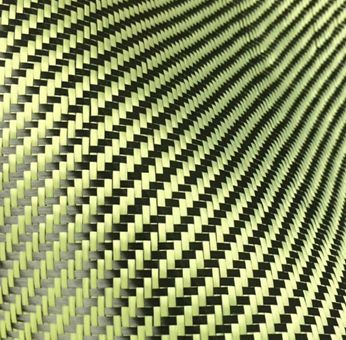
Aramid is a polymer, not a mineral
Kevlar is a brand. Aramid is the material class. DuPont brought Kevlar to market in 1971; Teijin sells the same chemistry as Twaron. Both are para-aramid.
Aramid is an aromatic polyamide. It is made from oil-derived monomers, not from rock or from pitch. The polymer chains are spun into a fiber and locked parallel to the fiber axis, and that alignment is where the strength comes from. Carbon fiber gets its stiffness from a carbonised lattice. Aramid gets it from the shape of the molecule.
| Para-aramid | Meta-aramid | |
|---|---|---|
| Trade names | Kevlar, Twaron, Technora | Nomex, Teijinconex |
| Chain shape | Straight and rigid, aligned to the fiber axis | Zig-zag, less ordered |
| Tensile strength | High, 3,000 MPa at Kevlar 49 | Roughly a third of para-aramid |
| Heat and flame | Good | Excellent, the reason Nomex exists |
| Main uses | Body armour, composites, ropes, tyres | Firefighter suits, insulation paper, honeycomb core |
| Seen on a paddle face? | Yes. This is what a “Kevlar face” means. | Not as a face. It shows up as a core material. |
The chain-shape and strength comparisons follow standard aramid material descriptions. Aramid is a polymer class defined by the position of the amide bond, not a single product from a single supplier.
“Kevlar face” names a material family, not a grade. It does not tell you which Kevlar, how many plies, which resin, or what is behind it. A 16 mm control build and a 13 mm hybrid build can both honestly say “Kevlar surface” and play nothing alike.
How aramid becomes a fiber
Aramid is spun from a liquid crystal solution. The chains are already rigid; the spinning step lines them up.
Two aramids, two chain shapes
Straight chains pack tighter than folded ones. That is the whole difference between Kevlar and Nomex.
Spinning aligns the chains
Aramid is spun from a liquid crystal solution, so the chains arrive almost fully oriented. DuPont has used this route since 1971.
Six steps from monomer to laminate
Polymerisation
Two monomers are reacted to build a rigid aromatic polyamide chain. The chain is stiff because the rings do not rotate freely.
Dissolving
The polymer is dissolved in concentrated sulfuric acid. It forms a liquid crystal solution, which is what makes this fiber route unusual.
Spinning
The solution is pushed through a spinneret. Shear force lines the domains up along the flow direction as they exit.
Washing and drying
Acid is washed out and the yarn is dried under tension. Residual moisture is measured here, because aramid holds water.
Weaving
Yarn is woven into plain, twill or cross-weave cloth. The pattern creates the visible grain on the face and the mechanical bite on the ball.
Lamination
Cloth is impregnated with resin, stacked in plies and cured under heat and pressure. Face, core and edge become one part.
The six figures that describe an aramid face
These are the values worth asking a supplier for. Four of them are the reason to buy aramid. Two are the reason to think twice.
The lightest of the three face materials. Carbon is 1.80 and E-glass is 2.54. Per unit of weight, aramid carries more load than steel.
Kevlar 49, straight-tested yarn. Lower than standard carbon at 4,900 MPa, and higher than E-glass at 3,400 MPa.
About half of standard-modulus carbon at 230 GPa, and about 1.5 times E-glass at 73 GPa. Aramid is tough, not stiff.
It stretches where carbon snaps. This is the number behind the impact tolerance, and behind the soft feel on a paddle.
Aramid is far weaker in compression than in tension, and it kinks instead of cracking. This is its best-known engineering limit.
Yarn picks up water from the air. Cloth has to be dried before layup or the laminate comes out with voids.
Kevlar 29 and Kevlar 49 values above follow DuPont's published technical guide; the compression ratio, moisture range and the glass and carbon comparisons are industry-typical published values used for material selection, not results from our own testing.
Aramid against the faces it competes with
Four face materials sit in the same buying conversation. The split is not strength against weakness. It is tough against stiff.
| Property | Aramid (Kevlar 49) | Carbon (T700) | E-glass | Aramid / carbon hybrid |
|---|---|---|---|---|
| Density | 1.44 g/cm³ — lightest | 1.80 g/cm³ | 2.54 g/cm³ — heaviest | About 1.6 g/cm³ |
| Tensile strength | 3,000 MPa | 4,900 MPa | 3,400 MPa | Between the two |
| Modulus | 112 GPa | 230 GPa | 73 GPa | Between the two |
| Elongation at break | 2.4% | 2.1% | 4.7% | Between the two |
| Failure mode | Stretches, then kinks | Shatters, no yield | Stretches, whitens, frays | Mixed, can delaminate |
| Impact tolerance | Best of the three | Worst of the three | Good, soft and cheap | Good |
| Vibration damping | Highest | Lowest | Low | Middle |
| Compression | Poor, about a fifth of its tensile strength | Good | Fair | Bounds the aramid, so better |
| UV and moisture | Poor alone, needs sealing under resin | Good | Good, but abrades | Poor, same as aramid |
| Relative material cost | High | Middle | Lowest | Highest of the four |
| Feel on a paddle | Soft, plush, quiet | Crisp, immediate | Springy, vague at low speed | Tuned between the two |
Property values are industry-typical published figures for the named fiber classes, used for material selection rather than taken from one mill datasheet. Hybrid performance depends on the ratio, the weave and the stacking order, so treat the hybrid column as a direction, not a number.
Where aramid loses on a paddle face
- It is the least stiff face you can buy. At 112 GPa it is half of standard carbon. A stiffer face returns more of the swing into the ball. Aramid returns less, and the difference is what players call a soft face.
- It is weak in compression, and it kinks. Aramid carries load along the fiber; push it sideways and it folds. That is why aramid rarely leads a structural ply. It usually sits on the surface with carbon behind it.
- It takes up water and hates UV. Bare aramid degrades in sunlight, and the yarn can hold several percent of its weight in water. Every aramid face has to be sealed in resin on all sides, and the cloth has to be dried before layup.
The fiber is the reason to buy it, and the fiber is also the reason it will never be the fast face on the shelf.
Where aramid was working long before pickleball
Aramid has been in service since the 1970s. Pickleball borrowed it, and the properties that matter here are the properties that mattered there.
Body armour and helmets
Aramid stops a projectile by stretching and absorbing the energy over a wide area. It does not shatter. This is the same property that stops a paddle from cracking at the edge.
Aerospace structures
Kevlar 49 is used where a part must survive impact without failing brittle. It appears in fairings, pressure panels and engine containment, usually with carbon carrying the stiffness.
Tyres, belts and hoses
High-speed tyres are reinforced with aramid cord. The fiber flexes millions of cycles without cracking, which is exactly the fatigue behaviour carbon cannot offer.
Marine and mooring lines
Aramid rope is strong, light and does not corrode. On a boat it replaced steel wire at a fraction of the weight.
Fire and electrical
The meta-aramid family is the firefighting and insulation material. It does not melt, does not conduct, and holds its shape at high temperature.
Honeycomb core
Aramid paper is folded into honeycomb and used as a structural core in aircraft floors. The same idea, in polymer form, shows up inside paddle cores.
Material references are listed at the end of the market-evidence section.
What aramid does on a paddle
Four things an aramid face changes, in the order a player notices them.
Long catch
Aramid deflects further under load than carbon does. The ball stays on the face longer, which players feel on dinks, drops and resets. The same property means the ball leaves a little slower.
Quiet hand
Aramid absorbs vibration by nature, not by adding a damping layer. Less high-frequency shake reaches the handle, which is why arm-friendly lines are built on this face.
Grip without grit
The weave itself gives the bite, so aramid does not need a heavy sprayed coating to hold the ball. The texture also wears slowly, so spin does not fall off as the face ages.
Signal colour
Aramid is gold, and red aramid is unmistakable against black raw carbon. Brands use it to make a control line read as a different product. That is a commercial choice on top of a mechanical one.
Why aramid fails differently
Same load, two failure modes
Illustrative. Both fibers still sit under resin in a real laminate, and the core decides how the whole paddle feels.
Contact and vibration
Same swing, same ball. Aramid holds the ball longer and passes less of the impact into the handle.
What we build behind an aramid face
Face
Aramid cloth, plain, twill or cross-weave, natural gold or dyed red. Some brands stop at 100% aramid. Others run aramid on top of a carbon structural ply, which is the build we quote most.
Core
Polypropylene honeycomb, 13 mm or 16 mm. Aramid and a thick core push the same way: more dwell, more forgiveness. Pairing aramid with a 13 mm core gives up the feel people buy aramid for.
Construction
Thermoformed unibody with foam-injected edges is the usual match, because an aramid face is already priced as a premium part. Cold-pressed works, and gives up the edge foam.
Weight and size
225 g ± 5 g is our standard window, with ± 2–3 g on precision builds. Shapes from 16.5 × 7.5 in hybrid down to junior 350 × 170 mm.
Surface
Raw weave, sealed matte or a printed finish. Aramid bites on its own grain, so we usually recommend raw. Sealing protects the fiber from UV and wear, and costs some spin.
Handle
PU-wrapped, grip circumference 101 / 105 / 108 mm. Elongated handles available for two-handed backhands.
An aramid face does not make a paddle faster. Stiffness and pop come from the laminate stack, the resin and the core. Swapping a carbon face for an aramid one on the same core changes the feel a lot and the exit speed in the wrong direction.
Aramid is harder to run than carbon
Three things make it a fussier material on the line. The cloth takes up moisture, so it has to be dried before layup. It is difficult to cut cleanly, so edge trimming generates more scrap. And it does not bond to resin as easily as carbon or glass, which makes the surface treatment step matter more rather than less.
Budget for a pre-production sample. It is the cheapest place to find out that your cure profile needs a change.
We build aramid and aramid-carbon hybrid faces to order, and we can quote the same shape in aramid, carbon or a hybrid stack so you can compare real costs before you commit.
Four brands shipping aramid faces today
Four production paddles with an aramid face, at four price points and in three currencies. The spec line each brand publishes on its own product page is the evidence.
Six Zero — Ruby
Face: 100% Aramid fibre · Core: 16 mm honeycomb polymer · 8.2 oz · USA Pickleball approved · AUD 250.00 on the AU store
Six Zero's own page reads: “this paddle features a 100% Aramid fiber face. Renowned for its high strength, toughness, and thermal stability… The cross-weave cloth pattern enhances spin, grip, and overall feel.” The published spec table lists Top Face Material as “Aramid Fibre”.
What it shows: the pure-aramid face as a flagship, not a compromise. The brand built a whole control line around it and named the color after it.
View on sixzeropickleball.comSpartus — Apollo
Face: premium 100% Aramid fiber · Swing weight 108 · Twist weight 7.45 · Spin over 2,300 RPM · USD 129.99
Spartus states: “The Apollo is the world's FIRST widebody paddle that uses a premium 100% Aramid fiber as its face material… a MASSIVE sweetspot from the incredibly high twistweight of 7.45.”
What it shows: aramid used to open up a wide, forgiving body. Note the same page now announces that the Oracle replaces the Apollo — and the Oracle is a carbon and fiberglass build, not an aramid one.
View on gospartus.comPakle — Blade X
16 mm Control: 100% DuPont Kevlar surface · Core 16 mm · Swing weight 115–120 · 13 mm Power: Kevlar and T700 hybrid · NZD 182.00
The brand's own series page splits the two builds and says why: “The 100% Kevlar® surface yields a relatively lower pop, emphasizing exceptional control and a soft touch. A blend of Kevlar® and T700 carbon fiber offers moderate rigidity, effectively absorbing and releasing energy, resulting in outstanding, crisp shot feel and power.”
What it shows: the clearest statement in the market. A brand selling both versions puts pure aramid on control and adds carbon to get power back. That is the material's limit, described by the company selling it.
View on paklepickleball.comHelios — Athos
Face: DuPont Kevlar surface · Unibody, thermoformed · USD 129.00
Helios writes: “Constructed with DuPont Kevlar surface—a bulletproof material—it delivers superior impact and abrasion resistance, enhancing dwell time for impressive topspin and powerful shots.” The same brand's T700 carbon model, the Apollo, lists at USD 139.00.
What it shows: aramid is not a price premium. In this brand's own line-up the aramid model sits below the carbon model on price. You are not paying more for the fiber. You are choosing a different feel.
View on heliospickleball.comThe same face material, across three currencies
| Brand | Model | Face spec, in the brand's own words | List price |
|---|---|---|---|
| Six Zero | Ruby | “100% Aramid fiber face”, cross-weave | AUD 250.00 |
| Spartus | Apollo | “premium 100% Aramid fiber”, widebody | USD 129.99 |
| Pakle | Blade X Control 16 mm | “100% DuPont™ Kevlar®” surface | NZD 182.00 |
| Helios | Athos | “DuPont Kevlar surface” | USD 129.00 |
Prices are list prices read from each brand's own store, in the currency that store quotes. Six Zero sells through separate AU and US storefronts, and the AU price is the one published against that page. Two of these four paddles are listed below USD 130, and in the Helios range the aramid model prices under the carbon model. Aramid is a feel choice, not a tier.
Who should buy an aramid face, and who should not
Buy aramid if you sell touch, spin and an arm-friendly story. Do not buy aramid if you sell exit speed, or a crisp loud hit. Match the face to the brief before the sample stage, because none of this is fixable afterwards.
| Your buying situation | What an aramid face actually gives you | Our advice |
|---|---|---|
| A control or all-court flagship at retail USD 150–250, sold on touch and spin | The softest catch of any face, a weave that bites without grit, and spin that fades slowly with wear. | Buy 100% aramid. |
| A power-first line sold on pop, exit speed and a loud hit | The lowest pop of the three face materials. Aramid absorbs and holds instead of throwing the ball back. | No. Specify 3K raw carbon or fiberglass. |
| An arm-friendly, senior or high-frequency-play line | The strongest vibration damping of the three, because the fiber absorbs shock by nature rather than by adding a layer. | Buy aramid, pair it with a 16 mm core. |
| A high-volume value line at retail under USD 100 | Nothing you can pay for. Quality aramid cloth costs more than glass or entry carbon, and it is harder to cut, dry and bond, so first-run scrap is higher. | No. Use fiberglass or entry carbon. |
| A new brand that needs to stand out from a wall of black raw carbon | A gold or red weave that no carbon face can copy, plus a ready-made “bulletproof” story your buyer already understands. | Buy aramid, and lead with the look. |
| A line whose customer wants a crisp sound and a hard, immediate response | A quieter, softer hit. Players who like a stiff ping off the face read aramid as muted. | No. Stay on raw carbon. |
Alternatives we quote the most: aramid over a carbon structural ply when you want the aramid feel without giving up stiffness. A 50/50 aramid and carbon hybrid when the brief asks for soft but not slow. Raw 3K twill when the whole story is bite at the lowest cloth cost. Send us your retail price and the player you are chasing. We will quote the build that fits.
Material references: tensile strength, modulus, density, elongation and moisture values follow the DuPont Kevlar technical guide. Chain structure, compression behaviour and the para-aramid against meta-aramid comparison follow the general descriptions in the Wikipedia entry on aramid. Brand specifications are quoted from each brand's own product page and belong to that brand.
Four things aramid will not do for you
We quote aramid faces, so check this list against our own quote.
Read this before you specify aramid
- It will not make a paddle faster. At 112 GPa it is the least stiff face material in use. Soft catch and slow exit are one property described two ways. If your buyer wants pop, this is the wrong fiber and no core will fix it.
- It will not carry the structure on its own. Aramid is weak in compression and kinks under load, so it almost always sits on the surface with carbon behind it. If you specify an all-aramid laminate, expect to lose stiffness.
- It will not survive bare. Aramid degrades in UV light and absorbs moisture, so every face has to be fully sealed in resin, and the cloth has to be dried before layup. Skip either step and you get voids or surface breakdown.
- It will not rescue a cheap core. An aramid skin on a thin, dead core plays like a thin, dead core. Money is better spent on core and construction first, and the cosmetic face last.
Summary: aramid is the toughest, lightest and softest face material, and the least stiff. Buy it when your customer is buying touch, spin and comfort. Skip it when your customer is buying speed.
What an aramid build costs, and how it ships
FOB pricing by build tier, published for OEM orders. These are the ranges we quote.
| Tier | Typical build | FOB price | MOQ |
|---|---|---|---|
| Entry | Fiberglass face, EVA core | USD 8.00–15.00 / pc | 500+ |
| Mid carbon | 3K carbon face, mid EVA core | USD 15.00–35.00 / pc | 300+ |
| Premium | Aramid or aramid-carbon hybrid face, multi-layer core, thermoformed | USD 35.00–65.00 / pc | 200+ |
| Flagship | Ceramic-sand surface, full custom, aramid over UD | USD 50.00–100.00 / pc | 100+ |
An aramid build usually lands in the USD 150–250 retail band. Below USD 100 retail, glass fiber and entry carbon are the realistic faces.
Packed and shipped
Each paddle goes into a PE bag, then a bubble bag, then a printed colour box if you want one. Master carton is 650 × 500 × 350 mm, 50 pieces per carton, around 12.5 kg.
Tell us the destination and we will quote CIF as well as FOB, with the carton dimensions on the invoice so your forwarder can plan.
What you can change
Face material (100% aramid, aramid over carbon, aramid and carbon hybrid), weave and cloth weight, face colour, core thickness 10–16 mm, core material, edge guard colour and logo, handle length and grip circumference, surface treatment, weight window, shape and your own packaging artwork.
The cloth itself is a stock material. The way it is stacked, laminated, cut and finished is where your product becomes yours.
What we can actually prove
Every check below runs in our plant, on your order. No lab claims we cannot show paperwork for.
X-ray inspection
Every production batch goes through X-ray. It shows voids, resin-rich pockets, core deformation and delamination. Aramid is the face most likely to trap moisture and produce voids, so this check matters more here than on a carbon build.
Compression and batch testing
Paddles from each batch are loaded and checked, with results logged against the batch record. You can ask for the report for your order.
Ball-impact tester
Our cannon-style rig fires balls at the face at controlled speed to check for face cracking, edge separation and core crush before we ship.
In-house USAP and PBCoR pre-check
We screen dimensions, surface roughness and bounce against the published standard before submission. Certification itself is issued to the brand owner, not to us.
Batch QC reports
Weight, thickness, balance point, grip circumference, surface roughness and visual inspection are recorded per batch and travel with the shipment.
Mill and origin documents
We buy aramid cloth on your bill of materials and pass on the supplier's own documents. Material brand claims stay with the brand that specified them.
Questions buyers actually send us
Is Kevlar the same as aramid?
Is an aramid face better than a carbon face?
Will an aramid face give the paddle more power?
Why do players say aramid gives more spin?
Does an aramid face really help with arm pain?
Is aramid heavier than carbon?
Should I use a hybrid aramid and carbon face instead?
Is the yellow cloth natural, and what about the red?
Can aramid and carbon be laminated in the same face?
What are your MOQ and lead times?
Tell us the face, we will quote the paddle
Send the face material, the cloth weight, the core, the shape and the surface finish you want. We will come back with FOB and CIF pricing, a sample lead time, and a straight answer on whether aramid is the right fiber for the player you are selling to.
Prefer email? lixifirm@outlook.com — we reply within 24 hours.