Carbon fiber: the stiffest, lightest face material in pickleball
Carbon fiber is stiff along the fiber and weak across it. Every carbon part is a stack of layers laid in different directions. On a paddle it gives crisp feedback, precise control and the lightest swing weight in the category. It also cracks on an edge knock instead of bending.
What it is
- It is a fiber of carbon crystals that run lengthwise.
- It is stiff along the fiber and weak across it.
- It always comes as layers in a resin matrix.
Where it wins
- It is the stiffest face material in pickleball.
- It is the lightest of the common face materials.
- It gives crisp feedback and precise control.
- It grips the ball when the surface is raw.
Where it loses
- It cracks on an edge knock instead of bending.
- It costs several times glass per kilogram.
- Raw texture wears smooth over a season.
- A bad press ruins it, and the outside looks fine.
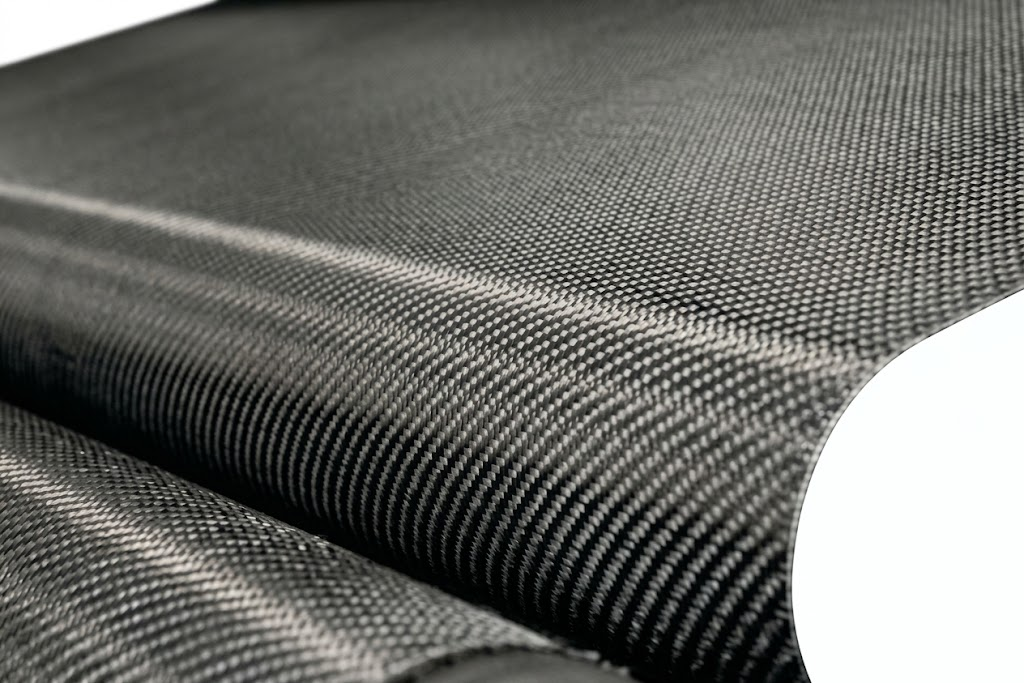
What carbon fiber actually is
Carbon fiber is a fiber made mostly of carbon atoms. The atoms sit in tiny crystalline sheets that run lengthwise along the fiber. It is not a metal and it is not a ceramic. It is a third kind of material, and that is why it behaves the way it does.
The starting point is not carbon. It is a plastic. Over 90% of the world's carbon fiber is made from polyacrylonitrile (PAN), a white polymer fiber. Workers heat that white fiber in stages until almost everything except carbon burns away. The result is black. It weighs about 7% less than the fiber it started as, and it is roughly half the weight and several times the strength of steel at the same cross-section.
It is stiff in one direction only
Inside the fiber, graphite-like crystal layers line up along the axis. The material is very strong and stiff along that axis. It is weak across it. Engineers call this anisotropy. It is the reason carbon fiber is always laid up in layers at different angles instead of used as one flat sheet.
A paddle face is never one layer. It is a stack, and the direction of each layer is part of the design.
It is not a finished material either
Like glass fiber, carbon fiber is a reinforcement. On its own it is a bundle of filaments. It becomes a paddle face only after it is combined with a resin matrix and cured under heat and pressure. Almost every high-end paddle uses epoxy.
The fiber decides stiffness and strength. The resin decides how well the layers stay bonded and how the paddle fails.
From white plastic fiber to black carbon fiber
Heat is the whole process
More heat means more stiffness and less strength.
Polymerisation
Acrylonitrile is polymerised into PAN. This white precursor fiber is where everything starts.
Spinning
PAN is spun into filament yarn, typically by wet spinning or dry-jet wet spinning. Filament counts here set the eventual tow size.
Oxidation
The white fiber is heated to 200–300 °C in air. It cross-links and stops being thermoplastic, so it will not melt in the next stage.
Carbonisation
The fiber is heated to 1,000–1,500 °C in an oxygen-free furnace. Non-carbon atoms leave as gas. The remaining carbon forms aligned crystal layers.
Surface treatment and sizing
The surface is etched and coated so it will bond to resin. This step is small, cheap, and responsible for most delamination failures when it is done badly.
Weaving or layup
The tow is woven into fabric or spread into unidirectional tape, then impregnated with resin and formed into the final part.
Turning PAN into carbon fiber means running furnaces at 1,000–1,500 °C for hours. The line needs a controlled atmosphere and a continuous supply. That is why carbon fiber costs multiples of glass fiber, even though both are made mostly of light elements.
Five numbers that define how carbon fiber behaves
These values explain every practical consequence: the crisp feedback, the precision, the light swing weight and the fragility at the edge.
Standard-modulus carbon sits at 3,500–4,500 MPa. T700 class reaches about 4,900 MPa. That is four to five times the specific strength of steel.
Roughly three times glass fiber. This is the number that makes a carbon face feel sharp instead of springy.
About 30% lighter than glass fiber and a quarter the density of steel. Lets a brand add structure without adding swing weight.
It barely stretches. Glass fiber stretches about three times as far. That is why carbon fails by cracking instead of bending.
Carbon fiber is over 93% carbon by weight. Graphitised fiber goes above 99%, and buys stiffness with strength.
Effectively zero along the fiber, and slightly negative in high-modulus grades. Carbon parts do not grow much when they heat up.
Industry-typical published values for standard-modulus PAN-based carbon fiber at room temperature. Every mill publishes its own datasheet; always ask which grade a paddle face actually uses.
"Carbon fiber" covers a wide family of materials
Two things specify a carbon fiber: what it was made from, and how many filaments are in the bundle. Both change the price and the behavior.
Precursor: what the fiber was made from
| Precursor | Share of production | Character | Typical use |
|---|---|---|---|
| PAN | Over 90% | Best balance of strength and cost; the standard choice | Paddle faces, aerospace, bikes, wind blades, pressure vessels |
| Pitch | Small | Made from petroleum pitch; reaches very high modulus, lower strength | Satellite structures, specialist high-stiffness parts |
| Rayon | Very small | Low strength, excellent heat insulation | Rocket nozzles, heat shields |
Tow size: how many filaments are in the bundle
The "K" in 3K, 12K or 18K means a thousand filaments. A 12K tow contains 12,000 filaments. Larger tows are cheaper to make per kilogram; smaller tows weave into a finer, more visible pattern.
Fine tow
Thin, expensive, and mostly used where appearance matters. Gives the tight, visible weave people recognise as "carbon look".
The paddle sweet spot
Strong enough for structure, fine enough to weave, and affordable at production volume. Most competitive paddle faces are 12K or 18K.
Industrial tow
Made for volume, not for looks. Common in wind blades, pressure vessels and automotive structural parts.
How the named grades differ
| Grade class | Tensile strength | Elastic modulus | What it is chosen for |
|---|---|---|---|
| Standard modulus | 3,500–4,500 MPa | 220–240 GPa | The default for sports equipment and general industry |
| Intermediate modulus | ~5,500–6,000 MPa | ~290 GPa | Where more strength and stiffness justify a price step |
| High modulus | ~4,000–4,500 MPa | 350–400 GPa | Stiffness-critical parts; strength per weight drops |
| Ultra-high modulus | Lower still | 500+ GPa | Spacecraft structures, where stiffness is everything |
The pattern holds across all carbon fiber: as modulus climbs, strength per unit weight tends to fall. You choose a point on that curve. Paddle faces live in the standard-modulus band, which is why "T700" and similar designations appear so often.
On brand-name fiber, a straight answer
You will see named fiber designations in paddle marketing: T700, PT-700, TORAY T700. Those are real designations from real mills. Brands that publish them are usually stating what they buy. But a fiber designation does not guarantee how the finished paddle was built.
Our position: we build to the fiber specification on your bill of materials. Where you name a specific mill, we procure against the certificate of origin and the material claim belongs to you, the brand. We do not put a brand-name fiber on our own account without a document trail.
Carbon fiber next to glass fiber and aramid
All three reinforce a plastic. They differ in stiffness, weight, cost and how they break. Those four differences decide which one belongs in your product.
| Property | Carbon (standard modulus) | E-glass | Aramid |
|---|---|---|---|
| Tensile strength | 3,500–4,500 MPa | 3,100–3,800 MPa | 2,900–3,600 MPa |
| Elastic modulus | ~230 GPa — very stiff | 72–76 GPa — flexible | 70–110 GPa |
| Density | 1.75–1.80 g/cm³ — lightest | 2.54–2.62 g/cm³ | 1.44 g/cm³ |
| Strain to failure | 1.5–2.0% — brittle | ~4.7% — tough | ~2.5–4% |
| Impact behavior | Absorbs little energy; cracks, may delaminate | Absorbs impact, cracks progressively | Best impact energy absorption |
| Fatigue life | Excellent; stable over millions of cycles | Good | Good, but sensitive to moisture |
| Electrical behavior | Conductive | Non-conductive | Non-conductive |
| Cost, order of magnitude | The most expensive of the three | The cheapest | Between the two |
Read the modulus and impact rows together. Carbon is stiff and precise. Glass is flexible and forgiving. That trade runs through every decision in this section.
One correction to the usual marketing line: "carbon is stronger than glass" is only half true. Standard-modulus carbon and E-glass have overlapping tensile strength. Carbon wins on stiffness per unit weight, not on raw strength.
That distinction matters when a buyer asks why a glass paddle can feel more durable in the field.
How the carbon is laid decides how the face plays
Fiber grade is only the first question. The second is how the tow is arranged: woven at 0/90, laid unidirectional, or mixed. Two "T700 paddles" can feel completely different because of this.
Three layouts used on paddle faces
The same T700 tow behaves differently in each of these three layouts.
Why "raw carbon" is a surface decision, not a fiber decision
Raw carbon
The weave is left exposed, with no paint or coating over it. The tiny gaps between tow crowns give the face its grip. It bites hard, and it wears as you play.
Coated and treated surfaces
Brands now add durable surface layers over the carbon: grit, oxide or proprietary textures. The claim is longer-lasting spin, because a raw weave slowly smooths out.
Decor weave vs structural carbon
A visible carbon pattern does not prove the paddle is carbon-reinforced. A single cosmetic layer over a glass laminate looks identical from the outside. Ask what is under the surface.
Layup angle
Every layer has a direction. Faces are stacked at mixed angles so the paddle resists twisting, not just bending. The layup schedule is the real engineering document.
Where the same material goes to work elsewhere
Aerospace
Modern wide-body airliners are about half composite by weight, most of it carbon fiber, because stiffness per kilogram decides how much aircraft you need.
Wind blades
Blade spars use carbon fiber where stiffness controls blade length, and glass fiber everywhere cost does.
Pressure vessels
Hydrogen tanks are filament-wound carbon fiber over a polymer liner. They are the strongest lightweight pressure vessels industry has.
Racing and bicycles
Formula 1 monocoques, road frames and golf shafts all trade on the same property: stiffness with almost no weight.
Carbon fiber shows up wherever a part must be stiff and light. Paddle faces are exactly that kind of part.
Now the pickleball part
Pickleball rewards two things carbon fiber is unusually good at. It puts spin on a hard plastic ball, and it returns the ball where you aimed. That is why the competitive tier is a carbon conversation.
It grips the ball
An exposed carbon weave has thousands of microscopic crowns and valleys. They grab the plastic ball and hold it a fraction longer. That is what lets a player put heavy topspin or backspin on the ball.
The fiber does not create spin by itself. The surface texture does. That is why the same fiber can spin hard on one paddle and not at all on another.
It barely moves
High modulus means a carbon face deflects very little. What the player puts in is what the ball gets out, in a straight line. That consistency is what makes soft dinks, resets and drop shots repeatable.
A flexible face adds power you did not ask for. A stiff face gives you exactly what you asked for.
It resists twisting
On an off-centre hit, a flexible paddle twists and sends the ball somewhere you did not intend. A stiff carbon face with a multi-angle layup resists that rotation. The sweet spot plays bigger than it measures.
Manufacturers call the measure of this resistance twist weight, and it is one of the numbers worth quoting on a spec sheet.
Thermoformed unibody, in section
A glued-on handle fails at the neck. A unibody layup removes the joint entirely.
Heat and pressure: the process that suits carbon
Carbon fiber layers are usually cured in a heated press. The resin flows, the stack consolidates and the part takes its final shape in one cycle. The carbon can run continuously from the face into the handle, so the whole paddle forms as one piece.
That is what the industry calls thermoformed unibody: no glued neck, less flex at the joint, less vibration reaching the hand.
What usually goes around the core
Carbon faces are paired with a polymer honeycomb core for a light, stiff structure, or with injected foam to add mass and damping. Many current builds do both: honeycomb in the middle, foam around the perimeter.
Perimeter foam adds weight where it stabilises the head without stiffening the middle. It is a cheap way to enlarge the sweet spot.
Typical specs for a carbon fiber build
| Parameter | Standard build | Notes |
|---|---|---|
| Face material | Raw carbon fiber, 12K or 18K woven, or 3K for a fine visible weave | Unidirectional layups used where stiffness matters more than texture |
| Surface | Exposed weave, or a durable textured surface layer | Texture drives spin; coatings drive how long that spin lasts |
| Core | Polypropylene honeycomb, 13 mm or 16 mm | Foam-injected perimeter or foam core optional |
| Construction | Thermoformed unibody, carbon running into the handle | Reduces the neck joint that fails on glued construction |
| Molded weight | 225 g ± 5 g | Precision builds held to ± 2–3 g |
| Handle | PU or EVA-filled handle, grip circumference no. 0/1/2 = 101 / 105 / 108 mm | Foam-filled handles damp more vibration |
| Hot-press capacity | Up to 80,000 paddles per month | Separate line from the cold-press fiberglass build |
Our own standard numbers for the carbon line. Layup angle, fiber grade and surface treatment are all adjustable against your target price and performance level.
Pick carbon when the player pays for feel, spin and precision and the price can carry the process. It is the wrong purchase when it cannot. The honest answer then is a glass build, not a cheaper imitation of a carbon one.
Brands already selling carbon fiber paddles
Six production paddles from six established brands, each naming its own face material on its own product page. The same word “carbon” covers four different material strategies and a USD 80 span in price.
JOOLA Perseus CFS
Carbon Friction surface · 16 mm core · elongated shape
The CFS (Carbon Friction) surface is JOOLA's original carbon-texture face, now offered in the Perseus shape that the brand's tour players use. Listed as USAP certified.
What it shows: a surface technology, not just a fiber choice. The same fiber family spreads across a whole product line.
View on joola.com ↗Six Zero Double Black Diamond Control
T700 raw carbon face · carbon fusion edge · 14 / 15 / 16 mm
Six Zero publishes the face material in its spec table: T700 raw carbon, with the carbon face and a carbon seam extending down through a thermoformed handle to form one piece.
What it shows: the full carbon playbook in one product — raw texture for spin, unibody for stability, carbon edge for the sweet spot.
View on sixzeropickleball.com ↗CRBN¹ X Series
T700 Toray carbon fiber surface · reinforced unibody · foam perimeter
CRBN names the fiber and the construction: a T700 carbon surface for dwell time, carbon fiber running from face through handle, and a foam-reinforced perimeter for stability.
What it shows: how far a brand will go on the material claim — mill, grade, construction and surface are all stated.
View on crbnpickleball.com ↗Selkirk LUXX Control Air with InfiniGrit
Florek carbon fiber face · InfiniGrit surface · 19 mm core
Selkirk lists a proprietary carbon blend as the face material paired with a durable grit surface, and states the intent directly: three times the spin durability of a raw carbon face. EVA foam fills the throat and handle.
What it shows: the market's answer to raw carbon's weakness — a surface that keeps its bite after the weave would have worn smooth.
View on selkirk.com ↗Vatic Pro PRISM
T700 raw carbon fiber · foam edge walls · 14 / 16 mm
Notable because of where it sits: the PRISM brings a named T700 raw carbon face and foam edge walls into a sub-USD 100.00 price band.
What it shows: carbon fiber is no longer reserved for the top of the price ladder. The material has moved down-market.
View on vaticpro.com ↗Paddletek Bantam TKO-C
PT-700 unidirectional raw carbon fiber · Bantam core
Paddletek specifies unidirectional raw carbon instead of a woven face. That trades the visible weave for a flatter, stiffer surface and its own spin texture.
What it shows: unidirectional layup is a real alternative to woven carbon, chosen for stiffness rather than looks.
View on paddletek.com ↗Who should buy a carbon fiber paddle, and who should not
Buy carbon when the player is paying for feel, spin and a price step above your volume line. Do not buy carbon when the target retail price cannot carry the material and the process behind it. A cheap carbon face is the worst of both worlds: carbon cost, glass performance. Match the face to the brief before the sample stage, because none of this is fixable afterwards.
| Your buying situation | What a carbon face actually gives you | Our advice |
|---|---|---|
| Building a tournament or performance line for players who pay for feel | A face that barely deflects, grips the ball hard and tells the player exactly what happened on contact. | Buy carbon. |
| Your customers ask for spin by name | A raw carbon surface is the reference point they are comparing everything else against. You stop having to explain the face. | Buy carbon — raw, not coated. |
| You already run a glass volume paddle and need a hero model above it | A stiffness and weight gap your glass line cannot reach, and a price step your distributor can see and justify. | Buy carbon. |
| The target retail price cannot carry the material and the process | A thin carbon skin over a cheap core. Carbon cost, glass performance, and a warranty you will pay for. | No. Build glass honestly instead. |
| Your buyers are beginners, schools or rental programmes | A face they cannot feel the difference in, at a price they will not pay. Club glass survives the abuse better. | No. Glass. |
| Your press, resin and edge-bonding process is not under control | Delamination and edge failure are expensive in a way a glass face is not. Carbon punishes a bad process. | Not yet. Prove the process first. |
Alternatives we quote the most: a glass build rather than a cheap copy of a carbon one, when the budget cannot carry carbon's process. Unidirectional carbon under a thin woven outer ply for carbon stiffness without carbon looks. A grit-coated surface instead of a raw weave when spin has to survive a full season. Send us your retail price and the player you are chasing. We will quote the build that fits.
Material reference sources: the property ranges above are industry-typical published values for standard-modulus PAN-based carbon fiber, and the manufacturing sequence follows standard precursor-fiber practice. For background see carbon fibers and a composites supplier such as Toray Composite Materials America. Product specifications are quoted from each brand's own product page in September 2026 and will change as brands update their ranges. All trademarks belong to their owners; no affiliation is claimed.
Where carbon fiber is the wrong choice
Four failure modes we see in carbon builds, and what prevents each one.
Four real weaknesses
1. It cracks instead of bending. Strain to failure sits around 1.5–2.0%, so a carbon face has very little give. A hard edge knock can start a crack or a delamination. Glass fiber would shrug that off. Carbon paddles die on edge impacts, not face impacts.
2. Raw texture wears out. The exposed weave that gives a raw carbon face its bite also smooths as it is played. Spin drops over a paddle's life, which is why coated surfaces now dominate the premium launches.
3. The word "carbon" is used loosely. A cosmetic carbon weave over a glass laminate looks the same from outside. Buyers should ask whether carbon is structural or decorative, and how many layers carry load.
4. Process sensitivity. Voids, resin-rich pockets and a wrong cure cycle can leave a carbon face weaker than a well-made glass one. Material grade guarantees nothing about the factory that pressed it.
The cost stack for a carbon build
What you are paying for
1. Fiber. Carbon tow costs multiples of glass reinforcement per kilogram. Larger tows are cheaper; fine cosmetic weaves are not.
2. Press cycle. Thermoforming takes heat, pressure and time in a press. That is expensive equipment, and its throughput sets your unit cost as much as the fiber does.
3. Surface engineering. Raw is cheapest. A durable coated or grit surface adds steps and yield loss.
4. Scrap rate. Cured carbon parts cannot be re-formed. A failed layup or a bad trim is a scrapped paddle.
Packing and shipping, as we build it
Default pack: one PE bag plus a bubble sleeve per paddle.
Master carton: 650 × 500 × 350 mm, 50 paddles per carton, about 12.5 kg gross.
Retail-ready packaging changes the carton count, so send the retail spec before we quote freight.
Customizable on a carbon build: face graphics, edge band, grip tape, end cap, silicone band, shape (cutting line drawing required), thickness and target weight.
What we can actually prove about a carbon build
Carbon is easy to claim and hard to verify from the outside. These are the checks that produce documentation you can pass on to your own customer.
X-ray structure inspection
A carbon layup can look perfect and still hide voids or a cold-bonded core. X-ray confirms internal structure before the batch moves to assembly.
Compression test on shipment samples
Paddles pulled from the production lot are pressed and measured, so what sits on the pallet matches the sample you approved.
Cannon impact test
A ball is fired at controlled speed into the face. It measures impact resistance and how the surface texture holds up — the number that matters for a raw carbon face.
USAP / PBCoR pre-check
We pre-screen builds against the current USAP and PBCoR limits so a submitted sample is not rejected on a technicality. Final certification is issued to the brand, not the factory.
Batch QC report
Measured weight, thickness and dimension records ship with every batch, traceable to the production date and the layup used.
Sampling and volume
Minimum order 200 pieces. Carbon samples take roughly 10–15 days because of the press cycle. Volume lead time is quoted against the actual quantity, since thermoforming capacity is finite.
Certification bodies issue marks to brands. We supply the pre-tested sample and the measurements behind it.
What buyers ask about carbon fiber
Is carbon fiber stronger than glass fiber?
Not in the way most people assume. Standard-modulus carbon and E-glass have overlapping tensile strength ranges. Carbon wins on stiffness per unit weight: roughly three times the modulus at about 70% of the density. That is what creates the crisp, precise feel and makes it the tournament material. If you need impact tolerance, glass fiber is the better material, not a cheaper one.
What does 3K, 12K or 18K actually mean?
The number is thousands of filaments in the tow. 3K means 3,000 filaments per bundle, 18K means 18,000. Smaller tows weave into a finer, more visible pattern and cost more. Most competitive paddle faces use 12K or 18K because it balances weaving quality against cost. The K number tells you nothing about strength. It only describes how the tow handles.
Do you use Toray T700?
We build to the fiber specification on your bill of materials. Where you name a specific mill or grade, we procure against a certificate of origin and the material claim belongs to you, the brand. We do not put a named mill's fiber on our own account without a document trail. If a supplier is happy to print a brand name with no paperwork behind it, that is worth noticing.
Raw carbon or a coated surface — which should I launch with?
Raw carbon gives maximum initial bite and the texture players associate with spin, at the lowest cost. It wears and the spin declines. A coated or grit surface costs more but holds its spin far longer. Most current premium launches use one. For a first product aimed at competitive players, raw is defensible. For a flagship, we would quote a treated surface.
Is a carbon face less durable than a glass one?
In a specific way, yes. Carbon fiber stretches only 1.5–2.0% before failing, so a hard edge impact can crack the face or separate the layers. Glass fiber stretches roughly three times as far and absorbs that impact. Carbon paddles rarely fail in the middle of the face. They fail at edges and necks. That is why unibody construction and edge reinforcement exist.
Why do some carbon paddles cost USD 99.00 and others USD 299.00?
Four things move the price: fiber grade and tow size, how many carbon layers are structural, the surface treatment, and the construction — a glued neck costs far less than a thermoformed unibody. A paddle at the bottom of the range may still use a genuine carbon face, but with fewer structural layers and a simpler build. Both can be honest products; the spec sheet should make clear which one you are buying.
Can a carbon paddle be USAP approved?
Yes, and most approved performance paddles are carbon. Certification is based on measured deflection, restitution, surface roughness and dimensions. It is not based on face material. Surface roughness limits have tightened in recent years, which is one reason brands moved to controlled coated surfaces instead of ever-rougher weaves. We pre-test against the current limits so a sample is not rejected on a technicality.
How do I tell structural carbon from a decorative carbon print?
Ask three questions: how many carbon layers carry load, what is the total laminate thickness, and is the handle continuous with the face. A single cosmetic weave over a glass or plastic core answers "one, thin, no". A structural build answers differently on all three. Ask for the layup schedule — a real manufacturer has one.
What is the MOQ and lead time?
Minimum order 200 pieces. Carbon samples run roughly 10–15 days, longer than a glass build because of the press cycle. Hot-press capacity is up to 80,000 paddles per month. Volume lead times are quoted against the actual order quantity and the season.
Do you also make fiberglass paddles?
Yes, on a separate cold-press line. Because we run both processes, we can tell you which one fits your price point instead of pushing the one we happen to have loaded. Fiberglass paddle manufacturing covers that side of the plant.
Tell us the performance level you are targeting
Send us your target retail price, the player you are building for, and the spin and control level you need. We will come back with the carbon build that fits — fiber grade, tow size, layup, surface treatment and construction included. If glass fiber is the better answer at your price point, we will say so.
Prefer email? lixifirm@outlook.com · reply within 24 hours · MOQ 200 pcs · carbon samples in about 10–15 days