EPP: the core that does not crush, and what that costs
EPP is a closed-cell polypropylene bead foam. In a paddle it either replaces the honeycomb core outright or fills the perimeter as a damping wall. It is the lightest core material, and it trades pop for consistency.
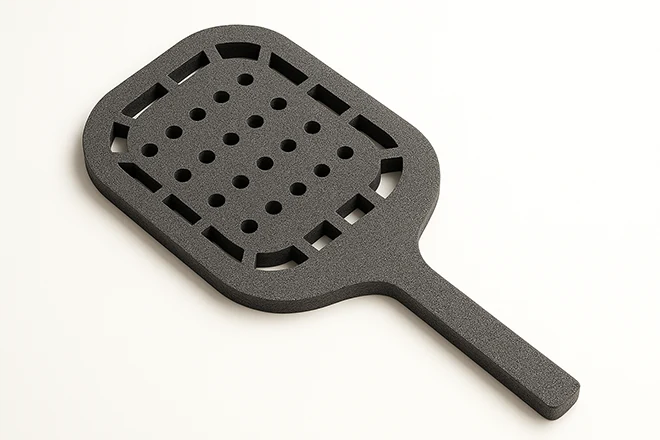
What it is
- A closed-cell bead foam. Polypropylene, expanded with gas and fused under steam.
- Not EPS. EPP springs back, EPS crumbles.
- Density is set by expansion ratio, from about 20 g/L to 200 g/L.
- It carries load in every direction. A honeycomb core does not.
Where it wins
- It cannot crush. There are no cell walls to buckle and collapse.
- The face reads the same from center to edge. No wall, no dead spot.
- It damps vibration better than any honeycomb core.
- It is the lightest core material at the same volume.
Where it loses
- It has no trampoline. Pop drops at low swing speed.
- Impact is quiet and dull. Some brands sell that sound. Some cannot.
- Below about 40 g/L it takes a permanent set and softens.
- Epoxy does not grip bare EPP. Skip the surface treatment and the face delaminates.
Polypropylene, expanded into beads and fused solid
EPP starts as ordinary polypropylene. A blowing agent expands it, and steam fuses the beads into a single closed-cell block. That block becomes the core.
Every cell is closed
Gas is trapped inside individual cells. At least 95% of the volume is sealed, so there is no path for water or air to travel through the block.
That sealed gas does real work. It pressurizes slightly under impact and adds to the stiffness of the cell walls around it.
The beads are welded, not glued
Steam softens the surface of each bead. Neighboring beads fuse where they touch, and the part comes out of the mold as one piece.
This is the step that decides quality. Cold spots in the mold leave beads unfused, and an unfused core feels fine for the first few hundred hits.
Base polymer
Polypropylene homopolymer. The same family as a yogurt cup. It melts near 160 °C.
Density range
20 g/L to 200 g/L. Expansion ratio runs 5× to 50×, and density is the inverse of that ratio.
Working temperature
−40 °C to +120 °C continuous. Short peaks to about 130 °C. It does not go brittle in the cold.
Water
0.5% or less in 24 hours, by closed cells and a hydrophobic polymer. It is used for food containers and delivery boxes.
Shape memory
After a 50% compression it recovers 95–98% of its thickness within a minute. EPS recovers under 30%.
End of life
Fully recyclable. It regrinds back into new EPP. It carries no microbial growth and can be steam cleaned.
EPP is not EPS. Expanded polystyrene is rigid, cheap and brittle. One hard hit and the cells shatter. EPP is the opposite: a low-modulus, elastic foam that absorbs the same hit and returns to shape. EPS would break on the first drive.
Six stages from resin to a molded core
EPP is not cut from a sheet. Every core is molded to shape, one cycle at a time.
Resin selection
Polypropylene with a melt flow index of 1.0–3.0 g/10 min. Too thin and the beads will not hold pressure.
Impregnation
CO2 or butane is loaded into the resin in an autoclave. 4–6 hours at 60–80 °C under 18–30 bar.
Pre-expansion
Steam at 100–150 °C expands the beads 10× to 40×. Steam pressure and time set the final density.
Aging
The beads rest 24–48 hours. Internal pressure equalizes and air moves back into the cells.
Steam-chest molding
Beads fill the mold. Steam at 1.5–3.5 bar sweeps through and fuses them in 30–90 seconds.
Annealing
The part cures at 60–80 °C for 4–8 hours. This is what stops the core from shrinking after it ships.
Steam does the work
The aging step is not optional. Mold before the beads stabilize and the core will shrink 1–3% in its first week. That changes the paddle's thickness and balance after it has already been assembled.
The numbers that describe an EPP core
These are molded-foam figures from published supplier and industry data. They describe the material, not one paddle.
Expansion ratio falls as density rises. Paddle cores sit at the light end.
Almost every cell is sealed. This is what keeps water out and rebound predictable.
Measured after a 50% compression. EPS recovers under 30% under the same load.
A closed cell and a hydrophobic polymer. Sweat and rain do not enter the core.
Short peaks to about 130 °C. Cold does not embrittle it the way it does foams.
It regrinds and molds again. Same polymer family as a yogurt cup.
Compressive strength scales with density
| Density | Strength at 10% strain | Strength at 25% strain | Where this grade is used |
|---|---|---|---|
| 30 g/L | about 60 kPa | about 120 kPa | Light packaging, one-hit protection |
| 45 g/L | about 120 kPa | about 200 kPa | General energy absorption |
| 60 g/L | about 250 kPa | about 400 kPa | Automotive bumper cores, seat cushions |
| 80 g/L | about 400 kPa | about 700 kPa | Structural support parts |
| 100 g/L | about 550 kPa | about 900 kPa | High-strength structural components |
Industry figures for molded EPP, tested to ISO 844. Strength roughly doubles when density doubles, which is why density is the only EPP spec that decides how the core behaves.
EPP against honeycomb, EVA and MPP
Four cores compete for the same slot inside a paddle. Each one fails a different way.
| Property | EPP | PP honeycomb | EVA foam | MPP |
|---|---|---|---|---|
| Density range | 20–200 g/L | 60–120 g/L | 180–250 g/L | varies by build |
| How it carries load | Cell walls plus trapped gas | Hexagonal cell walls | Uniform elastic compression | Micro-cells in one solid matrix |
| How it fails | Gradual compression set | Localized cell crush | Softening and creep | Gradual |
| Pop at low swing speed | Lowest | Highest | Medium | Medium to high |
| Sweet spot | Largest effective area | Smaller, punishing on mishits | Large | Large |
| Sound at impact | Quiet thud | Loud crack | Deep and muted | Muted thud |
| Weight for the same volume | Lightest | Light | Heaviest | Light |
| Core cost | Highest | Lowest | Medium | High |
| Best fit | Durability and comfort builds | Volume builds and pop | Perimeter walls, power hybrids | Thin all-court cores |
Density and core-weight figures are typical published ranges across suppliers, not measured on our line. EPP at 40 g/L is roughly half the density of an 80 g/L honeycomb core, so the core gets lighter. The EVA ring you wrap around it runs 180–250 g/L and puts the weight straight back.
Density is the only dial that matters
Order by density, not by feel words. Every other property of an EPP core follows from it. A supplier who cannot give you a g/L figure is guessing, and so are you.
| Density | Expansion ratio | What you feel | Best for | Risk |
|---|---|---|---|---|
| 35–45 g/L | 30–45× | Softest, longest dwell | Touch-first builds, senior and comfort lines | Compression set accelerates |
| 45–60 g/L | 20–30× | Balanced, plush | All-court builds, the safe default | Low |
| 60–80 g/L | 12–18× | Firmer, shorter dwell | Power-leaning builds, club lines | Low |
| 80–100 g/L | 6–10× | Stiff, close to solid plastic | Rare, niche builds | You lose the damping you paid for |
Below 60 g/L the cell walls thin out and permanent compression set grows. Industry fatigue data puts a 55 g/L core at 8–12% thickness loss after 10,000 impacts, against 2–3% for an 80 g/L core.
Density sets the feel
How the two cores fail
Two jobs: the whole core, or the ring around it
EPP appears in a paddle in one of two places. They are specified differently and they cost differently.
A solid core that replaces the honeycomb
The honeycomb comes out and a molded EPP block goes in. The whole hitting area becomes one continuous material with no walls and no open channels.
This is the build behind the "no dead spot, no core crush" claim. It is also the heavier tooling decision, because the core is molded to the paddle's outline rather than cut from a sheet.
A perimeter wall around a honeycomb core
The honeycomb stays and a foam ring is fitted around the inside edge. The ring adds twist weight, softens the edge and damps vibration before it reaches the handle.
We normally run EVA for this ring and EPP where lower weight matters more. A 5–6 mm wall is the common width.
What sits inside the sandwich
Specifications we quote
| Core thickness | 13 mm or 16 mm. Custom in between on request. |
| Finished weight | 225 g ±5 g. Precision builds hold ±2–3 g. |
| Perimeter wall | 5–6 mm EVA, or EPP where weight matters more. |
| Process | Hot press. Thermoformed unibody, or cold press with a molded foam insert. |
| MOQ | 200 pcs. |
| Samples | 10–15 days. |
| Production | 35 days up to 2,000 pcs. |
| Capacity | 80,000 pcs per month on the hot-press line. |
Our EPP core pickleball paddle factory page lists the core densities, wall widths and tooling options we build to.
"Foam core" now means two different builds. Do not let them share a name.
A Gen 3 or Gen 4 paddle is a polypropylene honeycomb core with EVA or TPE injected into the edges. A full-foam Gen 5 build is an EPP or EVA core in the middle with a foam ring around it. Both get marketed as "foam core". Ask which one a quote is for before you compare the number.
Four brands using EPP cores, and how openly they say so
EPP is in production at the top of the market right now. All four of these ship it. Three of them name it on the product page.
Ronbus
Quanta Pro and Tenon series · ronbus.com
Ronbus writes the core out in full: "4th Generation foam core technology featuring a lightweight EPP foam core and EVA elastomer ring." The Tenon series goes further and interlocks EPP and EVA in a mortise-and-tenon geometry.
What it shows: the brand ties its whole pitch to the failure mode it is replacing — "No more honeycomb, no more plastic, and no more core crush to worry about." That is a durability argument, not a power argument.
View on ronbus.comBread & Butter
The Loco 16 mm · bnbpickleball.com
The Loco spec sheet reads "16 mm Dual-Density Foam Core (EPP and EVA foam)": two foams in one core, one for structure and one for dampening. T700 raw carbon face with a fiberglass layer for pop.
What it shows: a two-density core is the practical answer to "EPP is soft but I still want some pop". Blend the foams instead of choosing between them.
View on bnbpickleball.comEnhance Pickleball
EPP Turbo · enhancepickleball.com
The product is named after its core. Enhance lists "Core Material: EPP Foam with EVA Perimeter Ring", 16 mm, thermoformed, at USD 119.99. Their own copy says they iterated on foam density to land the feel.
What it shows: an EPP core is not a premium-only build. This is the cheapest EPP paddle on this list, and it still runs a floating foam core with perimeter weighting.
View on enhancepickleball.comHEAD
Project FLEX · head.com
head.com lists a T700 carbon surface, a 14 mm profile, 230 g and a DualFusion Frame. The core is specified only as "Standard Core 14 mm". HEAD's retail spec sheets for the same paddle name it "EPP Foam Core".
What it shows: the same paddle can name its core in one document and leave it blank in another. When a spec block says "foam core" and stops, ask for the polymer before you quote against it.
View on head.comWho should buy an EPP core, and who should not
Buy EPP if the pitch is durability, comfort or edge-to-edge consistency. Do not buy EPP if the pitch is pop or price. Match the core to the brief before the sample stage, because the density is fixed once the mold is cut.
| Your buying situation | What an EPP core actually gives you | Our advice |
|---|---|---|
| You want a "zero dead spot, never crushes" durability claim | Honeycomb fails by cell crush. EPP has no cells to crush, so the claim is defensible and testable. | Buy EPP. |
| Clubs, academies and rental lines | Fewer replacements per season, and a longer warranty you can actually afford to offer. | Buy EPP. |
| You are selling arm protection and comfort | EPP damps high-frequency shock better than any honeycomb core. That is the whole case. | Buy EPP. |
| You are chasing the loudest crack and the fastest exit speed | EPP is quiet and dull on impact, and it has less pop at low swing speed. The sound is the opposite of what you are selling. | No. Specify a thin honeycomb core. |
| You are buying for volume at the lowest possible unit cost | EPP needs dedicated tooling and tight press temperature control. Cost per unit sits well above a cut honeycomb sheet. | No. Use PP honeycomb. |
| New brand, first order, shape not final | Density, mold and press settings all have to be tuned together, and changing shape after tooling is expensive. | Not yet. Prove the shape on honeycomb first. |
Alternatives we quote the most: PP honeycomb for volume builds, EVA injection for Gen 3 and Gen 4 power builds, and a carbon-rib core for brands that want no dead spots without foam.
Five things an EPP core will not do
Read this before you replace a honeycomb core with EPP
- It will not add pop. At low swing speed an EPP core is slower off the face than honeycomb. There is no trampoline. At high swing speed the gap closes, but it does not reverse.
- It will not stay light if you wrap it in EVA. EPP at 40 g/L is light. The EVA ring around it runs 180–250 g/L and puts weight straight back. You cannot have a soft perimeter and a light face at the same time.
- Below 60 g/L it takes a permanent set. Thin cell walls compress and stop fully recovering. Industry fatigue data puts a 55 g/L core at 8–12% thickness loss after 10,000 impacts, against 2–3% at 80 g/L.
- It delaminates if you skip surface treatment. Epoxy does not grip bare EPP. The face needs a roughened surface, usually corona treatment or mechanical abrasion, before bonding. This is the most common foam-core warranty failure there is.
- Uneven steam creates density hot spots. A cold spot in the mold makes a zone 15–25% denser than spec, and the ball leaves that zone faster. You cannot fix it after molding. You can only catch it with a durometer map.
Not every no-honeycomb paddle is a foam paddle. Gearbox sells the Pro Ultimate as "SSTCore" — a patented solid-span rib structure. Gearbox's own spec block lists a Toray T-700 carbon fiber core and a carbon fiber rib construction, and never uses the word foam. It answers the dead-spot problem with ribs instead of foam. Both approaches are real. They are not the same product, and they should not be quoted against each other as if they were.
What an EPP build costs, and how it ships
EPP is the most expensive core route
A complete EPP molding line runs USD 80,000 to USD 300,000 in industry terms. An EPP steam-chest molder has to hold 3.5 bar; an EPS line rated at 1.5 bar will not do the job, and retrofitting it later costs more than specifying it up front.
Published industry figures put a Gen 4 foam core at a 25–35% manufacturing premium over a thermoformed honeycomb build of the same face specification.
Where an EPP build lands on our price list
An EPP solid core sits in our top two tiers. FOB USD 35.00–65.00 / pc at MOQ 200 for a 12K or 18K carbon face over a multilayer foam core.
A flagship with ceramic grit and fully custom tooling runs USD 50.00–100.00 / pc at MOQ 100+. Samples take 10–15 days.
These are the ranges we quote. Send a spec and we will price it against your face material and core density.
What you can customise
| Shape | Custom outline, cut from a new mold. |
| Logo | Printed or molded into the face or the end cap. |
| Edge guard | Colour and profile. |
| Grip | Colour and logo. PU wrap, sizes 0, 1 and 2 at 101 / 105 / 108 mm. |
| End cap | Custom cap and silicone band. |
| Packing | Retail box, sleeve or plain carton. |
How it ships
| Inner packing | PE bag plus bubble bag. |
| Export carton | 650 × 500 × 350 mm. |
| Units per carton | 50 pcs. |
| Carton weight | About 12.5 kg. |
| Sample lead time | 10–15 days. |
| Production lead time | 35 days up to 2,000 pcs. |
As a solid EPP core paddle supplier we quote core density and face material as separate line items, so you can see what the foam is actually costing you.
What we can actually prove
The foam properties above are industry ranges. The five checks below are ours, and they ship with the lot.
X-ray structure inspection
Shows bead fusion and internal voids inside a finished core without cutting it open. This is the check that catches cold spots before a batch ships.
Durometer density map
Readings at 12 or more points across the face. A well-molded core stays within 5 points Shore C across the whole surface. More than that means uneven steam or bead clumping.
Ball-cannon impact tester
Fires the same strike thousands of times and re-measures rebound and thickness. This is how we verify that the core still recovers after the beat-down.
Bulk-sample compression test
Measures permanent set on cores pulled from the actual production run, not from a hand-made lab sample.
In-house USAP and PBCoR pre-check
Flags a build here before it goes to the brand's own test house. The certification still belongs to the brand, but we do not send out a paddle that we expect to fail.
Lot QC report
Every production lot ships with its density map and a cross-section bead-fusion check, cut from one unit per fifty.
Questions buyers actually send us
What is EPP?
Is EPP the same as EPS?
Does an EPP core crush?
Will an EPP core give my paddle more power?
Will it give more spin?
What density should I order?
Can I use EPP with a fiberglass face?
How is EPP different from the "foam core" most paddles advertise?
Does USA Pickleball approve EPP cores?
What does an EPP core cost, and what is the MOQ?
Tell us the core, we will quote the paddle
Send the face material, the core thickness and the foam density in g/L. We will come back with a price, a sample date and the density map we build to.
Or email lixifirm@outlook.com · we reply within 24 hours.