3K woven carbon fiber: a fine weave, not a strength rating
A 3K tow holds 3,000 carbon filaments. The number counts yarn size. It is not a grade and not a strength rating. 3K buys off-centre stability, a fine visible grain and a premium look. It costs more than 12K cloth, and the weave gives up a little stiffness.
What it is
- It is a tow count. One tow holds 3,000 filaments.
- The filaments are the same as in any other tow size.
- It is woven into cloth with a fine checkerboard.
Where it wins
- It resists twisting on off-centre hits.
- It spreads load evenly in both directions.
- It has the finest grain of the common weaves.
- Buyers recognise it on a product page.
Where it loses
- It is the most expensive cloth of the common sizes.
- The crimp costs 10–20% of straight-line stiffness.
- It adds nothing to strength by itself.
- Every flaw shows on a visible weave.
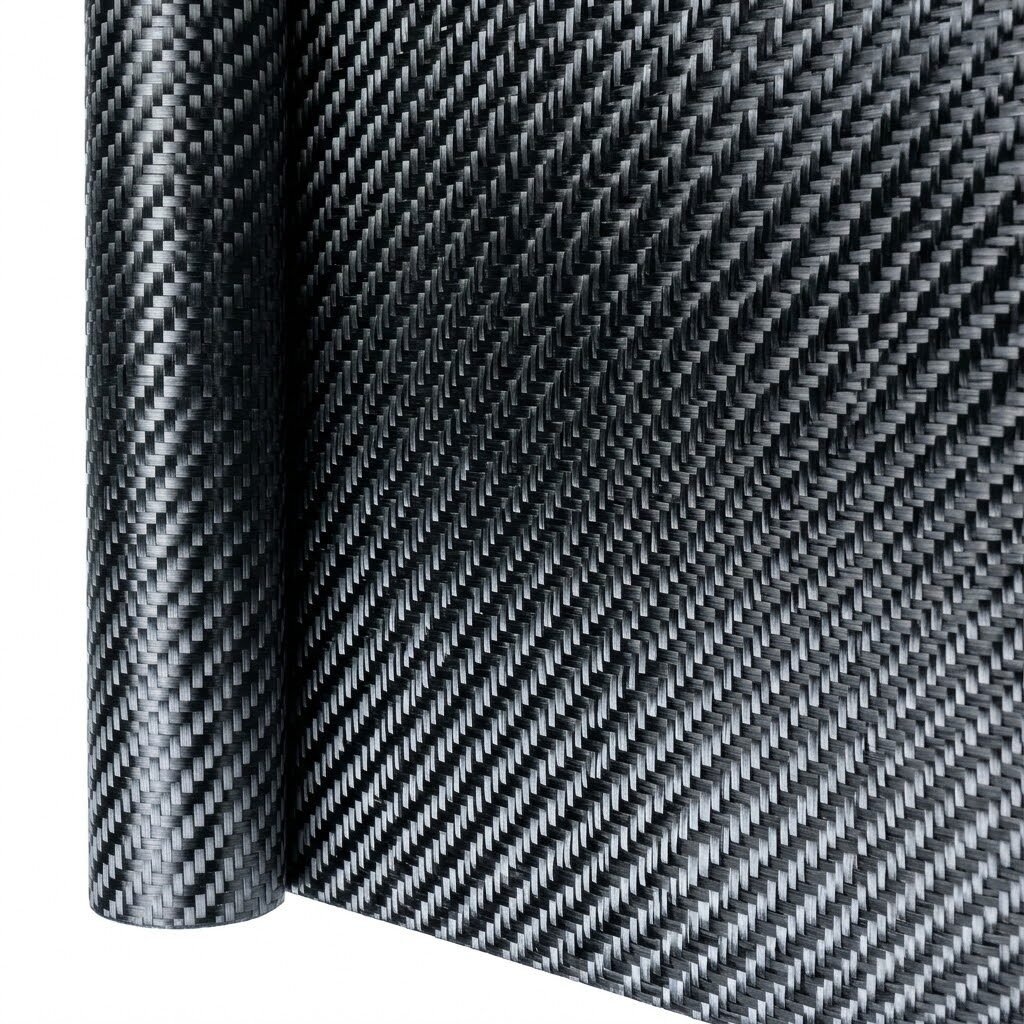
"K" just means thousand. Nothing more.
People read 3K as a quality badge. It is not. It counts how many carbon filaments are bundled together before weaving.
One tow = one bundle. A carbon tow (the industry also says "roving" or "yarn") is a bundle of thousands of hair-thin carbon filaments held together by a light resin coating called sizing. The "K" counts the filaments inside that bundle. 3K means 3,000 filaments per tow. Weave those tows together and you get 3K carbon cloth.
The filaments themselves do not change. A single carbon filament is roughly 5 to 7 micrometres across, about one tenth the width of a human hair. That holds whether you bundle 1,000 of them or 50,000. Tow size changes how the material looks and how much it costs. It does not change what carbon fiber is.
| Tow size | Filaments per tow | Typical cloth weight | How it looks | Where it gets used |
|---|---|---|---|---|
| 1K | 1,000 | 80–140 g/m² | Very fine, almost smooth | Luxury trim, watch cases, high-end car interiors |
| 3K | 3,000 | 160–280 g/m² | Clear small checkerboard | Cosmetic parts, bike frames, paddle faces |
| 6K | 6,000 | 280–400 g/m² | Bigger squares, coarser | Mid-structure panels, drone arms |
| 12K | 12,000 | 300–800 g/m² | Thick ribs, loose weave | Structural laminates, tubes, pressure vessels |
| 24K – 50K | 24,000 – 50,000 | Heavyweight fabrics | Very coarse, industrial | Wind blades, automotive structural parts, civil works |
Cloth weights and thickness figures are the published ranges from carbon fabric suppliers. Actual values move with the weaver, the yarn grade and the weave pattern.
Smaller tow numbers cost more, not less. Splitting carbon into finer bundles takes more spinning steps, and a 3K loom runs slower than a 12K loom. So 3K is the expensive end of the cosmetic market and the cheap end of the structural market. Structural engineers use 12K and above, because they are not buying the pattern.
Two things decide what the surface looks like
Two things decide the pattern. One is how many filaments sit in each bundle. The other is how the loom crosses those bundles.
Tow size changes the weave scale
Plain weave vs 2×2 twill weave
The fiber is already made before weaving starts
The carbon filament arrives on bobbins already cooked at 1,000–1,500 °C. Weaving only arranges it. The carbonization step is described above.
Sizing is applied to the yarn
A thin epoxy or polyurethane coating goes on each tow. It stops the filaments from snapping against each other on the loom and helps resin bond later. Sizing is typically 0.5–1.5% of the yarn weight.
Warping — thousands of tows are lined up
Warp tows are pulled in parallel onto a beam, in the exact order and tension they will be woven in. This step decides whether the finished cloth is flat or wavy. Bad warping is unfixable later.
Weaving — weft goes over and under warp
The loom crosses the weft tow through the warp at 90°. Plain weave crosses every single tow; twill skips so the pattern steps diagonally. A 3K loom runs slower than a 12K loom because the yarn is finer.
Heat setting locks the pattern
The woven cloth passes over heated rollers. This removes construction stress and stops the weave from shifting when it is later cut and laid into a mould.
Rolled, inspected, packed
Standard rolls run 100–150 cm wide. Cloth is inspected for broken tows, gaps and tension lines before it leaves the weaver.
Six numbers that define 3K cloth
Typical figures from published supplier data — carbon fabric spec tables and standard-modulus fiber data sheets.
The definition. It says nothing about strength, stiffness or quality — only how finely the yarn was split.
Each filament is roughly one tenth of a human hair. This is dozens of times thinner than a fibre of fibreglass.
The band most cosmetic 3K fabric sits in. Heavier cloth means bigger, coarser squares.
Before resin. A finished laminate face is a stack of these, so the cured thickness is a design choice, not a given.
How many tows cross each centimetre. This is what makes the squares about 2 mm across at typical weights.
Roughly three times stiffer than fibreglass and around a quarter the density of steel.
Sources: published carbon fabric supplier specification tables and standard-modulus carbon fiber data sheets. Tensile strength for standard-modulus carbon sits near 4,400–4,900 MPa with 1.5–2.1% elongation at break, depending on grade.
Why the squares are so small: at 6 tows per centimetre, one tow is only about 1.6 mm wide. Cross it with a tow of the same width and the visible cell is under 2 mm. That is why 3K reads as "fine engineering" from arm's length while 12K reads as "industrial".
3K woven vs 12K woven vs unidirectional
These three get sold as if they were tiers of quality. They are not. They are three different answers to three different problems.
| Property | 3K woven | 12K woven | Unidirectional (UD) |
|---|---|---|---|
| Filaments per tow | 3,000 | 12,000 | Depends on tape, often 12K–24K spread flat |
| Surface pattern | Small clear checkerboard | Coarse ribs, loose weave | Almost none — looks like brushed dark tape |
| Stiffness in both directions | Balanced 0°/90° by construction | Balanced, but coarser load paths | Extreme in one direction, weak across it |
| Interlocks per area | Highest — tightest structure | Lower | None |
| Resin needed | Moderate — the crimp holds resin | Moderate | Lowest — layers lie flat |
| In-plane stiffness per gram | Good | Best value of the three | Highest in its axis |
| Cost of the cloth | Highest | Lowest | Mid to high |
| Why people pick it | Looks, balanced feel, brand story | Structure per dollar | Maximum stiffness where it is needed |
Comparison based on industry-standard fabric classification and laminate practice. Real numbers move with the fiber grade, resin system and layup schedule.
Where 3K loses
3K is not the strongest and it is not the cheapest. If two paddles use the same fiber grade and the same core, a 12K or unidirectional face can deliver the same or better stiffness for less money. Weaving also forces the tows to crimp over and under each other. That crimp costs roughly 10–20% of the fiber's straight-line stiffness compared with the same fiber laid flat. You give up a little performance to get the pattern.
The honest trade: a buyer choosing 3K is usually buying appearance, brand differentiation and a tight, stable weave, not the highest modulus per dollar. That is a legitimate reason. It just should not be sold as "the strongest carbon".
Why a tight weave changes how a paddle face behaves
The weave is not just decoration. Where the tows cross, the material behaves differently from an open or flat laminate. The player feels it.
Balanced in both directions
A woven face puts the same amount of fiber at 0° and at 90°. The face bends the same way along its length as it does across its width. A one-directional laminate does not do this. It is stiff one way and soft the other, and the player feels the difference on different shot types.
More interlocks, less local denting
Plain 3K weave crosses a tow every single row. Those crossing points tie the structure together, so a hard hit in one small area cannot push a patch of face in on its own. This is where the "solid" feeling on off-centre contact comes from.
The weave itself is the texture
On a raw face there is no thick clear coat filling the bumps. The physical ridges where tows cross grip the ball. A smooth, glossy 3K face still looks like carbon, but the bite is gone.
This is the single most confused point in the whole category. All three can be sold as "3K carbon face".
Raw 3K
Bare woven cloth, cured with just enough resin to hold it. You can feel the ridges with a fingernail. Textured, grippy, and it slowly polishes smoother over months of play.
Coated 3K
The same cloth under a clear or tinted topcoat for gloss and scuff protection. It looks the sharpest out of the box. The coating smooths the surface, so spin has to come from something else, usually an added grit or peel-ply texture.
Printed "3K"
A flat face with a checkerboard pattern printed or embossed on top. No weave at all underneath. It is cheap, it photographs well, and it is common in the low-price tier. If the squares are perfectly identical and perfectly glossy, be suspicious.
One test you can run in a shop: Drag a fingernail across the face. Real woven 3K gives a repeating bump-bump-bump as you cross the tow ridges. A printed face feels uniformly smooth. A coated face feels smooth, with the pattern faintly visible underneath. You cannot tell which one you have from a photograph.
Where 3K ends up on a pickleball paddle
On a paddle, 3K woven carbon is almost always the face material, the outer skin you can touch. It is a design choice about feel and looks. It does not make a paddle automatically faster.
Off-centre hits: why a tight weave holds up
Why 3K feels crisp instead of bouncy
Cold press (most common for 3K)
Workers lay cloth over a pre-formed core, apply resin, and cure the stack under pressure at room temperature or with mild heat. The cycle is slower and tooling costs less. It suits a woven cosmetic face because there is no hot resin flow to disturb the pattern.
Thermoformed unibody (the premium route)
Face, core and edge are pressed together hot and cure as one piece, with the carbon running continuously into the handle. This removes the glued-on handle joint, where a lot of paddle failures start. Tooling is heavier, the cycle is longer, and torsional behaviour is better.
Face
3K woven carbon fiber, 200–240 g/m², plain or 2×2 twill. Raw (uncoated) for grip, or coated with added grit when the brand wants a glossier look.
Core
Polypropylene honeycomb, usually 13 mm or 16 mm. The 16 mm core is the common pairing with a stiff carbon face because it adds control back.
Weight
225 g ± 5 g for standard production. Precision builds can be held to ± 2–3 g on request.
Handle
PU wrap in grip size 0 / 1 / 2, measuring 101 mm / 105 mm / 108 mm circumference.
Edge
Thermoformed unibody where the budget allows it. On cold-pressed builds, a bonded or wrapped edge guard.
Surface finish
Raw textured, matte coated or glossy coated. This choice changes the spin behaviour more than the fiber choice does.
| Traits | What a 3K woven face gives you |
|---|---|
| Power / pop | High and fast. Reaction is immediate rather than springy. It does not have the trampoline rebound of fibreglass — it has a short, sharp release. |
| Feel | Crisp and direct. Feedback arrives at the hand without delay, which is why players who like clear hand feedback gravitate to it. |
| Spin | Moderate from the fiber itself. Real spin comes from the surface treatment — raw texture, grit, or a peel-ply finish. A glossy coated 3K face grips less than a raw one. |
| Torsional stability | High. The tight weave stiffens the outer edge, so off-centre hits twist the paddle less and the ball goes closer to where you aimed. |
| Consistency over time | Good. A stiff woven face holds its shape well. The part that changes with age is the surface texture, which polishes smoother long before the structure weakens. |
| Best fit | Players who want a quick, crisp, stable paddle for counter-punching and fast hands at the net — plus any brand that wants a face customers recognise on sight. |
3K woven is everywhere you have seen carbon
Pickleball is a late adopter. The same cloth has been on cars, bikes and drones for decades, and for the same reason. It looks like what it is.
Automotive trim
Mirror caps, interior panels, roof skins, aftermarket bonnets. The pattern is the product. Most of these parts are cosmetic laminates over a cheaper structural substrate.
Bicycles
Frame tubes and wheelsets. 3K and 12K both appear, but the frames sold on looks are the ones that leave the weave visible under a clear coat.
Drones and RC
Arms, plates and housings where a thin, stiff, light plate is needed and the part is small enough that 3K cost is acceptable.
Consumer gear
Laptop lids, phone and tablet cases, watch cases, luggage shells, musical instrument parts. Almost entirely appearance-driven.
The pattern most of these parts have in common: 3K woven is chosen when a visible surface is part of the value. Where the surface is never seen, the industry uses unidirectional tape and heavy 12K–50K fabric instead. Aircraft structure, wind turbine spars and pressure vessels all do this, because nobody pays for a pattern they will never look at.
Brands shipping 3K woven faces right now
Four production paddles with a 3K woven face, from USD 99.97 to USD 169.99, and four different positions on the price ladder. Each spec line below is quoted from the brand's own product page.
Gearbox
GX2 Integra XL — 16 mm · USD 169.99
Gearbox builds the most literal version of this material choice. Its published spec sheet does not stop at the word "carbon". It names the construction and the core separately.
Baden Sports
Perfection 3K — 16 mm · USD 119.99
One of very few mass-market paddles to put the material number directly in the product name. That tells you the weave is the selling point.
Vessel
Carbon Pro 2.0 — 16 mm · USD 139.00
Positioned on the industrial look and the sound of the hit as much as on measured performance. The materials panel is unusually explicit for the price band.
CPX
Pro Series — USD 99.97
Shows how far down the price ladder a genuine 3K face has travelled. Three years ago this was a USD 150+ feature.
Who should buy a 3K face, and who should not
Buy 3K if off-centre stability and a visible, fine carbon grain are what you are selling. Do not buy 3K if you are buying stiffness per gram, or if your buyer never looks at the face. Match the face to the brief before the sample stage, because none of this is fixable afterwards.
| Your buying situation | What a 3K face actually gives you | Our advice |
|---|---|---|
| Off-centre hits have to stay stable and predictable | The tight weave spreads load across the face. Off-centre stability is the one thing 3K is genuinely bought for. | Buy 3K. |
| Your customers judge spin by the grain they can see and touch | The finest, densest grain of the common weave sizes. At arm's length it reads unmistakably as real carbon. | Buy 3K — raw, uncoated. |
| You need the stiffest, lightest face your budget allows | Little. The crimp in the weave gives up 10–20% of the fiber's straight-line stiffness before the resin is even counted. | No. Ask for unidirectional or spread tow. |
| You are building a price-first private label | A weave that costs more to press and rejects more often on cosmetic grounds, on a paddle whose buyer is not studying the face. | No. Painted or coated face, money into the core. |
| The face is the whole product story at premium retail | The tightest, most technical-looking of the standard weave sizes, and the one buyers already recognise on a product page. | Buy 3K. |
| Your press and finishing process is not under control yet | Every pin hole, dropped tow and tension line stays visible on a glossy woven face. Cosmetic reject rates run higher than on painted parts. | Not first. Build the process on a coated face. |
Alternatives we quote the most: a 12K or unidirectional face plus a good texture for the same job at lower cost. Unidirectional carbon under a thin woven outer ply for maximum stiffness per gram. A grit-coated surface instead of a raw weave when spin durability matters more than initial bite. Send us your retail price and the player you are chasing. We will quote the build that fits.
Material references: Carbon fibers — Wikipedia for fiber structure and properties, and Toray Composite Materials America for tow size and product-grade data. Fabric-weight and construction figures above come from published supplier specification tables.
Prices and specifications are as published on each brand's own website at the time of writing and can change without notice. We are not affiliated with any of the brands listed and do not manufacture for them.
Four things about 3K that the marketing skips
We build with 3K every week. These are the parts that only show up after the samples arrive.
1. "3K" is not a strength rating
A 3K face made from an entry-grade fiber can be weaker and less stiff than a 12K face made from a high-modulus fiber. The number tells you bundle size. Strength and stiffness come from the fiber grade, the resin and the layup. The tow count describes none of those.
2. A lot of "3K" is printed, not woven
The cheapest way to sell a 3K look is to print the pattern on a flat sheet. It is legal, it is common, and from a product photo it is undetectable. If a brand cannot show you a spec sheet naming the actual fabric, assume nothing.
3. The weave surfaces every flaw
A visible pattern is a visible record. A trapped air bubble, a dropped tow, a tension line: all of them read as defects on a glossy woven face, and all of them disappear under paint. That is why glossy 3K cosmetic parts reject more often than structural parts that get covered up.
4. The texture is the first thing to go
The fibers will outlast the grip. A raw 3K face slowly polishes where the ball contacts it. A coated face wears through its coating at the sweet spot. The structure stays intact and the spin drops. That is normal, and no material choice avoids it.
And one more, about our own interest
We profit more from selling you 3K than from telling you not to. It costs us more to buy, it takes longer to press, and the reject rate is higher than a painted face. So treat everything above with that in mind.
If your product wins on performance claims alone, a 12K or unidirectional face plus a good texture will do the job for less money. Choose 3K when the visible weave is part of why your customer picks your paddle off the shelf, because that is the only thing it does better.
What a 3K build costs, and how we prove it
The FOB ranges we quote for 3K builds, the factory terms behind them, and the checks we can hand you paperwork for.
| Build tier | Face & core | FOB range | MOQ |
|---|---|---|---|
| Entry | Fibreglass face + EVA-tuned core | USD 8.00 – 15.00 / pc | 500+ |
| 3K carbon (this material) | 3K woven carbon face + polypropylene honeycomb | USD 15.00 – 35.00 / pc | 300+ |
| High-end | 12K / 18K multi-layer face, thermoformed unibody | USD 35.00 – 65.00 / pc | 200+ |
| Flagship | Ceramic-sand infused surface, full custom tooling | USD 50.00 – 100.00 / pc | 100+ |
FOB China, quoted per build. Final pricing depends on the exact fabric, core, weight tolerance, edge construction, packaging and order volume, and we confirm it against your spec before you commit.
Samples
10–15 days for a 3K build, because a woven face has to be pressed and finished before it can be judged properly. You will get the actual press sample, not a lookalike.
Production
Hot-press capacity of 80,000 paddles per month. Orders up to 2,000 pcs run about 35 days from approved sample. MOQ 200 pcs.
Packing
PE bag plus bubble wrap per paddle. Export carton 650 × 500 × 350 mm, 50 pcs per carton, about 12.5 kg per carton.
X-ray inspection
Shows whether the woven face is bonded to the core evenly and whether any air is trapped between the plies. On a visible-weave product this check matters more than usual, because a void under the pattern becomes a cosmetic reject.
Bulk-sample compression testing
Presses a production sample until the core yields. Confirms the face-to-core bond holds and the paddle does not soften in the first weeks of play.
Cannon impact testing
A pneumatic cannon fires balls at the face at match speeds, repeatedly, at the same spot. This is how we find out whether the surface texture survives real use or polishes out early.
In-house USAP and PBCoR pre-check
We run the dimensional and deflection checks in-house before sending samples for certification. The certificate itself belongs to your brand, not to us — we supply samples that meet the standard.
Every batch ships with a QC report covering weight tolerance, thickness, surface inspection and the tests above. Ask for the report on any order and we will send it.
3K carbon fiber FAQ
The questions that come up in almost every inquiry about this material.
What does "3K" mean in carbon fiber?
It counts the filaments in one tow. 3K = 3,000 filaments per bundle. Those bundles are woven into cloth. It is a description of the yarn, not a rating of strength, stiffness or quality.
Is 3K better than 12K?
It is better looking, and better balanced in a thin face. It is not stronger and it is not cheaper. 12K gives you more structural stiffness per dollar; 3K gives you a visible, fine, recognised pattern. If the pattern is not part of what you are selling, 12K is the more efficient choice.
Is a 3K paddle the same thing as a "raw carbon" paddle?
No, and the two get mixed up constantly. 3K describes the weave. "Raw" describes the finish. You can have a raw 3K face, a glossy coated 3K face, or a printed 3K pattern on a non-woven sheet. Raw means no thick topcoat is filling the weave, which is why raw faces grip the ball better.
Why does my 3K face look different from someone else's 3K face?
Three reasons: the cloth weight (200 g/m² and 240 g/m² have visibly different square sizes), the weave pattern (plain versus 2×2 twill changes how the light catches it), and the finish (raw, matte or gloss). All three can be called "3K" and all three look different.
Does the weave itself create spin?
Barely. Spin comes from the surface treatment, not the fiber. A raw woven face gives you a real texture that grips, which is worth something. A glossy coated face over the same weave grips much less. If spin is the goal, the finish decision matters more than the 3K decision.
Is a 3K carbon face stiff or flexible?
Stiff. Standard-modulus carbon sits around 230 GPa elastic modulus — roughly three times fibreglass. A 3K face deflects very little on contact, which is why the feedback feels crisp and immediate rather than springy.
Will the weave pattern wear off?
The pattern will not, but the texture will. The fibers outlast the surface. A raw face slowly polishes smooth where the ball hits most, and a coated face wears through its coating at the sweet spot. You lose grip over months, not structure. That is true of every surface material, not just 3K.
Can you make the 3K look without using woven carbon?
Yes — a printed or embossed pattern over a flat face is cheaper and it is what a lot of budget paddles already do. We will tell you which one you are looking at. If you want the pattern to be real, we quote real cloth; if you want the look at a lower cost, we can say so plainly and price accordingly.
Do you use Toray T700?
We buy fiber to your BOM, and we provide country-of-origin documentation for what we buy. If your specification names a specific fiber grade, we source to that specification. What we will not do is print a fiber brand name on a product or a page without your authorisation — that material claim belongs to your brand, and it has to be accurate.
What is the minimum order and lead time for a 3K paddle?
MOQ 200 pcs. Samples run 10–15 days. Orders up to 2,000 pcs ship in about 35 days from approved sample. Hot-press capacity is 80,000 paddles per month.
Building a 3K paddle? Send us the spec.
Tell us the face weight, the weave pattern, the finish and the core thickness you have in mind. We will come back with a quote, a realistic lead time, and an honest note on where your spec is costing more than it needs to.
Or email the spec directly to lixifirm@outlook.com — we answer within 24 hours.