Durable grit ceramic sand infused pickleball paddle manufacturer
Ceramic abrasive is mixed into the face resin and cured with the laminate. The grit is part of the face, so it cannot peel off the way a sprayed coating does. Our own ball-cannon test lost 47 RPM of spin across 100 hits. A conventional textured face lost about 100. On carbon fiber or fiberglass, cold pressed or thermoformed, MOQ 200.
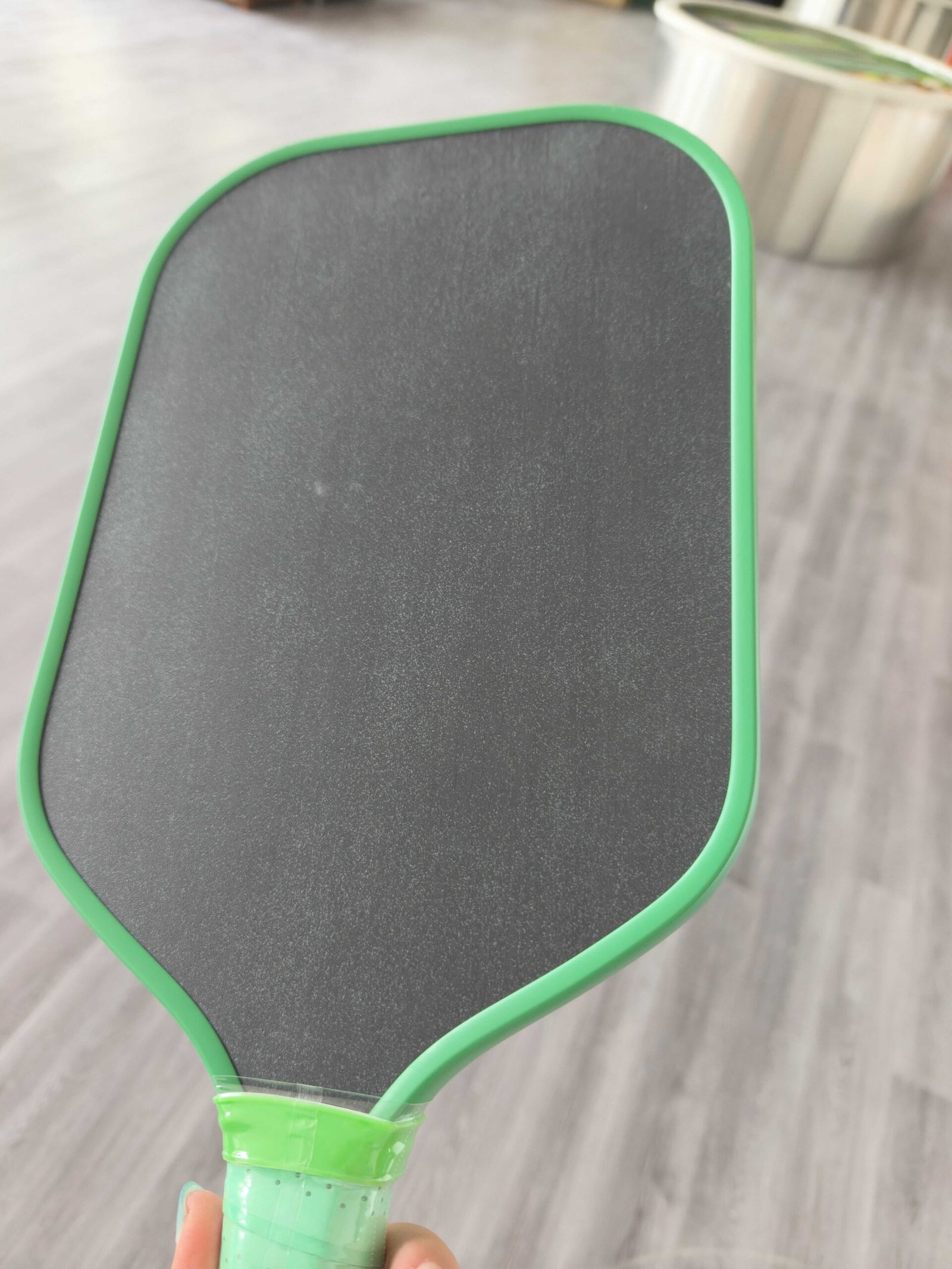
What it is
- Ceramic abrasive particles at 80 or 100 mesh, mixed into the face resin.
- Cured with the laminate, so the grit is part of the face structure.
- Runs on carbon fiber or fiberglass, cold pressed or thermoformed.
Where it wins
- Holds roughness longer. Our 100-hit test lost 47 RPM against about 100.
- Bites the ball at contact, so topspin and backspin both grip harder.
- Particle load is low, so paddle weight and balance do not move.
Where it loses
- Costs more than spray-on grit or a peel-ply texture. It adds a mixing step.
- A coarse 80 mesh face reads too aggressive on a control-first model.
- Certification is filed per model by your brand. We cannot file it for you.
Raw carbon goes smooth. Durable grit is the answer to that.
Grit is a wear part. This section covers what wears, why players miss it, and where a ceramic face sits in the market.
Grit is the texture on the paddle face. It is the only thing that lets a flat swing put spin on the ball. More friction at contact means a sharper topspin, a heavier slice and a drop shot that sits down instead of floating.
Most grit is fragile. A raw carbon face starts rough and polishes smooth where the ball lands most. Spray-on grit leaves with the coating that carries it. Players notice late because spin fades slowly. The third-shot drop that used to sit down starts floating. The serve return lands deeper than aimed.
Buyers now call the fix durable grit. The term covers any face built to hold its texture instead of fading. It is a category, not a brand, and the ways of building it are genuinely different. CSI is one of them.
What fades first
Spin, not power. A worn face still hits the ball hard. It just stops grabbing it. Power comes from the core and the layup, and both stay where they were.
Why players miss it
Core crush and delamination announce themselves. A smooth face does not. It goes quiet over weeks, and most players adjust their stroke instead of inspecting the surface.
What CSI is built for
Keeping the roughness high for longer. The abrasive particle sits inside the laminate, so it stays put while the resin around it wears.
Roughness is a number you can test. Ask any supplier for the reading before and after a wear cycle. A claim with no measurement behind it is a brochure line, and you cannot put it in a product spec.
Four ways to build a gritty face
Only one of them holds the abrasive inside the face. The other three put texture on the surface and let play take it off.
| Approach | How the grit is held | What play does to it | Added cost |
|---|---|---|---|
| Raw carbon weave | The weave itself is the texture. No added particle. | Polishes smooth where the ball lands most. | Lowest. It is just the face ply. |
| Spray-on grit | Particles sit in a surface coating. | The coating wears and takes the grit with it. | Low. One extra spray pass. |
| Peel-ply texture | A molded epoxy skin is peeled away to leave a pattern. Some makers now load the ply with diamond or carbide. | Plain resin flattens. A loaded ply holds much longer, and costs much more. | Low to high, depending on the ply. |
| Ceramic infusion (CSI) | Hard ceramic particles cured inside the face resin. | The particle stays embedded. The surface stays rough longer. | Highest. Mixing, dosing and a cure check. |
CSI is the fourth row. It buys retention, not peak grip on day one. A fresh spray-on face can feel rougher out of the box and be smoother than CSI by month three.
Ceramic mixed into the resin, then cured with the face
CSI is a laminate change, not a finish. It happens on the layup table, before the press closes.
How the grit is held
Coating, peel-ply or bare weave. Texture sits on the surface.
Where CSI puts it instead
CSI. One face, with the abrasive cured through the outer ply.
Six steps from resin batch to released sample
Resin batch
Ceramic abrasive is weighed and mixed into the face resin. The dose is set by mesh size and by the roughness target for the model.
Layup
Carbon or fiberglass plies are laid up with the loaded resin. The particle runs through the outer ply, not in a film on top of it.
Cure
Cold press or thermoforming cures the face, the core and the edge wall together, in one pass.
Surface check
We read roughness and gloss on the cured face and compare against the target. Out-of-range faces come off the line.
Wear cycle
A cut sample goes on the ball cannon for 100 hits at 90 km/h. Spin is read before and after.
Release
The sample ships with its own readings. You are not asked to trust a shared spec sheet.
What 100 cannon hits did to our face
We fired a ball at a CSI face 100 times at 90 km/h. Spin was read six times before and six times after, on the same rig.
Our ceramic face. Average of six readings before and six after, on the ball cannon.
The conventional textured face in the same study, over the same number of hits.
100 divided by 47. The grit holds longer. It does not hold forever.
| Reading | Before 100 hits | After 100 hits | Change |
|---|---|---|---|
| 1 | 1,609.84 | 1,535.26 | -74.58 |
| 2 | 1,793.05 | 1,514.06 | -278.99 |
| 3 | 1,662.24 | 1,788.55 | +126.31 |
| 4 | 1,694.67 | 1,727.73 | +33.06 |
| 5 | 1,705.13 | 1,604.25 | -100.88 |
| 6 | 1,548.02 | 1,562.10 | +14.08 |
| Average | 1,668.83 | 1,621.99 | -46.83 |
What each face gives up over the run
Both faces started inside the 2,100 RPM window the test rig is set to.
Single readings scatter in both directions. One shot after the cycle read higher than one shot before it, and that is normal on a ballistic rig. The average is the number that carries the result. Open the full test report (PDF).
80 mesh or 100 mesh: pick by the player, not by price
Mesh is a sieve count. The higher the number, the finer the particle. Both sizes cost the same to run.
| Grit size | Particle | Surface feel | Suits |
|---|---|---|---|
| 80 mesh (coarse) | about 180 microns | Aggressive. You can feel the tooth through the grip. | Spin-forward models, power shapes, players who hit heavy topspin. |
| 100 mesh (fine) | about 150 microns | Finer and more even. Reads calmer in the hand. | Control-first models, wide bodies, dink-heavy and beginner lines. |
Neither size is the better product. The coarse face grips harder at contact and is harder on the ball. The fine face feels calmer and suits touch players who want the texture to last without a loud surface. We quote both and let the model decide.
A custom mesh is possible. It moves the mix ratio, the sample window and the MOQ. Agree the number before the first sample, not after, because the face is not adjustable once it is cured.
Faces, constructions and cores CSI runs on
Ceramic infusion is a face change. The rest of the paddle can be whatever the model already uses.
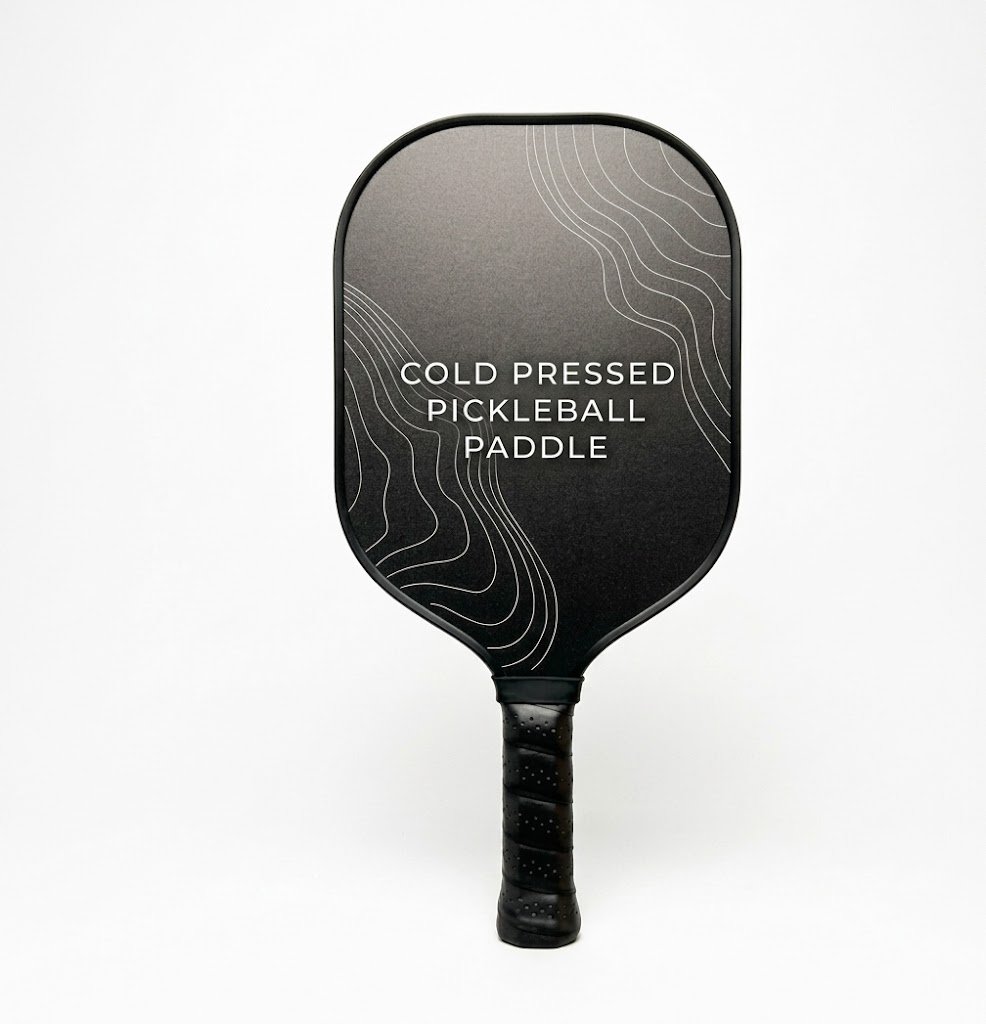
Cold pressed
Entry to mid-range builds. The face resin cures at room temperature. CSI goes in before the press closes, so the line runs unchanged.
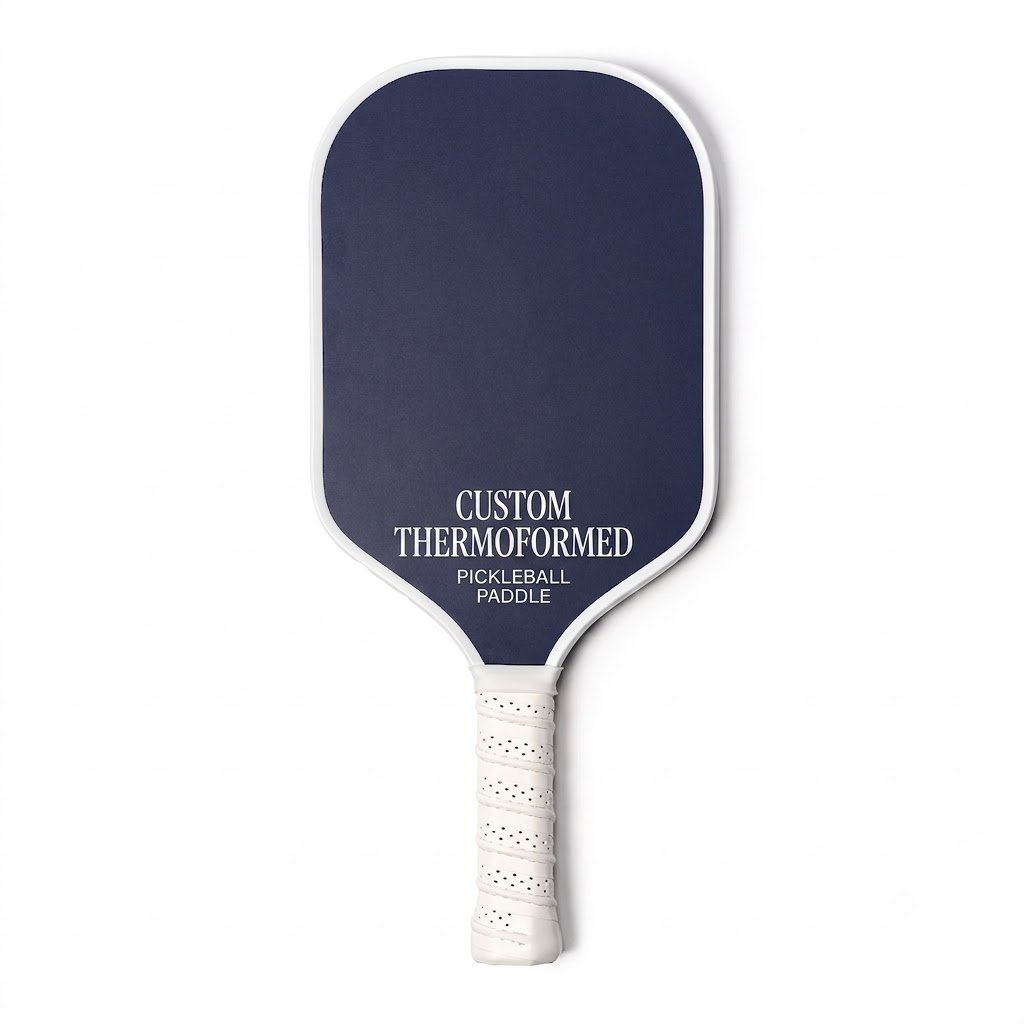
Thermoformed, with an edge wall
Mid to premium. Heat and pressure cure the face, the core and the edge wall in one pass. The ceramic cures in the same cycle.
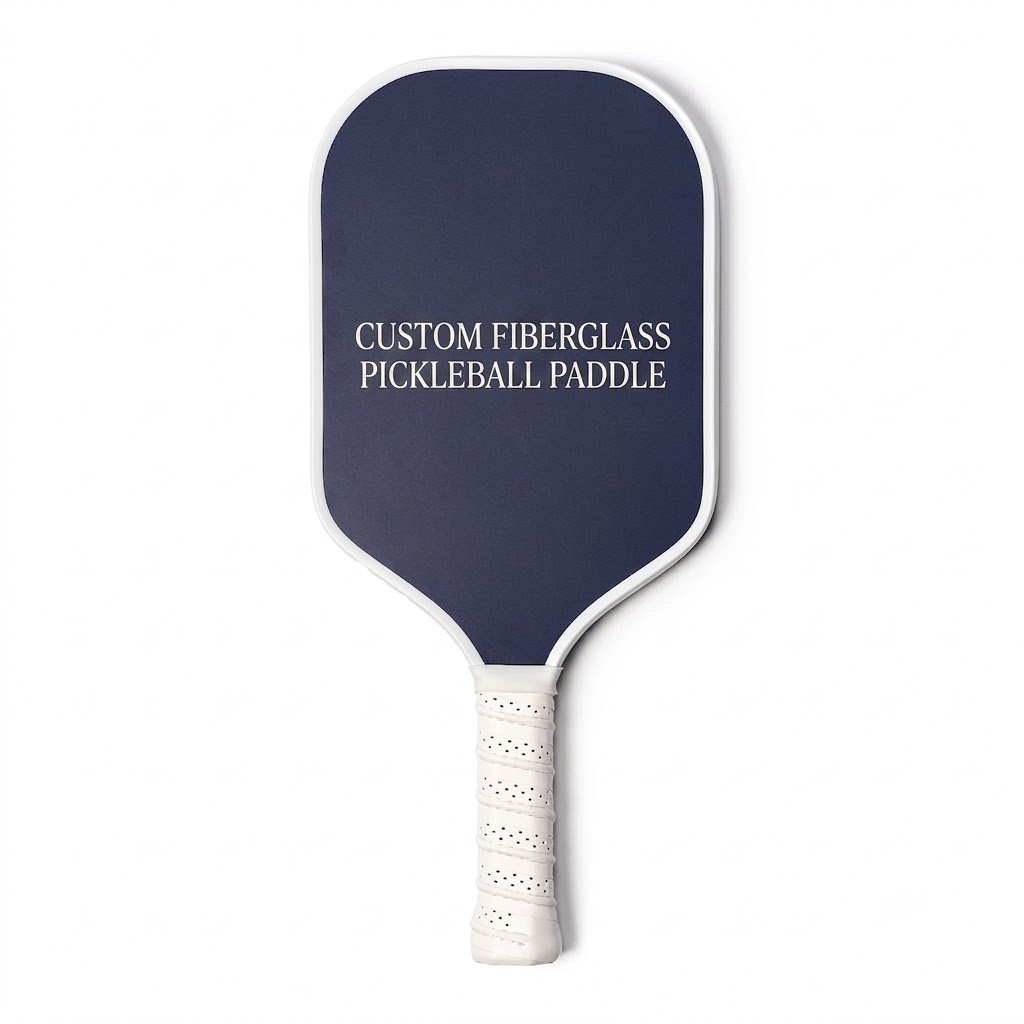
Fiberglass and edgeless
The abrasive runs on fiberglass as well as carbon. On an edgeless build the EVA wall handles the rim and CSI handles the face.
Face material
Carbon fiber or fiberglass. Any ply count you already run. The abrasive is dosed into the outer ply.
Core behind it
PP honeycomb, EPP, MPP or a custom core. The core sets power and forgiveness. CSI only changes the face.
Read the core side in our pickleball paddle materials guide, and the face side in surface finish: raw, matte, textured or sanded.
What the October 2026 spin rule changes for your SKU
Two bodies run paddle standards. They now judge spin in different ways, and the rule moved on 1 October 2026.
| USA Pickleball (USAP) | UPA-A | |
|---|---|---|
| Who it covers | Amateur and most sanctioned tournament play. | Professional events on the PPA and MLP tours. |
| How spin is judged | Surface roughness was the proxy. From 1 October 2026 the roughness and friction thresholds become measurements of record, and a dual-camera spin test becomes the limit for new submissions. | A ball is fired at the paddle and rotation is read with high-speed cameras. Performance is measured, not inferred from texture. |
| The spin ceiling | 2,100 RPM for models submitted from 1 October 2026. | Also 2,100 RPM, applied across the useful life of the paddle rather than only when new. |
| When it is tested | As new, out of the box. | After a break-in cycle, so worn-in performance counts. |
| Who files it | The brand, per model. Approvals issued before the change stay valid. | The brand, per model. Certification runs for 24 months and carries a per-paddle fee. |
What this means for a ceramic face. Player-applied grit, sand paint and stick-on texture are banned as equipment alterations. A ceramic particle cured inside the laminate during molding is not that. It is a factory surface, built the same way a peel-ply texture is built. The particle changes what the resin does at the surface, not what you are allowed to add to a finished paddle.
What we do and what we cannot do. We build faces to the published roughness and deflection targets, and we run an in-house pre-check on every sample before it ships. Model-level certification is a brand filing, not a factory filing. No factory can certify your SKU for you.
Put the spin target and the governing body in the RFQ. If your model is headed for professional events, it will be judged after break-in, not at the warehouse. Say so before tooling, because the core, the layup and the grit size all move the number.
Sources: equipment.usapickleball.org for the approved paddle list, and upaa.unitedpickleball.com for the UPA-A test procedure and spin limit. Our own note on both systems: USAP paddle certification.
What you can change on the paddle
The ceramic face is one line in the brief. Everything below is quotable in the same program.
Grit
80 mesh, 100 mesh, or a custom mesh agreed at sample stage.
Grit colour
Black is the natural colour. Blue, green and yellow are standard. Custom colour is possible with an adjusted MOQ.
Core
PP honeycomb, EPP, MPP or a custom core, at 13 mm or 16 mm.
Shape
Standard wide body, elongated, or a custom mould.
Branding
Silkscreen, heat transfer or UV print. End cap in deboss, emboss or print, and a silicone band if you want one.
Grip and edge
PU handle to reduce breakage, custom grip colour and material, custom edge guard colour.
The colour is dosed through the face, not printed on it. It does not wear off the way a printed pattern does.
Should you spec a ceramic sand face on your next model?
Buy CSI if your model sells on spin that lasts. Do not buy CSI if the face is a cost line you are trying to cut. Match the surface to the brief before the sample stage, because none of it is fixable after the cure.
| Your buying situation | What a ceramic face gives you | Our advice |
|---|---|---|
| You are launching a spin-forward model and want the grit to still be there in month six. | Abrasive cured inside the ply. The particle does not leave with a coating. | Buy CSI. Put the roughness target in the brief. |
| You are building a control-first model for touch players. | An 80 mesh face reads loud and bites hard, which is the wrong feel for that player. | Spec 100 mesh, or leave the face raw. |
| You need the spin claim to survive a customer test. | You get the before-and-after readings on your own sample, not a shared number. | Buy CSI. Ask for the wear cycle on the sample. |
| Your target price sits under a plain raw carbon build. | Nothing. CSI is an added step and it prices above peel-ply. | No. Spec peel ply and spend the money on the core. |
| You want a premium face colour that stays put. | The colour is dosed through the face, so it does not print off. | Buy CSI in your brand colour. |
| You are a distributor buying stock models for resale. | Nothing yet. A ceramic face is only yours if it is tooled for your brand. | No. Start from the stock spec, then customise. |
Alternatives we quote the most: a raw 3K twill face when the budget is tight, and a diamond-loaded peel ply when the brand already sells on abrasion tech. Both hold less than CSI over a wear cycle, and both cost less.
The parts CSI does not fix
Five things a ceramic face will not do for you
- It does not add power. Grit changes friction at the surface. Rebound is set by the core, the thickness and the layup. A gritty face on a soft core is still a soft paddle.
- It does not stiffen a soft face. If the model needs a firmer hit, that is a ply and resin decision, not a grit decision.
- It does not slow wear to zero. The particle stays seated. The resin around it still wears, and the face still smooths out eventually. We measure retention, not permanence.
- It does not rescue a bad bond. If the face-to-core bond fails, grit is beside the point. We inspect that joint on a cut sample for a reason.
- It does not fix your certification. A surface is not approved. A model is. If the SKU cannot pass the spin or deflection limit on the core and layup it is built on, the face will not change that.
Who makes it, and what we test
CSI is not bought in as a coating. We mix the batch and cure the face, so the reading on the sample is our reading to answer for.
Spin before and after a wear cycle
90 km/h, 100 hits, spin read six times either side. We run it on a cut sample from the actual batch, not on a hand-finished display paddle.
USAP and UPA-A targets on the bench
Roughness, deflection and gloss are checked before a sample ships, against the published limits. It catches a bad batch early, and it is not a substitute for your filing.
Face-to-core bond
We cut and image a sample to confirm the bond line and the cell structure under the face. A face that looks right and is unbonded fails here.
Readings with every shipment
Weight, balance, thickness and cure readings travel with the order. If a container lands out of tolerance, you can trace it back to the batch.
Two production bases, in China and Vietnam, run about 180,000 paddles a month across cold press and thermoformed lines. Nine years in racket sports, 55 patents, and an in-house R&D team working with a university composites lab. The same team that builds the face builds the sample you test. More about the factory.
MOQ, lead time and packing
Numbers you can put in a plan. Custom grit, colour and packaging shift the sample window, so confirm them at the brief.
| Item | Detail |
|---|---|
| MOQ | 200 pcs per design. Custom grit or colour can raise it. |
| Sample lead time | 7 to 15 days from design confirmation. |
| Mass production | 35 to 40 days for orders under 2,000 pcs. |
| Inner packing | PE bag plus bubble bag on each paddle. |
| Carton | 65 × 50 × 35 cm, 50 pcs per carton, about 12.5 kg gross. |
| Custom packing | Retail colour box, hanging hook, UPC or Amazon label, custom carton print, FBA-ready prep. |
| Price | A ceramic face sits in our flagship tier alongside full custom work, and those programs quote USD 50.00 to USD 100.00 per paddle. Core, grip, edge guard and packaging move the number. Send the spec and we quote against it. |
Samples ship with their own test readings. You are testing a real sample, not a look-alike.
Questions buyers ask before a CSI sample
What is durable grit on a pickleball paddle?
Durable grit is a general name for any face built to hold its texture instead of wearing smooth. A raw carbon face grips well when new and polishes down with play. Durable grit surfaces are designed so the roughness survives. The usual routes are infused particles, ceramic or carbide components, and protective layers over a molded texture.
How is ceramic sand infused different from spray-on grit?
Spray-on grit sits in a coating on top of the face. When the coating wears, the grit leaves with it. In CSI the ceramic particles are mixed into the face resin and cured with the laminate, so the grit is part of the face structure. There is no second layer to come off, and the particle stays seated while the resin around it wears.
How much spin does a CSI face lose over time?
In our own ball-cannon test, a CSI face lost an average of 47 RPM across 100 hits at 90 km/h. The conventional textured face in the same study lost about 100 RPM. That is roughly 2.1 times less spin lost. We publish the individual readings, including the ones that came back higher than before the run, because single shots scatter on a ballistic rig.
Does a ceramic face make the paddle heavier?
Not at the doses we run. The particle load in the outer ply is small, so total weight and balance stay inside the model's tolerance band. If you are chasing a precise swing weight, tell us the target at the brief and we check it on the sample. A face change should not move the balance point.
Should I order 80 mesh or 100 mesh grit?
80 mesh is coarse, at about 180 microns, and grips hardest. 100 mesh is finer, at about 150 microns, and feels more even. Spin-forward models usually take 80. Control-first and beginner lines usually take 100. Send us the player the model is for and we will recommend the size.
Will a ceramic face pass USA Pickleball certification?
Certification is decided per model, on spin, deflection and the other published limits, and it is the brand that files. A surface is never approved on its own. What we control is the build: we hit the roughness and deflection targets on the bench and ship the readings with the sample. From 1 October 2026 the governing spin limit is a direct measurement capped at 2,100 RPM, so the core and layup matter as much as the face.
What is the MOQ and lead time for a CSI program?
MOQ is 200 pcs per design. Samples run 7 to 15 days from design confirmation. Production runs 35 to 40 days for orders under 2,000 pcs. Custom grit, custom colour and custom packaging all move the sample window, so settle those before the brief turns into a quote.
Can I use a ceramic face on an EPP or MPP core?
Yes. The face and the core are separate decisions. CSI runs on PP honeycomb, EPP, MPP and custom cores, at 13 mm or 16 mm. The core sets power and forgiveness. The face sets grip. A foam core with a ceramic face is a soft paddle with a grippy surface, which is exactly what some models want.
What colours does the grit come in?
Four standard colours: black, which is the natural colour of the abrasive, plus blue, green and yellow. The colour runs through the face rather than being printed on it, so it does not wear away the way a printed pattern does. Custom colour matching is available with an adjusted MOQ.
Can you match the grit colour to our brand palette?
Yes, with an adjusted MOQ and a longer sample window, because the batch has to be dosed and cured to your shade. Send the reference under any standard light and we will come back with a sample swatch. Brand-matched grit is one of the cheapest ways to make a face look like it belongs to you.
Send us the spec
Tell us the face material, the construction, the core, the grit size and the colour. We will come back with a quote, a sample window and the test readings that come with the sample.
Prefer email? lixifirm@outlook.com. We answer within 24 hours.