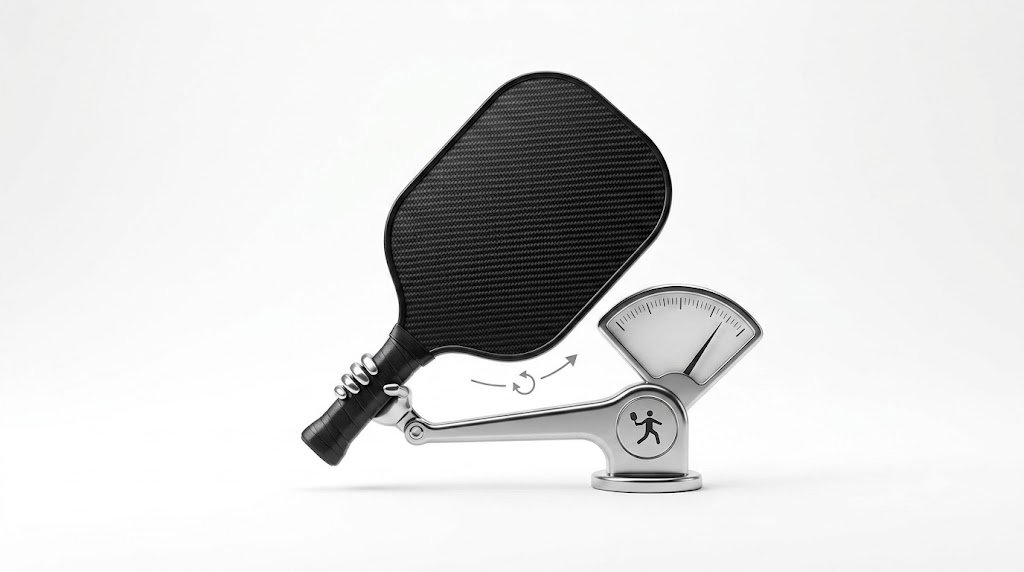
What Is Swing Weight and Why It Matters in Pickleball Paddle Design
Understanding the Difference Between Static Weight and Swing Weight
Static weight is the total weight of the paddle on a scale. Typically 220–240 g for cold-pressed paddles. Swing weight is how heavy the paddle feels when you swing it. It accounts for weight distribution, not just total mass.
Two paddles can both weigh 225 g. One feels head-heavy. One feels balanced. The difference is swing weight.
Swing weight is measured in kg·cm² or using a swing weight scale commonly used in tennis and pickleball. Most cold-pressed paddles fall between 105–125 kg·cm².
| Paddle Weight | Balance Type | Swing Weight Feel |
|---|---|---|
| 220 g | Head-light | Very maneuverable |
| 225 g | Neutral | Balanced |
| 230 g | Head-heavy | Power-oriented |
| 240 g | Head-heavy | High inertia, tiring |
How Swing Weight Influences Power, Stability, and Control
Higher swing weight generates more power. The paddle carries more momentum into the ball. Less arm effort needed for deep shots.
Lower swing weight improves maneuverability. Faster reaction at the net. Easier to reset and block. Tradeoff: less power on drives.
| Swing Weight | Power | Control | Maneuverability |
|---|---|---|---|
| Low (105–110) | Lower | Higher | Best |
| Medium (110–118) | Balanced | Balanced | Good |
| High (118–125) | Higher | Lower | Moderate |
Why Professional Paddle Brands Focus on Dynamic Weight Optimization
Static weight alone does not tell the full story. Two paddles with the same 225 g weight can feel completely different depending on where that weight is distributed. Brands that specify both static weight AND swing weight deliver a consistent playing experience across every unit in a production run.
The Relationship Between Paddle Construction and Swing Weight Performance
How Paddle Length and Shape Affect Swing Weight
Longer paddles have higher swing weight even at the same total weight. The mass is distributed farther from the hand, increasing rotational inertia.
Standard cold-pressed paddle length is 406 mm (16.0 inches). Within that length, shape variations shift the balance:
| Shape | Length | Swing Weight Effect |
|---|---|---|
| Standard (wide body) | 406 mm | Baseline |
| Elongated | 419 mm (16.5″) | +3–5 kg·cm² |
| Hybrid | 406 mm (narrower face) | -1–2 kg·cm² |
The Impact of Core Thickness on Dynamic Weight
14 mm core shifts proportionally more weight to the face sheets. The center of mass is closer to the face center. Result: slightly higher swing weight at the same total paddle weight.
16 mm core shifts weight toward the center of the paddle. The thicker core pushes the face sheets outward, distributing mass more evenly. Result: slightly lower swing weight.
| Core Thickness | Paddle Weight | Swing Weight Range |
|---|---|---|
| 14 mm | 225 g ±5 g | 112–118 kg·cm² |
| 16 mm | 225 g ±5 g | 108–114 kg·cm² |
How Surface Materials Change Paddle Balance and Handling
Fiberglass face sheets are lighter (180–220 g/m²). Carbon fiber face sheets are heavier (200–240 g/m²). The heavier carbon face shifts the balance point toward the head, increasing swing weight by 2–4 kg·cm² compared to fiberglass on the same core.
| Face Material | Fabric Weight | Effect on Swing Weight |
|---|---|---|
| Fiberglass | 180–220 g/m² | Lower |
| 3K Carbon Fiber | 200 g/m² | Moderate |
| 12K/18K Carbon Fiber | 220–240 g/m² | Higher |
Why Swing Weight Consistency Is Critical for OEM Bulk Production
Maintaining Performance Consistency Across Thousands of Paddles
A player buys a paddle and likes the feel. Six months later, they order the same model. If swing weight varies by ±5 kg·cm² between batches, the new paddle does not feel the same. Return or complaint.
OEM factories must control swing weight within ±2 kg·cm² across all units in a production batch.
How Small Weight Variations Affect Player Experience
| Variation in Swing Weight | Perceived Difference |
|---|---|
| ±1 kg·cm² | Not noticeable |
| ±3 kg·cm² | Noticeable by experienced players |
| ±5 kg·cm² | Noticeable by most players |
| ±8 kg·cm² | Plays like a different paddle |
Why Premium Brands Require Strict Manufacturing Tolerances
Brands selling paddles at $80+ retail cannot afford inconsistent swing weight. Their customers are experienced players who detect small differences. OEM factories that cannot deliver ±2 kg·cm² consistency lose premium brand contracts.
Key Factors That Affect Swing Weight During Cold Press Manufacturing
Core Density Control and Thickness Accuracy
PP honeycomb core density controls the base weight. A density variation of 10 kg/m³ changes core weight by 3–5 g per paddle. Combined with thickness tolerance (±0.3 mm), this is the largest source of swing weight variation in cold press production.
Carbon Fiber and Fiberglass Layup Distribution
Layup position matters. If the fiberglass or carbon fiber sheet shifts 2 mm toward the head during pressing, balance shifts. Swing weight changes by 1–2 kg·cm².
Resin Application and Lamination Weight Control
Resin accounts for 30–40% of the total paddle weight. Inconsistent resin application — too much in one area, too little in another — directly changes swing weight. Automated resin metering systems reduce this variation.
Edge Guard and Handle Component Weight Management
Edge guard: 5–8 g depending on material. Handle components (grip, end cap): 20–30 g. Weight variation in these parts accumulates. A grip that is 2 g heavier changes balance if it is at the far end of the handle.
How Cold Press Manufacturing Helps Control Dynamic Weight
Overview of Cold Press Pickleball Paddle Production Process
Cold press produces a flat composite panel at room temperature. The panel is then cut by CNC using a dieline. Because the panel is uniform in thickness and density before cutting, weight distribution is naturally consistent. No mold variation to account for.
Controlling Compression Pressure and Material Uniformity
Hydraulic pressure is maintained within ±5 tons during lamination. Consistent pressure means consistent resin distribution and consistent core compression. Result: consistent swing weight within ±2 kg·cm² from the first paddle to the thousandth.
Reducing Weight Variation Between Production Batches
Raw material batches — PP honeycomb, fiberglass fabric, epoxy resin — are tested before production. Density, fabric weight, and viscosity must fall within specified ranges. Any material outside spec is rejected before it reaches the press line.
Our OEM Process for Calibrating Pickleball Paddle Swing Weight
Step 1: Defining Target Performance Specifications with Brands
Brand specifies: target static weight (e.g., 225 g), swing weight range (e.g., 110–114 kg·cm²), and balance point (e.g., 240 mm from handle end). These three numbers define the playing feel.
Step 2: Optimizing Material Combination and Paddle Structure
Based on target specs, material selection begins. Core density, face sheet type, and thickness are chosen to hit the swing weight target. A prototype is produced and measured.
Step 3: Measuring Weight, Balance Point, and Swing Performance
Each prototype is measured three ways:
| Measurement | Tool | Tolerance |
|---|---|---|
| Static weight | Digital scale | ±1 g |
| Balance point | Balance beam | ±1 mm |
| Swing weight | Swing weight scale | ±1 kg·cm² |
Step 4: Fine-Tuning Production Parameters Before Mass Manufacturing
If swing weight is off-target, adjustments are made: change core density by ±5 kg/m³, adjust resin content by ±2%, or modify layup position. After fine-tuning, a pre-production run of 50 units is tested. Production proceeds only when all 50 fall within spec.
How Different Materials Influence Pickleball Paddle Swing Weight
PP Honeycomb Core vs. EPP Core Weight Characteristics
PP honeycomb is denser than EPP foam. PP core weight: 35–48 g per paddle depending on thickness. EPP is lighter but not commonly used in cold press production as PP. PP honeycomb is standard for cold-pressed paddles.
| Core Type | Weight per Paddle | Swing Weight Contribution |
|---|---|---|
| PP Honeycomb (14 mm) | 35–40 g | Baseline |
| PP Honeycomb (16 mm) | 40–48 g | Slightly lower swing weight |
Fiberglass Surface vs. Carbon Fiber Surface Balance Differences
Fiberglass has the same effect on swing weight regardless of thickness choice. 14 mm and 16 mm fiberglass paddles are priced the same and can be tuned to the same swing weight by adjusting core density.
Carbon fiber face sheets add 2–4 kg·cm² to swing weight compared to fiberglass at the same core thickness.
Hybrid Composite Structures for Customized Performance
Standard cold press uses a simple sandwich: face sheet + PP core + face sheet. No hybrid foam layers are added. Performance tuning is done through face material selection and thickness, not core modification.
Choosing the Right Swing Weight for Different Paddle Categories
Lightweight Paddles for Speed and Maneuverability
Target: 105–110 kg·cm² swing weight. Use fiberglass face, 16 mm core, low-density PP honeycomb. Result: fast, easy to maneuver. Best for beginners, seniors, and players who prioritize reaction speed.
Mid-Weight Paddles for Balanced Performance
Target: 110–116 kg·cm². The most common range for cold-pressed paddles. Available with either fiberglass or carbon fiber face. Suitable for intermediate to advanced all-court players.
High Swing Weight Paddles for Power and Stability
Target: 116–125 kg·cm². Achieved with carbon fiber face and dense core. More inertia for driving the ball. Best for power-oriented players.
| Category | Swing Weight | Face Material | Core Thickness | Target Player |
|---|---|---|---|---|
| Lightweight | 105–110 | Fiberglass | 16 mm | Beginner, senior |
| Balanced | 110–116 | Fiberglass or carbon | 14 or 16 mm | All-court intermediate |
| Power | 116–125 | Carbon fiber | 14 mm | Advanced, aggressive |
Common Swing Weight Issues in OEM Pickleball Paddle Production
Why Prototype Samples May Differ From Mass Production
Prototypes are hand-assembled with individual material selection. Mass production uses bulk materials. A 5 g/m² difference in fabric weight between the prototype roll and production roll shifts swing weight by 1–2 kg·cm². Mitigation: request pre-production run of 50 units before full manufacturing.
Causes of Inconsistent Paddle Balance
| Cause | Effect | Solution |
|---|---|---|
| Core density variation | ±3–5 g weight shift | Test each core batch |
| Resin pooling during press | Weight concentrated in one area | Automated resin spreader |
| Face sheet misalignment | Balance point shifts | Registration jig in layup |
| Grip weight variation | Handle balance changes | Weight-grade grips by batch |
How Manufacturers Solve Weight Variation Problems
Pre-production material testing. Every roll of fiberglass and every core sheet is weighed before use. Material outside spec is rejected. During production, paddles are weighed at 20% AQL sampling. If deviation exceeds ±3 g from target, the batch is halted and the cause is identified.
Quality Control Methods for Swing Weight Management
Static Weight Inspection During Production
Digital scale check at two points: after lamination (panel weight) and after CNC finishing (final paddle weight). Target: 225 g ±5 g for standard cold-pressed paddles. Any unit outside this range is rejected.
Balance Point Measurement Before Final Assembly
Balance point is measured from the handle end. Standard target: 235–245 mm for neutral balance. Head-light: 220–235 mm. Head-heavy: 245–260 mm.
Batch Testing Standards for Bulk Orders
| Parameter | Target | Tolerance | Sampling Rate |
|---|---|---|---|
| Static weight | As specified | ±3 g | 20% AQL |
| Balance point | As specified | ±5 mm | 10% AQL |
| Swing weight | As specified | ±2 kg·cm² | 5% AQL |
How OEM Brands Can Customize Swing Weight Specifications
Developing Different Paddle Models for Different Player Levels
One production line can produce multiple SKUs by varying core density, face material, and thickness. Same dieline. Same press. Different specs. This allows brands to offer a tiered line using a single OEM partnership.
Balancing Power, Control, and Market Positioning
| SKU | Face | Core | Static Weight | Swing Weight | Wholesale |
|---|---|---|---|---|---|
| Entry | Fiberglass | 16 mm | 222 g | 108 kg·cm² | $6–$8 |
| Mid | Fiberglass + ceramic | 16 mm | 225 g | 112 kg·cm² | $9–$11.50 |
| Premium | Raw carbon | 14 mm | 228 g | 118 kg·cm² | $8–$15 |
Working With an Experienced Pickleball Paddle Manufacturer
A factory that understands swing weight control delivers consistent paddles batch after batch. Lixisports measures weight, balance, and swing weight at every stage — from prototype development through bulk production.
FAQ About Pickleball Paddle Swing Weight
What is a good swing weight for a pickleball paddle?
For most recreational players, 110–116 kg·cm² is the ideal range. Beginners benefit from lighter swing weights (105–110). Advanced power players may prefer 116–125.
Is a heavier swing weight better for power?
Yes. Higher swing weight generates more ball speed on drives and smashes. The tradeoff is slower maneuverability and more arm fatigue over long play sessions.
How do OEM factories measure pickleball paddle swing weight?
Using a swing weight scale (similar to a tennis racquet swing weight machine). The paddle is placed on a pivot, and the machine measures rotational inertia. Balance point is measured separately using a balance beam.
Can swing weight be customized during manufacturing?
Yes. Swing weight is adjusted by changing core density, face material, thickness, and layup position. OEM factories like Lixisports offer full customization within standard cold press production parameters.