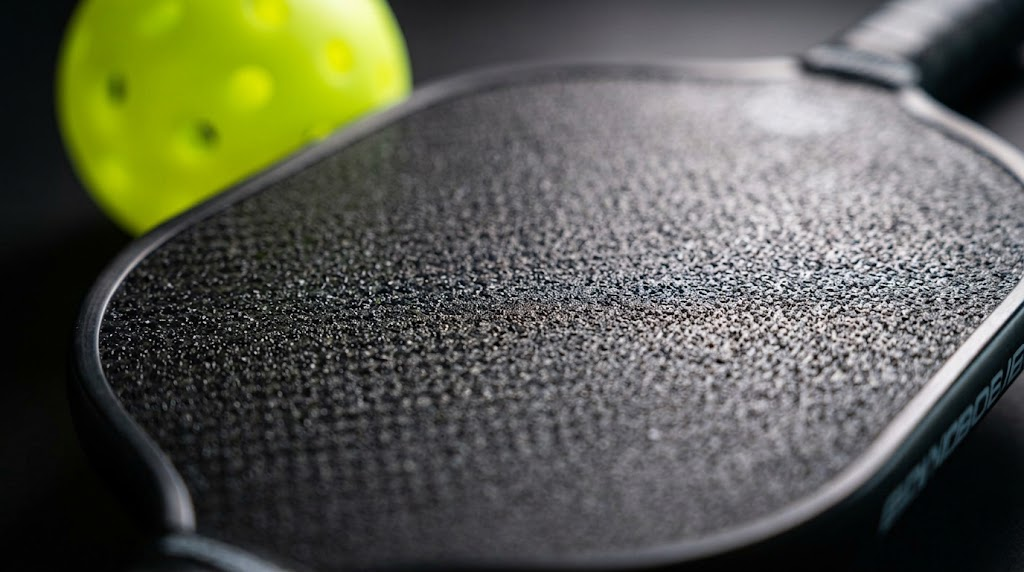
Durable grit is a paddle face that is built to keep its texture through repeated play. It combines hard particles with a resin system and a molding process that hold those particles in place.
A paddle face fails in one of three ways, and the way it fails sets how long the grit lasts. Etched resin peaks wear flat. Sprayed particles break off whole. Particles mixed into the resin wear dull, and they keep showing fresh edges. Four build choices set the grit life. They are how the grain is held, the resin under it, the molding line, and how the paddle gets used.
The Short Answer: Grit Dies Three Different Ways
- Etched peaks wear flat. A mold presses a pattern into the resin. The factory then peels off a thin epoxy skin. The pattern is made of resin, and there are no hard particles in it. Once the peaks wear down, the face turns smooth.
- Sprayed particles break off whole. A coating holds the grit on top. Each grain sits above the glue line. A hard hit knocks the grain off.
- Infused particles wear dull. Grains mix into the resin and cure with it. The resin wears down over time. New cutting edges show up, so the face gets finer instead of bare.
A spec sheet calls all three builds “textured”. The build you choose sets the shortest life the face can have.
What “Durable Grit” Means: A Category, Not a Coating
Durable grit became its own category in 2026, and buyers now ask for it by name. The term describes a face that holds its texture instead of fading away. The category holds four routes: diamond in peel ply, silicon carbide, a ceramic composite layer, and ceramic-infused texture.
Selkirk defines InfiniGrit as a molded face texture. That texture forms inside the mold itself, so the face does not depend on a sprayed coating to add grip. Selkirk says raw carbon fiber faces go nearly smooth after about 50 wear cycles. Selkirk says the InfiniGrit face lasts about three times longer.
Our ceramic-sand-infused face uses the infused route. We mix 80 or 100 mesh ceramic grit into the resin before molding. The grains cure inside the skin.
We should be clear about one number. Selkirk reports 3×. Our own test measured 2.1×. The two tests used different methods and different samples, so we report only the number we measured ourselves.
Lever 1 — How the Grit Is Held
A grain that stays buried in resin keeps showing a fresh cutting edge. A grain that sits on the surface breaks off whole.
- How deep it sits. Half-buried grains hold for months. Fully exposed grains break off in weeks.
- Particle size. Mesh counts holes per inch, so a higher number means a finer grain. 80 mesh is about 180 µm. 100 mesh is about 150 µm.
- How much grit, and how even. Full coverage keeps spin the same across the face. Thin coverage leaves dull spots.
- Hardness and shape. Ceramic keeps a sharp edge longer than quartz or common glass.
The words “textured face” appear on many spec sheets, and they describe three different builds. A buyer should ask for the route, the mesh size, and the grit spread instead.
Lever 2 — The Resin Under the Grit
The resin decides how deep each grain sits and how long it stays there. A soft or half-cured resin lets grains sink and pull out, and it also wears flat fast. A fully cured resin holds grains at a set depth.
Face material sets the starting point. Raw carbon carries peel-ply weave marks, so it starts coarse. Fiberglass starts smooth and depends more on added particles. The fibers themselves are much harder than the force that hits one grain. A face fails at the point where the resin meets the particle.
Lever 3 — The Process: Cold Press, Thermoformed or Unibody
Four process questions decide whether the grit survives molding.
- When does it enter? Mixed into the resin before layup, or sprayed on after cure. Premix locks grains in.
- Do pressure and heat flatten grains? Too much pressure pushes particles into the resin and closes the texture.
- Does the release film press the pattern out? The wrong film leaves a glossy face.
- Is the surface sanded after cure? Sanding cuts the peaks off and can pull grains loose.
Cold press suits entry fiberglass. Thermoformed builds use an edge frame, and unibody builds have no edge at all. The same formula wears differently on each line, so a molder has to check each line instead of each formula.
The complaint we hear most often is batch drift. A sample arrives coarse, and then the bulk order arrives smooth. A durable grit pickleball paddle supplier that mixes and molds its own grit locks the settings.
Lever 4 — Use Conditions: What Wears Grit Faster
This lever can shorten face life more than any build choice.
- The ball. A new ball has a sharper skin. A worn ball slides.
- The court. Asphalt and concrete wear a face down faster than indoor wood or acrylic.
- Play style. A heavy topspin player rubs the face far more often.
- Cleaning. Dirt fills the texture and cuts spin. Clean with warm soapy water and a microfiber cloth, or an alcohol wipe. Never use a sanding block. It rubs the grains off.
- When to replace. A worn face does not mean a worn core. Many paddles lose the face while the core is still good.
What 100 Cannon Hits Did to Our Face
We put a ceramic-sand-infused face on a ball cannon: 90 km/h, 100 hits, six shots measured before and six after.
- Before: mean 1,668.83 RPM.
- After: mean 1,621.99 RPM.
- Loss: 46.83 RPM. We report 47 RPM.
- Control face: about 100 RPM lost over the same test, so our loss is about 2.1× smaller.
Our “before” readings ran from 1,548 to 1,793 RPM. That spread is 245 RPM, about five times the size of the loss. One shot gives a random number. Two clean readings on the same face can differ by 245 RPM. That spread is five times larger than the wear you want to measure. Buyers should ask for the raw data behind any spin claim. A useful report shows spin, roughness (Rz and Rt), gloss, and COF before and after the run.
Roughness Limits: The Certification Ceiling on Aggressive Grit
The USAP handbook from January 2025 set average Rz ≤ 30 µm and Rt ≤ 40 µm. The same handbook set single-point limits of 33 and 44. It also set COF ≤ 0.1875, gloss ≤ 80 GU, flex ≤ 0.005 in, and PBCoR ≤ 0.43.
The rules changed on 2026-10-01. Roughness and COF readings now form the official record for each model. New paddles measure spin directly with two cameras, and the reading is capped at 2,100 RPM. Older batches keep their old approval. UPA-A covers pro play and uses the same cap, but it measures the paddle after break-in. A designer has to plan for that ceiling from the start. A coarse sample can pass and still fail in production.
Warranty and Claims: What a Fading Face Really Costs You
A fading face is the first complaint a brand hears. In most cases a fading face is normal wear rather than a defect. Three warranty positions work, and a brand should pick one and write it into the contract.
- Structure only. Cover cracks, layers coming apart, and a crushed core. Exclude surface wear.
- Spin floor. Cover the face until spin drops below a set share of the factory value.
- Spec instead of warranty. Do not cover the face, but write the grit route, mesh, and spread into the spec.
Wear belongs in the contract as a measured number, and it belongs in the warranty only if the brand chooses. RPM before and after, plus Rz and Rt, are easy to measure.
Where Durable Grit Does Not Help
Durable grit solves one wear path on the paddle, and other parts wear out on their own schedule.
- Grit covers only the face. The edge guard, core, grip, and glue line are four other failure paths.
- Coarser grit wears balls faster and pushes against the roughness cap.
- Ceramic-infused costs more than spray-on grit. It does not fit a line that competes on the lowest price.
- Our 2.1× is one structure in one test, not a promise for every formula.
- Durable grit does not promise high spin. Spin also depends on how you swing.
Choosing a Grit Spec for Your Line: Three Brand Scenarios
- Entry line. Fiberglass face plus standard spray-on grit. Price first, shorter face life accepted.
- Mid line. Carbon face plus etched or fine grit (100 mesh). Balances feel and life.
- Premium or tech-story line. Ceramic-infused at 80 or 100 mesh, sold on “spin holds over time” at a higher retail price.
All three lines can share one core platform, because grit is a layer a brand upgrades on its own. For planning, the MOQ is 200 pieces and samples take 10–15 days. A run of 2,000 pieces or fewer takes about 35 days.
FAQ
Is “durable grit” a real technology or marketing? It is both real and marketed. Grit cured into the resin holds texture longer than a sprayed coating. In lab testing, raw carbon faces went nearly smooth after about 50 wear cycles.
How long does paddle grit actually last? It depends on the route and on use. A sprayed face can fade in weeks of hard play. A cured infused face holds usable texture for months.
Can I clean my paddle without wearing out the grit? Yes. Warm soapy water and a microfiber cloth, or an alcohol wipe. Never use a sanding block or a rough pad. They rub the grains off.
Does coarser grit mean more spin? Spin does not come from coarseness on its own. It depends on particle shape and grain depth. A coarse face also risks the roughness cap.
Does aggressive grit wear out pickleballs faster? It can. A rougher face rubs the ball skin faster. That wear is a hidden cost of the extra spin.
Is ceramic-sand-infused grit USAP legal? Yes. The rules do not limit the core or face material. The finished paddle must pass the current roughness, COF, and spin limits. The brand handles certification.
Final Checklist: Grit Specs and Test Data to Ask For
A brand should send this list to any supplier before it approves a face.
- Grit route: sprayed, peel-ply, or infused
- Mesh size (80 or 100)
- Grit spread and even coverage, with a photo
- Resin system and cure settings
- Molding process and which line runs it
- Roughness (Rz and Rt) and COF on a production sample
- Wear test raw data: before and after RPM
- Certification plan, and MOQ with lead time in writing
- Batch QC report for every run
A supplier that answers all nine items has shown how well it controls the face. We publish the process, mesh options, and test data on our ceramic-sand-infused technology page.