We manufacture beginner pickleball paddles for OEM, wholesale and bulk orders
A beginner paddle spends its budget on forgiveness rather than on premium material. The head gets wider, the core stays at 13 mm, the grip drops to 101 mm, and every pair is weighed before it is boxed. The minimum is 200 pcs per design, and samples take 10 to 15 days.
What it is
- A 16.00 × 8.00 in widebody head on a 13 mm PP honeycomb core.
- A fiberglass or 3K carbon face at 0.20 mm, printed for the shelf or left plain for a club.
- A build weighed and paired, so a two-paddle box holds two paddles that feel alike.
Where it wins
- 0.24 in more room at each side of the face than a 7.52 in head leaves.
- About 10% more resistance to a miss-hit twist, from the same rim mass spread wider.
- A 101 mm grip that a smaller hand can close without squeezing.
Where it costs you
- The wider head adds 4 g to 5 g before any print goes on it.
- A 13 mm core gives back dwell time, so a hard swing feels less controlled.
- Pairing adds a weighing and sorting step to every order.
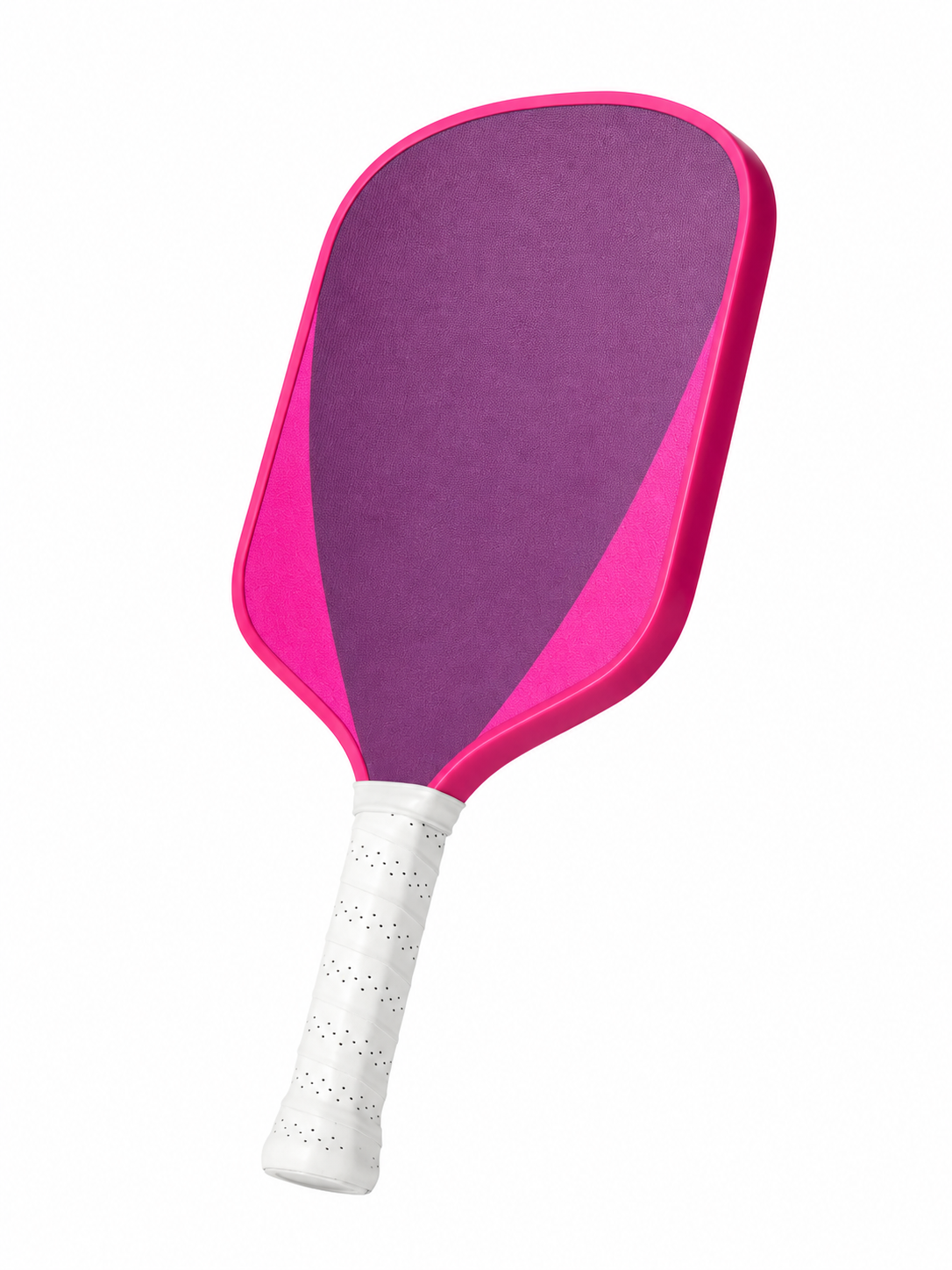
Product line
Three builds cover the channels these paddles sell in. The head is the same in all three, and the face, the print and the packing change.
A beginner pickleball paddle is built for a player who is still learning where the ball meets the face. That one fact moves money away from the face material and into the head geometry, the grip and the weight match.
All three builds sit on a 13 mm PP honeycomb core at 70 g/L and a 16.00 × 8.00 in head. The junior build is the exception, because a 350 × 170 mm head needs its own cut pattern and its own guard line.
| Build | Head | Weight | Face | MOQ | |
|---|---|---|---|---|---|
| B1 club | Widebody, 16.00 × 8.00 in | 223 g | Fiberglass 0.20 mm | Pad print, 1 colour | 200 pcs |
| B2 retail | Widebody, 16.00 × 8.00 in | 217 g | 3K carbon 0.20 mm | UV print, full bleed | 200 pcs |
| B3 junior | 350 × 170 mm | 170 g | Fiberglass 0.20 mm | Pad print, 2 colours | 200 pcs |
The 223 g build is the one a club reorders. A glass face is 13 g heavier than a carbon face before ink goes on, and a single-colour pad print adds another 2 g. That build takes a scrape from a low scoop far better than a printed carbon face does, which matters when forty members share twenty paddles. The carbon build drops to 217 g and photographs better in a retail box. The head behind all three is the one described on the 16.00 in head these are built on.
Specification
These are the lines a purchase order has to carry. Anything outside this list is a change request.
Head
Head size is 16.00 × 8.00 in widebody (406.4 × 203.2 mm). The junior head runs 350 × 170 mm on its own cut pattern.
Static weight
223 g on glass, 217 g on carbon, 170 g on junior. Every build ships at ±5 g against the printed target.
Thickness
The standard core is 13 mm. A 16 mm core runs on the same cut pattern and adds about 17 g to the build.
Core
The core is PP honeycomb at 70 g/L. Density is quoted in g/L, since cell count on its own leaves the weight open.
Face
Fiberglass or 3K carbon at 0.20 mm, with a matte or a textured finish.
Grip
PU wrap, 101 mm girth as standard. 105 mm and 108 mm run on request, and the junior build uses 88 mm.
Handle
4.25 in handle with a 5.0 in grip length. A 5.5 in grip moves the balance point back.
Edge guard
Molded TPU at 8 g to 12 g, colour matched to the face. The guard overlaps the face by 1.5 mm.
Pad print adds 2 g, heat transfer 4 g, UV digital 9 g and water transfer 11 g to the same base build.
Packing
50 pcs per 650 × 500 × 350 mm carton at about 12.5 kg. A two-paddle box drops the carton to 20 pcs.
Density moves the weight faster than any other line on this sheet. On the 16.00 × 8.00 in head, a 10 g/L step is worth about 11 g. Core density is therefore the first number we settle when a buyer names a weight band.
Forgiveness budget
Five parts of the build buy margin for a miss. Each one takes weight, money or a process step, and none of them is free.
A 2 in radius sweet spot covers 12.57 in² of a widebody face. The rest of the face is where a beginner actually hits.
An 8.00 in face leaves 4.00 in from centre to edge. A 7.52 in head leaves 3.76 in, so the same miss sits further out.
Two paddles in one box leave the scale within 2 g of each other, so a swap mid-session changes nothing in the hand.
A thin core returns the pace a player already has. A 16 mm core asks the player to supply that pace.
| Lever | What it buys | What it costs |
|---|---|---|
| Head width 8.00 in | 0.24 in of margin on each side of the face | 4 g to 5 g of extra face and core |
| Rim mass, guard 8 g to 12 g | About 10% more resistance to a miss-hit twist | Swing weight at the head end |
| Grip at 101 mm | A hand that closes without a squeeze | A second handle core in stock |
| 13 mm core | A faster ball off the face | Dwell time under a hard swing |
| Pair weighing | Two paddles that feel alike in one box | A weighing and sorting step per order |
The head width is the cheapest of the five, and it is also the smallest change. Moving from a 7.52 in face to an 8.00 in face adds 3.9% to the area, which is about 4 g at the same core density. The gain is 0.24 in of margin at each edge, plus a rim that sits further from the centre line.
Rim mass does more for a miss than face area does. A molded guard weighs 8 g to 12 g and sits at a 3.76 in radius, so a gram there counts for more than a gram at the middle. We compared a 16.38 × 7.52 in head with a 16.00 × 8.00 in head on the same face stack. The two came out about 10% apart on twist resistance, on a width difference of 6%.
The last two levers cost no material at all. A 101 mm grip and a weighing step are process choices, and they are the two a buyer most often leaves out of a first order.
Weight band
A lighter paddle forgives a miss less than the scale suggests. Three bands cover the beginner range, and the middle one fits most first-year adults.
| Band | Weight | Who it fits | What you give up |
|---|---|---|---|
| Light | 195–205 g | A player with shoulder or elbow pain | Stability on a miss, because the head twists further |
| Standard | 206–225 g | Most first-year adults | Nothing that shows inside one season |
| Heavy | 226–232 g | A tennis convert with a full swing | Arm speed late in a two-hour session |
| Junior | 160–170 g | A player under about 4 ft 6 in | Reach, which the 350 × 170 mm head partly returns |
A 195 g paddle swings faster than a 225 g paddle, and a beginner reads that speed as control. The same paddle rotates further when the ball lands an inch off centre, because there is less mass to resist the hit. A player already missing the centre gains nothing from that extra rotation.
226 g and up suits a player arriving from tennis, who brings a long swing and expects the paddle to absorb it. The cost shows up late in a session, when the arm drops and the head follows it down. The light end of the range has its own page in the builds we hold under 210 g.
The junior band is a separate build rather than a scaled adult one. At 160 g to 170 g the head stays at 350 × 170 mm and the grip drops to 88 mm. A full-size handle on that head forces a small hand to hold the paddle at the butt.
The weight on the box is a target, and the scale is where it gets proved. We weigh every paddle at the end of the line and hold the lot to ±5 g. A build that lands outside the band gets reworked before it is packed, and the lot card records the spread. The method sits in how the 5 g spread is held on the line.
Core thickness
Two thicknesses cover the beginner market. The choice follows the swing a player brings rather than the price of the paddle.
| Thickness | Ball off the face | Fits | Trade |
|---|---|---|---|
| 13 mm | Faster, with more of the swing returned | A first-season player, and every club fleet | Less dwell, so a hard swing feels less controlled |
| 16 mm | Slower, with a longer contact | A tennis convert, or a player who hits long | About 17 g more core, which sets a 225 g build |
A 16 mm core adds 3 mm of material under the same face, and that material weighs about 17 g at 70 g/L. A carbon build that leaves the line at 208 g arrives at 225 g on the thicker core. That happens to be the weight the rest of our catalogue is built around.
Thickness changes how long the ball stays on the face. A longer contact lets a player steer the ball, and it also takes pace out of a swing that is still being built. Most first-year players get more from the 13 mm core, because the ball comes back with the swing they already own.
Both cores run on the same cut pattern, so a brand can launch on 13 mm and move to 16 mm without a new mold. The change still needs a new pressing schedule and a new weight target on the spec sheet, and we quote those two together.
A longer head is a different conversation, since the 0.38 in it adds costs a beginner more than it returns. A beginner build stays on the widebody head, and the long shape has its own page in the long head we keep off a first order.
Grip size
Four girths cover the range, and the wrong one costs a player more than any face upgrade. A grip that sits too large makes a beginner squeeze.
| Girth | Hand | Where it ships |
|---|---|---|
| 101 mm / 4.0 in | Most adult women, and a man with a smaller hand | Standard on B1 and B2 |
| 105 mm / 4.1 in | Most adult men | A step up in handle core size, same head |
| 108 mm / 4.25 in | A large hand, or a player who wants less wrist | The least common line in a beginner order |
| 88 mm / 3.5 in | A junior hand | Junior build only, on its own handle core |
A grip that sits too large stops the fingers from closing around it, so the hand has to hold on with the palm instead. That tension travels up the forearm, and it is one of the reasons a beginner reports elbow pain in the first month.
The test takes ten seconds. A player should be able to touch the thumb and the middle finger around the handle with a small gap left over. You can run that test on a sample before the order goes in, and it costs nothing to change at that point.
Junior builds use an 88 mm grip on a 350 × 170 mm head. A full-size handle on that head puts the hand far from the balance point, and the paddle then feels heavier than the 170 g printed on the box.
Set matching
Clubs, schools and resorts buy these paddles in sets rather than in singles. A set is a weighing decision and a packing decision, and neither one happens on its own.
A two-paddle box holds two paddles taken from the same lot and weighed against each other. We hold the pair to 2 g, so a beginner who swaps paddles halfway through a session picks up the same feel. A 4-paddle set is held to 3 g across the four.
The weighing step runs at the end of the line. Every paddle passes a scale, the weight goes into 1 g bins, and the pairing station draws from adjacent bins. A lot that spreads wider than 5 g is stopped, because sorting cannot produce pairs out of a spread that wide.
Packing changes the carton count. A plain poly bag keeps 50 pcs in the 650 × 500 × 350 mm outer carton. A printed two-paddle box takes that carton down to 20 pcs, and a rigid gift box takes it to 24 pcs. Freight per unit rises as soon as each paddle gets a box of its own.
The pair is the unit a school actually buys. A single paddle has to be ordered 200 at a time to reach the minimum. A two-paddle set is 100 sets, which is the same 200 pcs, and it ships as one barcoded carton line. A club order that mixes builds is covered in how a club fleet order is built.
Wear in year one
A beginner paddle meets the court more often than any other build. Six parts take the damage, and each one has a fix that belongs on the spec sheet.
A low scoop hits the guard first
The guard is the part that meets the court when a player digs out a ball. A molded guard takes that scrape, and a taped strip lifts at the throat within weeks. Every beginner build here carries a molded guard.
The print dulls at the sweet spot
A printed face loses its gloss where the ball lands most. A single-colour graphic hides that for a season, and a full-bleed graphic shows it as a pale patch by month four.
Sweat reaches the handle first
A PU grip takes about a season of twice-weekly play before it glazes over. A perforated overgrip in the box costs very little, and it is the part a club replaces most often.
The end cap cracks on a drop
A beginner drops the paddle on its butt far more often than on its face. A molded cap with a 2 mm wall survives that drop, and a thin cap splits along the seam.
The face chips at the edge
The rim takes the hit when a player scrapes a low ball. The guard overlaps the face by 1.5 mm, so the carbon under it stays covered and does not chip away.
A car boot cooks the handle
A paddle left in a car reaches 60 °C and above. The molded guard holds at that temperature, and the PU grip goes tacky and then slippery once it cools.
None of these six parts is expensive on its own. A beginner paddle usually fails in year one because a cheap guard, a thin cap and a taped strip arrive together on one build. That build was quoted to a price rather than to a use.
A club that replaces twenty paddles a year spends less on the 223 g build with a molded guard than on a lighter build with a taped one. The difference sits in the guard and the cap, and neither one shows up on a face spec.
Compliance
Every model needs its own listing before it can be used in sanctioned play. A beginner paddle follows the same step as a flagship model.
A listing belongs to a model rather than to a brand or a factory. Changing the head size creates a new model, and a new model needs its own submission and its own sample set. Changing the print does not, which is the one place a beginner line stays cheap to extend.
The size rule is short. A paddle measures 17.00 in or less in total length, and length plus width comes to 24.00 in or less. The widebody head sits at 16.00 × 8.00 in, which sums to exactly 24.00 in. The rule sets no weight limit and no width limit of its own, so the build weight is a commercial choice rather than a compliance one.
A junior paddle goes through the same file as an adult model. The 350 × 170 mm head sums to 20.47 in, which leaves 3.53 in of room, and the listing still names the model and its production source.
A widebody head at 16.00 in leaves 1.00 in under the length limit, so the guard has room.
The 16.00 × 8.00 in head lands on the number exactly, with no margin left to spend.
A 350 × 170 mm head leaves 3.53 in of room, which is why a junior model files without a resize.
A new head size means a new file, and a new print on an approved head does not.
The filing side runs alongside the build. A submission needs a sample from production rather than from the bench, so the two schedules have to line up. The route sits in where a beginner model gets its listing.
Buyer fit
Four buyers order these paddles, and each one wants a different line on the invoice.
| Buyer | Build | Why it fits | What the order needs |
|---|---|---|---|
| Club or school fleet | B1 club, 223 g glass | A shared paddle takes scrapes and a printed carbon face does not | Guard colour, club logo, 200 pcs |
| Retail brand | B2 retail, 217 g carbon | The box photo sells before the spec sheet gets read | Artwork file, barcode, hangtag |
| Resort or rental desk | B2 with a 105 mm grip | A larger grip survives a queue of hands with no fitting step | One ink colour, no white, high contrast |
| Junior programme | B3 junior, 170 g | A small hand cannot close a 101 mm handle | Head size, 88 mm grip, sleeve print |
A club fleet and a retail brand want the same head for different reasons. The club wants a paddle that survives a shared rack, and the brand wants one that reads well in a photograph. The build changes at the face, and the head stays at 16.00 × 8.00 in for both.
A retail order carries more work before the line starts. Artwork, a barcode and a hangtag all have to be approved, and each one is a separate approval. A club order needs a logo and a guard colour, and it can go to press on a shorter calendar.
A junior programme usually pairs the 350 × 170 mm build with a full-size one. The junior head sits in the junior head in detail, and the packing that goes with it changes the carton count.
Limits
Five things this build cannot do, written down before an order instead of after one.
What we cannot do
- Geometry buys 0.24 in, and a beginner misses by more than that. The widebody head is the right shape for a new player, and it will not cover a swing that arrives late. Twenty minutes of drill moves a player further than any line on this sheet.
- The lightest build is not the most forgiving one. A 195 g paddle swings faster and rotates further on a miss. We build it when a buyer asks, and we say so when the order is heading away from the player it is meant for.
- A printed face will dull. The clear coat loses its gloss at the sweet spot inside a season of club play. A raw carbon face hides that better, and it costs more and photographs worse.
- Pair matching has a floor. Below 2 g the scale reads noise, and the next step up is a hand-built matching station that no beginner order needs to pay for.
- Junior and adult files do not scale. A 350 × 170 mm head is its own cut pattern, its own guard and its own handle core. A brand that wants both pays two setups.
Factory record
Each check leaves a record that travels with the lot, and a buyer can ask for it against any carton number.
Every paddle on a scale
100% of a lot passes a scale at the end of the line. The weight goes into 1 g bins, and the pair order is drawn from those bins rather than from a carton at random.
Core checked on every lot
An X-ray of a cut sample shows collapsed cells and voids that a weight check cannot see. Every core lot gets one before it goes to press.
Temperature and time per cycle
Each cycle records plate temperature, pressure and dwell. A lot that drifts outside the window is held rather than shipped.
10 N on a cured paddle
A pull test on the edge guard from each lot. A guard that lifts at 10 N fails the check, and the lot goes back for a re-bond.
Six drops from 1.2 m
A packed paddle dropped on each face, on the edge and on the butt. The cap and the guard take the damage, and both get checked after the sixth drop.
USAP and PBCoR in house
We run our own pre-check on each model before a sample goes to a lab. It catches a size or a surface problem before the submission is spent.
Same programme: ISO 9001 and BSCI audits, a QC report per batch, and a reply inside 24 hours on any claim. A reorder is matched against the first lot card rather than against a sample kept in a drawer.
FAQ
These are the answers that change a decision. Anything else is a quote question.
What is the minimum order for a beginner paddle?
200 pcs per design, and a design is one build with one print. A two-paddle box counts as one design at 100 sets, which is the same 200 pcs.
A three-SKU launch therefore starts at 600 pcs. Two builds on the same head share a print run only when the artwork is identical.
Which head size suits a beginner?
A 16.00 × 8.00 in widebody, because it leaves 4.00 in from centre to edge against 3.76 in on a 7.52 in head. That 0.24 in is the room a miss needs.
A long head at 16.38 × 7.52 in is legal, and it is not the first shape we would put in a beginner hand. The swing weight sits at the far end, and a new player already struggles to bring the head through on time.
What weight should a beginner paddle be?
206 g to 225 g covers most first-year adults. A 195 g build suits a player with shoulder or elbow pain, and it rotates further on a miss.
226 g and up fits a tennis convert who brings a long swing. We print the target weight on the box and hold the lot to ±5 g.
Can you match the two paddles in one box?
Yes, to within 2 g. Every paddle is weighed at the end of the line, the weight goes into 1 g bins, and the pairing station draws from adjacent bins.
A 4-paddle set is held to 3 g across the four. Pair matching is part of the standard process, and it adds no material to the build.
Do you build junior sizes?
Yes, at 350 × 170 mm and 170 g with an 88 mm grip. The junior head uses its own cut pattern, its own guard line and its own handle core.
A junior model still needs its own listing before it can be used in sanctioned play, even when the adult model of the same name is already listed.
Is a 13 mm or a 16 mm core better for a beginner?
13 mm suits most first-year players, because the ball comes back with the swing they already own. A 16 mm core holds the ball longer and asks the player to supply the pace.
The thicker core adds about 17 g at 70 g/L, which puts a 208 g carbon build at 225 g. A tennis convert often does better on the 16 mm.
Does a beginner paddle need a USAP listing?
Yes, if the paddle is sold for sanctioned play. A listing belongs to a model, so a new head size needs its own file and its own production sample.
A new print on an approved head does not create a new model. That is the one change a beginner line can make without a new submission.
How much weight does the print add?
2 g for a pad print, 4 g for heat transfer, 9 g for UV digital and 11 g for water transfer. The two heavy routes need a base layer, and the base layer is most of that weight.
When the packaging states a weight, those grams come out of the core density rather than out of the face.
Can one carton hold two different builds?
A carton holds one build. A mixed pallet is normal, and a mixed carton needs a repack step after the line, which we quote as a separate operation.
A club that wants twenty of each build gets two cartons and one pallet, and each carton label carries its own build code.
How long does a first order take?
Samples take 10 to 15 days, and a first production run of up to 2,000 pcs takes 35 days from approval. The weighing and packing steps sit inside that window.
A listing runs its own calendar beside production rather than after it. A new model that needs a listing before launch should carry that time in the plan.
Start an order
The head size, the weight band and the grip girth are what we need to quote. We will come back with the build that fits the player, the grams it adds and a sample date.
Shenzhen Banky Technology Co., Ltd. · ISO 9001 · BSCI · lixifirm@outlook.com