We manufacture purple pickleball paddles for OEM, wholesale and bulk orders
Purple shifts more than any other colorway we run, so every batch is checked under three light sources before it ships. Our white base coat carries no optical brightener, which keeps the shade within ΔE 1.2 across daylight, store light and daylight through glass. MOQ is 200 pcs per design and samples ship in 10 to 15 days.
What it is
- Three purples on a 16.00 × 8.00 in widebody or a 16.38 × 7.52 in elongated head.
- A white base coat with no optical brightener, under a printed or dipped color layer.
- Every sealed sample signed under D65, TL84 and UV light, not under one lamp.
Where it wins
- A shade that holds on a phone screen, in a gym and in daylight through a window.
- A base coat that keeps the hue from turning blue under sunlight.
- The same molds and cores as our standard line, so the color adds no tooling.
Where it costs you
- 9 g to 13 g of added weight, because purple needs a base coat or a dyed sheet.
- A three-lamp approval step that no other color in our range needs.
- A shade that still cannot be identical under every lamp on earth.
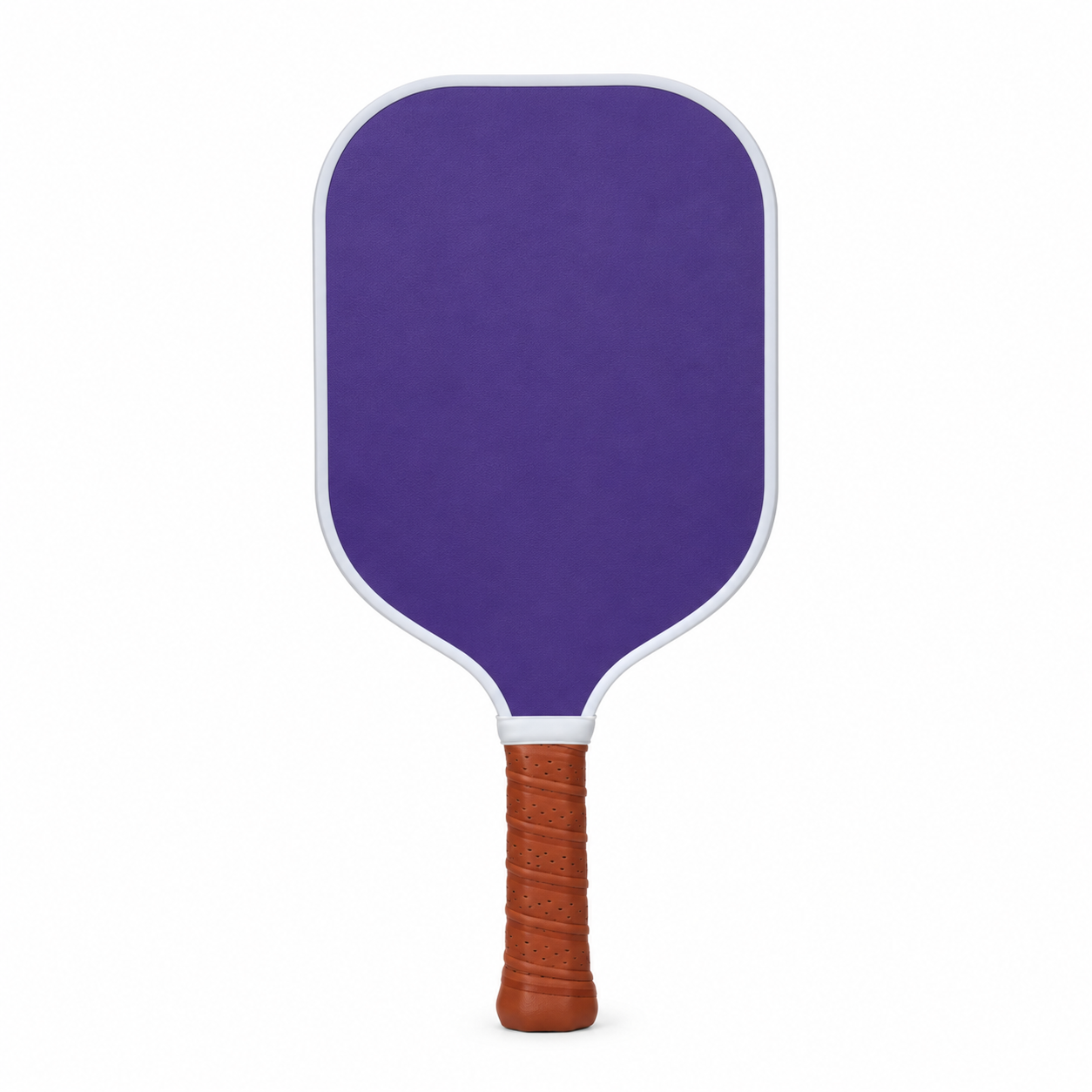
Purple product line
Three shades, three routes. The lighter the purple, the easier it is to build and the narrower the range of finishes that hold it.
A purple pickleball paddle is a paddle whose face color was specified to a reference and then matched on a white base. Purple is the hardest colorway in our range to hold, because two buyers can look at the same paddle under two lamps and describe two different colors.
The three shades below are the ones we quote most. Each one is a production route rather than a hex code, and the route decides the weight, the wear life and the unit price.
| Shade | Reference | Route | Face | Weight vs carbon | Typical buyer |
|---|---|---|---|---|---|
| Lilac | Pantone 2645 C | Dyed fiberglass | Glass 0.20 mm, color in the sheet | +13 g | Club lines, school programs, entry price points |
| Violet | Pantone 267 C | UV print, clear coat | 3K carbon 0.20 mm | +9 g | DTC brands, women's lines, gift sets |
| Deep purple | Pantone 2695 C | Hydro dip, clear coat | 3K carbon 0.20 mm | +11 g | Retail packaging, licensed and team lines |
Deep purple takes the dip route for a physical reason. A dark violet needs four or five ink layers on a UV printer, and a stack that thick cracks at the edge guard within a season. A dip film carries the depth in one pass, so the coating stays thin enough to flex.
Three light sources
A purple that passes under one lamp can fail under the next. We check all three before the sample leaves the building.
Retail buyers judge a paddle in a store. Players judge it in a gym lit by LED tubes. Distributors photograph it outdoors or through a window. Those three situations feed the eye different spectra, and purple is the shade where the difference shows first.
D65 is the daylight standard at 6500 K and it is where most color references are set. TL84 is a 4000 K tri-phosphor lamp that matches the light in a lot of retail space. UV is a 365 nm source with no visible output of its own, and its job is to show what the white layer does when sunlight hits it.
Daylight, 6500 K
Every other lamp is measured against this one. A shade approved here is the shade written on the Pantone chip.
Store light, 4000 K
A narrow-band fluorescent source with a green bias. Purples read slightly warmer and flatter here, which is what a customer sees on a shelf.
365 nm, no visible output
This lamp shows whether the white base coat carries an optical brightener. If it does, the purple turns blue in sunlight and nobody understands why.
Our target on a base coat with no optical brightener. A buyer who moves from a gym to a car park sees the same shade.
A brightener-loaded white pulls violet toward blue under UV. The shift is visible to anyone, and it is the most common reason a purple sample gets rejected.
Optical brighteners absorb UV and re-emit it as blue light. That added blue is what pulls a violet shade toward blue.
Why purple shifts
Two things move the shade after the ink is dry: what is under it and how thick that layer is. Both are control points, and both are easy to get wrong.
Most white coatings contain an optical brightener. The additive absorbs ultraviolet light and re-emits it in the blue part of the spectrum, which makes the white look cleaner to the eye. Under a lamp with no UV in it, the brightener does nothing. Under sunlight, it adds blue to everything above it.
A violet that sits on a brightened white is therefore two colors. In a gym it reads at a hue angle near 305°, and outdoors the same paddle reads near 298°. Eight degrees of hue is enough for a buyer to call it a different color, and it happens with no change to the ink.
| Base coat | Hue under D65 | Hue under UV-heavy light | Cost per paddle |
|---|---|---|---|
| Standard white, brightener loaded | 305° | 298° | Baseline |
| Brightener free, TiO2 only | 305° | 303° | +USD 0.15 |
Fifteen cents buys two degrees of hue stability. On a purple run we use the brightener-free white as the default, and we quote it as part of the build rather than as an option.
The second control point is base coat thickness. The layer runs 12 to 18 µm and we hold it to ±2 µm. A 4 µm swing moves the b* value by about 1.5, and b* is the axis that separates a blue violet from a red violet.
A thin coat lets the dark carbon underneath dull the color. A thick coat pushes the shade toward blue, because the white itself sits slightly cool. Neither failure shows up on a flat test panel. Both show up on a curved head, where the coating pulls thinner at the rim.
There is a third issue that only appears after assembly. The white layer is printed 0.3 mm inside the color layer, so no white edge can show at the outline. If the registration drifts past that margin, a hairline of white appears along the guard seam. On a black paddle nobody notices. On a purple one it reads as a scratch.
Specification
Every row describes the violet build on the widebody head. Rows that change with the shade carry a note in the last column.
| Item | Specification | Note |
|---|---|---|
| Build | Widebody, 16.00 × 8.00 in | The head most purple orders launch on. |
| Length plus width | 24.00 in | Exactly on the USAP ceiling, so no dimensional margin. |
| Thickness | 16 mm or 13 mm | 16 mm is standard. 13 mm saves 17 g if the color weight needs paying back. |
| Static weight | 234 g with UV print 236 g with a dip | Measured on the finished paddle with the guard fitted. |
| Weight tolerance | ±5 g standard ±2 to 3 g matched | Matched sets are sorted after curing. |
| Core | PP honeycomb, 70 to 80 g/L | Density is the dial used to pay back the color weight. |
| Face | 3K carbon 0.20 mm or dyed glass 0.20 mm | Dyed glass holds three lilac tones and no deep purple. |
| Base coat | 12 to 18 µm, ±2 µm | Brightener free by default. Required for print and dip. |
| Base registration | 0.3 mm inset | Keeps a white edge from showing at the guard seam. |
| Clear coat | 2H pencil hardness | Satin as standard. Gloss shows marks sooner on a dark shade. |
| Adhesion | 4B cross-hatch | Tested on a cured paddle, not on a flat panel. |
| Color tolerance | ΔE 2.0 inside a run ΔE 3.0 between runs | Measured under D65 at 45/0, then confirmed under TL84 and UV. |
| Hue spread, three lamps | ΔE 1.2 target | The figure that separates a stable purple from a sample you will reject. |
| Color zones | Face, guard, grip, end cap | All four matched from one sealed sample. |
| Grip | 101 / 105 / 108 mm | PU wrap at 1.5 mm or 1.8 mm, dyed to the guard shade. |
| Handle | 4.25 in | 4.00 in saves 3 g and costs a two-handed grip. |
| MOQ | 200 pcs | Per design. Two shades of one build count as two designs. |
| Packing | 50 pcs per carton 650 × 500 × 350 mm | About 12.5 kg per carton with the PE bag and bubble wrap. |
At 234 g the violet build sits 9 g above the same head with a raw carbon face. That is inside the ±5 g band of a single run. A brand that lists both a violet and a black version of one model is listing two different weights, and both should be written down.
If the packaging says 225 g, the 9 g comes back out of the core. Dropping density from 80 to 70 g/L removes 11 g from the same head and leaves 2 g of margin. The check that keeps that 2 g stable across lots is why we weigh after curing instead of after assembly.
Color approval
Four steps, and the third one is the step the sample gets rejected on.
Coupon under D65
We spray the reference on a 60 mm coupon and read L*a*b* against your chip. A match under D65 is the starting point, and it is the only part a Pantone number can describe.
Same coupon under TL84 and UV
The same physical coupon, moved to the other two lamps. A shade that drifts more than ΔE 2.0 here goes back to the coating bench before a paddle is built.
Finished paddle, all three lamps
Texture, clear coat and the curved outline all move the reading. This is the step where a flat coupon that passed can still fail, and it is the one worth waiting for.
Sealed sample and lot card
Three paddles are sealed. One goes to your office, one stays in our color room, one is cut into coupons. The lot card carries the L*a*b* values for every future run.
Inside a production run we hold ΔE 2.0. Between runs we hold 3.0, because coating lots change and a new white batch is never identical to the last one. A buyer who reorders eight months later should expect a small shift. The sealed coupon is what keeps that shift inside a range.
If a reorder has to match the first run exactly, say so at the quote stage. It costs a color adjustment and about five extra days, and it is cheaper than discovering the difference at the retail shelf.
Cost per route
Color is a small line item. The face underneath it decides which price band the paddle sits in.
| Route | Added cost per paddle | Added weight | Where it pays off |
|---|---|---|---|
| Dyed fiberglass | USD 0.80 to 1.20 | +13 g | The cheapest purple, and the one that survives a school season. |
| UV print, clear coat | USD 1.40 to 1.80 | +9 g | An exact violet on carbon, with no tooling charge. |
| Hydro dip, clear coat | USD 1.90 to 2.40 | +11 g | Deep purple and gradients that a thin ink layer cannot hold. |
The brightener-free base coat adds USD 0.15 above any route. That is the whole color premium on a purple run, and it is the cheapest defect prevention in the build.
These figures sit above the FOB tier the build already occupies. A fiberglass paddle with an EVA wall runs USD 8.00 to 15.00 from 500 pcs, and a 3K carbon build runs USD 15.00 to 35.00 from 300 pcs. A purple face does not cross a tier, so the color is a USD 1 to 2 item on a USD 20 paddle.
Two things add cost at the front end. A Pantone outside the shades we stock needs a color match fee, and a run under 500 pcs shares a smaller coating batch. Where the rest of the unit price goes matters when two quotes differ by USD 4.00.
Lead times
The three-lamp approval adds a day to the front end. It is a day well spent, because it is the only one that catches metamerism.
A stocked shade skips this. A new violet is sprayed on coupons and read under three lamps before it goes near a paddle.
Includes the color coupons and one finished paddle in the shade you signed off.
The clock starts when the sealed sample is signed.
The cold press fiberglass line runs 100,000 a month, which is where lilac is scheduled.
A purple order for a spring launch should be quoted in the autumn. The approval needs a physical sample in your hand, and courier time sits between the two ends of that step. Buyers who approve a shade from a screen image usually approve it twice.
A full calendar sits in how the two windows stack from PO to carton, including the point where a color change stops being free.
Buyer fit by channel
Four channels order purple, and the shade they need follows the light they sell under.
Retail and pro shop
Sells under TL84 and warm LED. Needs the shade to stay saturated when the store light pulls it warm, which is where a brightened white base fails first.
DTC brand
Sells from a photo lit with a softbox at 5500 K. Needs an exact Pantone and a sealed sample, because the listing image and the delivered paddle have to be the same object.
Club and school program
Sells to a purchasing officer who compares three quotes. Lilac on dyed glass is the answer, at the cost of 13 g and a narrower shade range.
Team and licensed line
Needs a deep purple that matches a jersey, a bag and a printed insert. Ask for the whole set in one approval round, because a face that matches nothing looks unfinished.
The builds on the light end of the range take the same purple face without a new mold. The 195 g to 218 g bands sit on the same cores used here.
On the other side of the range, the pink builds use the same four color zones with a brighter reference. The base coat does a different job under a pale shade.
For a brand, the useful question is which lamp your customer stands under. A pro shop and an online store need different priorities, and a shade that wins one can lose the other. The channel belongs in the brief, because it decides which base coat we run.
For a player, the paddle plays like the structure under the color. Purple changes the weight by 9 g and changes nothing about how the ball comes off the face. The structural spec is quoted separately for that reason.
Paddle limits
Five constraints we have hit on real production runs, written down so they do not surprise you at the sample stage.
What you should know before you order
- No purple is identical under every lamp. We can bring the spread to ΔE 1.2, which is close enough that most people cannot tell. We cannot make it zero, and a brand that promises an exact match across all lighting is promising something physics does not allow.
- The deep shade needs a dip, not a print. Four or five ink layers on a UV printer crack at the guard line. That pushes deep purple to a higher unit cost than violet.
- Dyed glass stops at lilac. Dye inside a glass sheet holds a soft purple and cannot reach a saturated violet. The mid and deep shades need a coated carbon face.
- A white edge can appear at the seam. The base coat sits 0.3 mm inside the color layer. If registration drifts past that margin, a hairline of white shows along the guard, and on purple it reads as a scratch.
- Purple shows guard wear more than pink does. A black guard against a dark purple face gives the eye a hard edge to compare, so a scuffed rim is easier to see.
Factory record
Six checks, and the first one is the reason we keep a three-lamp booth.
D65, TL84 and UV booth
Three sources in one booth, with the UV lamp on its own switch. Every purple sample is judged in all three before it is approved.
Spectrophotometer, 45/0
Reads L*a*b* and hue angle on the finished face, then reports ΔE against the sealed coupon. Lot cards carry the numbers.
Base coat at ±2 µm
Measured with a coating gauge on the cured paddle. A 4 µm swing moves b* by 1.5, which is the difference between blue violet and red violet.
Cross-hatch to 4B
A lattice cut through the coating, tape pulled at 60°, judged against the 4B standard on a cured paddle from each lot.
Pencil test to 2H
The clear coat has to resist a 2H pencil without cutting through. A softer coat scratches at the guard line within a month.
Lot card per carton
Coating lot, masterbatch lot, L*a*b* values and the operator on shift. A reorder can be matched to the first run instead of to memory.
Same program: ISO 9001 and BSCI audits, plus X-ray structure checks on every core lot, in-house USAP and PBCoR pre-checks on each model, and a QC report per batch. The approval file your brand submits sits outside the color work and runs on the same schedule.
FAQ
Questions buyers ask before a purple order, including the one about the sample that changed color on the drive home.
Why did my purple sample look different at home?
You moved it from one spectrum to another. A violet on a brightened white base picks up blue under sunlight and loses it under a warm lamp, and the shift is large enough to notice.
The fix is a base coat with no optical brightener. It costs USD 0.15 per paddle and holds the shade within ΔE 1.2 across three lamps.
Can you match a Pantone purple exactly?
We match to ΔE 2.0 on a coated carbon face, which most people read as the same color. An exact 0.0 match is not a real promise, because the texture and the clear coat shift the reading from the ink.
Send the Pantone code with a physical chip. A number alone gets us close. A chip gets us there in one round.
Does a purple face add weight?
Yes, 9 g with UV print and 11 g with a dip, because both need a white base under the color. Dyed fiberglass adds 13 g instead, and that comes from the glass sheet rather than from a coating.
If the weight has to stay at 225 g, we take the grams out of the core. A 10 g/L drop removes 11 g from the same head.
Why is deep purple more expensive than violet?
A dark violet needs four or five ink layers on a UV printer, and a stack that thick cracks at the edge guard within a season. We run it as a hydro dip instead, which carries the depth in one pass.
The dip costs USD 1.90 to 2.40 per paddle against USD 1.40 to 1.80 for the print. The difference is the film and the extra handling.
Can the guard and grip match a purple face?
Yes, and they should be ordered together. TPU, PU and ABS take dye at different rates, so we mix the three plastic parts from one masterbatch lot and spray the face to a physical sample.
All four zones land within ΔE 2.0 of each other on a good lot. Black remains the most common choice, because a black guard hides wear and makes the purple sit forward.
What is the minimum order for a purple paddle?
200 pcs per design. Two shades of one build count as two designs, because each shade needs its own approval and its own coating batch.
Runs under 500 pcs share a smaller coating batch, so the per-unit finishing cost is higher. The structural part of the price does not change.
How long does a new purple take?
Three to five days for the color match, then 10 to 15 days for samples. Production runs 35 days for up to 2,000 pcs once the sealed sample is signed.
Stocked shades skip the match step. A new Pantone adds five days and a match fee.
Will a purple face fade in sunlight?
The pigment system we use is lightfast under normal outdoor play, and we test the clear coat against alcohol rather than against sun exposure. Long-term fade is a risk on any coated face, and a darker shade hides it better than a lilac.
Is a purple paddle legal for USAP play?
Color has no bearing on approval. The paddle specification sets two dimensional limits, 17.00 in overall length and 24.00 in for length plus width, and no rule on color, thickness or weight.
The approval is filed per model by your brand. A colorway of an approved model is a new model number and needs its own filing.
Can you print a logo on a purple face?
Yes, either as a pad print over the clear coat or as a layer under it. Under the coat survives longer and reads softer. Over it gives a sharper edge and wears at the outline first.
On a hydro dip we print the logo into the film, so the mark sits inside the finish rather than on the surface.
Start an order
The Pantone reference, the head shape and the weight on the box are all we need to start. We will come back with the route that holds the shade, the grams it adds and a unit price at your quantity.
Shenzhen Banky Technology Co., Ltd. · ISO 9001 · BSCI · lixifirm@outlook.com