Introduction
Overview of Cold-Pressed Cutting and CNC Finishing
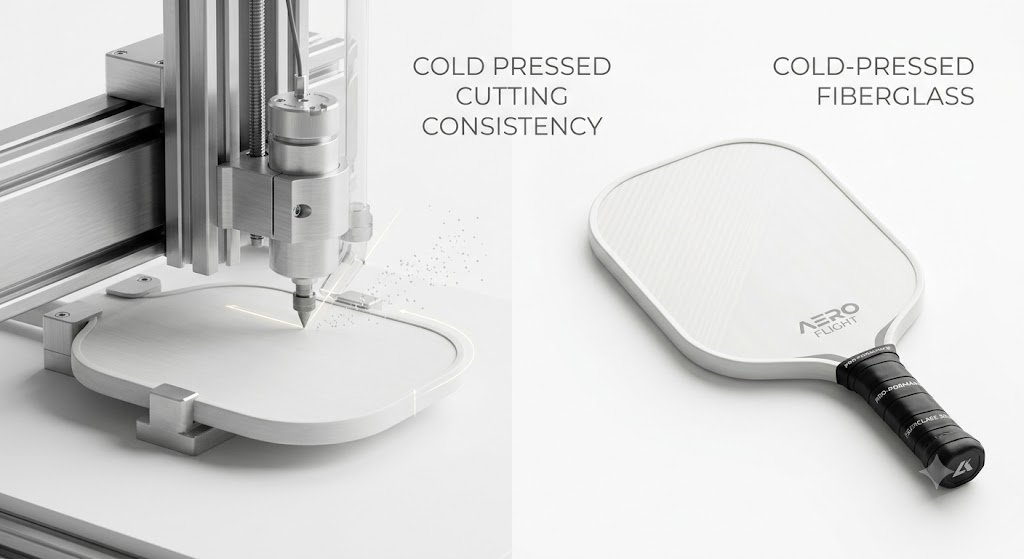
Cold-pressed cutting is a two-stage manufacturing process for composite pickleball paddles.
Stage 1 — Cold pressing. Fiberglass or carbon fiber face sheets are laminated onto a PP honeycomb core under hydraulic pressure at room temperature. The result is a flat composite panel. No mold is used. No heat curing is involved.
Stage 2 — CNC cutting. A dieline is drawn by the customer or factory to define the paddle outline and handle shape. The CNC machine follows this dieline to cut each paddle from the pressed panel.
CNC finishing then refines the edges, chamfers, and surface to final specification.
| Process | Temperature | Method | Result |
|---|---|---|---|
| Cold pressing | Room temp | Hydraulic lamination of flat panel | Flat composite sheet |
| CNC cutting (dieline) | Room temp | Programmed router follows dieline | Paddle shape from sheet |
| CNC finishing | Room temp | Precision edge profiling and surfacing | Final dimensions ±0.05 mm |
Understanding Cold-Pressed Cutting
What is Cold-Pressed Cutting in Manufacturing?
Cold-pressed cutting refers to the combined workflow of cold laminating composite materials at room temperature, then CNC-cutting the paddle shape using a dieline.
Cold pressing (lamination only):
- Fiberglass or carbon fiber face sheets are coated with resin.
- A PP honeycomb core is sandwiched between the face sheets.
- The stack is placed in a hydraulic press at 80–150 tons, room temperature.
- The resin cures over 8–12 hours. The result is a rigid, flat composite panel.
CNC cutting (shape definition):
- A dieline is created in vector format (.dxf or .ai).
- The dieline defines paddle outline and handle contour.
- The CNC machine loads the dieline and cuts the paddle shape from the pressed panel.
- No mold is needed. Shape changes only require a new dieline file.
Here is a simple comparison of cold pressed vs thermoformed pickleball paddle manufacturing.
| Aspect | Cold-Pressed (dieline + CNC) | Thermoformed (mold-based) |
|---|---|---|
| Shape definition | Dieline file → CNC cut | Steel mold cavity |
| Tooling cost | Very low (dieline only) | High (mold machining) |
| Cycle time | 8–12 hr lamination + fast CNC | 20–40 min per molded part |
| Shape change cost | Free (edit dieline) | $1,000–$1,500 new mold |
| Dimensional accuracy | ±0.05 mm (CNC limited) | ±0.2 mm (mold limited) |
Advantages of Cold-Pressed Cutting Techniques
No mold cost. A new paddle shape only requires a new dieline file. No steel or aluminum mold to machine. This makes cold pressing the lowest-cost entry point for new paddle brands.
Faster iteration. Dieline changes take hours. Mold changes take weeks. Brands testing multiple shapes can iterate in days.
Material flexibility. Cold pressing works with fiberglass and carbon fiber face sheets. Core material is typically PP honeycomb. Kevlar is avoided in cold press due to edge fraying. EPP and Nomex cores are uncommon in cold-pressed paddles.
Simpler supply chain. No heated press or autoclave infrastructure needed. Facilities can be set up faster with lower capital expenditure.
Lower minimum order quantities. Cold-pressed lines can run batches of 200 units economically. Thermoformed lines typically require 500+ units per run.
CNC Finishing and Dimension Consistency
How CNC Finishing Improves Dimension Consistency
The cold-pressed panel has uniform thickness but no defined paddle shape. The dieline-to-CNC workflow defines the shape, but the raw CNC cut still has tool marks and edge variation. CNC finishing refines this to tight tolerances.
The workflow is:
- Cold-pressed panel is inspected for thickness uniformity.
- Dieline is loaded into the CNC controller.
- Rough cut removes the paddle shape from the panel at high feed rate.
- Finish pass refines the perimeter, handle contour, and edge chamfer.
- Surface thickness is verified with a laser or contact probe.
- Out-of-spec parts are rejected before packaging.
CNC finishing addresses three specific issues:
- Cut edge quality. The rough CNC cut leaves a 0.1–0.3 mm step or burr. The finish pass removes it.
- Handle geometry. Handle thickness and width are cut to exact spec for grip fitment.
- Weight distribution. Panel thickness uniformity from consistent lamination pressure keeps weight variation low across the batch.
Factors Affecting Surface Finish in Milling
| Factor | Impact | Control Method |
|---|---|---|
| Spindle speed | Higher RPM = smoother finish | Maintain 18,000–24,000 RPM |
| Feed rate | Slower feed = better finish | 2–4 m/min for finishing passes |
| Tool diameter | Larger tools = fewer passes | 6 mm or 8 mm for paddle perimeters |
| Stepover | Smaller stepover = finer surface | ≤0.3 mm for final pass |
| Tool wear | Worn tools leave burrs | Replace tools every 500 parts |
| Material vibration | Chatter marks on surface | Vacuum fixture to dampen vibration |
Surface finish target for pickleball paddles: Ra 1.6–3.2 µm. This range balances smooth appearance with sufficient texture for paint or raw carbon adhesion.
Tolerance Standards and Quality Control Measures
Because cold pressing produces a flat panel (not a shaped blank), the pre-CNC state has different variation sources than mold-based processes.
| Parameter | After Cold Press (panel) | After Dieline CNC + Finish | Inspection Method |
|---|---|---|---|
| Overall length | N/A (not cut yet) | ±0.2 mm | Digital caliper |
| Width | N/A (not cut yet) | ±0.2 mm | Digital caliper |
| Thickness | ±0.3 mm (panel only) | ±0.1 mm | Thickness gauge |
| Weight | ±5 g (panel variation) | ±3 g | Digital scale |
| Handle squareness | N/A (not cut yet) | ±0.3° | Squareness jig |
| Edge chamfer width | N/A (not cut yet) | ±0.15 mm | Optical comparator |
QC checks happen at three points: incoming material inspection, post-press panel thickness check, and post-CNC final inspection. A 20% AQL sampling rate is standard. Critical dimensions are checked on every unit.
Material Considerations
Which Materials Benefit Most from Cold-Pressed Cutting?
| Material | Cold-Pressed Suitability | Why |
|---|---|---|
| Fiberglass | Excellent | Low cure temp, flexible layup |
| 3K Carbon Fiber | Good | Needs precise resin control |
| 12K/18K Carbon Fiber | Good | Stiffer weave, less panel warp |
| Kevlar | Not recommended | Frays at edges in cold press |
| PP Honeycomb Core | Excellent | No heat degradation, low cost |
| EPP Core | Not typical | Used mainly in thermoformed |
| Nomex Core | Not typical | Higher cost, thermoformed only |
Fiberglass and PP honeycomb are the standard combination for cold pressing. Carbon fiber face sheets also work but require tighter resin control because the cure window is narrower. Kevlar is not recommended — it frays at the cut edge in cold press. EPP and Nomex cores are uncommon in cold-pressed paddles.
Material Selection Considerations for CNC Processes
Hardness affects tool life. Carbon fiber is abrasive. It wears down carbide tooling 3–4x faster than fiberglass. Budget for tool replacement.
Layup orientation matters. Unidirectional carbon fiber can splinter during CNC routing if the toolpath direction is not aligned with the fiber orientation. A ±45° toolpath strategy minimizes edge fraying.
Core crushing risk. PP honeycomb compresses under clamping force. Vacuum fixtures are preferred over mechanical clamps for paddle cutting.
Resin system compatibility. Polyester resin cuts cleanly. Epoxy resin generates more heat during cutting, requiring coolant mist or slower feed rates.
Efficiency and Optimization in CNC Machining
How to Be More Efficient at CNC Machining
Use vacuum fixtures instead of clamps. Reduces setup time per part from 90 seconds to 15 seconds. No manual clamping needed.
Program trochoidal toolpaths. Instead of plunging straight in, the tool follows a curved path that maintains constant chip load. Results in 30–40% faster roughing cycles.
Batch operations. Cut multiple paddles from one pressed panel in a single nesting layout. The machine cuts continuously without reloading.
Tool selection matters. Use a diamond-coated end mill for carbon fiber. It lasts 15–20x longer than uncoated carbide.
Automate tool measurement. A tool presetter measures tool length and diameter automatically before each job. Eliminates manual offset adjustments.
| Optimization | Time Saved Per Part | Cost Impact |
|---|---|---|
| Vacuum fixture | 75 sec | Low one-time fixture cost |
| Trochoidal toolpath | 30–40% cycle time | Free (software change) |
| Panel nesting | 50% fewer load/unload cycles | Requires larger bed |
| Diamond-coated tools | 15x tool life | Higher tool cost per unit |
Design Optimization for Manufacturability
Design the paddle dieline with CNC cutting in mind. Rules:
- Maintain uniform panel thickness. ±0.2 mm variation across the pressed panel prevents vibration during cutting.
- Add tooling registration marks. Include alignment marks in the dieline so the CNC references the same origin on every cut.
- Avoid sharp internal corners. CNC tools are round. Minimum internal radius: 3 mm.
- Nest parts tightly. Arrange multiple paddle outlines on one panel to minimize waste. Typical material utilization: 75–85%.
- Mark fiber direction. Specify laminate orientation on the drawing so the CNC program adjusts toolpath direction accordingly.
Handling Common Challenges
Why Parts Change Size After Cutting
This is called dimensional instability. It happens for three reasons:
Residual stress release. The pressed panel has internal stress from compaction. When CNC cuts the paddle outline, the stress redistributes. The paddle can warp 0.1–0.3 mm.
Moisture absorption. Composites absorb ambient moisture. PP core is stable, but fiberglass face sheets can swell by 0.1–0.3% in high humidity. This shifts dimensions after cutting.
Temperature fluctuation. Composites have a different coefficient of thermal expansion than the CNC machine bed. A part measured at 20°C may measure 0.05 mm different at 30°C.
Prevention methods:
| Cause | Prevention |
|---|---|
| Residual stress | Age pressed panels 24 hours before CNC cutting |
| Moisture absorption | Store panels in controlled environment at <40% RH |
| Temperature variation | Measure parts in climate-controlled room (20±2°C) |
| Clamping distortion | Use vacuum fixtures with even hold-down pressure |
How to Prevent Unintended Moving and Unwanted Cutting in a CNC Machine
Part movement occurs when holding force is less than cutting force. Solutions:
- Increase vacuum pressure. Minimum 18 in-Hg for paddle cutting.
- Double-sided tape backup. Adds shear resistance for thin panels.
- Leave tabs. Leave 1 mm uncut bridges (tabs) around the paddle outline. Break them manually after cutting.
Unwanted cutting (overshoot or wrong path) happens due to:
- Tool deflection. A 6 mm end mill at 20 mm stickout deflects 0.03 mm under load. Reduce stickout to 15 mm or less.
- Backlash. Leadscrew wear creates 0.01–0.05 mm play. Compensate with backlash settings in the controller.
- Dieline file errors. Simulate the toolpath before cutting. Most CAM software includes collision detection.
CNC Precision and Accuracy
What is CNC Precision Machining: A Guide to Accuracy Processes
CNC precision machining is the ability to hold a target dimension within a specified tolerance across multiple parts. Two terms define it:
- Accuracy. How close the cut dimension is to the programmed dimension.
- Precision (Repeatability). How close multiple cuts are to each other.
A machine can be accurate but not precise. It can also be precise but not accurate. Both are required for manufacturing.
| Term | Definition | Measurement Method |
|---|---|---|
| Accuracy | Deviation from target | Cut test part, measure with CMM |
| Precision | Spread of repeated cuts | Run 30 parts, calculate standard deviation |
| Resolution | Smallest movement the machine can make | Ballbar test |
| Thermal stability | Dimensional shift over operating temp range | Run at cold start, measure drift |
For pickleball paddle finishing, target precision is ±0.05 mm position repeatability and ±0.02 mm spindle runout.
AI-Tuned CNC for Thermal Drift Control
How is Thermal Drift Reduced in CNC Machining?
Thermal drift is the dimensional change caused by heat buildup during machining. The spindle motor, ball screws, and cutting friction all generate heat. In a 30-minute batch run, the machine can warm up by 5–10°C. That heat expands the machine frame and changes tool position.
Traditional methods: coolant, spindle warmup cycles, and periodic manual offsets.
AI-tuned CNC uses a different approach. Machine learning models monitor real-time temperature sensor data and compensate tool offsets automatically.
How it works:
- Temperature sensors mount on the spindle housing, ball screw nut, and machine bed.
- The AI model maps temperature-to-expansion behavior using historical data from hundreds of prior runs.
- During cutting, the model predicts expansion in real time and adjusts Z and X axis offsets.
- Corrections happen within the control loop. No operator input needed.
| Method | Drift Compensation | Setup Time | Accuracy |
|---|---|---|---|
| Manual warmup + coolant | ±0.03 mm | 20 min warmup | Operator-dependent |
| Standard thermal compensation | ±0.015 mm | Pre-calibrated | Improved |
| AI-tuned (ML model) | ±0.005 mm | Self-learning | Highest |
Results from recent implementations show AI-tuned CNC reduces thermal drift by 70–80% compared to standard compensation alone. For pickleball paddle finishing, the last paddle in a 100-unit batch has the same dimensions as the first.
Real data: A 2025 study on composite trimming operations found that AI-compensated CNC maintained ±0.008 mm flatness across 200 parts. Uncompensated baseline: ±0.032 mm.
Ultra-Precision Finishing for Tighter Tolerances
Hybrid Cold-Pressed and CNC Workflows
Ultra-precision finishing combines the low-cost lamination of cold pressing with the accuracy of high-end CNC. The workflow pushes tolerances below industry standards without adding mold costs.
Typical hybrid workflow:
- Cold press lamination. Fiberglass/carbon face sheets bonded to PP core at room temperature. Flat panel output.
- Dieline-based rough CNC cut. The paddle outline is cut from the panel at high feed rate (6 m/min). 0.3 mm stock left for finishing.
- Finish CNC pass. A sharp, fresh tool follows the same dieline at low feed rate (2 m/min). Removes the remaining 0.15 mm.
- Final probe cycle. All critical dimensions validated automatically. Out-of-tolerance parts flagged.
| Stage | Feed Rate | Stock Removed | Tolerance Achieved |
|---|---|---|---|
| Cold press lamination | N/A | N/A | Panel thickness ±0.3 mm |
| Rough CNC (dieline) | 6 m/min | 0.3 mm stock left | ±0.15 mm |
| Finish CNC pass | 2 m/min | 0.15 mm removed | ±0.03 mm |
| Final probe | N/A | N/A | Verified ±0.03 mm |
This three-stage approach delivers dimensional accuracy that meets USAP pickleball paddle certification requirements while maintaining cycle times under 3 minutes per paddle.
Why this matters for B2B buyers. When you order 5,000 paddles from an overseas supplier, every unit must fit the same handle grip, pass through the same packaging line, and meet the same weight spec. Dieline-based cold-pressed + CNC workflows guarantee consistency at scale without mold investment.
Frequently Asked Questions
What factors affect surface finish in milling?
Spindle speed, feed rate, stepover, tool condition, material vibration, and coolant application. A worn tool or incorrect feed-speed ratio produces visible tool marks. Maintain 18,000–24,000 RPM with feed rates under 4 m/min for finishing passes.
How does CNC finishing improve dimension consistency?
The dieline defines the exact paddle shape. CNC cutting follows the same dieline for every unit. Finish passes remove tool marks from the rough cut. The result: edge profiles within ±0.05 mm, thickness within ±0.1 mm, and weight within ±3 g across the entire batch.
Why do parts change size after cutting?
Residual stress release from the pressed panel, moisture absorption, thermal expansion, and clamping distortion all cause dimensional change. Aging panels 24 hours before cutting and using vacuum fixtures reduce these effects.
Which materials benefit most from cold-pressed cutting?
Fiberglass and PP honeycomb core are the standard combination for cold pressing. Carbon fiber face sheets also work but require tighter resin control. Kevlar is not recommended — it frays at the cut edge. EPP and Nomex cores are uncommon in cold-pressed paddles.
How is thermal drift reduced in CNC machining?
AI-tuned thermal compensation uses temperature sensor data and machine learning to adjust tool offsets in real time. It reduces drift by 70–80% compared to standard methods. Manual warmup cycles and coolant application also help.