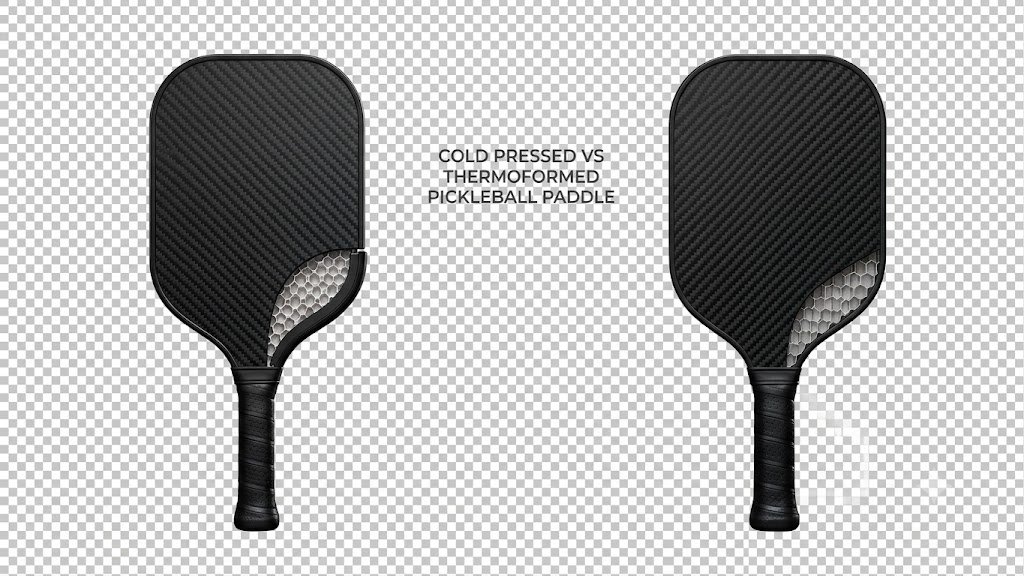
Understanding Cold-Pressed Pickleball Paddles
What is the Cold-Pressed Pickleball Paddle?
Cold-pressed paddles are built via high-pressure hydraulic lamination at room temperature. No heat. Face layers, PP honeycomb core, and handle are fused under controlled pressure and dwell time.
No thermal expansion. Each material layer retains its original properties. The result: uniform density, predictable flex, and consistent batch-to-batch quality.
Lixisports cold-pressed paddles use PU-reinforced handles to solve the most common failure point in this construction method—handle fracture.
Typical Materials for Cold-Pressed
| Component | Materials |
|---|---|
| Face | Fiberglass (entry), 3K/12K raw carbon fiber, Kevlar-carbon hybrid |
| Core | Polypropylene honeycomb (PPHC) |
| Edge Guard | TPU, ABS |
| Handle | Carbon fiber shaft with PU reinforcement |
| Grip | PU leather, perforated cushion |
Pros of Cold-Pressed Paddles
| Advantage | Details |
|---|---|
| Lower production cost | Simpler tooling, faster cycle time |
| Fast turnaround | Samples ~7 days. 2,000 pcs in ~30 days |
| Low MOQ | 200 pcs per design |
| Consistent flex | Uniform bonding—no hot spots, no dead zones |
| Low delamination risk | Zero thermal stress during lamination |
| Easy shape customization | dieline needed only, no mold needed |
| High capacity | 100,000 pcs/month at Lixisports |
Known limitations & solutions:
- Fiberglass faces: UV patterns can peel over time → use raw carbon face instead
- Handle breakage: common in cold-pressed paddles → PU handle reinforcement solves this
Exploring Thermoformed Pickleball Paddles
What is Thermoformed Pickleball Paddle?
Thermoformed paddles use heat (150–180°C) + pressure inside a closed mold. Carbon fiber face sheets and core material are placed into a mold cavity. Heat softens the polymer core perimeter. The face wraps around the edge and fuses to the core. The result: a rigid unibody structure with integrated edge protection.
This is the manufacturing standard for premium and pro-level paddles. The process is technically more complex than cold-pressing—fewer factories can execute it reliably. This creates a natural technology moat for brands.
Typical Materials for Thermoformed
| Component | Lixisports Options |
|---|---|
| Face | 3K / 12K / 18K carbon fiber, raw carbon, fiberglass, Kevlar |
| Core | PP Honeycomb / EPP / MPP / Custom |
| Edge | Face-wrap integrated (no separate guard on some models) |
| Handle | Molded unibody |
| Grip | PU leather, cushioned, perforated |
Carbon fiber weave comparison (Lixisports):
| Weave | Characteristics | Target Segment |
|---|---|---|
| 3K | Standard weave, balanced strength/cost | Entry to mid-range |
| 12K | Tighter weave, higher strength-to-weight | Mid-range to high-end |
| 18K | Dense weave, maximum stiffness/power | Pro-level |
| Raw Carbon | Uncoated, natural carbon look | Premium aesthetic |
Pros of Thermoformed Paddles
| Advantage | Details |
|---|---|
| Unibody durability | Molded construction resists impact fatigue |
| Large sweet spot | Perimeter bonding extends hitting zone to edges |
| Higher twist weight | Edge stiffness resists torque on off-center hits |
| Power transfer | Rigid frame returns energy efficiently |
| Kevlar compatibility | Thermoformed process handles Kevlar cleanly—cold press causes fraying |
| EPP/MPP core option | Prevents “core collapse” issue common in standard PP thermoformed |
| Higher brand margin | Complex process = fewer competitors = premium pricing ($80–$200+ retail) |
Production capability (Lixisports):
- MOQ: 200 pcs
- Samples: ~10 days
- Production: ~35 days for 2,000 pcs
- Monthly capacity: 80,000 pcs
- Equipment: automatic fabric cutting → vacuum thermoformed tanks → pre-shape lines → molded thermoformed production line
Comparing Paddle Types
Thermoformed vs. Cold-Pressed Paddles: Which is Better?
Neither is universally better. Each serves different market positions.
| Criteria | Cold-Pressed | Thermoformed |
|---|---|---|
| Manufacturing | Room-temp hydraulic press | Heat + pressure mold (150–180°C) |
| Cost | Lower | Higher (complex tooling, molds) |
| MOQ | 200 pcs | 200 pcs |
| Samples | ~7 days | ~10 days |
| 2,000 pcs lead time | ~30 days | ~35 days |
| Monthly capacity | 100,000 pcs | 80,000 pcs |
| Feel | Softer, longer dwell | Firm, crisp, responsive |
| Sweet spot | Consistent, moderate | Large, edge-to-edge |
| Power/Control | Control-biased | Power-biased |
| Weight | 225g ±5g | 225g ±5g |
| Thickness | 14mm / 16mm | 14mm / 16mm |
| Market position | Entry to mid-range | Mid-range to pro level |
| Brand margin | Lower (more factories compete) | Higher (technology moat) |
How Does Paddle Feel Differ: Cold-Pressed vs Thermoformed?
Cold-pressed: muted, pocketing sensation. Ball sinks into face. Longer dwell time. Better touch at net. Ideal for dinking, resets, soft-game control.
Thermoformed: firm and lively. Ball rebounds immediately. Rigid frame returns energy faster. Suits drives, counters, and aggressive baseline play.
Which Paddle Type Gives Better Spin: Cold-Pressed or Thermoformed?
Spin depends on face texture and surface technology—not the bonding method. Both cold-pressed and thermoformed paddles achieve USAP-compliant surface roughness with raw carbon peel-ply texturing.
For maximum and long-lasting spin, Lixisports offers ceramic sand infusion on both cold-pressed and thermoformed paddles. See Innovations section.
Selecting the Right Paddle
How to Choose Between Cold-Pressed and Thermoformed?
Cold-pressed fits:
- New brands entering the pickleball market
- Clubs and promotional buyers
- Entry-level to mid-range product lines
- Players who prioritize touch, dinking, control
- Custom shape requirements (simpler dieline changes)
- Budget-sensitive buyers who want fast turnaround
Thermoformed fits:
- Premium and pro-level product lines
- Brands that want less price competition (technology moat)
- Players who drive hard and counter fast
- Buyers who demand edge-to-edge sweet spot
- Kevlar face requirements
- Higher profit margin target ($80–$200+ retail)
What Skill Level Benefits Most From Thermoformed Pickleball Paddles?
| Skill Level | Recommendation | Why |
|---|---|---|
| Beginner (1.0–2.5) | Cold-pressed | Lower cost. Forgiving touch. |
| Intermediate (3.0–3.5) | Either | Cold-pressed refines touch. Thermoformed adds pop. |
| Advanced (4.0–4.5) | Thermoformed preferred | Extra power and forgiveness finishes points. |
| Pro (5.0+) | Player-preference | Many use thermoformed singles; cold-pressed doubles. |
Do Thermoformed Pickleball Paddles Cause More Arm Fatigue?
Stiffer unibody = more vibration transmitted to arm.
| Factor | Cold-Pressed | Thermoformed |
|---|---|---|
| Vibration dampening | Higher (layered structure absorbs) | Lower (rigid frame transmits) |
| Off-center shock | Moderate | Moderate-high |
| Mitigation options | — | EPP/MPP core, extended handle, foam-injected edges |
Players with arm sensitivity should select thermoformed models with EPP or MPP core. These upgraded cores provide better impact absorption than standard PP honeycomb.
Innovations in Paddle Design
Ceramic Sand Infused Tech Cold Pressed Paddles
Ceramic sand infusion embeds micron-scale carborundum particles (80 or 100 mesh) directly into face resin during cold-press lamination. The particles become part of the surface structure—not a coating.
Lixisports factory data:
| Parameter | Specification |
|---|---|
| Particle material | Carborundum (silicon carbide) |
| Mesh options | 80 mesh, 100 mesh (customizable) |
| Colors | Black (default), blue, green, yellow |
| Friction durability | 2× vs. standard textured faces |
| Spin retention (100 hits) | ~40 RPM loss vs. ~100 RPM on conventional |
| Surface roughness Ra | 8.9–11.2 μm (vs. 5.4–7.8 μm standard) |
| Applicable constructions | Cold-pressed, thermoformed, unibody |
| Compatible faces | Carbon fiber, fiberglass |
| Compatible cores | PP, EPP, MPP, custom |
| MOQ | 200 pcs |
Why it matters: Standard spray-on grit or peel-ply texture wears down. Ceramic sand stays embedded. Players get consistent spin across the paddle’s full lifespan.
Hybrid Cold-Pressed Thermoformed Paddles for Spin Control
Emerging design concept: cold-pressed center zone for dwell and touch + thermoformed perimeter for twist resistance. Currently in prototyping.
Design logic:
- Center: maximum dwell, precise touch
- Edge: twist resistance, off-center stability
Contact lixisports for hybrid development inquiries.
Enhanced Paddle Safety Features
Thermoformed Paddles Targeting Elbow-Friendly Shock Absorption
Recent thermoformed models address arm fatigue through targeted engineering:
| Feature | Method | Effect |
|---|---|---|
| EPP / MPP core | Upgraded core material vs. standard PP | Better impact absorption, prevents core collapse |
| Foam-injected edges | Low-density PU foam inside perimeter | ~28–35% vibration reduction |
| Split-core design | Two thin cores with dampening interlayer | Absorbs high-frequency shock |
| Extended handle (5.5–6″) | Two-hand grip; shifts balance | Less wrist load on singles |
| Kevlar face (thermoformed) | Inherent dampening properties + clean edges | Combines durability with shock absorption |
EPP and MPP cores are strongly recommended for premium thermoformed paddles. Standard PP honeycomb can collapse over time under repeated high-impact play—a well-known issue in the industry.
Frequently Asked Questions
Are cold-pressed pickleball paddles more durable than thermoformed?
Different durability profiles. Cold-pressed: better delamination resistance (zero thermal stress). Thermoformed: better edge impact resistance (face-wrap construction). Lixisports cold-pressed paddles add PU handle reinforcement to address the handle-fracture vulnerability.
What does thermoformed mean in pickleball paddles?
Carbon fiber face + core fused under heat (150–180°C) and pressure in a closed mold. Face wraps around edge, creating a unibody structure. This is the premium manufacturing standard. Lixisports runs a dedicated thermoformed line: automatic cutting → vacuum tanks → pre-shape → molded production.
Is thermoformed better for reducing fatigue?
Standard thermoformed with PP core: no—stiffer, more vibration. Thermoformed with EPP/MPP core + dampening features: yes. For arm-sensitive players, Lixisports recommends EPP or MPP core thermoformed paddles. For maximum comfort, cold-pressed remains the lower-vibration option.
Customization at Lixisports—both processes:
| Option | Cold-Pressed | Thermoformed |
|---|---|---|
| Mold/shape | Yes (simple) | Yes (custom mold; +15–25 days) |
| Logo | Silkscreen, heat transfer, UV, deboss/emboss | Same |
| Edge guard | Custom color & profile | Custom color & profile |
| Grip | Custom color, logo, material | Same |
| End cap | Custom logo & color | Same |
| Packaging | PE bag + bubble bag, 65×50×35cm, 50 pcs/ctn, ~12.5kg | Same |
| Retail ready | Hanger, UPC, Amazon label, color box | Same |
| Core material | PP | PP / EPP / MPP / custom |