Key Takeaways
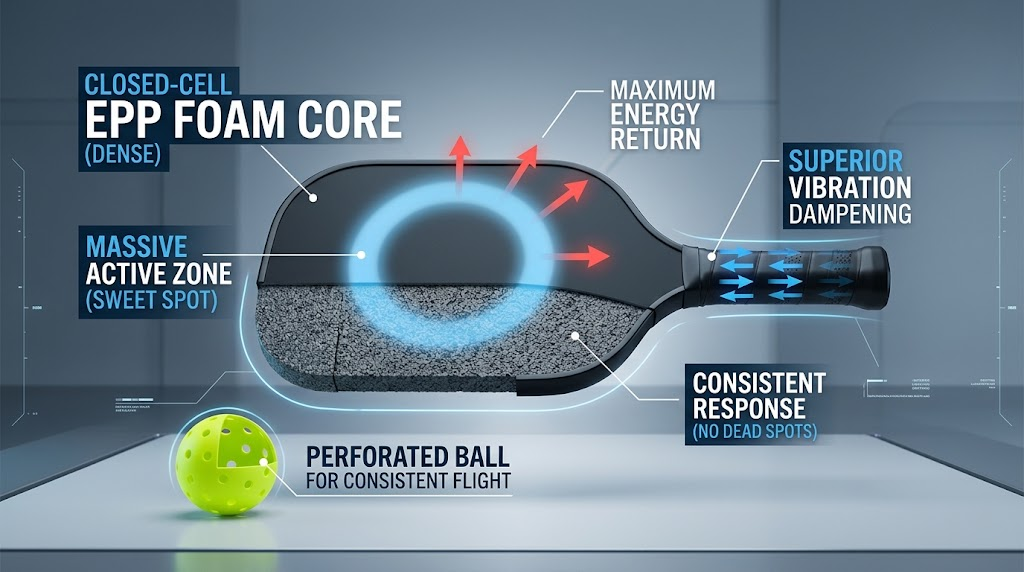
- EPP stands for expanded polypropylene. It is polypropylene plastic turned into a closed-cell bead foam.
- Closed-cell means each gas pocket is sealed. The foam does not absorb water, does not go flat, and returns to shape after impact.
- EPP is made by steam-molding pre-expanded PP beads inside a tool. Density is controlled at the molding step.
- Density (g/L) is the single most important number on an EPP spec. It controls weight, stiffness and price.
- Resilience is the core’s energy return. EPP combines high resilience with strong damping — crisp rebound, low vibration.
- EPP entered paddles to solve the PP honeycomb problem: permanent crushing and dead spots after months of hard play.
- EPP is not “better than everything.” It plays crisper and lasts longer, but it costs more than polyurethane or standard honeycomb builds.
EPP foam is suddenly everywhere in premium pickleball. Walk a retail wall and half the high-end paddles mention EPP on the back card. But the marketing copy rarely explains what the material actually is, so buyers are left comparing “EPP core” against “PP honeycomb core” without knowing what changed. This article is the material-level explanation: what EPP foam is, how it is made, what the spec numbers mean, and why it is replacing honeycomb in the paddles that players pay for.
What Does “EPP” Stand For? Expanded Polypropylene, Explained Simply
Polypropylene First
Start with PP: polypropylene. It is one of the most common thermoplastics in the world — food containers, bottle caps, automotive parts. It is light, tough, chemical-resistant and recyclable. “Poly” means many; “propylene” is the monomer. Long chains of propylene molecules form the plastic.
Then “Expanded”
Expanded polypropylene is PP that has been turned into a foam. Gas is introduced so the solid plastic becomes a mass of tiny beads with air trapped inside. The expansion does three things at once: it cuts density, it creates internal cushioning, and it turns a rigid plastic into a springy, compressible one.
So “EPP” is not a brand, not a marketing term, and not a different material from PP — it is polypropylene in foam form.
What Is Closed-Cell Foam (and Why It Matters)
Two Families of Foam
All plastic foams split into two structural families:
- Open-cell foam — the air pockets connect to each other. Squeeze it and air escapes; it absorbs water and softens over time. Think of packaging sponges or mattress foam.
- Closed-cell foam — each pocket is sealed inside its own plastic wall. Squeeze it and the trapped air compresses, then pushes back.
EPP is closed-cell. Every tiny bubble of gas is locked inside a polypropylene shell.
Why Closed-Cell Wins in a Paddle
Three consequences matter on court:
- No water absorption. Sweat, rain and humidity cannot soak into the core. The paddle does not gain weight over a season.
- No “going flat.” Open-cell foams lose their spring as the walls fatigue. Closed-cell EPP keeps its structure because the air cannot escape.
- Consistent rebound. Because every cell is sealed, compression at any point produces the same push-back. That uniformity is what players feel as a consistent sweet spot.
Closed-cell structure is the reason EPP behaves like a durable spring instead of a sponge.
How EPP Foam Is Made: Beads, Steam and Molding
Step 1: Raw PP Beads Are Pre-Expanded
The process starts with solid polypropylene beads. They are heated so gas expands inside each bead — this is the “pre-expansion” step. The beads grow into lightweight foam spheres with closed cells inside.
Step 2: Beads Fill a Mold in the Shape of the Core
The pre-expanded beads are blown into a mold shaped like the paddle core blank. How tightly the beads are packed at this stage is one of the controls for final density.
Step 3: Steam Fuses the Beads Together
High-pressure steam is injected into the mold. The beads expand a second time, press against each other, and fuse into a single solid block of foam — with no visible seams and no glue. This is called steam-chest molding.
Step 4: The Block Is Cut or Molded to Final Shape
The fused block is then cut, CNC-machined, or molded directly to the paddle core profile. It ships to the paddle assembly line where carbon skins are thermoformed around it.
Why the Process Matters for Buyers
Steam molding means EPP cores are uniform and seamless. There is no honeycomb wall pattern to crush, no open channels, no glue joints. The whole core is one continuous material — which is exactly why its impact behavior is so predictable.
What Density Means in an EPP Core (and Why the Number Matters)
The Number on the Spec: g/L
EPP density is quoted in grams per liter (g/L). Typical molded EPP ranges from about 30 g/L (very light, soft) to 90 g/L (dense, rigid). Pickleball cores usually sit in the middle band, with the exact figure set by the paddle’s target weight and feel.
What Density Controls
- Weight. Higher density = heavier core. At the same 16 mm thickness, a 60 g/L core weighs meaningfully more than a 40 g/L core.
- Stiffness and power. Denser EPP resists compression more. The face deflects less, so the paddle plays firmer and crisper.
- Durability. Very low-density foam can fatigue under hard smashes. A dense enough core keeps its shape for the paddle’s whole life.
- Price. Density is where the cost hides. A supplier quoting an unusually cheap EPP paddle is usually running a low-density core.
How to Read the Number
Ask for the actual figure, not a range. “EPP core, 60 g/L” is a spec. “High-quality EPP core” is a slogan. If a data sheet does not state density in g/L, the number is being hidden because someone does not want you to compare it.
What Resilience Means: How Much Energy the Core Gives Back
Two Properties, One Name: Rebound
Resilience is the foam’s ability to return energy after compression. Drop a ball on a highly resilient foam and it bounces high. Drop it on dead foam and it thuds.
EPP sits in an unusual spot: it is highly resilient and highly damping. Those two usually pull in opposite directions — springy foams ring, dead foams absorb. EPP returns energy quickly while absorbing the high-frequency vibration that makes paddles “tingy.”
What That Feels Like
- Crisp contact. The ball leaves the face fast because the core rebounds quickly.
- Quiet feedback. The same material absorbs the harsh frequencies, so the paddle sounds lower and feels more solid than a honeycomb paddle of the same weight.
- Controlled power. The energy return is damped, not explosive. Players describe EPP paddles as “powerful but not wild.”
Resilience is why EPP paddles feel alive without feeling harsh.
What Happens When You Hit an EPP Paddle
The Impact Sequence
- The ball contacts the carbon face.
- The face flexes inward and presses the EPP core beneath the contact point.
- The closed cells in that zone compress; air inside each cell is squeezed.
- The ball leaves the face, and the compressed cells push the face back to flat.
Because every cell is sealed and uniform, that sequence happens identically across the entire face. There is no wall orientation, no channel, no weak axis — just the same response at the center and near the edge (with an EVA perimeter adding edge stability).
What Uniformity Does for Players
A core that behaves the same everywhere means a paddle that does not have surprises. No dead zone develops where you hit hardest, because nothing crushes permanently. That consistency is the practical benefit behind all the material jargon.
Why Paddles Are Switching to EPP: The PP Honeycomb Problem
Honeycomb’s Weakness: It Crushes
PP honeycomb — the hexagonal-cell core used across the industry — is cheap, light and proven. But it has one structural weakness: the thin cell walls can permanently crush under repeated hard impacts. The paddle plays fine for months, then players notice a soft or “dead” zone forming where they hit most often.
The Secondary Problems
- Edge fragility. Honeycomb alone is weak at the rim; that is why so many paddles rely on edge guards.
- Sound. The hollow honeycomb channels amplify a higher-pitched “pop” that some players find harsh.
- Water sensitivity. Open honeycomb channels can wick moisture at a damaged edge, adding weight over time.
What EPP Changes
EPP replaces hollow channels with solid closed-cell foam. There is nothing to crush, no channels to ring, no path for water. Combined with a thermoformed EVA perimeter, the edge problem disappears too. That combination — durable core plus reinforced edge — is the engineering story behind the current premium generation of paddles.
EPP vs PP Honeycomb vs Other Foam Cores: One Table
| Attribute | EPP (expanded PP foam) | PP honeycomb | EVA / polyurethane foam cores |
|---|---|---|---|
| Structure | Closed-cell bead foam | Open hexagonal cells | Open or closed soft foam |
| Crush resistance | High — recovers after impact | Low — can develop dead spots | Low to medium |
| Rebound feel | Crisp, damped | “Pop,” more dwell | Soft, muted |
| Vibration damping | High | Moderate | Very high (can feel dead) |
| Water absorption | Near zero | Can wick at damaged edges | Depends on cell type |
| Long-term shape | Excellent | Fair | Poor to fair |
| Edge behavior (bare) | Soft — needs EVA wall | Weak — needs edge guard | Soft |
| Cost tier | Premium | Mid | Low to mid |
| Typical position | Tournament / premium lines | Value-to-mid lines | Budget / beginner lines |
None of these is “wrong.” They are different price-performance points. EPP’s job is the top of the range: durable, crisp, quiet — at a premium cost.
Who Actually Feels the Difference: Players and Use Cases
Players Who Notice EPP Most
- Power players — they feel the crisp rebound and the extra consistency on hard shots.
- Elbow- or wrist-sensitive players — EPP’s vibration damping is a genuine ergonomic benefit.
- Frequent players — anyone hitting 10+ hours a week will be the one to find a honeycomb dead spot first. EPP is the answer to a problem they have already felt.
Businesses That Should Care
- Premium brands — EPP + raw carbon is the current USD 150–250 retail tier. Missing it means missing the category.
- Clubs and training centers — paddles take daily abuse; EPP’s shape recovery lowers replacement frequency.
- Brands with a sustainability story — EPP is a single-resin, recyclable material. It supports a clean environmental claim without a separate material label.
Where EPP Does Not Pay
Budget retail, first-time players, and giveaway programs do not need EPP. A honeycomb or soft-foam build serves those price points, and paying for EPP there would only raise the price without a perceivable benefit to that buyer.
FAQ: Is Denser Better? Does EPP Play Slower? How Long Does It Last?
Is denser EPP always better?
No. Density should match the target feel. Denser EPP is firmer, heavier and more durable; lighter EPP is softer and easier to swing. “Better” depends on the paddle’s weight target and playing style. What matters is that the density is specified, not that it is maximum.
Does EPP play slower than honeycomb?
It can feel that way at first, but it is not slower — it is damped. Honeycomb “pop” makes a paddle sound and feel fast. EPP returns similar energy with less vibration, which some players read as “quieter” rather than “slower.” On a machine, the rebound difference between good EPP and good honeycomb builds is small.
How long does an EPP core last?
A well-molded EPP core outlasts the face and grip of the paddle. The realistic answer: for the usable life of the paddle, with no dead-zone formation under normal play. The paddle will wear at the surface and grip long before the core fatigues.
Is EPP legal under USAP rules?
Core material is not restricted. USAP rules govern dimensions, weight and surface characteristics — not whether the core is foam or honeycomb. EPP paddles pass the same certification path as any other build. (Certification is filed by the brand, using samples that meet USAP standards.)
Can EPP be recycled?
Yes. Because EPP is a single resin (polypropylene), it is recyclable without separating layers — one reason sustainability-focused brands prefer it.
Final Checklist: How to Read an EPP Core Spec
When a supplier hands you an EPP quote, the spec sheet should answer these lines. If a line is missing, the spec is incomplete:
- Core material: state “EPP (expanded polypropylene)”, not just “foam.”
- Density in g/L — a specific number, not a range or a slogan.
- Total core thickness: 14 or 16 mm typical.
- Perimeter construction: EVA foam-injected wall, width in mm. Bare EPP is a different product.
- Face material and grade listed separately (e.g., raw carbon T700, 3K weave).
- Weight tolerance: 225 g ±5 g standard; ±2–3 g for a Precision Program.
- Sample lead time and production lead time for your quantity.
- Foam datasheet and batch density report attached to the PO.
- Packaging and carton spec (e.g., 50 pcs / carton, carton size and weight).
A complete EPP spec is boring on purpose. Every number on it exists so that the paddle you approve is the paddle that ships.
For OEM/ODM builds on an EPP core with a thermoformed EVA perimeter — MOQ 200 pcs, samples in 7–15 days, production ~35 days for a 2,000-pc run — work with a dedicated EPP foam core pickleball paddle manufacturer