Key Takeaways
- A paddle’s core controls rebound speed, dwell, vibration, weight and long-term consistency. Everything else — spin, shape, most of the sweet spot — comes from the face and the structure.
- EPP does not cost you power. It returns energy quickly, but in a damped way — players read it as “crisp,” not “dead.”
- EPP’s real performance signature is consistency: no cell collapse means the same response in month one and month twelve.
- Vibration damping is measurable in the hand. EPP removes the high-frequency “ting” while keeping feedback.
- Sweet spot is mostly an EVA-perimeter story, not a core story. Core and perimeter are two separate specs.
- Six-way comparison: EPP and PP honeycomb differ most on durability and vibration, least on raw power.
- Test before committing: weight check, tap test, edge press, drop test, and play feel against a control paddle.
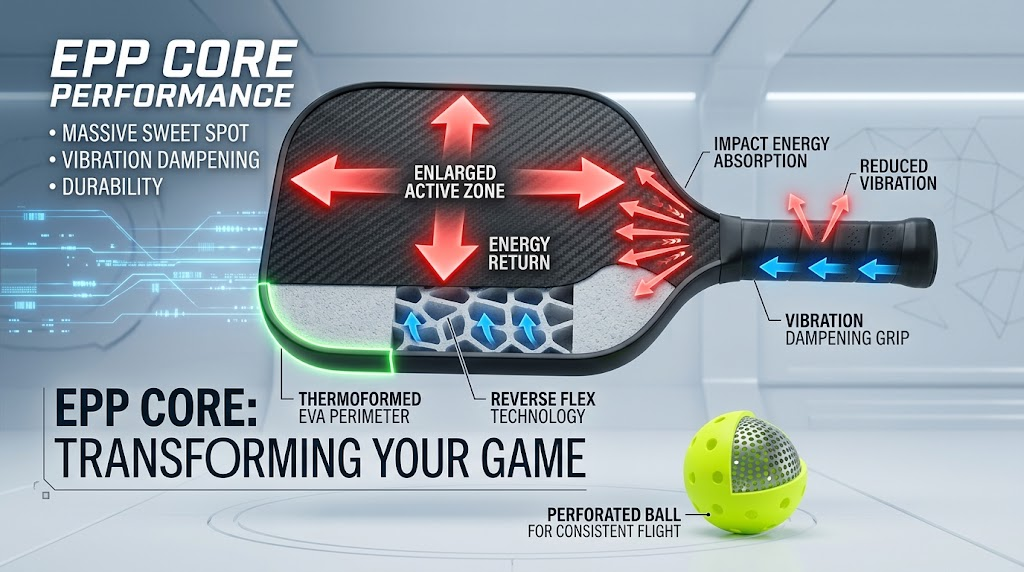
Buyers spec a paddle by the numbers on a sheet, but players buy the paddle by what happens on impact. An EPP core does not change the graphics, the spin, or the shape. It changes the physics underneath the face — and those changes show up as power, feel, vibration, weight and durability. This article maps each performance attribute to what the core actually does, so you know exactly which claims EPP can back up and which belong to a different part of the build.
What the Core Actually Controls: A One-Line Framework
Every performance attribute of a paddle is owned by one of three parts:
- The face owns spin and most of the surface feel.
- The core owns rebound, dwell, vibration, weight and long-term consistency.
- The perimeter structure owns edge stability and much of the sweet spot.
If you keep that framework in mind, half of the marketing claims you read become easy to sort. When a brand says “EPP core = more spin,” that claim is wrong on its face — spin comes from the surface, not the core. When a brand says “EPP core = quieter and more consistent,” that claim matches the material’s actual job.
So this article is strictly about the second row: what the core controls, and what EPP does to each of those five attributes.
Power: Does a Foam Core Cost You Pop?
The Wrong Assumption: Foam = Soft = Slow
The most common misconception is that any foam core plays slower than honeycomb. That assumption is true for soft open-cell foams — and false for EPP.
EPP is a closed-cell, high-resilience foam. Its rebound speed is close to a honeycomb core of the same thickness. The difference is not how fast the energy comes back; it is how the energy is delivered — in a controlled, damped wave instead of a hollow “pop.”
What Players Actually Feel
- Power potential is similar to honeycomb at equal density.
- The delivery feels crisper and drier — the ball leaves quickly, but without the metallic ring.
- Players who rely on hard drives notice the consistency more than the peak speed: the same pop on the 100th hit as the first.
The One Case Where EPP Costs Power
Very low-density EPP (below ~40 g/L) starts to feel soft under hard smashes. That is a spec problem, not a material problem. A paddle built with the correct mid-density EPP loses nothing to honeycomb on power.
Control: Softer Landings, Longer Touch
Dwell Time, Explained
Dwell time is how long the ball stays on the face during impact. Longer dwell gives players more control over placement; shorter dwell gives a snappier, less forgiving response.
EPP sits in the middle of the spectrum. Its damped rebound creates a slightly longer, more controllable contact than a springy honeycomb core — without the mushy, dead feel of a soft foam.
Why That Reads as “Control”
- Softer landing on resets and dinks.
- Easier to shape shots because the ball is on the face a fraction longer.
- Predictable response at partial swing speeds — the paddle does not suddenly “fire” when you swing at 60%.
Control players often prefer EPP over honeycomb for this reason. The trade-off: players who want maximum dwell-and-magnesium softness may prefer an even softer core. EPP is the control upgrade, not the softest option.
Vibration: Why EPP Cores Feel Quieter in the Hand
Where Vibration Comes From
On impact, the paddle face vibrates at high frequency. That vibration travels up the handle into the hand. Honeycomb cores transmit more of it because the hollow channels act like small resonators. Players describe the result as “tingy” or “harsh on off-center hits.”
What EPP Does Differently
Closed-cell EPP absorbs high-frequency vibration before it reaches the handle. The result:
- Quieter sound at contact (lower pitch, less ring).
- Less harshness on off-center hits.
- Reduced hand and wrist fatigue over long sessions.
The Nuance Buyers Should Know
Damping is not the same as deadening. A well-built EPP paddle keeps the low-frequency feedback that tells you where you hit — it only removes the harsh high-frequency “ting.” That is the difference between a paddle that feels quiet and a paddle that feels mushy. EPP is the former.
Weight: How the Core Helps You Hit Target Weight
Density Is the Weight Dial
Core density is the main lever for hitting a weight target. Because EPP density is set precisely at molding (measured in g/L), a manufacturer can dial the core to land the paddle in a narrow weight window.
Why That Matters for OEM Programs
- 8.0 oz (227 g) line: lighter core density, without cutting face quality.
- 8.5 oz (241 g) line: denser core density, without adding a weighted plug.
- Consistency: a stable core density means the finished paddle weight stays inside ±5 g — or ±2–3 g on a Precision Program.
A core you can tune is the difference between promising “around 8.0 oz” and delivering a consistent, spec-confirmed weight batch after batch. On the production side, this is where working with a dedicated EPP foam core pickleball paddle manufacturer matters: a factory that molds its own cores can set density to hit your target weight band consistently, instead of adjusting weight with plugs after the fact.
Durability: No Cell Collapse, Consistent Over a Season
The Failure Mode EPP Removes
PP honeycomb cores can crush permanently under repeated hard impacts. The visible symptom is a dead spot — a zone where the paddle suddenly plays soft. It develops slowly, then players start aiming around it.
EPP’s closed cells compress and recover. There is no thin cell wall to break and no channel to collapse. The practical result is that a paddle plays the same in month one and month twelve.
Why Consistency Is a Performance Feature
Coaches and clubs care about this more than recreational players do, because a paddle that changes feel mid-season is a paddle that changes a player’s game. For tournament programs and club fleets, EPP’s consistency is the strongest performance argument of all.
Sweet Spot: Where the EVA Perimeter Comes In
The Honest Answer: The Core Is Not the Main Driver
The sweet spot is mostly determined by the overall stiffness of the face and the perimeter structure, not by the core material alone. If you want a genuinely large sweet spot, the spec that matters is the perimeter construction.
The EPP + EVA Perimeter Combination
EPP’s bare edge is soft. In a modern thermoformed build, an EVA foam wall is injected around the perimeter (typically 5–6 mm wide). That wall:
- Stiffens the rim so off-center hits stay solid.
- Extends the effective sweet spot toward the edges.
- Absorbs edge vibration before it reaches the handle.
So the honest way to read a spec: EPP gives you durability and consistency; EVA perimeter gives you the sweet spot. If you want both, you need both lines on the spec sheet.
The Six-Way Comparison: EPP vs PP Honeycomb in One Table
| Performance axis | EPP + EVA perimeter | PP honeycomb + EVA perimeter |
|---|---|---|
| Power potential | High, damped delivery | High, springy delivery |
| Control / dwell | Slightly longer, more controllable | Shorter, snappier |
| Vibration damping | High — quiet in the hand | Moderate — more “ting” |
| Weight consistency | Excellent (density set at molding) | Good |
| Durability over a season | No cell collapse, stable feel | Can develop dead spots |
| Sweet spot | Large (from EVA perimeter) | Large (from EVA perimeter) |
The columns differ most on vibration and durability, and least on raw power. If a brand positions EPP as “just as powerful as honeycomb,” that is roughly true. If a brand positions EPP as “quieter and more consistent, all season,” that is exactly what the material does.
How to Test an EPP Core Before You Commit
Off-Court Tests (No Play Required)
- Weight check. Weigh the sample and confirm it hits the agreed target (e.g., 225 g ±5 g). A core density issue shows up here first.
- Tap test. Tap across the face with a knuckle. A uniform, dry sound indicates a uniform core. Dull or hollow zones suggest voids or inconsistent density.
- Edge press. Press the edge with a thumb. It should feel solid. Flex or creak suggests a weak perimeter — meaning the EVA wall may be missing or thin.
- Drop test. Drop the paddle from ~1.5 m onto a hard floor, edge first, several times. How the edge survives tells you about the build quality fast.
On-Court Test
Play 20 minutes with the EPP sample, then 20 minutes with your current honeycomb paddle. Ignore the specs and answer two questions:
- Which one feels harsher in the hand after 20 minutes?
- Which one changes feel more as you hit toward the edges?
Those two answers — vibration and edge consistency — are exactly the attributes EPP is supposed to win on.
FAQ: Is EPP Less Powerful? Does It Wear Out? Who Plays Best With It?
Is EPP less powerful than PP honeycomb?
No. At equal density and thickness, EPP returns similar energy. It delivers that energy in a damped, crisper wave instead of a hollow pop, which players sometimes misread as “less power.” On hard drives, most players find EPP at least as powerful — and more consistent hit after hit.
Does an EPP core wear out?
The core outlasts the face and grip. EPP’s closed cells do not crush under normal play, so the paddle does not develop the dead spots that appear in honeycomb cores over a season. Realistic answer: the surface and grip will wear long before the core changes feel.
Who plays best with an EPP paddle?
- Power players who want consistency on hard shots.
- Control players who want a slightly longer, softer landing.
- Players with elbow or wrist sensitivity (quieter, less vibration).
- Clubs and coaches who need a fleet that plays the same all season.
Does EPP make a paddle quieter?
Yes. EPP damps high-frequency vibration, so contact sounds lower-pitched and feels less “tingy” than honeycomb. It is quiet, not dead — low-frequency feedback stays.
Is a denser EPP core better for performance?
Only if the target weight and feel call for it. Higher density = firmer and heavier; lower density = softer and lighter. “Best” density is the one that hits your target weight and play feel. The spec must state the number either way.
Can an EPP core deliver a large sweet spot on its own?
No — sweet spot is driven by the perimeter structure. EPP provides durability and consistency; an EVA foam perimeter provides the sweet spot. Order both.
Final Checklist: Performance Specs to Confirm Before Ordering
- Core material and density in g/L (e.g., EPP 60 g/L) — not just “EPP.”
- Total thickness: 14 or 16 mm.
- Perimeter construction: EVA foam wall, width in mm.
- Target weight and tolerance: e.g., 225 g ±5 g (or ±2–3 g Precision Program).
- Face material and grade stated separately from the core.
- Vibration / dampening claim backed by a test method or data.
- Sample available for tap, edge-press, drop and play testing.
- Dead-spot guarantee or replacement policy for premature core failure.
- Batch weight report promised with production.
- Sample and production lead times in writing.