Key Takeaways
- “Foam core” is an umbrella term covering three modern builds: EPP cores, hybrid EPP/CNC cores, and dual-density foam builds — all wrapped in a thermoformed EVA perimeter.
- The shift started at the pro level. Once tour players moved to thermoformed foam builds, retail followed within two seasons.
- Foam won on four fronts: forgiveness (bigger sweet spot), durability (no dead spots), feel (quieter, less vibration), and cost (thermoforming made it scalable).
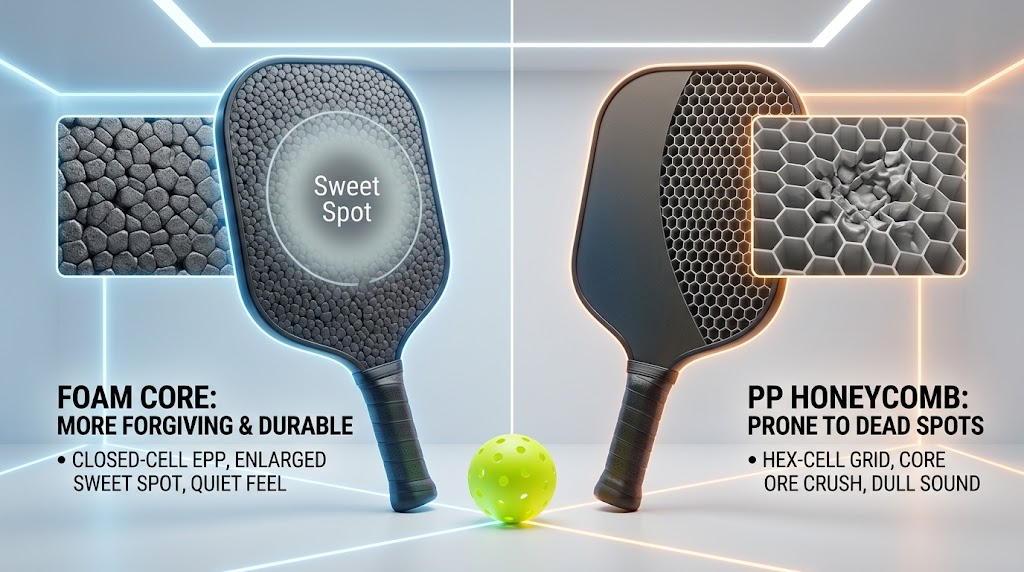
- The “dead paddle” — a honeycomb core that permanently crushes where you hit hardest — is the single strongest sales argument for foam.
- Foam went from pro-only to affordable because the manufacturing caught up: molded cores, automated thermoforming lines, and EVA edge injection at scale.
- EPP is the flagship material inside the foam trend: closed-cell, density-tunable, recyclable — and paired with an EVA perimeter it covers every premium use case.
- Foam core is not a fad. The durability data and warranty economics point the same direction: fewer dead paddles, fewer replacements.
- For brands, the choice is not foam vs honeycomb. It is which foam build fits your price tier.
Foam core paddles were a niche story five years ago. Today they dominate the top of the retail wall, and the trend keeps moving down-market. For a brand owner, that raises a practical question: is this real engineering progress, or another marketing cycle? This article follows the trend from the pro tour to the factory floor, explains the four reasons foam won, and tells you what it means when you spec your next line.
What “Foam Core” Actually Covers: Three Builds, One Name
“Foam core” sounds like one product.
For a broader explanation of foam-core construction and how it compares with traditional honeycomb designs, see this foam-core paddle guide.
It is actually three different constructions that share one idea — a continuous foam core instead of a hollow honeycomb core:
- EPP core. Expanded polypropylene foam, closed-cell, molded to shape. The flagship foam build. Pairs with a raw carbon face and an EVA perimeter in most premium paddles.
- Hybrid EPP cores with CNC machining. The EPP core is cut with channels or grooves (chevron or diamond patterns) to tune flex and energy return in specific zones.
- Dual-density foam builds. Two foam densities stacked or combined — for example a denser outer layer for power and a softer inner layer for feel — often using microcellular polypropylene (MPP).
All three usually share one structural feature: a thermoformed EVA foam perimeter that seals the edge and extends the sweet spot. That combination — foam core plus foam perimeter — is the “foam core paddle” buyers actually mean.
Where It Started: The Pro-Paddle Shift That Changed Everything
The Thermoforming Breakthrough
The turning point was not a marketing campaign. It was a manufacturing change: thermoforming. Instead of gluing separate face sheets onto a core and adding an edge guard, thermoforming wraps the whole paddle as one piece. The carbon skin bonds directly to the core, and the edge becomes a continuous structure.
Thermoforming made foam cores practical. A honeycomb core needs an edge guard because its walls are exposed and weak at the rim. A foam core, sealed inside a thermoformed shell with an EVA wall, needs no guard and no glue line.
The Tour Effect
Once tour players adopted thermoformed paddles, the performance differences — bigger sweet spot, quieter feel, consistent response — became visible in prize-money matches and then in retail. Pro-shop buyers started asking for “the paddle the pros use,” and brands had to follow. Within two retail seasons, foam moved from a specialty SKU to the center of the premium wall.
The Four Reasons Foam Won
If you compress the whole trend into one sentence: foam cores give players more forgiveness, more durability, better feel — and thermoforming made them affordable enough to sell at scale.
| Reason | What players got | What it replaced |
|---|---|---|
| Sweet spot | Bigger effective hitting area | Small-center honeycomb feel |
| Durability | No dead spots over a season | Crushed honeycomb cells |
| Vibration | Quieter, less hand fatigue | Hollow “ting” and harsh off-center hits |
| Cost | Premium performance at retail USD 100–250 | Pro-only pricing |
Each reason is worth unpacking, because each one maps to a different part of the build.
Sweet Spot: How Foam Made Paddles More Forgiving
Two Mechanisms, One Result
The sweet spot grew for two reasons. First, the EVA foam perimeter stiffens the rim, so off-center hits near the edge stay solid instead of going dead. Second, the foam core itself responds uniformly across the face — there is no honeycomb wall pattern that plays differently depending on where you hit.
The result is a paddle that is forgiving. Misses toward the edge lose less power and feel less harsh. For the recreational majority — players who do not hit the center every time — that is the single most valuable performance upgrade available.
What This Means for Retail Positioning
Forgiveness sells. A beginner or intermediate player cannot feel a density difference, but they can immediately feel a paddle that does not punish off-center hits. That is why foam cores expanded beyond the pro tier: the benefit is most obvious to the least skilled players.
Durability: The End of the “Dead” Paddle
The Problem Players Knew but Could Not Name
Honeycomb cores can crush permanently under repeated hard impacts. The cell walls collapse, and the paddle develops a soft, dead zone exactly where the player hits most. Players describe it as “the paddle went dead” — and until foam cores arrived, they assumed it was normal wear.
What Foam Changed
Closed-cell foam does not have thin walls to crush. The cells compress and recover, so the paddle keeps its response for the usable life of the face and grip. The dead-paddle complaint, which used to drive warranty claims and replacements, largely disappears on foam builds.
The Warranty Math
For brands, this is an economic argument as much as a performance one. A paddle that dies mid-season becomes a return, a refund, or a lost customer. Foam cores reduce that failure mode to near zero. Fewer dead paddles means fewer warranty claims — which is exactly why the trend is sticky, not a fad.
Vibration and Feel: Why Foam Cores Play Quieter
The Hollow Ring Problem
Honeycomb cores act like small resonators. The hollow channels amplify a higher-pitched “pop” at impact, and off-center hits send a sharp vibration up the handle. Many players never notice it — until they try a foam paddle and feel the difference.
The Foam Signature
Closed-cell foam absorbs the high-frequency vibration before it reaches the hand. Foam paddles play quieter, with a lower-pitched, drier sound. The hand feedback is solid rather than harsh, which reduces fatigue in long sessions and is noticeably kinder to elbows and wrists.
Quiet Is a Feature, Not a Side Effect
For clubs, schools and training centers — where players hit for hours — the vibration difference is a genuine ergonomic benefit worth marketing. It is one of the few paddle attributes a customer can feel in a 30-second demo without any skill.
Manufacturing Caught Up: How Foam Went From Pro-Only to Affordable
The Cost Barrier Was Process, Not Material
Foam cores were never expensive as a material. The barrier was that early thermoformed builds were slow, hand-intensive and low-volume. Early adopters paid pro-only prices because the process had not scaled.
What Changed on the Factory Floor
Modern foam-core production industrialized the process:
- Molded cores. EPP and other foam cores are steam-molded or CNC-machined in precise, repeatable batches — density controlled in g/L at the molding step.
- Automated thermoforming lines. High-volume lines wrap carbon skins around cores consistently, removing most hand-labor variance.
- EVA edge injection. The perimeter foam is injected as part of the molding cycle, so edge reinforcement is automatic rather than a separate assembly step.
- Scale. Serious thermoforming plants run 80,000+ paddles per month across multiple lines, which collapses unit cost.
That combination took foam-core paddles from a USD 200+ specialty product to a build that lands in the USD 25–40 / pc FOB range at OEM MOQs of 200 pcs — affordable enough for mid-tier brands to launch.
Where EPP Fits in the Foam-Core Trend
The Flagship Material
EPP (expanded polypropylene) is the material most people mean when they say “foam core.” It is the closed-cell, high-resilience foam that delivers the trend’s core promises: it does not crush, it dampens vibration, and its density is tunable at molding to hit a weight target.
Why EPP Leads
- Closed-cell structure — no water absorption, no fatigue.
- Density control — the manufacturer dials g/L to hit 225 g ±5 g (or ±2–3 g on a Precision Program).
- Recyclability — a single-resin material, useful for sustainability claims.
- Proven at scale — EPP + raw carbon + EVA perimeter is the dominant premium build on the US market.
EPP Is Not the Whole Trend
Dual-density builds and CNC-machined foam cores exist because different price tiers and play styles want different tuning. EPP is the flagship, but the foam-core trend is bigger than any single material. The common thread is the same: continuous foam instead of hollow honeycomb.
Is Foam Core a Fad? What Warranty Claims and Returns Say
Three Signals That Say It Is Permanent
- Warranty data. Dead-paddle claims — crushed honeycomb cores — are a real, recurring cost for brands. Foam cores remove the failure mode. Products that reduce warranty costs do not get un-invented.
- Tier migration. The trend started premium and moved down-market. A feature that keeps falling in price is a technology curve, not a marketing fad.
- Manufacturing investment. Factories built thermoforming lines around foam cores. Once capacity and tooling exist, the industry does not go backward.
The Honest Caveat
Not every “foam core” paddle is good. Low-density foam in a cheap build can feel slow and dead — which is a spec problem, not a material problem. The trend is real; the quality varies by density, perimeter construction and face grade. That is why the final checklist exists.
What This Means for Your Brand: Which Foam Build to Choose
| Your price tier | Recommended build | Why |
|---|---|---|
| Retail USD 150–250 (premium) | EPP core + raw carbon + EVA perimeter | The current flagship. Best durability, feel and weight control. |
| Retail USD 100–150 (mid) | EPP core or dual-density foam + painted carbon face | Foam benefits at a lower face cost. |
| Retail under USD 100 (value) | Honeycomb or budget foam build | Foam does not pay off below this point. |
The Positioning Rule
- Sell forgiveness and quiet to recreational players.
- Sell consistency and durability to clubs, coaches and tournament programs.
- Sell weight precision and recyclability to premium and sustainability-focused brands.
If your line only has a honeycomb option, you are missing the category your competitors are already selling into. If your line only has an EPP option, you are over-speccing your value tier. The winning line usually carries both.
FAQ: Is Foam Core Legal? Does It Play Slower? Is It Just Marketing?
Is foam core legal under USAP rules?
Yes. USAP rules govern dimensions, weight and surface characteristics — not core material. Foam-core paddles follow the same certification path as honeycomb paddles. (Certification is filed by the brand, using USAP-compliant samples.)
Does foam core play slower than honeycomb?
Quality foam cores do not play slower. EPP, in particular, returns energy as fast as honeycomb at equal density — it just delivers it in a damped, crisper wave. Slow, dead foam is a low-density spec problem, not a property of foam cores.
Is “foam core” just marketing?
No, but the label is imprecise. “Foam core” covers EPP, hybrid CNC foam, and dual-density builds — three different products. Always ask which foam, what density, and whether an EVA perimeter is included. A real spec answers all three.
Why do pros use foam core paddles?
For the same reasons amateurs do, amplified: consistency under hard play, a larger effective sweet spot, and quieter feel. Pro players hit hardest, so they are the first to notice when a core starts to fail.
Are foam core paddles more expensive?
Slightly more than equivalent honeycomb builds at the same quality tier, because of the thermoforming process and the foam material. At OEM scale (MOQ 200 pcs), premium foam builds land around USD 25–40 / pc FOB. The delta is small; the retail positioning upside is large.
How long does a foam core paddle last?
For the usable life of the paddle. The face and grip wear before a quality closed-cell foam core changes feel. No dead-zone formation under normal play.
Final Checklist: Foam-Core Specs to Confirm Before Ordering
- Which foam: EPP, hybrid CNC foam, or dual-density (MPP) — not just “foam core.”
- Core density in g/L, stated as a number.
- Perimeter construction: EVA foam wall, width in mm.
- Total thickness: 14 or 16 mm.
- Face material and grade, stated separately from the core.
- Target weight and tolerance: 225 g ±5 g, or ±2–3 g Precision Program.
- Surface: raw carbon or grit-treated (ceramic sand, mesh size, color).
- Sample available for tap, edge-press, drop and play testing.
- MOQ, sample lead time, and production lead time in writing.
- Warranty / replacement policy for premature core failure.
Foam core is the direction the market is moving, not a detour. Order the build that matches your tier — and verify the spec behind the label.
Building your next line on foam? Talk to a foam core pickleball paddle manufacturer who molds cores in-house and can send matched EPP vs honeycomb samples for your own testing — MOQ 200 pcs, samples in 7–15 days.