We manufacture light pickleball paddles for OEM, wholesale and bulk orders
Three bands run from 195 g to 218 g on a 13 mm core, with a 160 g junior size beside them. Weight tolerance is ±5 g as standard and ±2 to 3 g on a matched set. MOQ is 200 pcs per design, samples ship in 10 to 15 days, and every piece is weighed in our Shenzhen factory before it is packed.
What it is
- A 195 g to 218 g band in a 16 in head, plus a 160 g to 170 g junior size at 350 × 170 mm.
- A 13 mm PP honeycomb core at 65 to 70 g/L, under 0.20 mm carbon or 0.25 mm fiberglass.
- A 5 g standard tolerance, or 2 to 3 g when the run is sorted into matched sets.
Where it wins
- Faster hands at the kitchen line, because a lighter head turns over with less effort.
- Less arm fatigue across a four-hour session, which is what schools and clubs ask for.
- Junior and women's lines that reuse the same molds as the standard range.
Where it costs you
- Less momentum on a drive, because the head carries less mass into the ball.
- Lower twist weight on a mishit unless the rim keeps its guard.
- A second SKU to stock, because one weight band does not fit every player.
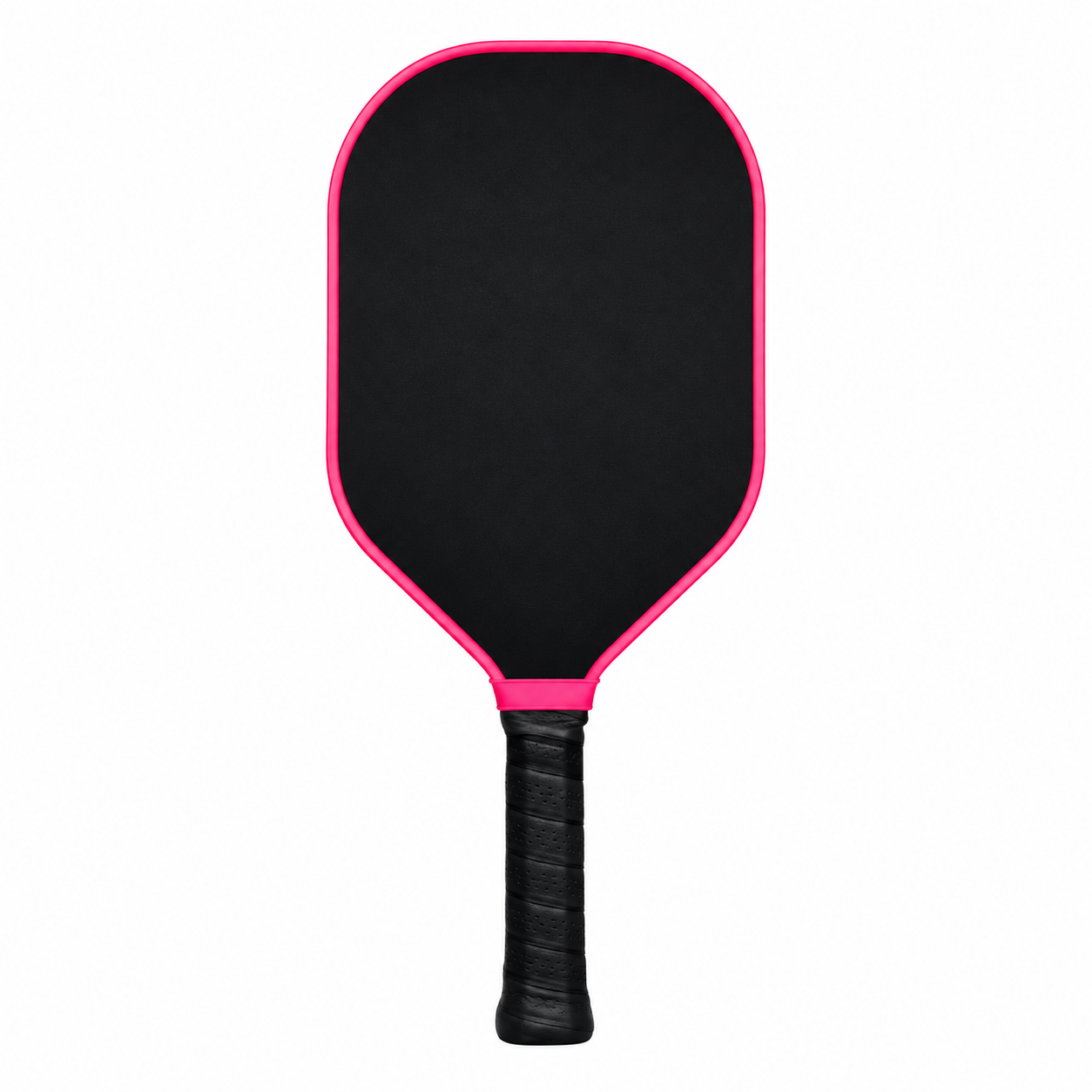
Light runs 195 g to 218 g, and 195 g is where we stop
Three bands cover the light end of the market. Each one is a weight target we hold through a production run rather than a number we picked off a sample.
A lightweight pickleball paddle is a paddle that weighs under 7.8 oz, which is 221 g. The three builds below are the ones we quote most often, and they share the molds, the cores and the faces of the rest of the line. The difference between them sits in how much material goes into each part.
Build L2 is the one most brands launch with. It weighs 206 g to 218 g on the widebody head at 16.00 × 8.00 in, because a wide face gives a newer player more room to miss. The L1 build keeps the same core at a lower density and cuts the longer 16.38 × 7.52 in head. That saves 8 g of core mass. It also gives a player who already finds the center a little more reach.
Light here means the number on a scale. A 208 g paddle can still swing heavier than a 225 g one, because swing weight depends on where the mass sits. That split is worth understanding before you sign a spec, and how static weight and swing weight split apart covers the measurement.
| Build | Static weight | Head | Core | Face | Grip | Typical buyer |
|---|---|---|---|---|---|---|
| L1 control | 195 to 205 g 6.9 to 7.2 oz | 16.38 × 7.52 in elongated | 13 mm PP honeycomb, 65 g/L | 3K carbon 0.20 mm, or glass 0.20 mm with the guard removed | 101 mm | Small-hand players, control players, juniors moving up |
| L2 all-court | 206 to 218 g 7.3 to 7.7 oz | 16.00 × 8.00 in widebody | 13 mm PP honeycomb, 70 g/L | 3K carbon 0.20 mm or 12K carbon | 105 mm | Women's lines, club retail, a first private-label SKU |
| L3 junior | 160 to 170 g 5.6 to 6.0 oz | 350 × 170 mm 13.78 × 6.69 in | 13 mm PP honeycomb, 60 g/L | Fiberglass 0.25 mm | 101 mm | Schools, youth programs, players aged 8 to 12 |
Price follows the material tier. Fiberglass with an EVA wall starts at USD 8.00 to 15.00 per paddle from 500 pcs, and 3K carbon runs USD 15.00 to 35.00 from 300 pcs. A light build stays inside the tier its face and core already sit in.
Weight sits in seven places, and the core holds a third of it
A 208 g build is planned part by part before any sheet is cut. The budget below is the one we work to for the L2 head.
| Part | Grams | Where the number comes from |
|---|---|---|
| Core, 13 mm at 70 g/L | 75 | 65.5 in³ of core volume, or 1.07 L. Density is the dial that sets this line. |
| Two faces, 0.20 mm carbon | 51 | 1,652 cm² of face area across both sheets, at a cured density of 1.55 g/cm³. |
| Handle core and PU grip | 38 | A 4.25 in handle with a 1.5 mm grip. Going to 1.8 mm adds 3 g. |
| Adhesive film | 14 | Two bond lines, face to core on each side. |
| Edge wall, 5 mm EVA | 12 | Runs the full rim and closes the core to the outside. |
| Edge guard, TPU | 11 | Molded to the outline. This part sits where stability is bought. |
| Butt cap and end weight | 7 | The balance trim. Move it forward and the paddle swings heavier. |
| Total | 208 | The plan adds up before the run. The scale decides what each piece ships at. |
A 10 g/L change in core density moves this head by about 11 g. No other part gives a buyer that much control over the final number, and no other part is as easy to repeat from batch to batch.
The core is also the part that decides how the paddle feels. A lighter core is softer under the ball, so a light build and a soft build are usually the same build.
The six changes add up to 58 g, and no shipped build uses all six
Every light build starts from the 225 g standard and takes material out of the same six places. Each one has a price that shows up on the court rather than on the invoice.
| Change from the 225 g standard | Grams off | What it costs the player |
|---|---|---|
| Core 16 mm to 13 mm | 17 | The thinner core deflects less, so the pop drops before the weight does. |
| Core density 80 to 70 g/L | 11 | A softer face, and a sweet spot that compresses sooner under daily play. |
| Face 0.25 mm to 0.20 mm | 13 | Less material above the core at the contact point, so the face wears through sooner. |
| Edge guard removed | 11 | An exposed rim. The first chip lands on the laminate instead of on the guard. |
| Handle 4.25 to 4.00 in | 3 | Less room for a second hand, and less counterweight behind the grip. |
| Grip 1.8 to 1.5 mm | 3 | A firmer feel with less cushion, which some players read as harsh. |
If you take all six, the paddle lands at 167 g. That is a junior paddle with a senior head. Our light line uses two or three of them, and the choice between them is a choice about which trade your customer will accept.
For a brand, the useful question is what the paddle has to do at 7.4 oz. A club that hands one model to forty players needs stability more than it needs grams, so the guard stays. A junior program needs grams, so the head gets smaller and the guard can go.
If you sell into schools, the L3 head is the cheapest 40 g you will ever remove. A smaller outline cuts the core volume and the face area at the same time, so one decision takes weight off two lines of the budget.
A lighter paddle twists earlier on a mishit unless you move mass back to the rim
The heavy versus light pickleball paddle question has two answers, and they point in opposite directions. One is power, the other is stability.
A paddle that weighs less carries less momentum into the ball. At the same hand speed a drive leaves the face slower, and a slow drive gives the opposing player more time. That cost is real at 200 g, and no amount of face material removes it.
The second cost is stability. When the ball lands an inch off center, the head rotates around the handle axis and the ball leaves on a line nobody chose. Mass at the 3 and 9 o'clock rim resists that rotation, and a light build has less of it to spend. The bench comparison behind that number sits in how the 3 and 9 o'clock rim decides stability, measured on two paddles of the same weight.
We compared the same widebody mold at 225 g and at 208 g on our own bench. The light build twisted earlier on the same off-center hit, and it lost more ball speed on that hit. We closed part of the gap by keeping the 5 mm EVA wall and the 11 g TPU guard. Both parts sit on the rim, which is where the rotation starts.
That is why the guard is the most expensive 11 g in the weight table. Dropping it is the fastest route to a low number, and it is the change a player feels first on a mishit. On any build under 205 g we would rather take the 13 g out of the face and keep the guard.
That is 17 g under the 225 g standard, and the gap is what a player feels as faster hands.
The widest points of the head sit furthest from the handle axis, so a gram there resists rotation more than anywhere else on the head.
It sits on the rim, which is why dropping it removes stability along with the weight.
The spec sheet carries a band, because one number is a promise nobody can hold
Every figure below describes the L2 all-court build. The weight is written as a range, and the tolerance is written next to it.
| Item | Specification | Why it is written that way |
|---|---|---|
| Build | L2 all-court light | The band most brands launch with, and the one that fits club and school orders. |
| Length | 16.00 in | Measured on the finished paddle with the guard fitted. |
| Width | 8.00 in | The widebody outline. There is no separate width rule. |
| Length plus width | 24.00 in | Exactly on the ceiling, so this head has no dimensional margin. |
| Thickness | 13 mm | 3 mm thinner than the standard core, which is where 17 g of the saving comes from. |
| Static weight | 206 to 218 g 7.3 to 7.7 oz | A band, not a target. The band is what the scale is allowed to read. |
| Weight tolerance | ±5 g standard ±2 to 3 g matched | Matched sets are sorted after curing at the cost of hand labour. |
| Balance point | 9.4 to 9.9 in from the butt | Set with the 7 g end weight. It moves the swing feel without moving the total. |
| Swing weight | Measured per design on request | We do not publish a number for a build we have not measured on the machine. |
| Core | 13 mm PP honeycomb, 70 g/L | Cell size 6 to 10 mm. Density is the QC parameter, not wall thickness. |
| Face | 3K carbon 0.20 mm or 12K carbon | Fiberglass at 0.25 mm is available and adds about 30 g to the pair. |
| Edge wall | 5 mm EVA | The wall takes the first impact when the guard is dropped. |
| Edge guard | 11 g molded TPU | Color matched to the grip. Removable on request, at a stability cost. |
| Grip | 101 / 105 / 108 mm | PU wrap at 1.5 mm. The 101 mm size covers most small-hand orders. |
| Handle | 4.25 in | 4.00 in saves 3 g and costs a two-handed grip. |
| MOQ | 200 pcs | Per design. Two colorways of one build count as one design. |
| Packing | 50 pcs per carton 650 × 500 × 350 mm | About 12.5 kg per carton with the PE bag and bubble wrap. |
At ±5 g, the lightest and the heaviest paddle in a 200-piece run can sit 10 g apart. On a 208 g paddle that is 4.8%, which is wider than the gap between the L1 and L2 bands. A buyer who signs a single number and receives that spread will hear about it from the first retail customer.
A matched set is sorted after curing to ±2 to 3 g. It costs more per unit because the sorting is done by hand. The sorting is also the only way to promise that two paddles from the same box feel the same. The four process steps that shift static weight are the ones we sort against.
USAP publishes no weight rule, so weight is your decision and not a compliance one
The dimensional test has two numbers. Weight sits outside that list, which changes how a light line should be sold.
Overall length is capped at 17.00 in. Length plus width is capped at 24.00 in. There is no separate width cap, no thickness cap and no minimum or maximum weight in the paddle specification.
All three of our heads sit between 16.00 and 16.38 in, so each one clears the cap.
The widebody head lands exactly on it. The elongated head leaves 0.10 in and the hybrid 0.02 in.
A 195 g paddle and a 260 g paddle pass or fail the same dimensional test.
A light paddle is therefore a marketing decision with a real engineering cost. A listing can say what it likes about weight, as long as the number on the box matches the number on the scale. The approval itself is filed by your brand, per model, and the certification route we hand to your brand sets out what the lab checks.
The widebody head used for L2 has no dimensional margin at all. A light build on that mold still has to hold its width through curing, because 8.04 in would put the model over the combined limit. The elongated head is the easier one to build light, and it leaves 0.10 in to work with.
A light build picks a core by density and a face by how thin you dare go
The core decides most of the weight, and the face decides how much of that weight you can take back.
PP honeycomb, 60 to 90 g/L
The cheapest way to hold stiffness at a low weight, because the stiffness comes from the cell walls rather than from solid material. At 60 g/L a 13 mm core in the L2 head weighs 64 g. The trade is a hollow structure that can crush at the sweet spot after heavy use.
EPP foam, 60 to 100 g/L
A closed-cell bead foam that holds its shape and damps vibration better than a honeycomb. A 60 g/L core in the same head weighs the same 64 g and feels softer. It costs more than PP, and the pop has to come from the face or the core geometry.
MPP, 45 to 90 g/L
A microcellular foam with cells under 100 µm, so the core is a continuous body instead of a hollow one. It holds stiffness and toughness together and it is the most expensive of the three, because the process window is about 15 °C wide.
The face is the second place to save grams, and the choice is less obvious than it looks. Fiberglass is the cheaper sheet and the heavier one, because a cured glass laminate runs at 1.9 to 2.0 g/cm³ against 1.5 to 1.6 for carbon. Two glass sheets at 0.20 mm weigh about 64 g on this head against 51 g for carbon at the same thickness.
For a light build that difference is the whole game. Choosing glass at the same thickness costs the 13 g you just saved by thinning the carbon, and it puts the paddle back into the midweight band.
| Face option | Thickness | Weight per pair | Note for a light build |
|---|---|---|---|
| Fiberglass | 0.25 mm | 80 g | The cheapest face we run, and the heaviest. On the L2 head it lands at about 237 g, so it belongs on the junior head. |
| Fiberglass | 0.20 mm | 64 g | The same weight as 3K carbon at 0.25 mm, at a lower material cost. On the L2 head it lands at about 221 g. |
| 3K carbon | 0.25 mm | 64 g | A visible weave and a stiffer face. About 221 g on the L2 head, which sits outside the light band. |
| 3K carbon | 0.20 mm | 51 g | The default for L2. It leaves room for the guard and the 5 mm wall. |
| 12K carbon | 0.20 mm | 51 g | Same weight as 3K at the same thickness, with a wider tow and a softer feel. |
| Ceramic sand infused | 0.25 mm plus grit | 66 g | Adds 2 to 3 g of grit over a plain face. About 223 g on the L2 head, so it needs the guard off. |
A thin face carries a cost. At 0.20 mm there is less material above the core, and the face takes the impact with less support underneath. We keep 0.20 mm for carbon and 0.25 mm for glass, because a thin glass sheet loses stiffness before it loses weight.
Thermoforming removes the edge guard, and that is the 11 g we do not always take
The two build routes reach a light target in different ways, and only one of them gives up the guard.
The thermoform line bonds the face and the core in one heated cycle under pressure and injects the EVA wall into the open edge. The finished rim is the wall itself, so no separate guard goes on and the 11 g comes off without touching the core or the face.
The cold press route cures at room temperature and fits a molded TPU guard on the rim. It costs less to tool, and the guard takes the first chip that a court, a bag or a dropped paddle would otherwise put into the laminate.
We do not recommend dropping the guard below 205 g unless the wall is 5 mm or thicker. On those builds the wall alone has to carry the impact, and a 4 mm wall on a 13 mm core is thin enough to dent at the corner.
For a brand, the route also sets the sample schedule. A thermoformed build needs its own mold either way, and the choice is quoted as one tooling line rather than as a change to the part number.
A light paddle is cut in the same three heads, and head area sets the core mass
All three footprints run on the same 13 mm core and the same face stack. The only weight difference is the volume of core inside the outline.
| Head | Length × width | Face area | Core at 70 g/L | What it does for a light build |
|---|---|---|---|---|
| The 16.38 × 7.52 in elongated cut | 16.38 × 7.52 in | 123.2 in² | 72 g | The lightest of the three at the same density, and the one that leaves 0.10 in of USAP margin. |
| The 16.00 × 8.00 in widebody cut | 16.00 × 8.00 in | 128.0 in² | 75 g | The most forgiving face, at 3 g more core and zero margin on the 24.00 in rule. |
| The 16.30 × 7.68 in hybrid cut | 16.30 × 7.68 in | 125.2 in² | 74 g | Between the two on reach and on weight, with 0.02 in of margin. |
The three footprints span 4.8 in² of face area and 3 g of core at 70 g/L. That is less than one density step, which is why we turn density first and reach for the outline second. The page that puts all three outlines in one frame draws them at a single scale.
Head shape still matters to the player, because it changes where the sweet spot sits and how the paddle feels at the end of the swing. It just does not change the weight as much as buyers expect, and a brand should not pick a footprint to hit a number.
Which buyers order a light build, and which should stay at 225 g
A light build fits a brief with a smaller player or a longer session. A 225 g build fits a brief built on power or fleet durability. The line-up decides this before the sample stage, because switching bands after tooling costs a second run.
| Your buying situation | What the light build gives you | Our advice |
|---|---|---|
| A junior or school program for players aged 8 to 12 | 160 to 170 g on a 350 × 170 mm head, so the paddle fits a smaller swing | Order L3. |
| A women's line, a small-grip SKU, or a control-first retail range | 195 to 205 g with a 101 mm grip and a longer head | Order L1. |
| A club fleet that hands one model to every member | 206 to 218 g with the guard kept, on the widest face we cut | Order L2. |
| A first private-label SKU with no data from the market | 210 to 215 g sits in the middle of L2, so most players can use it | Order L2 at 212 g nominal. |
| A power line for 4.5 and above | Less plow-through on a drive, because the head carries less mass | No. Take 225 to 235 g. |
| A flagship with a ceramic face and a premium price | The grit and the light band pull the spec in two directions | No. Keep the two SKUs apart. |
| One SKU meant to cover every player | One band cannot serve a junior and a power player | No. Stock two bands. |
Alternatives we quote the most: a 225 g standard build on the same head for buyers who want one model. For a first order that has to cover tooling, there is the start-up brand route from 200 pieces.
Where our light line stops
- We do not build a 16 in head below 195 g. Under that number the core is too soft to hold its shape, and the middle of the face deadens after a few months of play.
- We do not promise a swing weight from a static number. Two builds at 208 g can sit far apart on swing weight once the balance point moves.
- We cannot copy a competitor's weight from a listing. The published number is rounded, and the tolerance behind it is not public.
- A light paddle does not add power. It moves the trade toward hand speed, and a listing that claims both is overselling the part.
- We do not certify. USAP and UPA-A approval is filed by your brand for each model, and a lighter paddle does not change that route.
If your target is a 7.0 oz paddle with the stability of an 8.0 oz one, the honest answer is that the two numbers fight each other. We can get close with rim mass, a thicker wall and a wide head. We cannot make the trade disappear.
How we hold a 5 g band across a 2,000-piece run
The thermoform line runs 80,000 paddles a month and the cold press line runs 100,000. A light build is harder to keep on target than a standard one, because every part is thinner and the tolerance takes a larger share of the total.
Core density checked against the batch sheet
Cores are weighed before the run starts. A 10 g/L drift is 11 g on the finished paddle, so this is the check that protects the band.
Every ply stack weighed to 0.1 g
Two face sheets and two adhesive films are weighed together, because a heavy film shows up in the total the same way a heavy face does.
Cure log with temperature and time
Each press cycle is recorded. A half-cured bond line weighs the same and fails earlier, so the log is what makes the weight repeatable.
Each piece weighed on its own scale
The reading goes into the batch file next to the serial range. A piece outside the band stays in the reject bin.
Matched sets sorted to 2 to 3 g
Sets are built from weighed pieces rather than from a random carton, which is what the extra cost per unit buys.
X-ray and compression on the bulk sample
The sample comes off the production run, not off the sample table, so the structure report describes what you receive.
Before a bulk release we run the twelve checks a sample has to clear, and every carton is covered by the pre-shipment check on the finished carton. Samples take 10 to 15 days, and the lead time breakdown by quantity covers runs above 2,000 pcs.
Light paddle questions buyers ask before tooling
What counts as a light pickleball paddle?
Under 7.8 oz, which is 221 g. Retail listings usually split the market at 7.8 oz, and anything below that number is sold as lightweight. Our own light line runs 195 g to 218 g, and the 225 g standard sits just above it.
What is the lightest paddle you build?
160 g to 170 g in the junior size, on a 350 × 170 mm head. In a full 16 in head the floor is 195 g. Below that the core has to be soft enough that the sweet spot compresses under normal play, and we would rather quote the limit than sell past it.
Does a light paddle lose power?
Yes, at the same hand speed. A 208 g head carries less momentum into the ball than a 225 g head, so a drive leaves the face slower. Players recover part of it with a faster swing, and that is the trade the light band is built on.
Is there a minimum weight for USAP?
No. The paddle specification caps overall length at 17.00 in and length plus width at 24.00 in, and it sets no weight limit in either direction. A light paddle and a heavy paddle go through the same dimensional test.
What weight tolerance do you hold?
±5 g as standard, and ±2 to 3 g on a matched set. The matched set costs more per unit because the pieces are sorted by hand after curing, and it is the only way to promise that two paddles from the same box feel alike.
Why do two paddles from the same order weigh differently?
Three inputs move the total: core density, the adhesive film and the grip. A 10 g/L change in density is about 11 g on the finished paddle, which is more than the whole standard tolerance. That is why we check density on the incoming cores rather than on the finished piece.
Can you match a competitor's paddle weight exactly?
We can match a band, and we cannot match a rounded listing number. Send the model, the published weight and the grip size, and we will build to the same band on our own head. The swing weight will still differ, because the mass distribution inside their paddle is not public.
What is the MOQ on a light build?
200 pcs per design. Two colorways of one build count as one design. Fiberglass builds priced from USD 8.00 need 500 pcs, and 3K carbon builds priced from USD 15.00 need 300 pcs.
Do light paddles wear out faster?
A 13 mm core at 70 g/L compresses sooner than a 16 mm core at 80 g/L, so the face softens earlier under daily play. The difference shows up first in the middle of the face, and it is the reason a light build is a poor choice for a club fleet that plays every day.
Which grip size ships with a light paddle?
101 mm, 105 mm or 108 mm. The 101 mm grip covers most small-hand and junior orders, and the 105 mm is the usual choice for the L2 all-court build. A smaller grip also removes a few grams, because there is less wrap on the handle.
Send the weight band. Get a sample plan and a quote.
Once we have the band, the head and the face, we confirm what the core has to weigh before anything is cut. A photo or a competitor model is enough to start, and we will write the drawing back to you in grams.
Email goes to lixifirm@outlook.com, and we answer within 24 hours.