What is a Cold Pressed Pickleball Paddle?
Definition and Overview
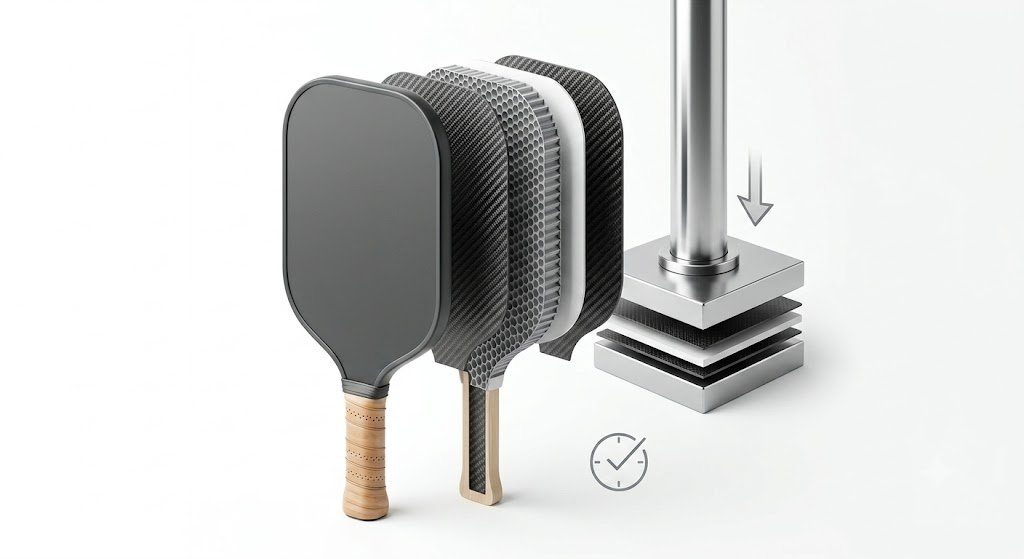
A cold-pressed pickleball paddle is manufactured by bonding face materials, core, and handle together under high hydraulic pressure at room temperature. No heat. No thermal curing.
The face layers—typically fiberglass or carbon fiber—are laminated directly onto a polypropylene honeycomb core. A hydraulic press applies uniform pressure across the entire surface. The adhesive cures at ambient temperature. The result is a paddle with consistent density, predictable flex, and tight dimensional tolerance.
We produce cold-pressed paddles with a PU-reinforced handle system. This directly addresses the most common failure mode in cold-pressed construction: handle fracture at the neck.
History and Evolution
Cold pressing entered pickleball manufacturing as the cost-effective alternative to thermoforming. Early cold-pressed paddles used basic fiberglass faces and simple PP cores. Handle durability was the main problem—the bonded joint between handle and paddle face would crack under repeated impact.
Three key developments changed this:
| Era | Development |
|---|---|
| Early stage | Basic fiberglass + PP core. Handle breakage common. |
| PU handle | PU-reinforced handle joint resolved fracture issue. |
| Raw carbon face | Eliminated UV pattern peeling. Enabled premium positioning. |
| Ceramic sand infusion | Embedded texture technology. 2× surface friction lifespan. |
Cold pressing now accounts for the majority of entry-to-mid-range paddle production globally. Lixisports alone ships 100,000 cold-pressed paddles per month.
How Cold Pressed Pickleball Paddles are Made
Material Preparation and Selection
The process starts with material cutting and preparation.
Face materials:
- Fiberglass sheets: cut to paddle shape + margin. Cost-effective. Suitable for entry-level paddles.
- Carbon fiber sheets: 3K or 12K weave. Cut to shape. Raw carbon (uncoated) available for premium aesthetic.
- Surface treatment: for ceramic sand infusion, carborundum particles (80 or 100 mesh) are mixed into the face resin before lamination.
Core material:
- Polypropylene honeycomb (PPHC): pre-cut to paddle dimensions. Standard choice for cold-pressed.
- Density selected based on target weight and stiffness.
Handle:
- Carbon fiber shaft with PU reinforcement. The PU layer distributes impact stress across the neck joint.
Cutting at Lixisports:
Automatic fabric cutting machines ensure precision and minimize carbon fiber waste.
Layer Stacking and Pressing Process
This is the core of cold-pressed manufacturing.
Step 1: Layer arrangement
Bottom to top stacking order:
- Bottom face sheet (fiberglass or carbon fiber)
- Adhesive film
- PP honeycomb core
- Adhesive film
- Top face sheet (fiberglass or carbon fiber)
- Handle assembly inserted and aligned
Step 2: Hydraulic pressing
The assembled stack enters a hydraulic press. Key parameters:
| Parameter | Specification |
|---|---|
| Pressure | Uniform, controlled via hydraulic system |
| Temperature | Ambient (room temperature) |
| Dwell time | Optimized per material combination |
| Cycle time | Short; no heating/cooling required |
Pressure bonds all layers simultaneously. The adhesive flows into the honeycomb cell walls, creating full-surface contact. No thermal expansion means no warping. No post-press curing required.
Step 3: Edge trimming
After pressing, excess material around the paddle perimeter is trimmed. The edge guard (TPU or ABS) is applied.
Why cold pressing produces fewer defects:
- Only two process variables: pressure and time
- No heat-related variables: temperature gradient, cooling rate, thermal expansion mismatch
- This simplicity translates to higher yield rates and consistent batch quality
Finishing and Quality Control
After pressing and edge trimming:
| Stage | Process |
|---|---|
| Surface finishing | Peel-ply removal (raw carbon), or UV/silkscreen logo application |
| Edge guard installation | TPU/ABS guard bonded to perimeter |
| Grip wrapping | PU leather or perforated cushion grip applied to handle |
| End cap assembly | Custom logo end cap + optional custom logo silicone band |
| Weight check | Target: 225g ±5g. Paddles outside tolerance rejected. |
| Visual inspection | Surface defects, edge alignment, logo placement |
| Balance check | Swing weight and balance point verified per spec |
| Packaging | PE bag + bubble bag → carton (65×50×35cm, 50 pcs) |
Fiberglass caution: UV-printed patterns on fiberglass faces are more prone to peeling than on raw carbon faces. For brands planning UV-printed designs, raw carbon substrate is recommended.
Materials Used in Cold Pressed Paddles
Commonly Used Materials
| Component | Material Options | Notes |
|---|---|---|
| Face | Fiberglass | Entry-level. UV prints may peel. |
| Face | 3K carbon fiber | Standard premium. Balanced cost/performance. |
| Face | 12K carbon fiber | Tighter weave. Higher stiffness. |
| Face | Raw carbon | Uncoated, natural carbon aesthetic. |
| Face | Kevlar hybrid | Durability-focused. Cold press may cause edge fraying. |
| Core | PP honeycomb | Standard. Proven reliability. |
| Core | EPP | Optional upgrade. Better impact resistance. |
| Core | MPP | Optional upgrade. Enhanced structural longevity. |
| Handle | Carbon fiber + PU | PU reinforcement prevents neck fracture. |
| Edge guard | TPU / ABS | Custom color and profile. |
| Grip | PU leather / cushioned / perforated | Custom color and logo. |
| Surface tech | Ceramic sand (80/100 mesh) | Embedded carborundum particles. 2× friction durability. |
Eco-friendly Material Options
Cold pressing itself has environmental advantages over thermoforming:
- No energy consumed for heating (ambient temperature process)
- No thermal curing emissions
- Shorter cycle time = lower energy per paddle
Material-level eco options under development:
- Recycled PP core content (subject to impact resistance testing)
- Water-based adhesives
- Reduced-waste cutting patterns via automatic fabric cutting
Currently, no widely adopted eco-certification standard exists specifically for pickleball paddles. Lixisports manufacturing facilities hold ISO and BSCI certifications.
Pros of Cold Pressed Pickleball Paddles
Performance Benefits
| Benefit | Explanation |
|---|---|
| Softer feel | Layers bonded without heat retain material softness. More dwell time. Better touch at net. |
| Consistent flex | Uniform pressure bonding. No hot spots. Ball response is predictable across the face. |
| Minimal break-in | Paddle plays consistently from first use. No stiffness period to work through. |
| Control-oriented | Energy absorption favors placement over raw speed. Ideal for dinking and resets. |
| Customizable balance | Simple paddle dieline modifications allow weight distribution tuning. |
Who benefits most from cold-pressed performance:
- Touch players who prioritize dinking, drops, and resets
- Doubles specialists who need control over power
- Players transitioning from table tennis (accustomed to dwell-oriented feel)
Longevity and Durability
| Durability Factor | Cold-Pressed Performance |
|---|---|
| Delamination resistance | High. No thermal stress = lower delamination risk. |
| Handle durability | Resolved. PU reinforcement eliminates neck fracture. |
| Face wear (fiberglass) | UV prints may peel. Raw carbon face: no peeling concern. |
| Face wear (ceramic sand) | 2× friction lifespan vs. standard textured faces. |
| Edge guard retention | Standard TPU/ABS bonding. No inherent weakness. |
| Core integrity | PP core maintains structure through normal use. |
Lab-verified durability data (ceramic sand surface):
After 100 repeated impact cycles:
- Conventional textured surface: ~100 RPM spin loss
- Ceramic sand infused surface: ~40 RPM spin loss
- Result: ceramic sand maintains >60% more spin consistency over use
Comparing Cold Press and Thermoformed Paddles
Differences in Manufacturing Processes
| Stage | Cold Press | Thermoformed |
|---|---|---|
| Temperature | Ambient (room temp) | 150–180°C |
| Equipment | Hydraulic press | Heated mold + vacuum tanks |
| Bonding method | Adhesive film cured at ambient | Heat-fused unibody |
| Edge construction | Separate edge guard (TPU/ABS) | Face wraps around edge (integrated) |
| Mold requirement | paddle dieline needed, low cost | Custom mold per shape (+15–25 days) |
| Cycle time | Fast (no heating/cooling) | Slower (heat + cooling required) |
| Defect sources | Pressure uniformity, adhesive distribution | Temperature gradient, cooling rate, material shrinkage |
| Kevlar compatibility | Edges may fray | Clean edge finish |
Performance and Cost Comparison
| Criteria | Cold Press | Thermoformed |
|---|---|---|
| Production cost | Lower | Higher |
| MOQ | 200 pcs | 200 pcs |
| Samples | ~7 days | ~10 days |
| 2,000 pcs | ~30 days | ~35 days |
| Monthly capacity | 100,000 pcs | 80,000 pcs |
| Feel | Softer, dwell-focused | Firm, crisp, responsive |
| Sweet spot | Consistent, moderate | Large, near edge |
| Power/Control | Control-biased | Power-biased |
| Weight | 225g ±5g | 225g ±5g |
| Thickness | 14mm / 16mm | 14mm / 16mm |
| Retail price range | $40–$100 | $80–$200+ |
| Market position | Entry to mid-range | Premium to pro |
| Brand margin | Lower (commodity pricing) | Higher (technology moat) |
| Arm comfort | Better (more vibration absorption) | Can cause more arm fatigue |
| Core collapse risk | high with PP | Higher with standard PP (solved by EPP/MPP) |
Manufacturer recommendation (Lixisports): Cold-pressed for brands entering the market—low MOQ, fast turnaround, proven quality. Thermoformed for brands targeting premium positioning—higher margin, less price competition.
How to Choose the Right Pickleball Paddle
Analyze Your Playing Style
| Player Profile | Recommended Construction | Why |
|---|---|---|
| Control / touch player | Cold-pressed | Softer feel, longer dwell, better net control |
| Power / drive player | Thermoformed | Rigid frame, faster energy return |
| All-court balanced | Either; test both | Preference determines final choice |
| Beginner (1.0–2.5) | Cold-pressed | Lower cost. Forgiving touch. Easy entry. |
| Intermediate (3.0–3.5) | Either | Cold-pressed refines touch. Thermoformed adds pop. |
| Advanced (4.0–4.5) | Thermoformed preferred | Extra power and forgiveness. |
| Doubles specialist | Cold-pressed tends to favor | Soft game emphasis. |
| Singles player | Thermoformed tends to favor | Power drives from baseline. |
| Arm-sensitive | Cold-pressed | Less vibration transmission. |
| Budget-conscious | Cold-pressed | Lower cost. Same core quality. |
Consider Material Benefits
| Priority | Material Choice |
|---|---|
| Lowest cost | Fiberglass face + PP core |
| Best control | Raw carbon face + PP core (cold-pressed) |
| Best power | 18K carbon face + EPP core (thermoformed) |
| Best spin | Carbon face + ceramic sand infusion (either process) |
| Best durability | Kevlar face (thermoformed for clean edges) |
| Arm comfort | Cold-pressed + PU handle |
| Premium aesthetic | Raw carbon face (uncoated natural finish) |
| Brand margin | Thermoformed (technology moat = less competition) |
Eco-Friendly Innovations in Pickleball Paddle Manufacturing
Sustainable Materials and Production Methods
The pickleball paddle industry is in early stages of sustainability adoption. Current and emerging approaches:
Production-level advantages (cold press):
- Room-temperature manufacturing. Zero heating energy consumption.
- No thermal curing emissions.
- Shorter cycle time = lower electricity per paddle.
- Lower equipment footprint vs. thermoforming lines.
Material innovations under development:
- Recycled PP content in honeycomb cores
- Bio-based epoxy adhesives (replacing petroleum-based)
- Water-based inks for logo and graphics
- Reduced material waste via automatic precision cutting
Challenge: Performance cannot be compromised. Any eco-material must match or exceed current standards for impact resistance, weight tolerance (±5g), and surface durability.
Certifications and Environmental Impact
| Certification | Scope | Status at Lixisports |
|---|---|---|
| ISO 9001 | Quality management | Available upon request |
| BSCI | Social compliance / ethical manufacturing | Available upon request |
| REACH (EU) | Chemical substance regulation | Material compliance evaluated per order |
| Prop 65 (California) | Toxics enforcement | Material compliance evaluated per order |
Full lifecycle environmental data (carbon footprint per paddle, manufacturing waste metrics, end-of-life recyclability) is not yet standardized across the industry. Brands seeking eco-positioning should request material-specific compliance documentation from their manufacturer.
Durability Testing: Ensuring Longevity of Cold Pressed Paddles
Methods of Durability Testing
Lixisports conducts the following standard durability protocols:
| Test | Method | Pass Criteria |
|---|---|---|
| Impact fatigue | 5,000+ ball impacts at center and edge | No delamination, no face cracks |
| Handle stress | Repeated flex cycles at neck joint | PU-reinforced: no fracture |
| Surface abrasion | Accelerated wear simulation | Texture loss within spec |
| Spin retention | 100-hit repeated impact + RPM measurement | Ceramic sand: ≤40 RPM loss |
| Edge guard adhesion | Peel test at guard-paddle interface | No separation |
| Environmental cycling | Temperature/humidity exposure | No warping, no delamination |
| Drop test | Multiple drops from 1.5m onto hard surface | No structural failure |
Ceramic sand specific:
Comparative spin durability test results:
| Surface Type | Initial RPM | After 100 Hits | RPM Loss |
|---|---|---|---|
| Standard textured | ~2,000 | ~1,900 | ~100 |
| Ceramic sand infused | ~2,100 | ~2,060 | ~40 |
Ceramic sand infused surfaces retain approximately 60% more spin consistency after extended use.
Importance of Longevity in Paddle Performance
For B2B buyers, paddle longevity directly affects:
- Warranty claims and return rates
- Brand reputation
- Customer lifetime value
- Repeat purchase cycles
Cold-pressed paddles with PU handle reinforcement and optional ceramic sand surface offer a compelling durability package at a competitive price point.
Frequently Asked Questions
What is the difference between hot pressed and cold pressed pickleball paddles?
Hot pressing (thermoforming) uses heat (150–180°C) and pressure in a closed mold to fuse face and core into a unibody structure. Cold pressing uses room-temperature hydraulic pressure with adhesive bonding. Hot-pressed paddles are stiffer, more powerful, and more expensive. Cold-pressed paddles are softer, more control-oriented, and more cost-effective.
Are cold pressed pickleball paddles better than thermoformed ones?
Neither is universally better. Cold-pressed suits control-oriented players, beginners, and budget-conscious buyers. Thermoformed suits power players, advanced competitors, and premium-positioned brands. The “better” choice depends on playing style, skill level, and price target.
What is the latest technology in pickleball paddles?
Three key innovations at Lixisports:
- Ceramic sand infusion — carborundum particles (80/100 mesh) embedded in face resin. 2× surface friction lifespan. Available on both cold-pressed and thermoformed paddles.
- EPP/MPP cores — upgraded core materials that prevent “core collapse” in thermoformed paddles.
- PU-reinforced handles — eliminates handle fracture in cold-pressed paddles.
Do cold pressed paddles last longer than other types?
Cold-pressed paddles have lower delamination risk because manufacturing generates zero thermal stress. Thermoformed paddles have better edge impact resistance due to wrapped-face construction. Overall longevity is comparable when each construction’s known weak points are addressed: PU handle for cold-pressed, EPP/MPP core for thermoformed.
What materials provide the best performance in pickleball paddles?
| Goal | Material | Construction |
|---|---|---|
| Best control | Raw carbon face | Cold-pressed |
| Best power | 18K carbon face + EPP core | Thermoformed |
| Best spin longevity | Carbon face + ceramic sand | Either process |
| Best arm comfort | Fiberglass or carbon + PU handle | Cold-pressed |
| Best durability | Kevlar face | Thermoformed (clean edges) |
| Best value | Fiberglass + PP core | Cold-pressed |
Lixisports cold-pressed paddle specs at a glance:
| Parameter | Specification |
|---|---|
| Construction | Cold-pressed (ambient temp hydraulic) |
| Face materials | Fiberglass, 3K/12K carbon, raw carbon, Kevlar |
| Core | PP honeycomb (standard), EPP, MPP |
| Weight | 225g ±5g |
| Thickness | 14mm / 16mm (customizable) |
| Handle | PU-reinforced carbon fiber |
| Surface technology | Ceramic sand infusion (80/100 mesh, 4 colors) |
| MOQ | 200 pcs |
| Samples | ~7 days |
| Production (2,000 pcs) | ~30 days |
| Monthly capacity | 100,000 pcs |
| Customization | Shape, logo, edge guard, grip, end cap, silicone band |
| Packaging | PE bag + bubble bag, 65×50×35cm carton, 50 pcs/ctn, ~12.5kg |