A custom grit paddle starts as a sample order. The terms you settle on that sample carry into every bulk order after it. Three numbers set those terms: the minimum order, the sample fee and the sample lead time.
A sample run uses the same face material and the same core as the bulk run. The press cycle matches as well. The difference sits in the setup. The mold plate, the artwork and the material lot all have to exist before the first sample does.
For a brand, the useful question is what each level of change adds to that setup. Each level adds its own piece, and each piece adds its own days and its own minimum.
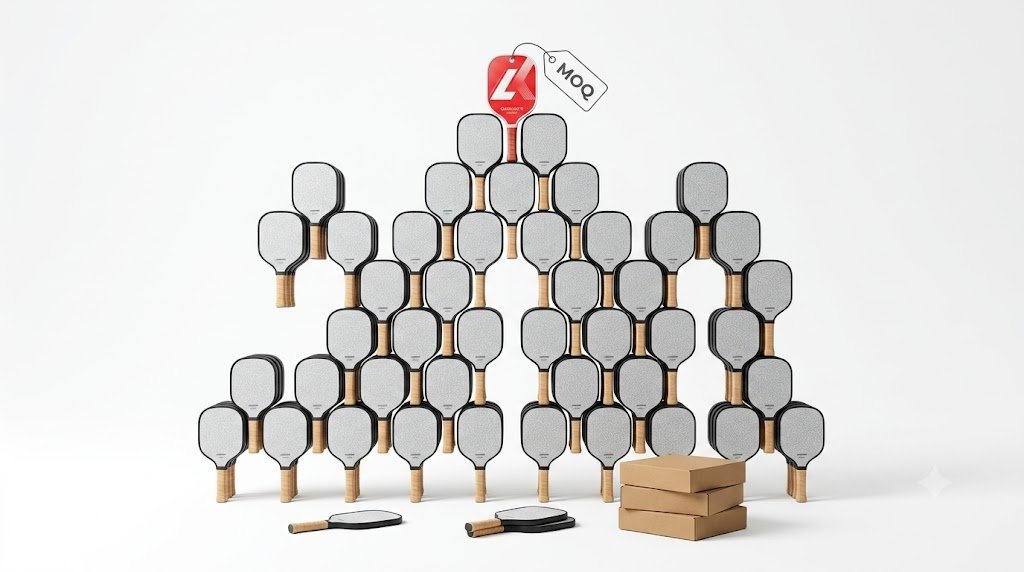
Two numbers set the terms before the first paddle exists
The minimum order decides which price band a build can land in. The sample lead time decides when your launch date can sit. Both numbers come from the same source, which is how much has to be built before production starts.
Two factories can quote different minimums for a paddle that looks the same on paper. The lower number says little on its own. It usually means the two builds sit at different custom depths. The baseline rules sit in what a paddle MOQ covers.
Custom depth comes in four levels
Every request a brand sends lands at one of four depths. Each depth needs a different piece to exist before pressing starts.
| Level | What changes | What has to exist first | Effect on the sample clock |
| 1 | Logo and color on a stock build | An artwork file | None |
| 2 | Graphics, edge-guard color, carton print | Artwork plus print-ready files | 1 to 2 days |
| 3 | Grit grade or texture depth | A new mold plate | 3 to 5 days |
| 4 | Shape, thickness or core | A new paddle mold and a new spec sheet | A full sample cycle |
Level 1 and Level 2 leave the mold alone, so they ride on stock tooling. Level 3 and Level 4 need tooling before the first paddle exists. That tooling is where the extra days and the higher minimum come from.
A texture change reaches further than the surface. The grit, the resin and the ply stack all read the new texture differently. The knock-on effects are listed in the cost of changing a grit face.
The mold plate is the piece that moves the minimum
A molded grit texture is cut into the surface of a metal plate. A new texture therefore needs a new plate before anything can be pressed. The grit face we mold before bulk production shows how that plate feeds the press line.
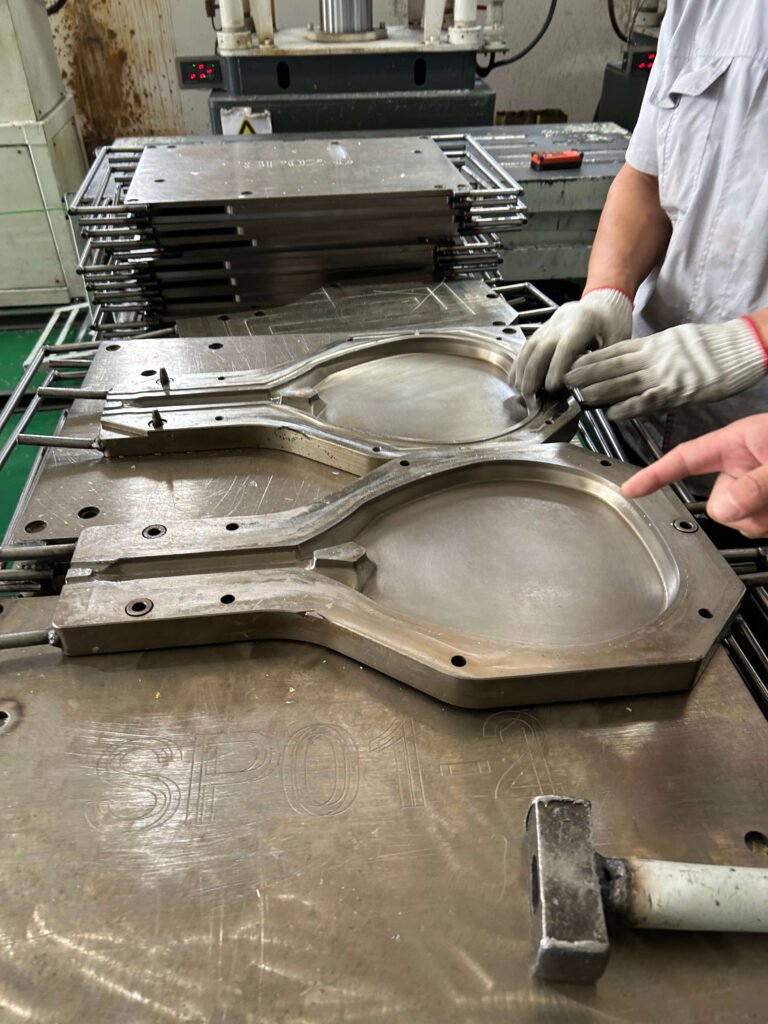
The plate is a one-time cost, and the factory has to recover it across the order. That is the mechanism behind most custom minimums. A higher minimum has a mechanism behind it. It is the number of pieces the tooling needs in order to make sense per paddle. The fee itself is one of the six lines covered in reading a quote line by line.
A sample run takes 10 to 15 days at our plant
We quote sample lead time as a range, because the range depends on the custom depth. The steps below are the ranges we quote, and they add up to the 10 to 15 days we commit to.
| Step | Days |
| Spec and artwork sign-off | 1 to 2 |
| Mold plate preparation, for a new texture | 3 to 5 |
| Material picking and lot checks | 1 to 3 |
| Layup and pressing | 1 to 2 |
| Curing, cutting and edge guard | 1 to 2 |
| Inspection, weighing and packing | 2 to 3 |
A Level 1 build skips the plate step, so it lands near the 10-day end. A Level 3 build carries the plate step, so it lands near the 15-day end. A Level 4 build reopens the spec, and we re-quote rather than fit it into the range.
If setup were cheap, you would see the sample fee track the paddle price. You would see a Level 1 sample cost about the same as a Level 4 one. Neither holds, and the gap between the two samples is mostly the plate.
The sample fee credits against the bulk order
A sample run carries the full setup of a production run in miniature. That is why a sample costs more per piece than the bulk order will.
At our plant the sample fee credits against the first bulk order if sample cost is under 100 USD and bulk order exceeds 2000 units paddles. The fee therefore works as a deposit rather than a cost. The credit rule belongs in writing on the quote. At some factories it is a default, and at others it is a clause you have to ask for.
Material stocking sits behind the visible steps
The plate and the press are the visible parts of the sample clock. The quiet part is the material, and it splits into two cases.
Stock faces, stock cores and standard resin are on our shelves, so picking takes a day or less. A special resin color or a non-stock grit grade comes from a supplier as a full lot. That lot time eats into the 1 to 3 days we allow for picking.
Supplier batch times stay outside our quote, because we cannot control them. If a build needs a material we have to order, we say so on the quote. The clock starts when the lot lands. That is the honest limit of any 10 to 15 day promise.
A signed sample starts a 35-day bulk run
Once you sign the sample, the bulk order runs against that exact build. Under 2,000 pieces we quote 35 days from deposit to packed cartons.
The press line has room to spare. Our thermoformed line runs about 80,000 paddles a month. A 2,000-piece order occupies the capacity for less than a day of line time. The 35 days mostly cover the queue, the material lot for your spec and the batch checks in between.
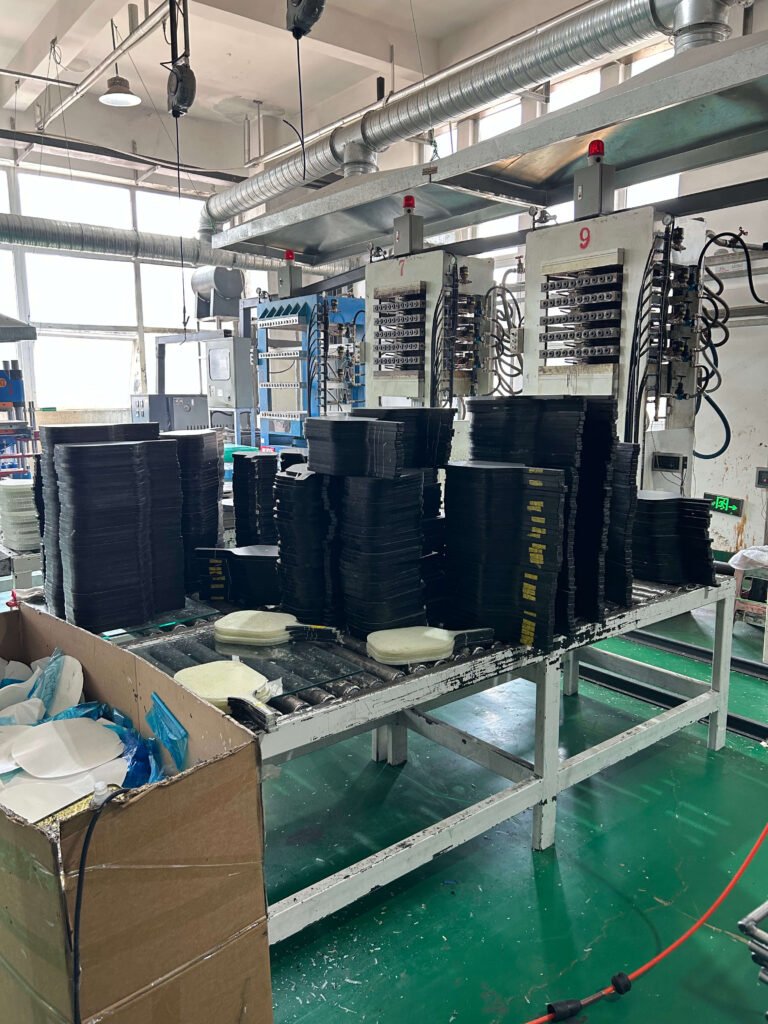
The unit price inside that run moves with the order size. The three cost lines that respond to volume are laid out in the price shape at your order size.
What moves the dates after they are set
Two things reset the sample clock, and both start on the buyer side.
An artwork revision after pressing reopens the plate at Level 3 or the print files at Level 2. The affected steps run again. A late spec change to weight or thickness reopens the whole build. That change touches the weight budget described in adding grit without moving the weight.
The third mover sits outside both plants. A certification test, where the build needs one, books into a lab queue that we do not schedule. We leave it off the 10 to 15 days and quote it separately.
Where our numbers stop
We can quote our own plant. A sample takes 10 to 15 days. A bulk run under 2,000 pieces takes 35 days. A full custom grit build starts at 200 pieces. Those are the ranges we commit to, and they hold when the spec is frozen at sign-off.
We cannot quote another factory’s clock, and we cannot fold certification lead time into ours, because the lab sets that date. We also cannot promise a fixed sample fee for every level. A Level 4 build is a new project rather than a variant.
The sample decides what the bulk run has to match. Signing off on a grit sample lists what to check before you sign. The sample itself is a small run. It will not match the bulk in every respect, and the gap between sample and bulk explains which differences to expect.
What to confirm before you send artwork
The sample clock starts when these items land together. A missing item stops the clock more often than any factory delay does.
- The artwork in print-ready files, with colors called out
- The grit grade and texture depth, named on the spec
- The face material and the ply count per side
- The core type and the total thickness
- The weight and its tolerance
- The carton print and the packaging level
- The credit rule for the sample fee, in writing
<figure>

Our engineering team answers spec questions within 24 hours and quotes the sample clock against your exact level of change.
FAQ
Why do custom paddle factories have a minimum order at all?
The minimum exists to spread one-time setup across enough pieces. A mold plate and a press setup cost the same whether the order is large or small, so a small order pays more per piece for the same work.
What is a typical MOQ for a fully custom grit paddle?
At our plant it is 200 pieces for a full custom build. Levels of change below that can ride on stock tooling, and their minimums follow the stock build instead.
How long does a custom paddle sample take?
Ten to 15 days covers most samples at our plant. The range moves with the custom depth, because a new mold plate adds 3 to 5 days that a logo change does not carry.
Is the sample fee refunded?
It depends, if sample fee is under 100 usd and bulk order quantity exceeds 2000 units, sample fee is refundable.
Why does a new texture raise the MOQ?
A new texture needs a new mold plate, and the plate is a one-time cost. The minimum rises so the plate cost per paddle stays reasonable at the price you were quoted.
Can I get a sample without paying tooling?
Yes for changes that reuse stock tooling, such as a logo on an existing build. A new texture or a new shape cannot skip the plate, because the texture lives on the plate itself.
What happens if I change the artwork after the sample is made?
The affected steps run again, and the clock resets for those steps. A change that reaches the mold plate costs more than a print change, which is why the spec should be frozen before pressing starts.
Does the 35-day bulk lead time include certification testing?
No. A lab books its own queue, so we quote certification separately when a build needs it. The 35 days run from deposit to packed cartons at our plant.