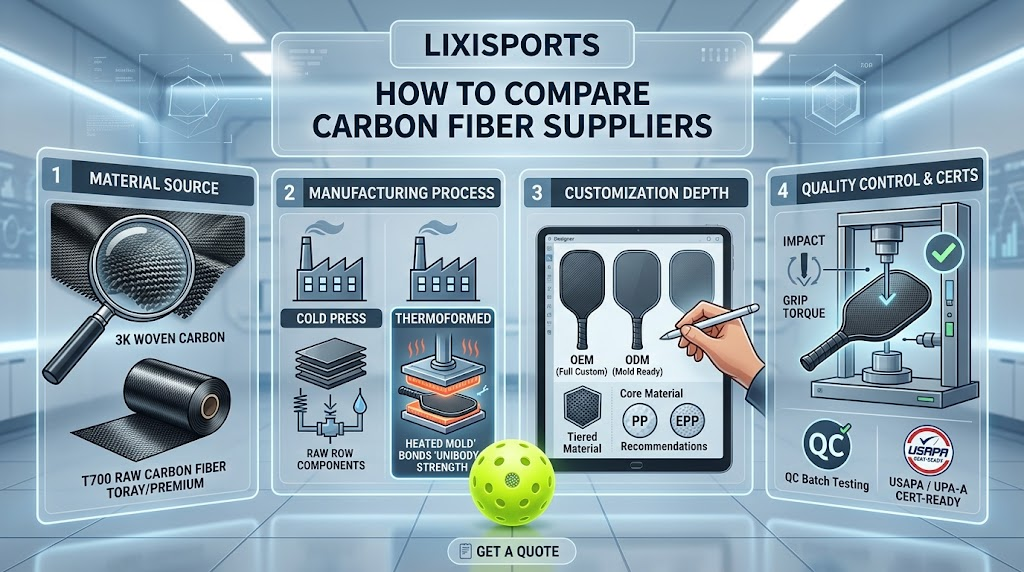
Summary: Most pickleabll paddle supplier comparisons fail because buyers compare the only number that is easy to get — unit price — and ignore the four numbers that actually decide the outcome. This guide gives you a four-axis framework (price, quality, MOQ, lead time), the benchmark numbers to judge each axis against, a copyable side-by-side comparison table, and the red flags that end the evaluation early.
Why Comparing Suppliers Fails Without a Framework
Collect three quotes, pick the middle one. That is how most sourcing decisions are made. It fails in three ways:
- Quotes are not comparable. One is EXW, one is FOB, one includes packaging. The middle price is often the most expensive once everything is added.
- Price is one axis of four. A 10% price advantage is erased by one late shipment in launch season, or one delamination wave after launch.
- Nobody writes down the criteria. Decisions made without a scorecard default to whoever replied fastest.
The fix is a framework: judge every supplier on the same four numbers, in the same format, before emotion or salesmanship enters. This guide defines the four numbers, the benchmarks for each, and the table to collect them in.
The 4 Numbers That Decide Everything
| Axis | The number to collect | What it predicts |
|---|---|---|
| Price | Unit price at your tier, FOB, with inclusions listed | True landed cost |
| Quality | Weight tolerance offered + defect rate data + per-lot QC contents | Return rate, warranty exposure, review score |
| MOQ | Minimum order per SKU, per color, per custom option | How much cash each test order locks up |
| Lead Time | Sample days and bulk days, quoted separately | Launch date, reorder responsiveness |
Everything else — certifications, factory photos, sales responsiveness — is supporting evidence for these four numbers, not a substitute for them.
Comparing Price: The Apples-to-Apples Rule
A unit price is meaningless until it is normalized. Before comparing, force every quote into the same format:
- Same trade term. FOB, named port. If one factory quotes EXW, add the China-side charges (inland trucking, export clearance, terminal handling, documentation) or the comparison is off.
- Same construction. “Carbon fiber paddle” covers cold-pressed T700, thermoformed T700, woven 12K/18K and hybrid layups. These can differ by a factor of two or more. Compare layup by layup, process by process.
- Same inclusions. Packaging, edge guard, handle type, print method, surface texture. A quote without an inclusion list is not a quote.
Real benchmarks for judging the price axis:
| Signal | Benchmark | Read |
|---|---|---|
| Sample price vs volume price | ~1.5x is normal; often credited against first order | 3x signals a factory avoiding small buyers |
| Tier gap (200 pcs vs 2,000+ pcs) | Under 5% = efficient small-batch production | 40%+ = heavily setup-driven factory |
| Step discount beyond 5,000 pcs | Moderate — fixed costs already diluted | Big promises at high volume are a red flag, not a deal |
Ask every supplier for two tiers — your target quantity and one step below. The gap tells you more about their cost structure than the price itself.
Comparing Quality: What to Measure, Not What to Believe
Websites all say “high quality.” Quality is only comparable in numbers. Three measurements separate suppliers:
1. Weight tolerance. Ask for the tolerance in writing.
| Tolerance offered | What it means |
|---|---|
| ±10g or “about the same” | No batch-level weight control |
| ±5g | Standard controlled production — acceptable for volume SKUs |
| ±2–3g | Precision program — sorted or matched production, worth paying for on hero SKUs |
2. Defect rate on the construction you are buying. Ask: “What is your batch defect rate on thermoformed T700?” A number under 1% structural is reasonable for a controlled line. “Very low” is not a number.
3. What ships with each lot. A per-lot QC report — weight distribution, balance data, surface finish sampling — should be free. A factory that cannot produce one is not running batch QC, whatever the website says.
Supporting evidence, in descending order of value: third-party inspection access policy, USAP pre-test data for your target construction (roughness, deflection), spin durability test data (e.g., surface textures that retain roughly 40 RPM loss per 100 hits versus ~100 RPM for standard finishes), and audit certificates issued before you ask.
Comparing MOQ: What the Number Really Means
MOQ is not one number. It hides three:
| MOQ type | What to ask |
|---|---|
| MOQ per SKU | Minimum per shape/model |
| MOQ per custom option | Minimum per color, per graphic, per handle variant — often higher than SKU MOQ |
| MOQ for customization itself | Some factories take orders at 200 pcs but only open custom tooling at 1,000+ |
Benchmarks:
- 50–100 pcs with customization open: flexible, OEM/ODM-focused factory. Best for testing designs cheaply.
- 200–500 pcs: typical factory floor. Workable for most programs.
- 1,000+ with no flexibility at lower tiers: the factory is optimized for large contracts. Cheaper at scale, expensive to learn from.
The real question MOQ answers: how much cash does one experiment cost? At a 100-pcs MOQ, testing two designs costs two test orders. At a 1,000-pcs MOQ, it costs ten times more — and unsold inventory.
Comparing Lead Time: Sample Time vs Bulk Time
Suppliers quote one “lead time” number that hides two very different clocks. Always separate them:
| Phase | Typical benchmark | Notes |
|---|---|---|
| Sample (standard construction) | 7–15 days | Includes graphics |
| Sample (new mold or custom shape) | +2–3 weeks for tooling | Tooling runs once; reorders skip it |
| Bulk production, 500–2,000 pcs | 25–45 days | Cold-pressed faster than thermoformed |
| Peak season (Q1–Q2 ahead of summer) | Add 2–4 weeks | Book early or absorb the delay |
| Reorders on archived molds | Noticeably faster | Molds stored and production already set up |
Two rules:
- A supplier who quotes one number for both sample and bulk is guessing. Push for the split.
- Get the lead time in the PI (proforma invoice), not in chat. A date with penalties attached is a commitment; a date in a chat window is a hope.
Also compare lead-time volatility, not just length. Ask what happened to their delivery dates in the last peak season. The answer — or the evasion — predicts your launch date better than any quote.
The Trade-Offs: When Cheaper Is More Expensive
The four axes trade against each other. Know which trade you are making:
- Price vs quality: a USD 0.30 per-unit saving is erased by a 1% higher defect rate on a USD 25 paddle — before counting warranty handling and reviews. Do the math per 1,000 units.
- MOQ vs price: low-MOQ factories charge 3–5% more per unit at small tiers. That premium buys inventory flexibility. For a new brand, it is usually the right purchase.
- Lead time vs price: air freight beats a late factory, at a cost that dwarfs any quoted savings. A factory that misses sample dates will miss bulk dates.
- Everything vs stability: the cheapest quote often comes from the most capacity-constrained factory. When their bigger client’s order arrives, your order moves.
A supplier scoring well on three axes and mid on one beats a supplier that claims to win all four. Nobody wins all four.
A Side-by-Side Comparison Table You Can Copy
Score every candidate on the same rows. Copy this into your RFQ replies and require the blanks to be filled:
| Line item | Supplier A | Supplier B | Supplier C |
|---|---|---|---|
| Unit price, FOB named port, construction specified | |||
| Trade term + inclusions list (packaging, edge, handle, print) | |||
| Sample price + credit policy | |||
| Weight tolerance offered (±g) | |||
| Batch defect rate on my construction (%) | |||
| Per-lot QC report: yes/no, contents | |||
| Third-party inspection allowed: yes/no | |||
| MOQ per SKU / per custom option | |||
| Sample lead time (days) | |||
| Bulk lead time (days), peak-season adjustment | |||
| Tooling ownership terms | |||
| USAP pre-test support: yes/no |
Do not proceed to negotiation with any row blank. The rows a supplier will not fill are the rows that contain the problems.
Red Flags: Quotes That Look Too Good
End the evaluation early on any of these:
- A price 30–40% below the field on identical construction. Either the construction is not identical, or the quality control is not there. Verify layup and process in writing before believing the number.
- No tolerance, no defect rate, no QC report — but instant pricing. They quote fast because they have never measured anything.
- Sample at 3x volume price, no credit. The factory does not want your order size.
- One lead-time number for everything. No sample/bulk split means no production planning.
- Tooling “included free.” Then you do not own it. Ask where the mold is stored and whose name is on it.
- Certification promised “after the order.” USAP submission is per model. Factories that understand this say so immediately.
- No third-party inspection access. A factory with real QC has nothing to hide from SGS.
One red flag is a question. Two is a pattern. Three is an exit.
FAQ
How many suppliers should I compare?
Three to five, in the same comparison table. More than five and the differences blur; fewer than three and you have no field to compare against.
Should I always pick the lowest price that passes quality?
No. Weight the axes by your situation. New brand: weight MOQ and sample lead time heavily. Established brand: weight quality tolerance and bulk capacity. Launch-critical timeline: weight lead-time reliability above everything.
What if a supplier refuses to give defect-rate data?
Treat missing data as data. A controlled line knows its numbers. No number means no measurement, and no measurement means no improvement.
How do I verify lead-time claims before committing?
Order samples first and time them. Sample performance is the cheapest reliable predictor of bulk performance.
Do bigger factories always win on price?
They win at high volume. At 500–2,000 pcs, mid-size OEM/ODM factories often win on price and responsiveness because your order matters to them.
Is a factory visit necessary?
For a first order under USD 10,000, a third-party inspection replaces it. For a strategic program, visit — or send your QC partner with a checklist.
Final Checklist: What to Collect From Every Supplier
- Unit price at two tiers, FOB, construction and inclusions itemized
- Sample price and credit policy, in writing
- Weight tolerance offered, in writing
- Batch defect rate on your target construction
- Per-lot QC report contents
- Third-party inspection policy
- MOQ per SKU and per custom option
- Sample and bulk lead times, quoted separately, with peak-season adjustment
- Tooling ownership, storage location and transfer terms
- USAP pre-test support and submission process