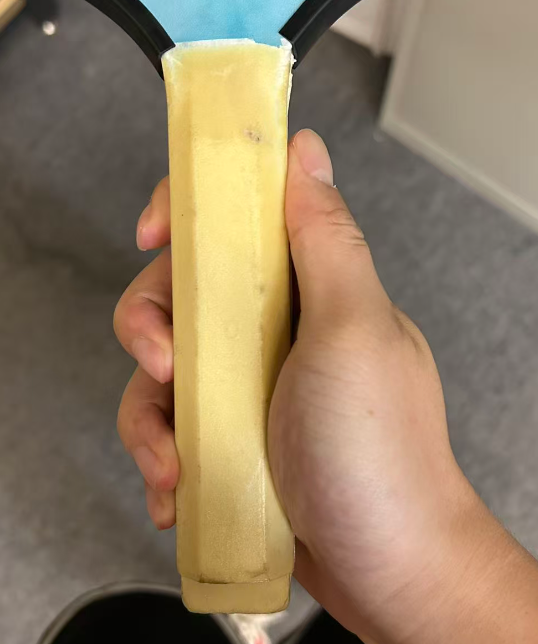
Understanding Cold-Pressed Pickleball Paddles
Typical Materials for Cold Press
Cold-pressed paddles are made by bonding face sheets to a polypropylene honeycomb core under high pressure at room temperature. No heat. The handle is inserted and glued during the same pressing step.
| Component | Material Options |
|---|---|
| Face | Fiberglass (entry level), 3K/12K carbon fiber, raw carbon, Kevlar |
| Core | PP honeycomb (8mm or 10mm cell size), EPP, MPP |
| Handle | PU-reinforced carbon fiber shaft |
| Edge Guard | TPU / ABS |
| Grip | PU leather, cushioned, perforated |
| End Cap | Custom logo (deboss/emboss/print) + silicone band option |
PP honeycomb is the most widely used core material. It is stiffer than EPP or MPP—giving more power on drives—but it can collapse after long-term use. The cell size (8mm or 10mm) affects density and weight.
Fiberglass is the most common entry-level face. It costs less, but UV-printed designs on fiberglass tend to peel. Raw carbon is the better choice for brands that want a durable, premium look without coating problems.
Advantages of Cold Press
| Advantage | Why It Matters |
|---|---|
| Lower cost | Simple tooling, no heating |
| Fast production | Samples ~7 days. 2,000 pcs in ~30 days |
| Low MOQ | 200 pcs per design. Low inventory risk |
| Steady flex | Even pressure bonding. No heat-related weak spots |
| Softer feel | Materials keep their natural softness. Better touch at the net |
| Control-focused | Absorbs energy instead of blasting it back. Great for dinks and resets |
| High output | 100,000 pcs/month |
| Eco advantage | Room-temp process. Zero heating energy. Low carbon footprint |
Cold-pressed paddles are the main choice for entry-to-mid-range products. They fit new brands, clubs buying in bulk, and promotional buyers who need cost-effective customization.
Neck Cracks in Cold-Pressed Pickleball Paddles
What Causes Neck Cracks?
The paddle neck—where the handle meets the face—takes the most stress of any part of the paddle. In cold-pressed paddles, this weak point is made worse by how the paddle is built.
Why necks crack in cold-pressed paddles:
| Cause | What Happens |
|---|---|
| Stress concentration | The neck is the thinnest part. All impact force hits this spot. |
| Glue-only bond | Cold pressing uses adhesive to join handle to core. There is no heat fusion. |
| Repeated bending | Every swing, volley, and drive bends the neck. Tiny cracks grow over time. |
| Mixed materials | Stiff carbon handle glued to softer PP core. Different flex rates cause peeling stress. |
| Off-center hits | Mishits near the edge twist the paddle. That twisting force goes straight to the neck. |
| No one-piece build | Unlike thermoformed paddles (single piece), cold-pressed paddles are layers glued together. |
Handle neck fracture was the number one quality problem in cold-pressed paddle manufacturing. Fixing it is what led to the PU-reinforced handle.
How Does PU Neck Reinforcement Prevent Paddle Breakage?
The fix: a molded polyurethane (PU) handle that wraps around and strengthens the neck joint.
How it works step by step:
PU molding: The carbon fiber handle shaft goes into a mold. Liquid PU resin is poured in and hardens around the shaft. This forms a smooth, reinforced collar at the neck.
Stress spreading: PU is flexible and elastic. When force hits the paddle face, the PU collar bends slightly and spreads the shock over a wider area. Instead of concentrating at one narrow point, the force is shared.
Two-material damping: Carbon fiber (stiff) + PU (flexible) = energy management teamwork. The carbon shaft delivers power. The PU layer soaks up vibration that would otherwise weaken the glue bond.
Bigger glue area: The PU collar extends beyond the raw handle-to-core joint. More bonded surface area means less peeling stress per square millimeter.
Standard handle vs. PU-reinforced handle:
| Factor | Standard Handle | PU-Reinforced Handle |
|---|---|---|
| Neck fracture rate | Common failure | Eliminated |
| Stress build-up | Maximum at narrowest point | Spread across PU collar |
| Bond area | Handle-to-core only | Handle + PU collar-to-core |
| Vibration at neck | High (all passes through) | Reduced (PU absorbs it) |
| Bend cycle life | Limited | Much longer |
| Weight cost | Baseline | Tiny (+2–4g, compensated) |
The PU handle is now standard on all cold-pressed paddles from lixisports-cold pressed pickleball paddle manufacturer.
PU Handles vs. Pallet Handles in Cold-Pressed Paddles
Is PU Handle Better than Pallet?
Pallet handles are the older method. A pre-made rigid pallet (usually wood, foam, or hard plastic) is glued to the carbon shaft and wrapped with grip tape.
| Factor | Pallet Handle | PU Molded Handle |
|---|---|---|
| Neck reinforcement | Almost none. Pallet sits on grip area, not the neck. | PU collar covers the neck zone. |
| Shock absorption | Only from the grip tape | PU absorbs shock at the structure level |
| Weight consistency | Uneven (wood soaks moisture, foam flattens) | Consistent (molded density, controlled) |
| Build tolerance | Manual assembly. Higher variance. | Molded. Lower variance. |
| Custom shape | Limited. Standard pallet shapes only. | Moldable to any grip size or shape. |
| Longevity | Pallet can crack, flatten, or come loose. | PU is one solid piece. Cannot loosen. |
| Cost | Lower | Slightly higher (mold cost) |
Bottom line: PU handles beat pallets on every performance measure except raw cost. For any cold-pressed paddle sold above the cheapest price point—and for brands that care about durability—PU is the clear winner.
Impact on Paddle Weight and Balance
The question brands ask most: “Will the PU handle make the paddle too heavy or head-heavy?”
Factory data:
| Parameter | Standard Handle | PU Handle |
|---|---|---|
| Total paddle weight | 225g ±5g | 225g ±5g |
| Handle weight | Baseline | +2–4g (PU collar) |
| How it is offset | N/A | Slight core density or adhesive adjustment |
| Balance point | Mid-balanced | Mid-balanced (kept the same) |
| Swing weight | Reference | Within ±3 units |
The 2–4 grams from the PU collar is balanced out during lamination. Usually by a small tweak to core density or adhesive film. Total weight stays at 225g ±5g. Balance does not shift.
If a brand wants a head-light or head-heavy feel on purpose, that can be tuned through mold design and material choice. The PU handle adds protection. It does not force a compromise.
Average Lifespan of a Pickleball Paddle
How Long Do PU-Reinforced Paddle Handles Last?
How long a paddle lasts depends on how often it is used, playing style, and storage. Industry averages:
| Usage Level | Plays Per Week | Standard Handle Life | PU Handle Life |
|---|---|---|---|
| Casual | 1–2× | 12–18 months | 18–24 months |
| Regular | 3–4× | 8–14 months | 14–20 months |
| Competitive | 5–7× | 4–8 months | 8–14 months |
| Pro | Daily + events | 2–4 months | 4–8 months |
The PU collar adds roughly 40–60% more handle life across all levels.
What usually ends a paddle’s life first:
| Failure | How Common (Standard) | Does PU Handle Help? |
|---|---|---|
| Face texture wears out (spin drops) | #1 most common | No (separate tech: ceramic sand infusion helps) |
| Neck snaps | #2 most common | Yes—eliminated |
| Core collapses (PP honeycomb) | Common in thermoformed | No (EPP/MPP core helps) |
| Edge guard peels | Occasional | No |
| Grip wears down | Normal (replaceable) | No |
Face wear is still the top reason paddles get retired. Lixisports offers ceramic sand infusion to extend surface life. PU handles fix the second biggest problem—and the worst one, since a snapped neck means the paddle is dead instantly.
Innovative Solutions in Pickleball Paddle Design
Hybrid PU-Carbon Necks for Shock Dispersion
The next step in cold-pressed handle design: hybrid PU-carbon necks.
The idea:
Instead of a carbon shaft with a PU collar on top, the entire neck area is built as a layered sandwich: carbon fiber sheets and PU elastomer sheets stacked together and molded as one piece.
What each layer does:
| Layer | Job |
|---|---|
| Carbon layers (3–4 sheets) | Stiffness. Power transfer. |
| PU layers (2–3 sheets) | Shock absorption. Vibration damping. Crack stopping. |
| Outer PU shell | Looks. Grip base. Impact protection. |
Expected gains:
- Vibration cut by roughly 40–55% vs. plain carbon handle
- Neck bend life: 2–3× longer than standard cold-pressed
- Weight penalty: +3–6g (balanced out by core tuning)
- Production complexity: Moderate (co-molding; single curing cycle)
Currently in prototype testing. Brands interested in co-development can contact the engineering team.
Bio-Based PU Resins for Crack-Resistant Paddles
Sustainability is starting to reach paddle handle design. Bio-based PU resins—made from castor oil, soybean polyols, or lignin—give similar strength to regular PU but with a smaller carbon footprint.
| Property | Regular PU | Bio-Based PU (Castor Oil) |
|---|---|---|
| Tensile strength | 25–35 MPa | 22–32 MPa |
| Stretch before break | 300–500% | 280–450% |
| Tear resistance | Comparable | Comparable |
| Wear resistance | High | Moderate-high |
| Renewable content | 0% | 30–60% |
| Carbon footprint | Higher | Lower (plant-based carbon) |
| Cost | Baseline | +10–20% (early-stage premium) |
| Works with current process | Standard | Needs formula adjustment |
Bio-based PU is not yet cheaper than regular PU. But for brands aiming at eco-conscious buyers—especially in Europe where green rules are stricter—the extra cost may be worth it.
Current status: Lixisports tests bio-PU resins from certified suppliers. Available for brands on request with adjusted MOQ and lead time.
Frequently Asked Questions
Are hot pressed or cold pressed pickleball paddles better?
Neither is always better. Hot pressed (thermoformed) paddles are stiffer, more powerful, and built as one piece. They fit premium and pro-level products. Cold-pressed paddles are softer, more control-oriented, and cost less. They fit entry-to-mid-range products. With PU handle reinforcement, cold-pressed paddles have fixed their main durability weakness, making them a strong pick for brands that want quality at a better price.
Why do pickleball paddles break so easily?
Two main reasons. First: face texture wears down. Surface grit fades over time and spin drops. This is the top reason paddles are replaced. Second: handle neck snaps. The narrow joint between handle and face takes the most stress, especially in cold-pressed paddles where the bond is glue-based, not heat-fused. lixisports addresses both: ceramic sand infusion for surface life, and PU-reinforced handles to stop neck breaks.
Do pro pickleball players use 14mm or 16mm?
Both. 14mm paddles are lighter and faster through the air. Good for quick hands at the net. 16mm paddles have a thicker core, more stability, bigger sweet spot, and soak up more vibration. Good for power players and players with arm issues. It comes down to personal feel. Lixisports offers both as standard, with custom thickness available through mold development.
Will PU handles change paddle weight and balance?
Barely, and it is controlled. The PU collar adds about 2–4g to the handle. This is offset by a slight core density or adhesive layer adjustment during production. Total weight stays at 225g ±5g. Balance and swing weight stay within spec. If a brand wants a specific balance (head-light or head-heavy), that can be dialed in.
What is finite-element testing in PU neck reinforcement?
Finite-element analysis (FEA) is a computer simulation. It models how stress and strain move through the paddle structure when it hits a ball. For PU neck reinforcement, FEA is used to:
| What FEA Does | Why It Matters |
|---|---|
| Stress mapping | Finds the exact points where the neck takes the hardest hit |
| Material testing | Simulates different PU hardness, collar thickness, and shapes |
| Fatigue prediction | Models thousands of bend cycles to guess when failure might start |
| Weight tuning | Finds the smallest PU volume that still gives full strength |
| Balance simulation | Predicts how PU placement shifts the center of mass |
FEA lets engineers test hundreds of handle designs on screen before cutting a single physical mold. This cuts development time and makes sure the first real prototype already hits the target. The FEA data directly shapes the PU collar design, thickness, and material used in production.
Cold-pressed PU handle paddle specs:
| Parameter | Specification |
|---|---|
| Construction | Cold-pressed, room temperature hydraulic |
| Handle | PU-reinforced carbon fiber (molded) |
| Face | Fiberglass, 3K/12K carbon, raw carbon, Kevlar |
| Core | PP honeycomb (8mm/10mm cell), EPP, MPP |
| Weight | 225g ±5g |
| Thickness | 14mm / 16mm (custom) |
| MOQ | 200 pcs |
| Samples | ~7 days |
| Production (2,000 pcs) | ~30 days |
| Monthly capacity | 100,000 pcs |
| Customization | Shape, logo, edge guard, grip, end cap, silicone band |