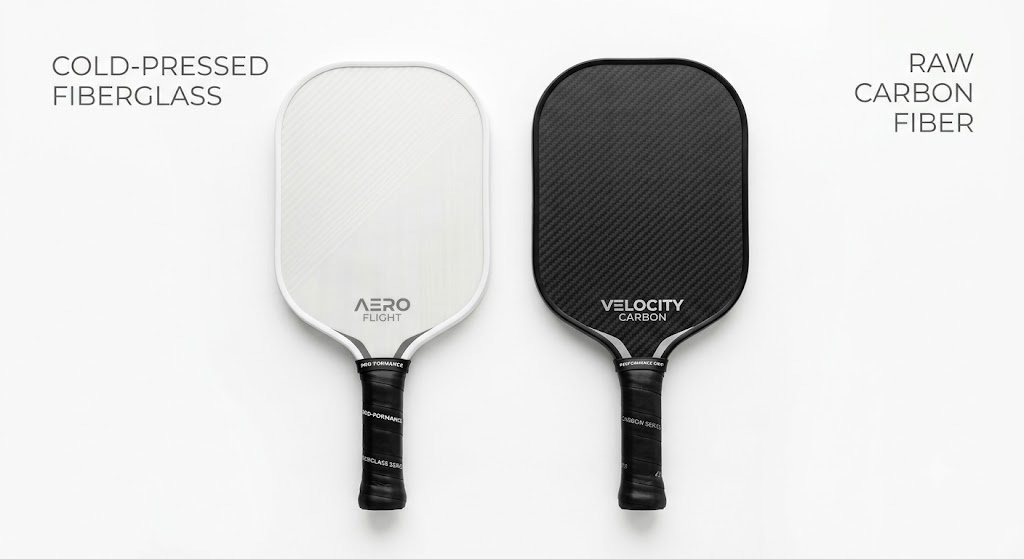
Differences Between Fiberglass and Raw Carbon Fiber
Understanding the Basics
Cold-pressed pickleball paddles are made by laminating face sheets onto a PP honeycomb core at room temperature. The face sheet material determines most of the paddle’s playing characteristics.
Two materials dominate the cold-pressed market:
Fiberglass (E-glass / S-glass). Woven glass fibers embedded in epoxy resin. Translucent appearance. Standard weight: 180–220 g/m² fabric. Entry-level paddles.
Raw carbon fiber (3K / 12K / 18K tow). Woven carbon fibers in epoxy resin. Black or twill appearance. No paint or coating on the surface. Standard weight: 200–240 g/m² fabric. Mid-range paddles.
| Property | Fiberglass | Raw Carbon Fiber |
|---|---|---|
| Fiber type | E-glass or S-glass | PAN-based carbon |
| Fabric weight | 180–220 g/m² | 200–240 g/m² |
| Appearance | Translucent, white/light | Black, twill weave |
| Typical paddle price tier | Entry | Mid |
| Cold press suitability | Excellent | Good (needs resin control) |
Durability Comparison
Durability covers two areas: face sheet integrity and surface texture retention.
Face sheet integrity. Fiberglass is more flexible. It absorbs impact without cracking. Typical service life: 6–12 months of regular play before surface wear affects performance. Raw carbon fiber is stiffer and harder. It resists denting but can crack under point impact (e.g., a hard drop on a court surface). Service life: 12–24 months.
Surface texture retention. Raw carbon fiber has a natural weave texture. The epoxy fills the valleys between weave tows. As the epoxy wears down during play, the weave peaks become exposed, maintaining grip. Fiberglass paddles often rely on a painted or coated texture layer. That coating wears off over time.
| Durability Factor | Fiberglass | Raw Carbon Fiber |
|---|---|---|
| Impact resistance | Good (flexes) | Moderate (can crack) |
| Surface wear life | 6–12 months | 12–24 months |
| Texture retention | Coating-dependent | Woven-in, long-lasting |
| UV resistance | Moderate (may yellow) | Excellent |
Surface Texture and Spin
Spin generation depends on surface roughness at the ball contact point.
Fiberglass surface. Smooth out of the press. Spin is generated by an added coating — typically a painted texture or ceramic sand-infused resin layer. Without this coating, fiberglass produces low spin (800–1,000 RPM). With ceramic sand infusion, spin increases to 1,400–1,600 RPM.
Raw carbon fiber surface. The weave creates a natural micro-texture. Even without added coating, raw carbon produces 1,200–1,400 RPM of spin. With ceramic sand infusion, raw carbon reaches 1,600–1,800 RPM.
| Surface Type | Base Spin (no coating) | With Ceramic Sand Infusion |
|---|---|---|
| Fiberglass | 800–1,000 RPM | 1,400–1,600 RPM |
| Raw Carbon Fiber | 1,200–1,400 RPM | 1,600–1,800 RPM |
| Painted fiberglass | 900–1,100 RPM | 1,300–1,500 RPM |
Raw carbon fiber produces more spin at baseline because the weave texture is structural, not applied. It does not wear smooth over time.
Benefits of Fiberglass for Cold-Pressed Paddles
Enhanced Control Capabilities
Fiberglass has lower stiffness than carbon fiber. This translates to more flex at ball impact. The flex absorbs energy, reducing exit speed. Players feel more “pocketing” — the ball sinks into the face briefly before launching.
Measurable effects:
| Metric | Fiberglass | Raw Carbon |
|---|---|---|
| Face stiffness | Lower | Higher |
| Ball dwell time | Longer (1–2 ms more) | Shorter |
| Power generation | Lower | Higher |
| Control at low speed | Better | Moderate |
| Feedback at impact | Softer | Crisper |
Fiberglass paddles are preferred by beginners and recreational players who prioritize control over power. The forgiving flex reduces mishit penalties.
Cost-Effectiveness
Fiberglass is the lowest-cost face material for cold-pressed paddles.
| Cost Factor | Fiberglass | Raw Carbon Fiber |
|---|---|---|
| Material cost per paddle | $1.50–$2.50 | $4.00–$7.00 |
| Tooling | None (dieline + CNC) | None (dieline + CNC) |
| Production scrap rate | 3–5% | 5–8% |
| MOQ from Lixisports | 200 units | 200 units |
| Wholesale price range | $6–$10 | $8–$15 |
For new brands entering the market, fiberglass cold-pressed paddles offer the lowest risk. The lower wholesale price allows competitive retail pricing ($25–$50) while maintaining margin.
Advantages of Raw Carbon Fiber for Cold-Pressed Paddles
Superior Durability and Longevity
Raw carbon fiber has a longer usable life for two reasons:
No coating to wear off. Fiberglass paddles rely on a paint or coating layer for grip. Once that coating wears — typically after 3–6 months of frequent play — the paddle loses spin and needs replacement. Raw carbon fiber does not have this failure mode. The weave texture is structural. It remains functional for the life of the paddle.
Higher stiffness retention. Fiberglass loses stiffness over time as micro-cracks develop in the resin. Raw carbon fiber retains 90%+ of its original stiffness over 24 months of regular play.
| Longevity Metric | Fiberglass | Raw Carbon Fiber |
|---|---|---|
| Spin retention at 6 months | 60–70% of new | 85–95% of new |
| Stiffness at 12 months | 75–85% of new | 90–95% of new |
| Typical replacement cycle | 6–12 months | 12–24 months |
| Resale value | Low | Moderate |
Control vs. Power for All Levels
Raw carbon fiber offers a different control-power balance than fiberglass.
At low swing speeds (dinks, drops), raw carbon fiber is less forgiving. The stiff face produces less pocketing. Players must develop cleaner technique to control soft shots.
At high swing speeds (drives, smashes), raw carbon fiber delivers more power output per unit of input energy. The stiff face returns more energy to the ball.
| Skill Level | Fiberglass Fit | Raw Carbon Fit |
|---|---|---|
| Beginner | Excellent | Challenging (stiff) |
| Intermediate | Good | Good |
| Advanced | Low preference | Preferred |
| Senior / arm issues | Better (less vibration) | Moderate (more vibration) |
Raw carbon fiber paddles are the standard choice for competitive and tournament players. The tradeoff: a longer learning curve for soft-game control.
Material Impact on Paddle Performance
Vibration and Comfort Considerations
Fiberglass damps vibration better than carbon fiber. The glass fibers themselves have higher internal damping — they absorb vibrational energy and convert it to heat. Carbon fibers are stiffer and transmit more vibration to the hand.
Measured vibration at handle (1,000 Hz impact):
| Metric | Fiberglass | Raw Carbon Fiber |
|---|---|---|
| Peak acceleration at grip | 8–12 g | 14–20 g |
| Vibration decay time | 4–6 ms | 6–9 ms |
| Subjective feel | Damped, soft | Crisp, responsive |
Practical impact. Players with tennis elbow or wrist sensitivity should choose fiberglass. Raw carbon fiber transmits more shock. Adding a vibration-dampening grip (thickness 1.5–2.0 mm) reduces handle vibration by 20–30% on carbon paddles.
Spin Performance and Technique
Spin is a function of surface roughness and ball compression at impact.
Raw carbon fiber generates higher spin without technique adjustment. The weave texture grabs the ball surface regardless of swing path.
Fiberglass requires intentional brushing motion to generate equivalent spin. Players who rely on topspin drives benefit more from fiberglass — the longer dwell time allows more ball deformation and grip.
| Spin Factor | Fiberglass | Raw Carbon Fiber |
|---|---|---|
| Max spin potential | 1,800 RPM | 2,100 RPM |
| Spin with minimal effort | Lower | Higher |
| Spin drop-off over time | Faster | Slower |
| Best for spin style | Brush/spin-heavy | All-court |
Emerging Material Technologies in Paddle Design
Raw Carbon Fiber Durability Advances
Fiber manufacturers are developing higher-toughness carbon fiber grades for paddle applications.
Standard aerospace-grade carbon fiber (T300, T700) is designed for stiffness, not impact resistance. Newer grades target paddle-specific requirements: higher strain-to-failure without sacrificing modulus.
| Carbon Type | Tensile Modulus | Strain to Failure | Impact Toughness |
|---|---|---|---|
| T300 (standard) | 230 GPa | 1.5% | Baseline |
| T700 (standard) | 230 GPa | 2.1% | 20% higher |
| Next-gen paddle grade | 220 GPa | 2.8% | 50% higher |
Next-gen carbon fibers reduce edge cracking risk in cold-pressed paddles. They allow thinner face sheets (0.3 mm vs. 0.5 mm) without increased breakage. Result: lighter paddles with the same durability.
Surface Texture Innovations for Spin
Three texture technologies are being applied to cold-pressed paddle faces:
Ceramic sand infusion. Ceramic particles (80–100 mesh) are mixed into the epoxy resin before lamination. The particles create a uniform, durable rough surface. Test results after 100 hits: spin loss of approximately 40 RPM on ceramic-infused surfaces versus approximately 100 RPM on conventional surfaces.
Peel-ply textured finish. A textured release film is applied to the face during pressing. After cure, the film is peeled off, leaving a controlled rough surface. Less durable than ceramic infusion.
Laser-engraved micro-grooves. A CNC laser cuts shallow grooves (0.1 mm deep, 0.3 mm pitch) into the cured face. Consistent, repeatable texture. Higher cost, but spin output is predictable across every paddle.
| Technology | Durability | Spin Boost | Cost per Paddle |
|---|---|---|---|
| Ceramic sand infusion | High | +400–600 RPM | $3.00–$3.50 |
| Peel-ply texture | Moderate | +200–300 RPM | $1.50–$2.00 |
| Laser micro-grooves | High | +300–500 RPM | $1.50–$3.00 |
Fiberglass Hybrids for Optimized Performance
Enhanced Control in Cold-Pressed Paddles
Fiberglass upgrades combine fiberglass face sheets with surface texture treatments to improve performance while keeping the PP honeycomb core structure intact.
Cold-pressed fiberglass paddles use a pure PP honeycomb core. This is the most basic and cost-effective structure on the market. No foam or hybrid core materials are added — the value is in the face sheet treatment.
Fiberglass + painted texture. Standard entry-level finish. Low cost. Spin performance degrades as paint wears.
Fiberglass + ceramic sand infusion. Adds 400–600 RPM of spin. The ceramic particles are embedded in the resin and do not wear off like paint. Wholesale price increase: $3–$3.50 per unit.
Fiberglass + 16 mm core thickness. Standard thickness options are 13 mm and 16 mm. Both thicknesses are priced the same. The thicker core adds vibration absorption without affecting wholesale cost.
| Configuration | Spin Level | Wholesale Price Range |
|---|---|---|
| Fiberglass + painted texture, 13 mm | Moderate | $6–$8 |
| Fiberglass + painted texture, 16 mm | Moderate | $6–$8 |
| Fiberglass + ceramic sand, 13 mm | High | $9–$11.50 |
| Fiberglass + ceramic sand, 16 mm | High | $9–$11.50 |
Cold press fiberglass is designed as the entry-level, best-value option. The structure stays simple: fiberglass face, PP honeycomb core, epoxy bond. Performance upgrades come from surface treatment, not core modification.
Frequently Asked Questions
Is fiberglass or raw carbon fiber more durable in paddles?
Fiberglass is more impact-resistant. It flexes instead of cracking. Raw carbon fiber is stiffer and can crack under point impact. However, raw carbon fiber retains its surface texture longer — fiberglass paddles lose spin as the coating wears off. Service life: fiberglass 6–12 months, raw carbon 12–24 months.
Which surface gives more spin on cold-pressed pickleball paddles?
Raw carbon fiber. The weave texture produces 1,200–1,400 RPM baseline. Fiberglass produces 800–1,000 RPM without added coating. With ceramic sand infusion, both surfaces gain 400–600 RPM of additional spin.
Do raw carbon fiber paddles provide better control than fiberglass?
No. Fiberglass provides better control, especially at low swing speeds. The lower stiffness allows longer ball dwell time and more pocketing. Raw carbon fiber delivers more power but requires cleaner technique for soft-shot control.
How does paddle surface material affect vibration and comfort?
Fiberglass dampens vibration better than raw carbon fiber. Peak acceleration at the grip is 8–12 g for fiberglass versus 14–20 g for carbon fiber. Players with arm sensitivity should choose fiberglass or use a thick grip on carbon paddles.
Are cold-pressed carbon fiber paddles worth the higher price?
For B2B buyers: it depends on target market. Carbon fiber paddles serve the mid-tier with wholesale prices of $8–$15 and retail of $40–$80. Fiberglass paddles serve the entry tier at wholesale $6–$10. Carbon fiber is worth the price if your customers expect 12–24 month durability and high baseline spin. Fiberglass is the better choice for first-time buyers and recreational players on a budget.